


Heads up, this article is longer than usual, but Senator Zaffirini made a lot of terrible votes.
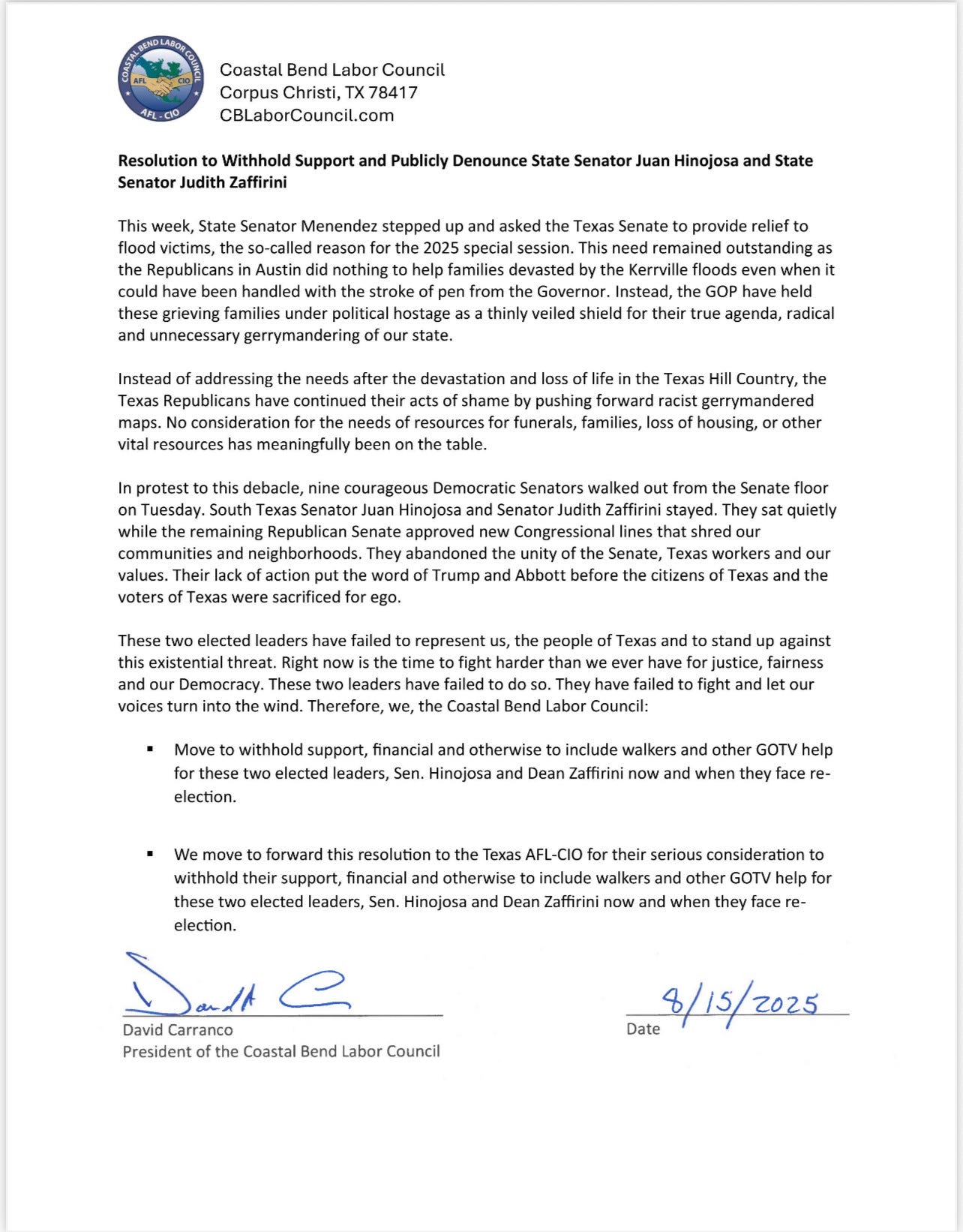
Yesterday, the Coastal Bend Labor Council passed a resolution to withhold support and publicly denounce State Senators Juan “Chuy” Hinojosa and Judith Zaffirini for their failure to fight alongside the nine Senators who walked out of the Senate.
Of course, all of my luck, I wound up arguing with one of the only three Zaffirini Stans in the entire state for almost an hour on Bluesky last night, who wanted to convince me that it didn’t matter whether Zaffirini stood up for democracy over this one vote or not. According to the Zaffirini Stan, the Senator has passed more bills and is a bigger champion for disability rights than anyone else in the Senate.
First, advocating for the civil rights of all marginalized groups is a core Democratic principle. But we’re in Texas, and there isn’t a marginalized group in the state, including the disabled community, that has full civil rights. So, while it’s great that Zaffirini is someone who is known as standing for disability rights, as a Democrat, don’t we expect that from her?
She passes more bills and votes for more Republican priorities than any other Senate Democrat (besides Hinojosa).
Some of y’all may remember that during the regular legislative session, at some point, I got so mad at watching the Democratic Senate because of how the Senators over there were voting, particularly Zaffirini and Hinojosa. I was so angry I said, “I’m not watching those mofos for the rest of the session, because all they’re doing is rubber-stamping the GOP’s agenda.”
I also claimed that Zaffirini votes with Republicans approximately 80% to 90% of the time. Later in the session, one of the Democratic Chairs from one of the counties in Zaffirini’s district contacted me and said she visited Zaffirini’s office to ask about my claim about how often Zaffirini votes with Republicans. The Chair noted that the staffers were so excited about Zaffirini’s 75,000 consecutive votes in the Senate, but otherwise had no idea about Zaffirini’s allegiance with the GOP.
After that, I promised to expose all of her votes this session, the dirty ones that hurt working people, that aligned with oil executives and billionaires, and were a slap in the face to Democrats everywhere. Then the floods happen. Then the special session.
Now is the time we finally need to talk about how Senator Zaffirini has been voting.
Understanding the difference between “key votes” and “non-key votes.”
Key votes are the ones that leadership, interest groups, media, and advocacy organizations consider consequential enough to define a legislator’s record. These are the votes that we, as Democrats, are most likely to hear about. How a legislator voted on an abortion issue, an LGBTQ+ issue, vouchers, or whatever special interest groups have made a significant topic at the time.
However, during a legislative session, the legislature churns through hundreds or even thousands of votes, and most of them never make the news. They slide through quietly, buried in amendments, consent calendars, or unanimous votes that no one outside the chamber is watching. Those are the non-key votes. The ones that don’t become press releases, but often do more to shape the state than the handful of “big” votes that get clipped for social media.
And here’s the truth about Texas politics. The real action isn’t in the culture war bills. The real action is in the corruption. The system here is built to funnel public money into private hands, to write checks for billionaires and corporations while the rest of us get stuck footing the bill. Bills that hand out tax breaks to oil companies, deregulate corporate polluters, starve public schools, gut worker protections, and make it easier for big donors to keep getting richer. Those are the ones that slide through while everyone is yelling about drag queens and border walls.
It’s been going on for so long that it no longer shocks people. Corruption is the water Texas politics swims in. A contract here, a subsidy there, a new loophole for the same old lobbyists, it’s just “business as usual.” And because it’s business as usual, no one hardly even bats an eye when Democrats like Zaffirini, Hinojosa, or former Senator Eddie Lucio Jr. line up with Republicans on these votes.
That’s the cycle. Republicans set the agenda for their donors, the culture war bills grab the headlines, and the corruption bills slide by with bipartisan support. And instead of standing as a real opposition, some Democrats have become willing participants. Helping to normalize the corruption, rubber-stamp it, and keep the whole rotten machine running.
Senator Zaffirini’s worst votes in the 89th Legislative Session.
You can follow the hyperlinks to find the bill text and voting records. Zaffirini voted in favor of all of the bills below.
SJR18 was one of the worst handouts to the wealthy this session, a constitutional amendment to permanently ban Texas from ever taxing capital gains. It does nothing for working families stuck paying property and sales taxes, but it guarantees the richest Texans will never pay a dime on their investment profits.
SB13 was one of the session’s big book-ban bills, giving parents new powers to block their kids from checking out certain library materials. It’s a censorship law dressed up as “parental rights,” designed to target books about race, gender, and LGBTQ+ students, and it will chill what kids are allowed to read in public schools.
SB17 bans many non-citizens and foreign-tied entities from “designated countries” (initially China, Russia, Iran, North Korea, plus any others the governor adds) from buying or otherwise acquiring Texas real estate. It’s bad because it invites profiling and chills lawful immigrants and students, hands the governor sweeping designation power, and criminalizes ordinary housing/land transactions, disproportionately harming Asian and other immigrant communities.
SB706 made it easier for people from other states to carry handguns in Texas by recognizing any out-of-state license without requiring equivalent safety standards or background checks. That weakens public safety and expands the reach of states with looser gun laws into Texas communities.
SB495 blocks the Texas Department of Insurance from using environmental, social, and governance (ESG) standards when regulating insurers. That means companies can ignore climate risks, pollution impacts, or labor abuses without consequence, protecting corporate profits while leaving working-class Texans to bear the cost of disasters and environmental harm.
SB509 makes it harder to quickly challenge unlawful election actions by requiring courts to notify Ken Paxton before granting any temporary restraining order, and voiding orders issued without that notice. This gives Paxton power to delay or interfere in urgent election cases, weakening protections for voters.
SB24 forces Texas schools to add lessons on the “dangers of communism.” It’s straight out of the GOP’s red scare playbook, a propaganda bill meant to revive Cold War fearmongering and smear anything left of center as dangerous. We talked about this during the session. It’s basically modern McCarthyism, designed to distract from real issues while Republicans police ideology in classrooms.
SB14, the so-called “Regulatory Reform and Efficiency Act,” set up a new office under the governor’s control to slash agency rules and weaken oversight. It forces agencies to cut regulations, reduces deference to their expertise in court, and makes it easier for industries to fight or overturn rules meant to protect workers, consumers, and the environment. In practice, it hands more power to big business and lobbyists while stripping away public protections.
SB924 rewrote the definition of “video service” to exclude streaming platforms, shielding big companies from having to pay local franchise fees for using public rights-of-way. That’s lost revenue for cities that fund basic services, shifting costs onto working people while handing streaming giants and telecoms a break.
SB379 banned SNAP recipients from buying sweetened drinks and candy with their benefits. Instead of addressing poverty or food insecurity, it polices and shames low-income families by restricting what they can eat, while doing nothing to improve access to affordable, healthy food. It’s a classic example of punishing the poor under the guise of “health policy.”
SB21 created the “Texas Strategic Bitcoin Reserve,” a special fund outside the state treasury for buying and holding cryptocurrency with taxpayer money. It lets outside crypto firms manage the reserve, and even allows use of derivatives. It’s a massive public gamble on an unstable and speculative asset class that primarily benefits crypto investors and industry insiders.
SB621 bans cities, counties, or any local government from creating or running a public bank. That shuts down the possibility of community-owned banks that could provide affordable credit, fund local projects, or reduce reliance on Wall Street institutions. It protects private banks’ profits at the expense of working-class Texans who might benefit from fairer lending and local reinvestment.
SB472 changed the property tax appeals process to favor big property owners by restricting when appraisal districts or review boards can push back against appeals. In practice, it makes it easier for wealthy corporations and landowners to challenge and lower their appraisals, shifting more of the tax burden onto working- and middle-class homeowners.
SB617 makes it harder for cities to convert properties into housing for unsheltered people. It gives nearby residents the power to block or delay housing projects through lawsuits, adding red tape and NIMBY barriers instead of helping people get off the streets.
SB29 overhauled corporate governance rules in Texas by granting companies broad new powers to limit shareholder rights and shield directors and officers from liability. These changes tilt the balance of power heavily toward corporate boards and investors, especially those on national exchanges, while weakening tools small shareholders use to hold executives accountable.
SB878 reshaped local economic development programs by limiting how cities and counties can use tax abatements, loans, or grants. In practice, this favors big corporations that already know how to game the system, while tying the hands of local governments trying to use public money for community needs.
SB1388 expanded the state’s so-called “Thriving Texas Families Program.” It blocks hospitals, clinics, and providers from receiving funds if they have any affiliation with abortion-related organizations, funneling more public money to anti-abortion crisis pregnancy centers instead of real healthcare.
SB2188 gave the state and spaceflight companies like SpaceX sweeping power by blocking counties and cities from regulating launches and allowing frequent beach closures along the Gulf Coast for “space flight activities.” That means working-class coastal communities lose access to public beaches, local governments lose authority, and billionaire space companies get special treatment.
SB414 rewrote the rules for local bond elections, forcing ballots to include long, complex financial breakdowns and splitting projects into multiple separate propositions. While pitched as “transparency,” it’s really a way to confuse voters and make it harder for schools, cities, and counties to pass bonds for things like classrooms, roads, and infrastructure.
SB8 forces every Texas county sheriff to seek an agreement with ICE under the federal 287(g) program, deputizing local jail staff to enforce federal immigration law. n practice, this bill mandates more collaboration with ICE, expands criminalization of immigrant communities, and militarizes local jails at taxpayer expense.
SB241 expanded the statewide ban on vagrancy laws, forcing cities and counties to enforce it under threat of being labeled “violating entities” and losing tax revenue. It requires locals to set up complaint hotlines, report arrests, and even reimburse DPS or the AG for enforcement costs, turning being unsheltered into a criminal justice issue instead of a housing one.
SB311 expanded the Texas Supreme Court’s writ power. This shift centralizes power in a Republican-dominated court, giving it more authority to intervene in disputes and override local judges, further politicizing the judiciary in favor of the state’s ruling party.
SB36 created a new Homeland Security Division within DPS to centralize border security operations. For border communities, that means more militarization, more cameras, and more DPS coordination with federal agencies and even private groups, all under the governor’s control. It expands policing instead of addressing real needs like infrastructure, healthcare, or jobs, and it locks border residents into constant surveillance and law-enforcement presence.
SB1057 raised the bar for shareholder activism by requiring investors to hold at least $1 million or 3% of voting shares for six months before submitting a proposal. That effectively shuts out small investors, pension funds, and worker-led coalitions from holding corporations accountable on issues like wages, climate risks, or corporate governance, while giving more power to entrenched executives and wealthy shareholders.
SB1210 changed the balance of Texas’s courts by giving the state Supreme Court new power to step into criminal law when it conflicts with the Court of Criminal Appeals. That means the Republican-controlled Supreme Court can now overrule the state’s highest criminal court on constitutional questions, further politicizing the judiciary and concentrating power in one partisan bench.
SJR27 proposed a constitutional amendment to restructure the State Commission on Judicial Conduct, change who appoints its members, and expand its disciplinary powers over judges. While pitched as accountability, it really hands more control to the governor and the Republican-dominated Supreme Court, raising fears of partisan manipulation of judicial discipline.
SB1758 shielded cement kilns and aggregate operations from liability if their blasting or vibrations damaged nearby semiconductor facilities. In effect, it prioritized heavy industry by giving polluting cement and aggregate producers legal protection over the fast-growing tech sector, instead of holding them accountable for environmental and community harms.
SB33 expanded Texas’s abortion bans by prohibiting any government spending on “abortion assistance,” empowering the attorney general to sue, waiving immunity, and adding penalties for even indirect support. It’s part of Republicans’ escalating war on reproductive freedom, targeting not just providers but anyone who helps Texans access care, even out of state.
SB1541 gave the Secretary of State sweeping new power to take over county election offices after an audit. While framed as accountability, it’s really another Republican attempt to centralize control over elections in Austin and undermine large, diverse counties like Harris. It makes it easier to politicize election administration under the guise of audits.
SB310 banned the use of ranked-choice voting, even though that’s a Democratic Platform priority. This blocks a reform that would make elections more representative, reduce costly runoffs, and give voters more real choices. By outlawing ranked-choice voting, Republicans keep in place a system that depresses turnout and preserves their power.
SB819 set new hurdles on renewable energy by forcing large solar and wind projects to file for a “public interest” determination with the Public Utility Commission. These burdens don’t apply to fossil fuel plants, meaning the bill slows clean energy growth while shielding oil and gas from similar scrutiny.
SB1099 created a new penalty enhancement targeting undocumented immigrants. This law doubles down on racial profiling and criminalization of immigrant communities, especially in border regions, while stoking fear for political gain.
SB22 created the Texas’s film incentive program. The bill allows the state to deny funding for any content it deems “inappropriate” or portraying Texas in a “negative” light, opening the door to censorship while funneling huge subsidies to production companies. In practice, this is a corporate giveaway wrapped in culture-war language, using public dollars to boost private film studios, while letting politicians police art.
SB1951 increased penalties on property owners who fail to timely file rendition statements or property reports. While pitched as enforcement, it hits small property owners and working-class taxpayers the hardest, while large corporate landholders have the lawyers and resources to dodge or delay.
SB825 ordered the governor’s office to conduct an annual study on the “economic, environmental, and financial impact of illegal immigration.” It’s a propaganda tool to fuel anti-immigrant narratives, giving Republicans state-funded talking points for their border scare campaigns instead of addressing real community needs.
SB1883 restricted how cities and counties can raise or adjust impact fees on developers. It weakens local governments’ ability to make growth pay for itself, shifting infrastructure costs onto taxpayers while giving developers more control over the process.
SB1870 stripped cities and counties of the power to decriminalize or deprioritize marijuana and hemp enforcement. It lets any Texas resident file complaints, gives the attorney general power to sue, and slaps local governments with fines of $25,000–$50,000 per violation. This is a direct attack on local democracy and it ensures more criminalization of working-class and marginalized communities.
SB1963 let electric utilities pass on massive “system restoration costs” from storms or disasters by securitizing them into long-term bonds, repaid through new charges on customer bills. Instead of holding utilities accountable for grid failures or forcing them to invest in resilience, the bill guarantees they can offload costs onto working Texans while protecting corporate profits.
SB870 expanded the powers of school marshals by allowing them to openly carry while in uniform on K–12 campuses. This increases the presence of guns on campuses and risks accidents or escalation, while doing nothing to address the root causes of school violence.
SB2570 gave correctional guards and peace officers broad legal justification to use “less-lethal” weapons like stun guns, chemical sprays, or impact devices. While framed as safety, it widens the scope for force against incarcerated people and communities already targeted by policing, increasing the risk of abuse without adding real accountability.
SB1924 rewrote how “school offenses” are handled, letting police issue citations to kids. While it adds confidentiality and expunction provisions, the bill ultimately deepens the school-to-prison pipeline in Texas, especially in Black, brown, and working-class communities where school policing is already heavy.
SB2779 changed how coastal hotel occupancy tax revenue is handled. It also added a clause with a culture-war rider will be used to block equity-focused programs. In practice, the bill narrows local flexibility, empowers unelected boards, and bakes Republican ideology into how communities can use their own tax dollars.
HJR4 proposed a constitutional amendment to permanently ban Texas from ever imposing an occupation tax. That means Wall Street firms, brokers, and high-frequency traders get ironclad protection from being taxed in Texas, even as working families keep shouldering sales and property taxes. It’s another billionaire giveaway dressed up as constitutional principle.
HCR35 was a resolution urging Congress to change federal tax law so that spaceports could qualify for tax-exempt private activity bonds. It’s another corporate subsidy, making it easier for billionaire-backed aerospace companies to access cheap financing while everyday Texans get no relief on schools, housing, or healthcare. It’s part of the Legislature’s ongoing pattern of prioritizing space billionaires over working families.
SB506 gave the secretary of state new authority over local ballot initiatives. Framed as “neutrality,” it’s really another way for Republicans to interfere with home-rule cities and weaken grassroots petition power.
SB2284 further stripped cities and counties of their ability to regulate firearms. It blocks local governments from requiring liability insurance, regulating commerce in weapons, or even restricting firearms in many public spaces. This means communities can’t set their own safety standards, even where residents want stronger protections.
SB2138 extended Texas’s fossil fuel protection laws by banning the Permanent University Fund, the Texas University Fund, and all public universities from investing in financial companies that “boycott” oil and gas. This ties higher education money to the fossil fuel industry, blocks schools from pursuing responsible investment strategies, and prioritizes oil profits over students and taxpayers.
SB2681 made it easier for third parties to challenge a voter’s registration. This opens the door to partisan actors and vigilantes targeting voters, especially in communities of color, students, and immigrants, with challenges that can slow or block their right to vote.
SB2519 restricted how cities and counties can use property tax revenue. In practice, this ties the hands of local governments, making it harder to finance infrastructure or community projects and shielding corporate interests from having to compete with public investment.
SB261 banned the sale of lab-grown or cell-cultured meat and protein in Texas. It’s part of Republicans’ culture-war push to protect the cattle industry, blocking food innovation that could reduce environmental damage and provide cheaper, more sustainable protein options. Instead, it shields big agriculture and keeps Texans stuck paying for the costs of factory farming.
This article is already way too long to even get into her campaign finance reports. But trust me, where there’s smoke, there’s fire.
They say legislators are supposed to “vote their district.” If you judged Zaffirini by her record, you’d think she represented some wealthy, corporate-captured, socially conservative, anti-immigrant enclave where local governments get muzzled and working people don’t count.
But in reality, her district is majority Hispanic, heavily working-class, younger than average, poorer than the state overall, and stretching from Austin/San Antonio suburbs to rural South Texas border counties. Her voters look nothing like the fantasy district her voting record serves. They’re struggling families, Spanish-speaking households, and immigrant communities. The very people hurt most by the bills she helps pass.
And after spending the day digging through Senate journals, I’ll admit my earlier claim of 80–90% alignment with Republicans may have been high. It’s closer to 60%. But even that makes her the most GOP-friendly Democrat in the Senate, second only to Chuy Hinojosa. Yes, she sticks with the caucus on the headline/key votes, but on the rest (the “non-key” votes) where corruption hides in the fine print, she sides with billionaires, corporations, and Republicans. And that’s the problem.
November 4: Constitutional/TX18/SD09 Election
Click here to find out what Legislative districts you’re in.
LoneStarLeft is a reader-supported publication. To receive new posts and support my work, consider becoming a free or paid subscriber.
Follow me on Facebook, TikTok, Threads, YouTube, and Instagram.
So I got this in my email.
These days, my “non essential” email read time is minimal at best, as I’ve recently been diagnosed with stage 4A prostate cancer which didn’t even register on a PSA 6 months ago, and normally takes years before one even needs to consider metastasis as an issue. So that’s what I mean by “non essential”.
That being said, your extremely in depth article not only confirms what I’ve known for a good decade + about the levels of institutionalized corruption in this state and the public’s utter lack of knowledge to the degree it exists, but you have taken the time to dig under the hood, drilling down into what had to be an immense amount of research to compile the list of bills presented.
It’s folks like you who not only have opinions on the subject, but do the insanely tedious work to locate and highlight all the moving parts of how corruption works.
In my younger years, I had such energy, (I taped the entire watergate hearings by taping a old school “piano key” cassette recorder microphone to the TV at age 9) and have always been pretty “woke” decades before the term even existed.
We need people like you, who are willing to do the heavy lifting to do this kind of research to give the rest of us tactical and factual ammunition to bring the awareness of this kind of crap our “elected” officials do (and I use that term lightly as TX has the corner in the market on voter suppression). and is the beta site for ensuring the public’s voice is never heard, nor acknowledged by the media.
As a result of the hideous costs of healthcare in this country (that little 20% co-insurance clause until you hit the ridiculous max out of pocket number that’s so conveniently buried in your insurance plan, wherein the tests and procedures that actually matter fall under either “out of network” or “deemed not medically necessary” (spoiler alert: PSMA’s (the main useful test to not only find metastatic movement but also see if whatever treatment you have is actually working, have been deemed a “one and done” meaning they’ll only cover one of these and you’re on the hook for the rest at $16K a pop), we haven’t exactly got a lot of free cash to support the good works people like you are doing, and god knows it’s needed as I’ve got north of $5K out of pocket this month alone in incoming bills.
So with all that in mind, I upgraded to a paid subscriber anyway.
Sometimes you just have to call the ball. I may not survive this, but your work needs to.
Thanks.
I worked at the Senate in 2019, I noticed that Lucio Jr. frequently aligned with repubs in his committee votes. I worked again in the regular session this year, and after you mentioned Zaffirini and Hinojosa's voting on the floor, I began looking up their records--woah. Thank you for exposing these pseudo-GOPers, for your research, and for exposing the truth, Michelle!