

Note: This article is longer than my usual, but this story is too important not to tell.
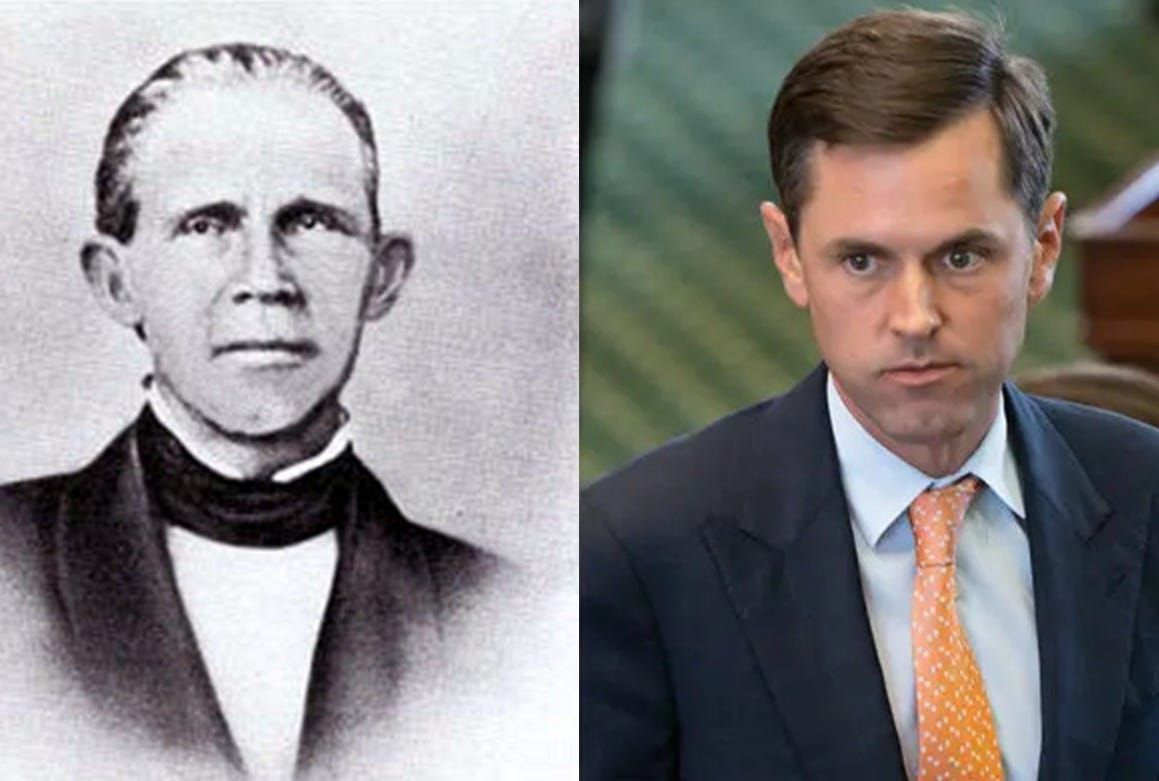
On Tuesday night, Mayes Middleton won the Republican primary runoff for Texas Attorney General. He will now face Democratic State Senator Nathan Johnson in November. The winner of that race becomes the top law enforcement officer in the second-largest state in America, the person who decides which laws get enforced, which corporations get investigated, and which civil rights get protected.
Middleton won because he spent more than $16 million of his own money to blanket Texas airwaves, calling himself “MAGA Mayes” and promising to be the ideological successor to Ken Paxton, a man who used the AG’s office as a personal political weapon for a decade.
That fortune didn’t come from the bootstrapped Texas grit that Republicans love to mythologize. It came from oil. And before the oil, it came from cattle. And before the cattle, it came from a slave plantation on Bayou d’Inde in southwest Louisiana, where a man named Henry K. Moss built a small empire on the labor of people he legally owned on free land.
Mayes Middleton is a seventh-generation Texan. He says this like it’s a credential. And in some rooms in this state, it still is. But when a white Texas Republican brags about being a seventh-generation Texan, the correct question isn’t “How long your family has been here?” The correct question is “What were they doing while they were here, and who paid for it?”
To understand who Mayes Middleton is, you have to go back almost 200 years, to a stretch of southwest Louisiana wetland called Bayou d’Inde, where a man named Henry K. Moss arrived from Georgia, claimed land that wasn’t his to claim, and built a fortune that has never stopped growing. The people who built it for him were never compensated. Their descendants were poisoned. And the man who inherited that fortune just won the Republican nomination for Attorney General of Texas.
That’s a direct line. And we’re going to trace every inch of it.
If you’re new here, hyperlinks lead to sources.
Henry Kirkland Moss was born in 1796 in Lincoln County, Georgia.
He was a white man in the American South when being a white man in the American South was the most valuable thing a person could be. He migrated to southwest Louisiana, to a stretch of land along Bayou d’Inde in what is now Calcasieu Parish, and he got there the way most wealthy white men got anywhere in early America, on the back of a colonial land system that handed territory to the right people and called it opportunity, a Spanish Land Grant.
He built a tannery. He ran cattle. He farmed. And he did all of it using enslaved people. That was how wealth was built in the American South, and Henry Moss was very good at building wealth. According to the 1860 slave census, Henry Moss owned 57 enslaved human beings. He was, by the historical record, the largest white slaveholder in southwest Louisiana.
The hundreds of acres Henry Moss controlled along Bayou d’Inde were Indigenous land. At the same time, the people who had lived on it for centuries were entirely erased from the transaction. Henry Moss got his land for free from the Spanish, who gave it to him because that is what colonial governments do. They convert stolen land into private wealth.
But Henry K. Moss was no pioneer. He was a slaveholder with a free land grant.
When the Confederacy lost, and the United States government legally forced Henry Moss to free the people he had enslaved, he gave them a small parcel of land nearby, a strip of earth along the Old Spanish Trail, about two miles north of his bayou. The freed people took it because what else were they to do when they had nothing, and someone offered them something? They built homes. They planted crops. They raised families. They named the place after the man who had enslaved them, because that, too, is how America works.
They called it Mossville.
Henry K. Moss died in January 1875. He died a wealthy man. The wealth did not die with him.
It’s important to understand what happened to the people of Mossville.
The people of Mossville did what Black communities across the American South did after emancipation.
Over the next century, Mossville grew into a genuine community. At its peak, more than 800 families called it home. It was, according to historians, one of the earliest free Black settlements in the entire American South, a place where people who had been legally classified as property built schools, churches, businesses, and a life.
Then the oil industry moved in.
Starting in the 1940s, petrochemical companies began surrounding Mossville with industrial facilities. Around it. Encircling it, the way you encircle something you intend to consume. By the time anyone was paying attention, more than a dozen chemical plants had been built within the community’s boundaries. Children got sick. Adults got sick. People died young, and nobody in Baton Rouge or Washington asked too many questions about why, because the people dying were Black and poor.
The region became part of what researchers and journalists now call Cancer Alley, an 85-mile stretch of the Mississippi River corridor between Baton Rouge and New Orleans, dense with petrochemical facilities and, not coincidentally, with Black communities. The fact that these plants were built here, in these communities, and not in the neighborhoods where the executives who ran them lived, is not a coincidence either.
It has always been a policy. Environmental racism, and Mossville is one of the most documented examples of it in the United States.
In 2012, a South African petrochemical company called Sasol announced plans to build the largest chemical complex of its kind in the Western Hemisphere directly on Mossville’s doorstep. The Louisiana state government, in its infinite wisdom, decided that the correct response was to give Sasol $115 million in public money to buy out the residents.
Most residents took the money. What choice did they have? They were being poisoned. The government wasn’t coming to help them. The corporation had already won. So they took what they were offered, packed up everything they had built over 150 years, and left the land that had been given to their ancestors as a parting gift from the man who enslaved them.
The community is gone now. A 2019 PBS documentary, Mossville: When Great Trees Fall, caught the last residents on film before the end. It is worth watching, but it isn’t an easy watch.
Henry K. Moss built his fortune on Bayou d’Inde using enslaved labor. When he was forced to free those people, he gave them a scrap of land nearby. That land became Mossville. The same oil and petrochemical industry that made the Moss family fortune grow for another hundred years, the industry that funded the political career of the man at the center of this story, is the industry that poisoned Mossville, surrounded it, and ultimately erased it.
That is a documented, linear, American fact.
Now we follow the money.
Henry K. Moss ➡️ Erastus Moss
Henry Moss had several children. One of them was a son named Erastus, born December 23, 1831, in Lake Charles, Louisiana, Henry’s son, raised on the plantation, heir to everything his father built. Before the Civil War, while his father was still running the slave operation on Bayou d’Inde, Erastus migrated east into Texas. He settled in Chambers County.
By the time Erastus Moss appears in the historical record, he controls somewhere between 30,000 and 35,000 acres. That figure comes from his own grandson’s written account of him. He ran cattle across all of it. He ran a general store. He became the first mail carrier of Double Bayou, delivering mail on horseback from Smith Point to Beaumont, a two-day trip each way. He was, by every measure, one of the dominant figures in early Chambers County. It should be noted that Erastus Moss also owned human beings.
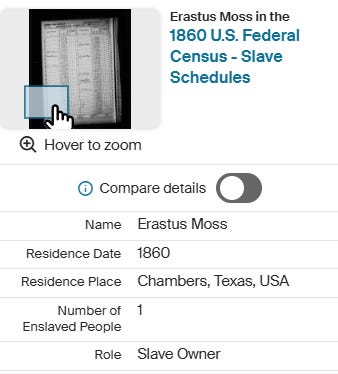
The Texas Historical Commission knows his name. There is a structure in Anahuac, Texas, that the Commission’s own survey photographs and catalogs as the Moss-Middleton Ranch House. This physical landmark still bears the names of both families and sits on land that traces directly back to this man and his father’s slave fortune.
You do not accumulate 30,000 acres of Texas land on a mail carrier’s salary. The capital that seeded Erastus Moss’s Texas empire came from Louisiana. It came from the free land in Bayou d’Inde. It came from the labor of 57 enslaved people who never saw a dollar of it.
Erastus Moss ➡️ Archie Middleton
This is where the Moss fortune becomes the Middleton fortune, and it happens the way so much of American history happens.
Erastus Moss had a daughter. Her name was Mary Ellen Moss, and everyone called her Molly. Molly married a man named David Middleton, and in February 1877, the smallpox epidemic swept through Chambers County. The historical record is precise about what happened at the Moss and Middleton households that month. A contemporary journal entry from Double Bayou reads: “Mollie Middleton died.” A physician’s letter from the same week documents two to four cases at the Erastus Moss home. David Middleton died, too. Both of them, gone within days of each other, leaving behind a fifteen-month-old boy named Archie.
Everyone expected him to die, but he didn’t.
Erastus Moss took the baby in and raised him on the ranch. The 1880 federal census for Chambers County, Texas, lists Archie Middleton, age four, living in Erastus Moss’s household.
When Archie grew up, he inherited. The Encyclopedia of Texas describes Archie D. Middleton as “widely known throughout this section as a man whose practical knowledge of stockraising has played an important part in the development of the ranching industry in his locality”. It states plainly that when he reached maturity, he took over management of the ranch he had inherited. The same ranch. The same land. The same fortune, now wearing a different last name.
In 1904, Archie married Effie Clarice Mayes, daughter of a substantial Wallisville rancher. In 1906, he built a mansion on a hill in Wallisville, a beautiful southern-style home that still stands. He also had oil. The Gulf Coast was producing it by then, and men who already owned large tracts of coastal land were positioned to profit from what was underneath it. Archie Middleton was one of those men.
Archie Middleton ➡️ Randall Middleton
Archie and Effie’s son, Randall Mayes Middleton, was born June 30, 1906, in Chambers County, Texas. He inherited the ranch. He inherited the oil interests. He inherited the political connections that had been accumulating alongside the land and the money for two generations. He was prominent enough in Texas that when he died in 1961, the Texas House of Representatives adopted a memorial resolution in his honor, introduced by Rep. Billy Walker. The Texas House does not adopt memorial resolutions for ordinary people. It adopts them for people who mattered, and in Texas, in 1961, the people who mattered were the people who owned things.
Randall Middleton ➡️ John Gregg Middleton
Randall’s son, John Gregg Middleton, inherited the family holdings and, in 1972, founded Middleton Oil Company, an independent oil and gas operation that would grow to more than 65 operational wells across South Texas and the Gulf Coast. John was a civic pillar of Chambers County, including the city council, the board of the local bank, and the board of the country club. Governor Bill Clements, the first Republican elected to statewide office in Texas since Reconstruction, appointed him to the Trinity River Authority. He was, by every measure, exactly what generations of accumulated wealth produce. A man of standing, of influence, of connections, in a state that rewards all three.
John Gregg Middleton died in 2013.
He had one child.
John Middleton ➡️ David “Mayes” Middleton
Mayes Middleton inherited everything. The oil company. The ranch. The mineral holdings across Chambers, Jefferson, Kimble, Liberty, and Webb Counties. The cattle operations. The land. All of it, every acre, every well, every dollar, that traces in an unbroken line back through John to Randall to Archie to Erastus to Henry K. Moss, who built the original fortune on Bayou d’Inde using 57 people he owned on that Spanish land grant.
That is the chain. Six generations. Two centuries. One unbroken transfer of wealth, from a slave plantation in Louisiana to the Republican nominee for Attorney General of Texas.
Mayes Middleton was born into it. And he is using it to buy his way into the most powerful law enforcement office in the state.
So what does a man do when he inherits a fortune built on enslaved labor, grows it on oil money, and decides he wants more?
In Texas, apparently, he buys a political movement.
First, he bought the infrastructure.
Before Mayes Middleton ever ran for office, he spent years making sure the Texas Republican Party was sufficiently radicalized to produce someone like him. Between 2008 and 2015, he and two other oil executives (Tim Dunn and Farris Wikles) donated millions to Empower Texans PAC. This dark money operation painted itself as a conservative advocacy group but functioned as a wrecking ball aimed at any Texas Republican who wasn’t extreme enough. Middleton wrote the checks and sat on the board of the Empower Texans Foundation.
Empower Texans, led by its pompous director Michael Quinn Sullivan, spent years primarying moderate Republicans, flooding Texas House races with dark money, and pulling the entire party rightward. It worked. The Texas House Freedom Caucus launched in 2017, and three-quarters of its founding members had received donations from Middleton. He would eventually financially support all but one of them. Middleton singlehandedly built and funded the Freedom Caucus.
He also served on the board of the Texas Public Policy Foundation (the Texas counterpart to the Heritage Foundation). He served on the executive committee of the Texas Business Leadership Council. These are the institutions that write the policy agenda that Texas Republicans then pass into law.
Then, he bought his first race.
In 2017, when Chambers County was trying to pass a bond measure to build a new jail, the existing one was overcrowded, run-down, and lacked adequate bathrooms. Mayes Middleton showed up at commissioner hearings to fight it. Not because he cared about jail conditions. Because the bond would have raised property taxes, and Mayes Middleton does not like paying taxes. He offered to donate 27 acres of his own land to the county as an alternative site. The gesture sounds generous until you realize he would have written it off, and that the entire point was to protect his tax bill.
He told the Baytown Sun in May 2017, “The taxpayers come first, the government comes second.” By taxpayers, he meant himself. By government, he meant the human beings sitting in an overcrowded, crumbling jail.
That same summer, he announced he was running for Texas House District 23, primarying the sitting Republican incumbent, Wayne Faircloth. His campaign platform was “defending life, liberty, and private property against big government,” which, translated, means protecting the interests of people who already have property from the people who don’t. He won.
In his first term in the Texas House, Middleton co-sponsored the “Preborn Nondiscrimination Act,” which banned abortion in cases of fetal abnormality. If you find out during your pregnancy that your fetus has a condition incompatible with life, Texas, thanks in part to Mayes Middleton, says you must continue that pregnancy anyway. He co-sponsored SB1978, which protected individuals and organizations that discriminate against LGBTQ people under the cover of religious liberty. He voted to fund Choose Life grant programs, taxpayer money directed to anti-abortion crisis pregnancy centers that target low-income women with fear and shame, while opposing Medicaid expansion, food assistance, and every other program that would actually support the babies he was so determined to see born.
He voted against decriminalizing marijuana possession. In Chambers County, the county he claims as home, the county he bragged about being a seventh-generation resident of, Black residents are 9.3 times more likely to be arrested for marijuana than white residents. It’s the highest racial statewide arrest disparity for cannabis. Mayes Middleton knew this. And he voted to keep the law that produces that disparity exactly as it was.
In December 2020, while Texas was recording 20,000 new COVID cases per day and 250 Texans were dying every single day, Middleton was on a Texas Freedom Caucus video calling for the state to reopen. This was the same political moment when Lieutenant Governor Dan Patrick went on Fox News to suggest that elderly people should be willing to sacrifice their lives for the economy. Middleton was right there with it.
When he moved to the Texas Senate, he didn’t moderate. He accelerated. He authored the bathroom bill, legislation targeting transgender people’s access to restrooms. When trans activists showed up at the Capitol to protest, he turned the protest into a campaign ad, declaring himself the candidate “kicking perverted men out of women’s restrooms and locker rooms.” He has described himself throughout this AG campaign as “MAGA Mayes.”
Mayes Middleton has never worried about whether he could pay his electric bill, afford a doctor, or put food on the table. He has never lived in a neighborhood that a chemical company decided was acceptable collateral damage. He has never been one of the 11% of residents in his own district who live in poverty, or one of the 16% who have no health insurance. He has never been a Black man in Chambers County, watching the marijuana arrest statistics and understanding exactly what they mean.
The insulation that allows him to vote the way he votes, to look at 250 Texans dying per day and think reopen the economy, to look at a crumbling jail and think my tax bill, to look at a pregnant woman with a fetal abnormality and think not my problem to solve, that insulation was purchased. It was purchased with money from slavery and colonization, maintained with oil money, and protected with dark money.
And now, having spent years building the machinery that produces this kind of politics, he wants to run the office with the most power to enforce it.
The caucacity.
Mayes Middleton won the Republican primary runoff for Texas Attorney General. He did it by spending more than $16 million of his own money and positioning himself as the rightful heir to Ken Paxton’s tenure.
Middleton has no meaningful prosecutorial experience. It didn’t matter because Mayes Middleton wasn’t running on qualifications. He was running on money and proximity to Trump, and in the 2026 Texas Republican primary, that was enough.
He is now the Republican nominee. He will face Democratic State Senator Nathan Johnson in November.
On one side, a man whose family wealth originates in a Louisiana slave plantation, who inherited an oil fortune built on land seized from Indigenous people and labor stolen from Black people, who used that fortune to radicalize the Texas Republican Party, buy himself a legislative seat, vote against the interests of his own constituents at every turn, and spend $16 million to purchase the Republican nomination for the most powerful law enforcement position in Texas.
On the other side, Nathan Johnson, a State Senator from Dallas who has spent his career focused on criminal justice reform, healthcare access, and the kind of unglamorous legislative work that doesn’t get you a $16 million war chest but does get you a record worth defending.
Henry K. Moss arrived in Louisiana with nothing but whiteness and the colonial dream of converting whiteness into land.
He enslaved 57 people. He built a fortune. He died wealthy. His son Erastus crossed into Texas with that fortune and turned it into 30,000 acres of coastal prairie in Chambers County. Erastus’s grandson Archie inherited it after surviving a smallpox epidemic that killed both his parents before he was old enough to walk. Archie’s son, Randall, was prominent enough to be memorialized by the Texas House of Representatives. Randall’s son John founded an oil company. John’s son, Mayes, inherited all of it. Every acre, every well, every dollar. And used it to buy himself a seat in the Texas legislature, fund the radicalization of the Texas Republican Party, and just this week, purchase the Republican nomination for Attorney General of Texas.
That is the chain. Unbroken. Two hundred years. Slavery to oil to political power.
And the people who built the original fortune? The 57 enslaved people who worked Henry Moss’s tannery, cattle operation, and farmland on Bayou d’Inde? Their descendants built Mossville. They survived 150 years of American racism. And then the oil and petrochemical industry, the same industry that made the Moss-Middleton fortune grow for another century, moved in, surrounded them, and poisoned their air and water. When a South African corporation needed their land, the state of Louisiana gave that corporation $115 million in public money to buy them out.
The Middleton family got the generational wealth. The people they enslaved got Cancer Alley.
This is not a story about ancient history. The consequences of what Henry K. Moss built are still being lived, by the descendants of Mossville who were displaced, by the residents of Chambers County who are uninsured and in poverty, by every Black Texan who has been arrested for marijuana in a county where they are 9.3 times more likely to be stopped than their white neighbors, by every low-income woman who has been steered into a crisis pregnancy center with taxpayer money. At the same time, Medicaid expansion remained blocked, by every worker who was told to go back to their job in December 2020 while 250 Texans a day were dying of COVID.
Mayes Middleton didn’t cause all of that alone. But he has voted for and funded all of it, and built the political infrastructure that produces it. And he did it from behind the insulation that two centuries of wealth built on stolen labor and stolen land, and never once felt the consequences of it personally.
That is white supremacy. Not the hood-wearing kind that people use to tell themselves this isn’t about them. The kind that lives in land grants and inheritance law and tax abatements and dark money PACs and legislative votes and the quiet, compounding interest of never having to start from nothing because someone else was forced to build everything you started with.
That is what is on the ballot in November.
His opponent is Nathan Johnson, Democratic State Senator from Dallas. Johnson has spent his career on criminal justice reform and healthcare access, the exact things Middleton has spent his career dismantling. The election is in November 2026. The winner becomes the Attorney General of Texas. The person who decides which laws get enforced, which communities get protected, and which corporations get to keep doing what they’re doing without consequence.
We know what Mayes Middleton will do with that office. He has told us. His family history has told us. His voting record has told us. His $16 million campaign ad buy has told us.
Be angry. You should be angry. A fortune built on slavery is about to be used to purchase the legal apparatus of the largest red state in America, and the people who will pay the price for that are the same people who have always paid the price. The poor, the uninsured, the Black, the brown, the working, the ones who never had a grandfather’s oil company to inherit.
But anger without action is just grief with nowhere to go.
So here is what you do with it.
You donate to Nathan Johnson’s campaign. You volunteer. You register people to vote. You share this piece with everyone you know in Texas, and some people you know outside of it, because the Texas AG race has national consequences.
You tell people who Mayes Middleton is. Not the version on the campaign mailer. The real version. The one that starts on a slave plantation on Bayou d’Inde and ends with a man who has never struggled a day in his life asking for the power to decide how the law applies to people who struggle every day.
The chain that built Mayes Middleton’s fortune is two hundred years old, and it has never been broken.
November is our chance to break what comes next.
Click here to find out what Legislative districts you’re in.
LoneStarLeft is a reader-supported publication. To receive new posts and support my work, consider becoming a free or paid subscriber.
Lincolnton, GA is where my family originally comes from. He is my current state senator. He will make Paxton look like a moral upstanding citizen if he is elected. I'll be working overtime to ensure he does not win this race. Thank you for such a thorough deep dive on his family history and his own history within the state.
Goddamn you’re good.