


This morning, as I was out running errands, I learned that Rep. Gene Wu was in Arlington, poll-greeting with my Rep., Chris Turner, and that it was a polling location I happened to be driving by. So, I stopped to say hi just for a quick minute, and the absolute last person in the world who I expected to be there was there. Representative Richard Raymond from Laredo.
Lone Star Left will hit its 1,000th article sometime in 2026. I don’t remember every single thing I’ve written, not exactly, but I remember being angry at Richard Raymond a bajillion times, over many legislative sessions. I’m sure I’ve blasted him more than once for his votes, his donors, and his Donald Trump impressions.
So there’s a particular kind of awkward that happens when you’ve spent years criticizing someone in public, and then suddenly they’re standing ten feet in front of you on a sidewalk in Arlington at ten in the morning. I was going to talk to Rep. Wu for a moment and then leave, until Raymond walked over and introduced himself.
“Hi, Richard Raymond.”
”Michelle Davis, Lone Star Left.”
”What’s that?”
”Oh, um, a publication. A newsletter.”
”Uh-huh. What kind?”
”Well, it’s partisan. I write about Texas politics, mostly about the Texas Legislature.”
I look over at Gene Wu, and he’s going like:
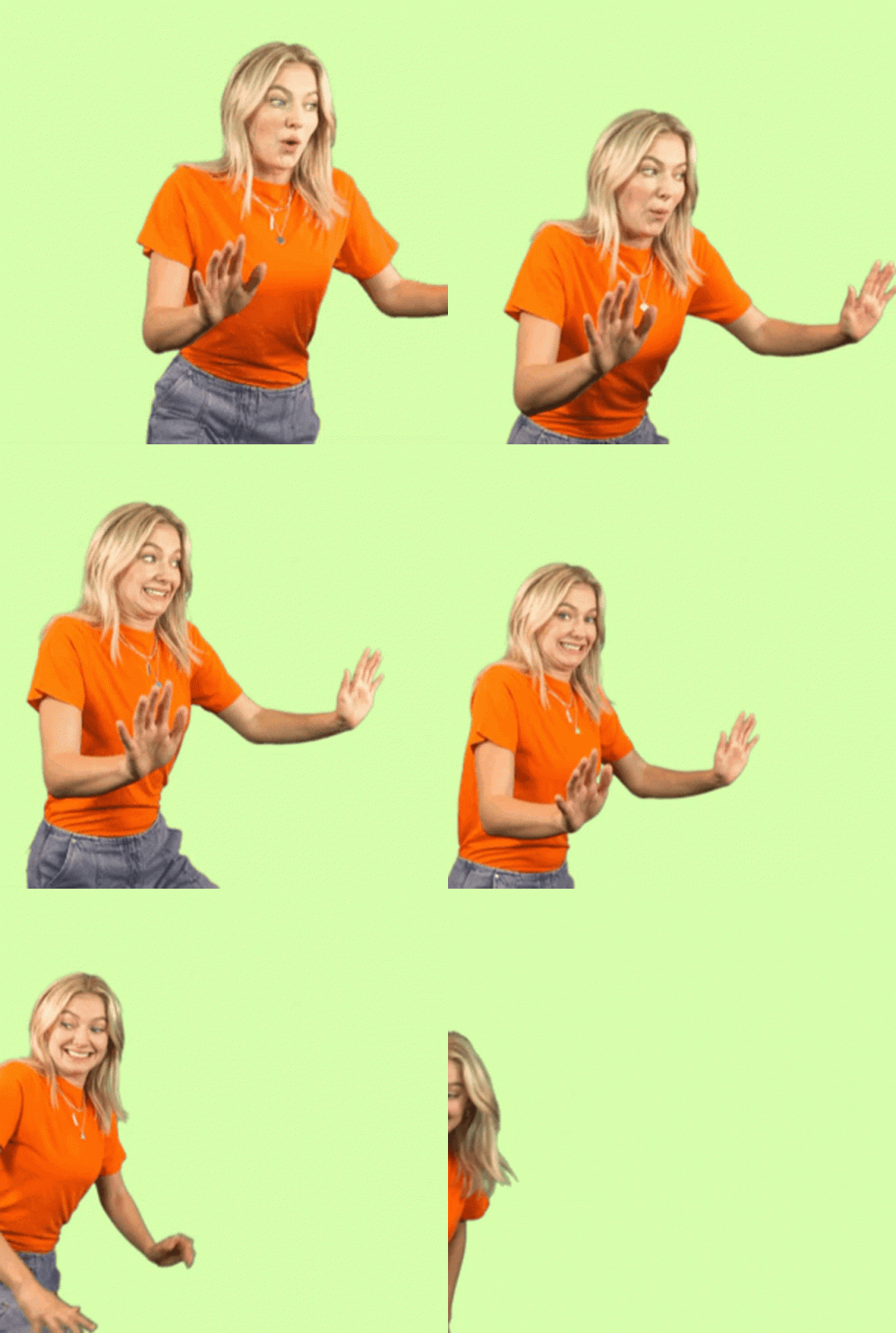
My mind was churning back to early 2025, trying to catapult over all the political events that have happened since then, the hundreds of articles I’ve written, and the hundreds of thousands of words. All I could think was, “corporate owned, votes like a Republican, talks like Trump.”
We actually had a fairly pleasant conversation. I don’t mean fake pleasant. I mean, I kept it real.
We talked about corporate tax abatements. We talked about the fossil fuel influence on the border. And I told him something I don’t think legislators hear very often.
I told him I watch the Legislature every single day of the 140-day session. Not just the big key votes. I watch the small ones. The procedural ones. The amendments. I see the votes when Democrats think nobody’s looking.
We talked about Henry Cuellar. Vicente González. At one point, he told me he had never read anything I’d written before. Which honestly surprised me. He said he’d look me up.
So, Rep. Raymond, if you’re reading this now, I’ll say this, you were kind. You were respectful. You were willing to stand there and have an honest conversation with someone who has criticized you for years. That says something about your character.
Polymarket.
A very nice lady contacted me the other day, and she was upset about something I had included in a recent article. I had linked to a Polymarket graph, and she accused me of using “fake data” and trying to influence undecided voters.
Polymarket as of 2/27/2026, 9:00 pm CST:
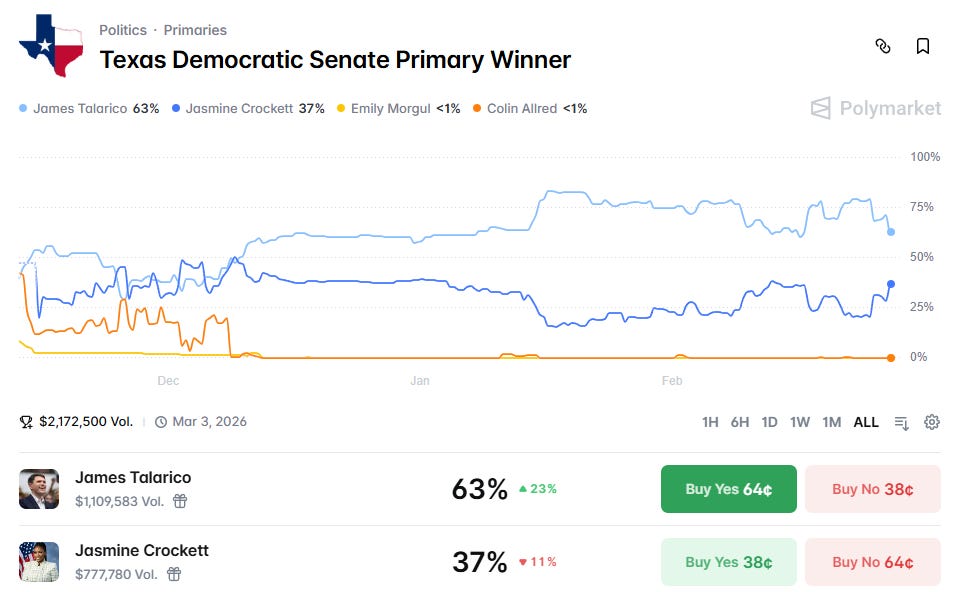
First, I want to be clear about something. I go out of my way to be transparent. When I cite numbers, I link the source. When I reference data, I show you where it comes from. When I draw a conclusion, I explain the logic behind it. You may disagree with my interpretation, but you will always be able to see exactly what I’m looking at. Nothing is hidden. Nothing is invented.
For those unfamiliar, Polymarket is not a poll. It’s a prediction market. People use real money to bet on political outcomes, and the odds shift based on what thousands of participants collectively believe will happen. It functions less like a survey and more like a real-time probability tracker, aggregating public information, news, polling, and sentiment into a single number. It is a useful signal, and it has historically been more accurate than many individual polls because it reflects incentives, not just opinions.
That said, her message was a good reminder of something I need to do better.
Because I write a daily newsletter about Texas politics, most of my readers are highly engaged. They already understand concepts like prediction markets, polling averages, sample size, and margin of error. They live in this world with me. But it was wrong for me to assume that everyone automatically knows what Polymarket is, or how to interpret a graph like that. That’s on me.
Going forward, when I include charts, graphs, or probabilistic models, I will do a better job explaining what they are, what they are not, and why they matter. Not because I doubt your intelligence, but because transparency means ensuring everyone has the tools to understand the information.
The goal has never been to influence you with hidden information. The goal has always been to show you exactly what I’m seeing, and trust you to draw your own conclusions.
For what it’s worth, there isn’t ONE poll in this Senate race I would trust. Not one. Here are the crosstabs breakouts of Latinos in independent polls since December:
UT Tyler: Crockett +19
Univ. of Houston: Crockett +9
Univ. of Texas: Crockett +4
TPOR/Slingshot: Talarico +10
Texas Southern: Talarico +10
Chism: Talarico +29
Emerson: Talarico +34
The fluidity of early voting numbers.
If I had a ton of money, I would start a data company. Data is the new gold. This primary season, I’m relying on other data companies to put data out there, and then I’m talking to you about it. While we expect it all to be accurate, for us not to have fevers when reading it, and for there not to be technical glitches. Shit happens.
Take Tarrant County’s numbers with VoteHub this week, for example.

On February 25, VoteHub posted that they had made a technical correction to their Tarrant County early vote modeling that affected racial composition estimates, the numbers we talked about a few days ago. In plain English, that means their underlying assumptions or inputs needed to be adjusted, and when you adjust the inputs, the outputs change.
That’s data science in real time.
When you’re modeling turnout before Election Day, you’re estimating. You’re projecting. You’re refining as better data comes in. Sometimes that means you have to go back and correct something. In fact, the willingness to correct is a sign the system is working, not failing.
But it’s also a reminder that any single snapshot, from any single source, on any single day, is just that. A snapshot.
Today was the last day of Early Voting.
Which means now, for the first time, we’ll soon have the full Early Vote universe.
This weekend, let’s look at everything together. VoteHub. Secretary of State data. County files. Prediction markets. Polling. All of it.
And then Tuesday is election day. Make sure to join me here on Substack at 7 pm on election night for a live chat as we watch and discuss the results together.
Stay tuned.
March 3, 2026: Primary Election
Click here to find out what Legislative districts you’re in.
LoneStarLeft is a reader-supported publication. To receive new posts and support my work, consider becoming a free or paid subscriber.
Follow me on Facebook, TikTok, Threads, YouTube, and Instagram.
OMG! I wish I was a fly on your shoulder to listen to the conversation with you and Rep. Raymond! I would have loved to see Rep. Wu face too. 😁
Great article as usual!
I look forward to join you on Tuesday, I’m going to the BCDP primary election party for a bit so I’m not sure how well I will be able to focus. I should be home by 8:00 pm.
How long will you be on?
I’m so excited that March 3 is around the corner.
I’m already working on the NEISD School Board Elections. May 3. Then the run off. May 23? May is busy!
Looking forward to your analysis of early voting across Texas.