


If you haven’t heard already, National Democrats (DLCC) announced yesterday that they plan to flip 12 Texas House seats. We actually need 14 to flip the Texas House, but we’ll get to that. Here were the targets, from the Texas Tribune:
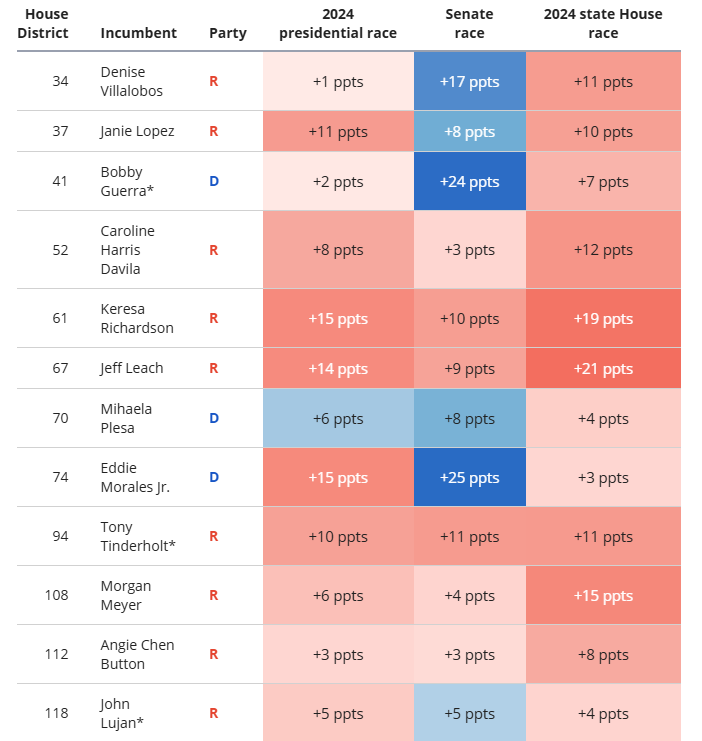

They include HD41, HD70, and HD74 as Democratic holds. Which, fine, but in this election, in this environment, they’d probably be fine. But they get the extra support, and it helps turnout at the top of the ticket.
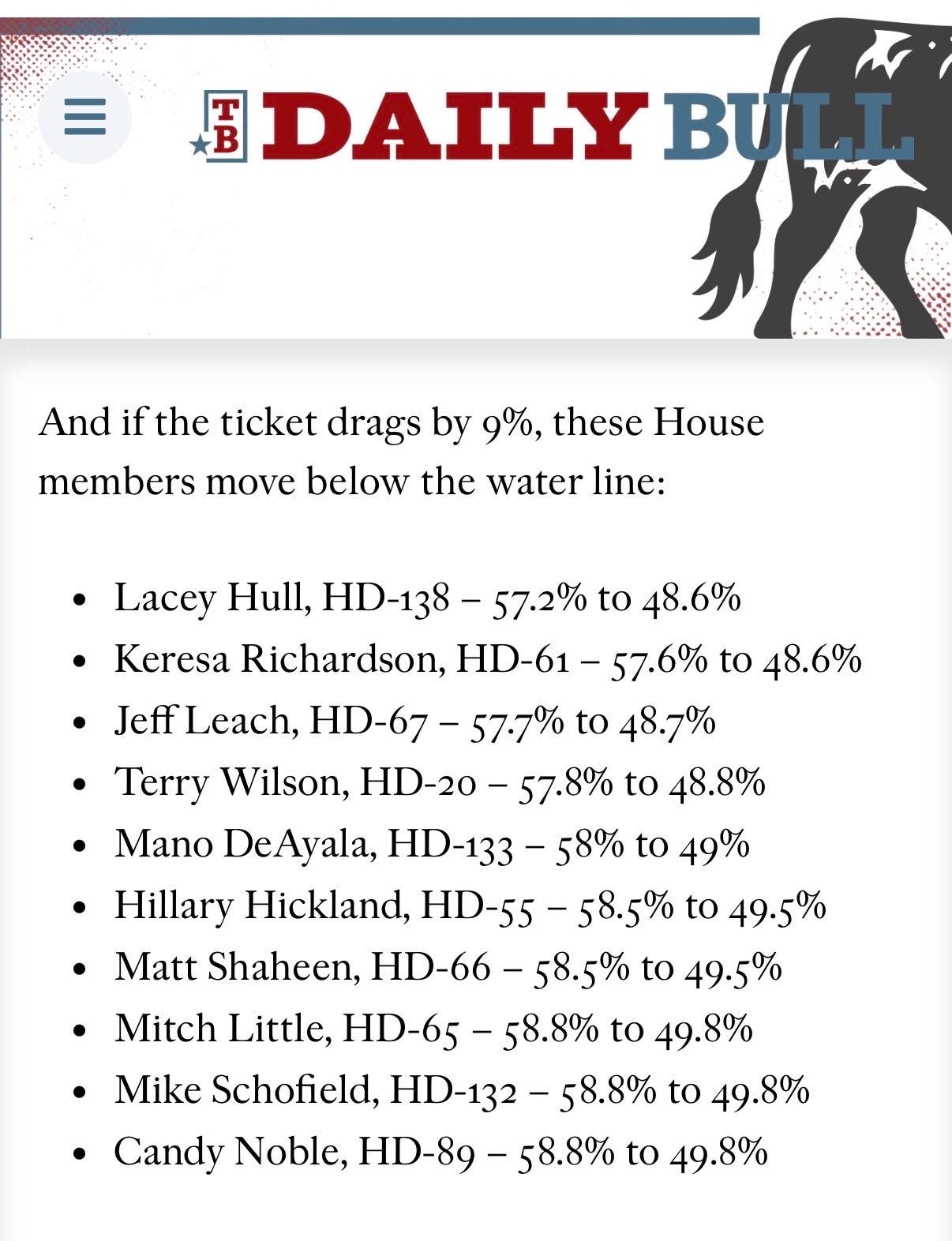
Then there was the Texans for Lawsuit Reform analysis, published by the right-leaning Texas Bullpen, which showed which seats they thought would flip if Republicans underperformed by 7% or by 9%.
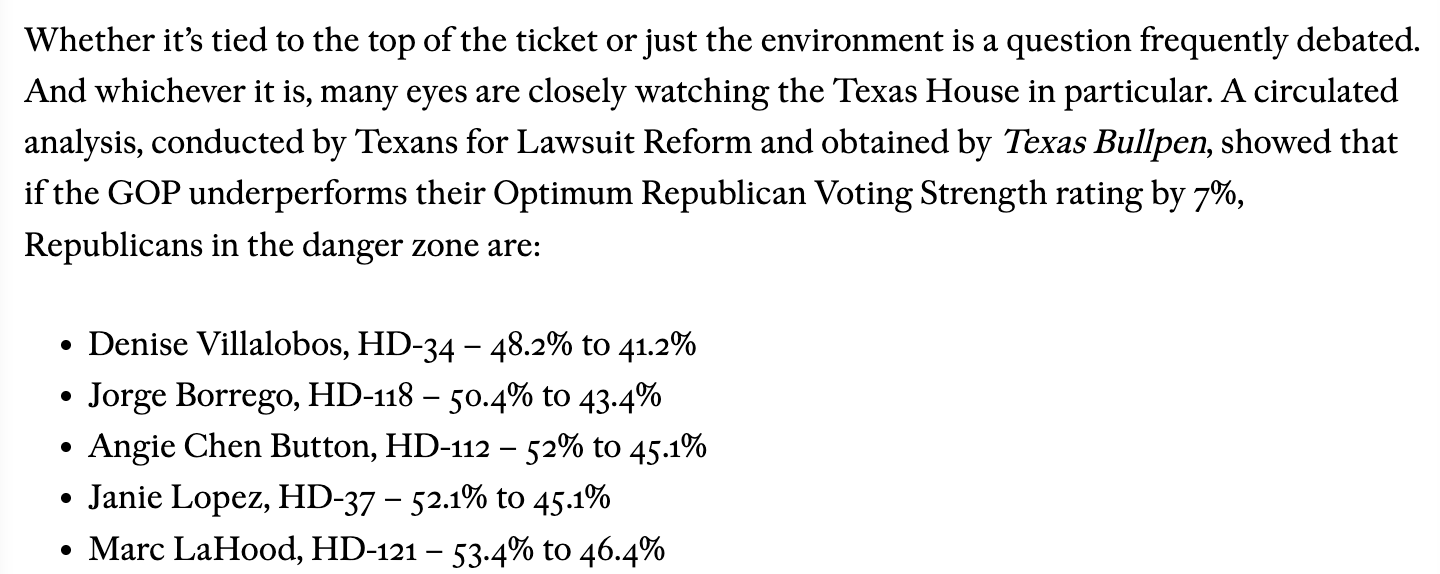
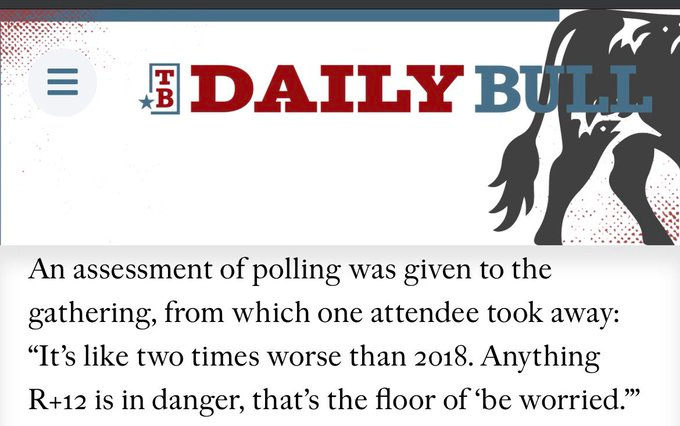
Then, also from the Texas Bullpen, yesterday, the GOP’s summit in Austin, one attendee said, “Anything R+12 is in danger.”
Glorious, isn’t it?
The seats that overlap. The BIG targets.
We’re just doing this chronologically.
HD34: Denise Villalobos vs. Stephanie Guerrero Sáenz. If the Election Gods are listening right now, please head down to Nueces County, because Sáenz needs so much help. This is literally the most flippable seat in the state, in a county that is also likely to flip if it gets organized, and she still hasn’t launched her campaign yet. In the most important election year of our lives. In the most flippable seat in Texas. I have no idea what the game plan is for this seat, but if the DLCC is really planning on getting behind it, someone needs to get down there and make sure the opportunity isn’t squandered.
HD37: Janie Lopez vs. Oziel “Ozzy” Ochoa. Ochoa is going to be another progressive voice for us in Austin, and has an education background and platform that will be favorable in this district. He’s a lifelong Harlingen resident with deep community roots and 17 years of experience in public education as a teacher, coach, administrator, and principal. I’ll have to dig up Janie Lopez’s old campaigning videos, of her driving up and down neighborhoods, screaming out of her car window, “Vote for Janie.” That’s always been hilarious to me.
HD61: Keresa Richardson vs. Brittany Black. Keresa Richardson is nuttier than a soup sandwich. Last legislative session, I tracked which Republicans had signed which pledges (i.e., Texit, Abolish Abortion, No Dem Chairs, ect), and she was the only Republican who signed EVERY SINGLE ONE. She’s never heard a conspiracy theory or racist dog whistle that she didn’t want to be a part of. Her entire brand is built on being the loyal MAGA choice in a Collin County district that keeps getting less white and more educated every cycle. Black previously filed to run for Congress as a Republican before switching parties. A wrinkle she’s called a mistake. Democrats see it as possibly competitive due to backlash over the closures of several local schools, which they blame on Republicans, and continued population growth in northern Collin County. The TLR analysis puts Richardson underwater, with a 9% GOP underperformance.
HD67: Jeff Leach vs. Jordan Wheatley. Leach the leech. He’s been fending off Democratic challengers in this Collin County district since 2018 and keeps winning. Jordan Wheatley will now get his shot at one of the more entrenched Republican incumbents on the target list. The TLR analysis says Leach goes underwater at 9% GOP underperformance, which means this is purely a wave-dependent seat. The demographic profile, highly educated, heavily Asian-American suburbs, is the right long-term picture. But Wheatley needs both the environment and serious money to make this happen.
HD112: Angie Chen Button vs. Zach Herbert. This is the white whale of Dallas-area suburban politics. Button has survived every wave since 2018 in a Garland/Richardson district that keeps trending Democratic and keeps not quite flipping. The district is 54.7% Anglo, but with a substantial Asian-American population, and the kind of educated suburban profile where Paxton as the top of the ticket is genuinely toxic. If there’s one seat on this list where a strong candidate and a favorable environment collide, this is it.
HD118: Jorge Borrego vs. Kristian Carranza. Lujan ceded reelection to run for Congress, making this an open seat. Kristian Carranza, the Democratic nominee from 2024 who lost to Lujan by only 4 points, is running again. Jorge Borrego won a competitive Republican primary, defeating two other candidates. This is a majority-Hispanic south San Antonio district where Beto would have won by 5 points in 2018. Carranza already knows the district, has the name recognition, and has a rematch story to tell.
HD121: Marc LaHood vs. Zach Dunn. LaHood is the far-right guy who knocked out a moderate Republican in 2024, specifically over school vouchers, which means the business wing of his own party doesn’t love him, and he drew a primary challenger this cycle backed by Texans for Lawsuit Reform. LaHood won anyway. Zach Dunn is a prosecutor in the Family Violence Division at the Bexar County DA’s office, and a prosecutorial record that plays well in a San Antonio suburban district that Trump only carried by 5 points. This race has real potential.
HD133: Mano DeAyala vs. Josh Wallenstein. DeAyala won his own primary runoff by just 51-49 this cycle, barely surviving. That kind of near-death primary experience going into a tough general environment is not a great place to be. Wallenstein is a small-business owner and ethics attorney who has spent his career protecting taxpayers and fighting corruption, which maps perfectly onto the anti-Paxton message that will drive this entire cycle. This is a west Houston district that’s nearly 50/50 Anglo-non-Anglo, with 14% Asian-American, and has exactly the kind of educated suburban profile where the environment works for Democrats.
HD138: Lacey Hull vs. Tyler Smith. This west Houston district is 41% Hispanic, 10% Black, with a non-Anglo majority that keeps growing. Hull won by 14 points in 2024, which sounds comfortable until you remember that was a Trump year with a presidential race driving Republican turnout. Tyler Smith gives Democrats an offensive play in the Houston area in HD-138, a seat that belongs on any real target list. Hull’s margin in 2024 was built on Trump turnout that won’t be there in November. Smith needs to be on every Houston-area Dem’s radar.
Those ⬆️ are the nine seats that overlap between the DLCC targets and the seats the TLR appears to be worried about.
What about the other DCLL targets that TLR didn’t mention as a concern, and why aren’t they concerned?
There are three districts. HD52, HD94, and HD108. We’re going to speculate that the TLR analysis is modeling based on Republican Optimum Voting Strength. Essentially, what these districts look like at full GOP mobilization. Their model is tuned to structural partisanship, not candidate-specific or environment-specific factors.
HD52 and HD94 both have Republican incumbents or nominees who have historically run ahead of the top of the ticket. Harris Davila and a Tinderholt-built GOP machine in HD94. TLR’s model likely treats that as a structural cushion that requires more than a 9% shift to overcome.
HD108 is a different story. TLR’s allies in the business community like Morgan Meyer. He chairs Ways and Means. He’s their guy. They’re not going to ring an alarm bell about a seat held by one of their most valuable committee assets.
The DLCC, by contrast, is looking at candidate quality, fundraising potential, and environmental factors that a partisan structural model doesn’t capture. That’s why these three are on their list but not TLR’s panic list, and it’s also why you shouldn’t read TLR’s silence on these seats as proof they’re safe.
HD52: Caroline Harris Davila vs. Chris Jimenez. Harris Davila holds the seat that James Talarico himself once occupied, which makes flipping it both poetic justice and strategically important. She’s Dan Patrick’s chief of staff’s wife, a hard-right MAGA loyalist in a Round Rock/Georgetown district that is among the fastest-growing and fastest-changing in the state. Trump carried it by 8 points in 2024, but the Senate race margin was only 3 points, which is the tell. The DLCC sees this as flippable. The TLR analysis doesn’t have her in their danger zone at either 7% or 9% underperformance. But in a 9%+ wave environment, with Paxton at the top of the ticket and no Trump to drive MAGA turnout, the math gets uncomfortable for her fast.
HD94: Cheryl Bean vs. Katie O’Brien Duzan. Tinderholt’s open seat in Tarrant County. Bean won the Republican primary outright with 53.8%, defeating Texans for Vaccine Choice founder Jackie Schlegel and three other candidates. The Republican baseline here was built on one of the most extreme members of the Texas House, a guy who once filed a bill to make abortion punishable by death. Trump carried the district by 10 points in 2024, and the Republican incumbent won by 11. The DLCC put it on the list. Tarrant County has been trending Democratic, and we expect Democrats across the county to overperform in November.
HD108: Morgan Meyer vs. Allison Mitchell. This is the seat that nearly flipped in 2018. Meyer won with 50.1% of the vote, a margin of 0.2 percentage points. Democrats have come close numerous times, but haven’t succeeded. It’s 75.6% Anglo, highly educated, old-money Dallas establishment Republican territory. Meyer survived his own 2024 Republican primary against a challenger who came after him specifically for his role as a House Manager in the Paxton impeachment trial. Meyer won that with only 51% of the vote. Meyer is already radioactive with the MAGA base for voting to impeach Paxton, and now Paxton is at the top of the ticket. The TLR analysis doesn’t flag this one either, probably because the old-money establishment vote has consistently propped Meyer up even as MAGA erodes his base from the right. But the internal contradiction of his position, too moderate for MAGA, not moderate enough for Democrats, makes this genuinely interesting in 2026.
That’s the 12 DLCC targets, but there are six more seats that the TLR is worried about that the DLCC isn’t targeting.
What are those five seats TLR is shaking in their boots over, but the DC Democrats haven’t noticed yet? And why?
This is my speculation. TLR is a Texas organization with Texas-specific modeling. They know these districts from the inside. They’re running simulations based on precinct-level Republican voting behavior, and their model indicates that with a 9% GOP underperformance, the structural floor of these seats, all of which are in high-growth, demographically shifting corridors, isn’t where it used to be.
The DLCC, by contrast, is a national organization making resource allocation decisions. They’re looking at candidate infrastructure, fundraising capacity, and proven electoral competitiveness, races where they can point to a near-miss and justify the investment. Most of these six seats don’t have a recent near-miss on the books. They look safe on a national spreadsheet.
And in this case, I’m siding with the GOP monsters on their assessment. Because even though they’re not on our side, they know Texas better than DC Democrats, and so do I. And Republicans should be worried about these seats.
The DLCC could still add them to their list later.
HD20: Terry Wilson vs. Matthias-Jonah Early. Wilson represents a chunk of Williamson County, the same fast-growing Austin exurb territory that keeps producing surprises. The TLR analysis puts Wilson underwater at 9% underperformance. Early is the Democratic challenger, though there’s not much public profile on him yet. This is a stretch target, but in a county where the Austin migration story keeps rewriting the political math every two years, you don’t dismiss Williamson County seats casually. The DLCC simply isn’t paying attention here, yet.
HD55: Hillary Hickland vs. Amelia Rabroker. Hickland is a Moms for Liberty nut on a crusade against dildoes. Bell County is 45.9% Anglo, nearly 23% Black, 25.8% Hispanic, with a massive military population that has historically swung based on economic conditions and federal policy. Hickland won by a comfortable margin in 2024, but the TLR analysis flags her as 9% GOP underperformance, suggesting their model sees structural softness here. The DLCC isn’t looking here, and that’s probably a mistake.
HD66: Matt Shaheen vs. Sandeep Srivastava. Shaheen is a Plano Republican who has held this Collin County seat since 2014 and keeps surviving. The district is 55.3% Anglo with a massive Asian-American population of 20.4%, which is the highest Asian-American share of any district on either target list. Trump carried it by 14 points in 2024, but the Senate race gap was only 9 points. Srivastava is the Democratic challenger, and his name recognition alone in a heavily South Asian district could matter more than the DLCC’s models account for. The TLR analysis puts Shaheen underwater at 9% underperformance. This is exactly the kind of district where a wave plus the right candidate bio can produce an upset that nobody saw coming.
HD89: Candy Noble vs. Angie Carraway. Noble is a Collin County incumbent who has held this seat since 2018 and has been largely comfortable in it. But the district covers the same northern Collin County territory that keeps getting more diverse, more educated, and less reliably Republican every cycle. The DLCC hasn’t targeted this seat, possibly because Noble’s margins have looked comfortable on paper. But comfortable margins in rapidly changing Collin County are often a lagging indicator rather than a predictor.
HD132: Mike Schofield vs. Sara McGee. Schofield is a west Houston Harris County Republican in a district that is 43.1% Anglo, 28.5% Hispanic, 14.1% Black, a majority-minority district that Schofield keeps winning through sheer personal vote strength and low Democratic turnout. This may be the single most demographically misaligned seat held by a Republican on their entire list. The DLCC isn’t targeting it, probably because Schofield has consistently outrun his district’s demographics, and there’s no high-profile candidate investment here yet. But if Harris County Democrats are running up the score countywide, which the environment suggests they will, Schofield’s personal-vote cushion gets tested hard.
So, you add those five districts the TLR is scared of to the 12 districts the DLCC is targeting, and that gives us 17 plump and juicy red districts ready to flip blue. That sure enough covers 14 seats and gives us a few seats’ worth of breathing room in case any of those candidates turn out to be duds.
The receipts are there, and for once, they’re coming from both sides of the aisle.
When DC Democrats, Texas Republican insiders, and a tort reform lobby that has spent decades propping up the Texas GOP majority are all running the same basic calculation and arriving at the same basic answer, you pay attention.
Fourteen seats. One majority. Thirty years of one-party rule in the Texas House are on the line.
We’ve been told Texas isn’t ready. We’ve been told to wait. We’ve been told the map is too hard, the money too scarce, the voters too checked out. The Republicans running these internal analyses clearly didn’t get that memo. They’re scared, and they should be.
Now the question is whether we show up organized, funded, and ready to take it in every single one of these districts, from Corpus Christi to Collin County to the west Houston suburbs.
The Election Gods are listening. Are we?
Click here to find out what Legislative districts you’re in.
LoneStarLeft is a reader-supported publication. To receive new posts and support my work, consider becoming a free or paid subscriber.
This is a great Article. I pray the DLCC reads it. ☺️
Then they can help flip the 17 and Texas can get the 14 we need! 🙏🏼
Glad to see there are a couple in my area and I am glad to see they are helping Plesa but it was a rather awkward inclusion. It appeared they were not giving her credit or else were opposing her. We all know she has made such a difference in the State House and must be re-elected.