

It may feel, in the moment, like Texas primaries have crossed some new line. That something about this cycle is uniquely bitter, uniquely personal, uniquely ugly. Every attack feels unprecedented when it’s fresh. Every accusation feels like proof that Democratic politics has finally broken into something it wasn’t before.
However, there was a time when the Democratic primary was the only event that mattered. Winning the primary meant winning the office. Just like the Republican primaries have been in the last few decades. And when the stakes are absolute, the fights become struggles over identity and legitimacy.
Long before modern social media, Texas Democrats were already tearing each other apart in elections, scandals, and recounts. Reformers accused insiders of corruption. Establishment figures warned insurgents would destroy the party. Wedge issues became weapons. Rumors spread. Alliances shattered. And when it was over, the damage didn’t always heal.
What looks ugly now is part of a much older Texas tradition.
1962 - John Connally vs. Don Yarborough.
In 1962, Texas was effectively a one-party state, and whoever survived the Democratic primary would certainly become governor. And unlike this year, when the Democratic base is decidedly progressive, back in the 60s the Democratic base was much more Conservative (ode to the Southern Strategy).
The governor’s election that year wound up in a runoff between John Connally, who represented the conservative establishment. He was oil-aligned, business-friendly, and trusted by the existing power structure. Don Yarborough was the insurgent, backed by liberals who believed Texas was overdue for change.
What do all Conservatives do in political contests? They call their opponents “communists,” and they’ve been doing it for the better part of 100 years. During the runoff election, one of the biggest attacks from Connally against Yarborough was to call him and every Texan who voted for him a “RED.” Check it out:
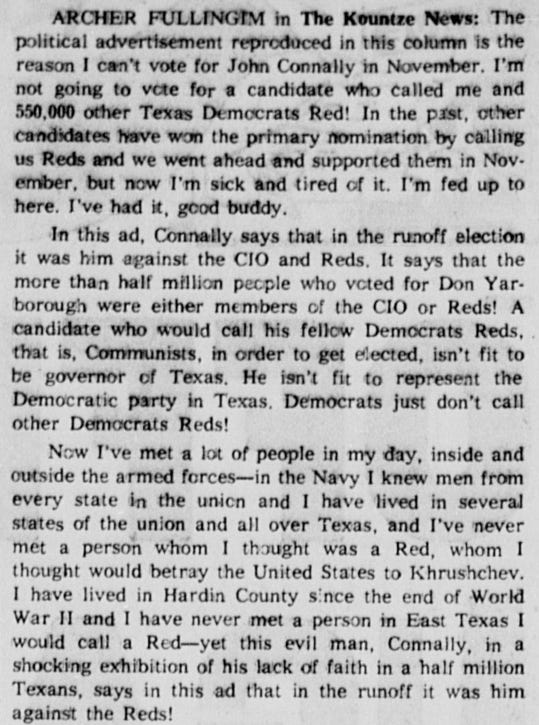
Needless to say, it really pissed off liberal Democrats in Texas. Classic Conservatism. It should be noted that Connally switched to the Republican Party in 1973.
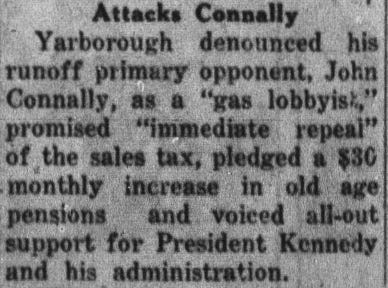
Yarborough attacked Connolly back, calling him a “gas lobbyist” and promising an immediate repeal of sales taxes and full support of the Kennedy Administration.
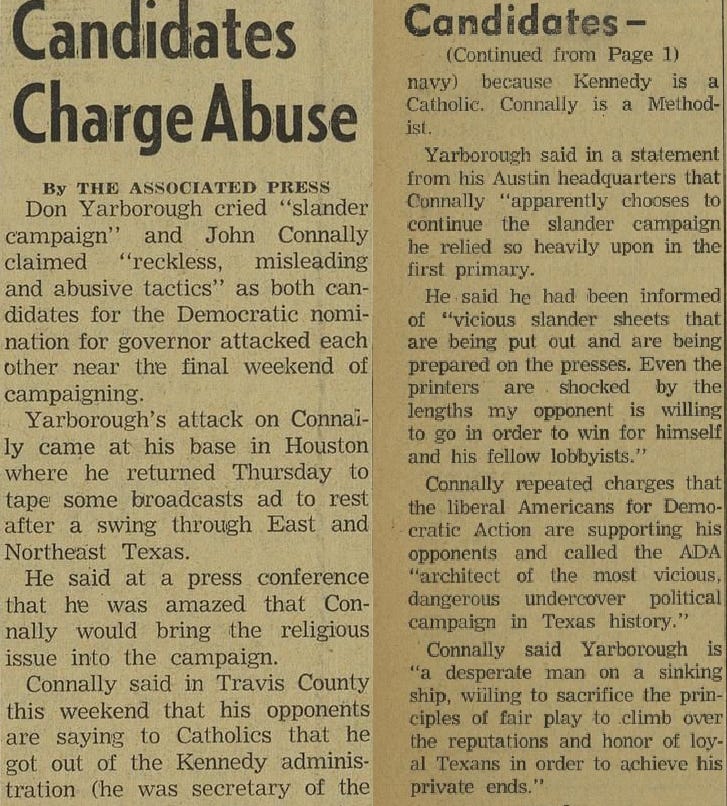
It only escalated from there. Both men were arguing about whether the other deserved to govern at all. Don Yarborough publicly denounced what he called a “slander campaign,” while John Connally responded by accusing Yarborough’s side of using “reckless, misleading and abusive tactics.” It was front-page warfare, with each campaign trying to define the other as big, fat liars.
Religion quickly became one of the weapons. Connally claimed his opponent was spreading rumors among Catholic voters that he had been pushed out of the Kennedy administration because of Kennedy’s Catholicism.
Connally’s campaign also escalated the legitimacy fight by tying Yarborough to the liberal Americans for Democratic Action, portraying the group as a shadow force behind his candidacy and calling it the “architect of the most vicious, dangerous undercover political campaign in Texas history.” Yarborough was presented as the product of outside liberal influence, someone willing to abandon the “honor of loyal Texans” to win power. Yarborough responded by accusing Connally of relying on slander to protect his position.
John Connally won that runoff election in June of 1962 with 51% of the vote. He was seriously wounded the next year while riding in Kennedy’s limousine in Dealey Plaza, but survived and served as Texas governor until 1969.
Don Yarborough ran for governor again in 1964 and 1968, but was never elected to political office.
1972 – Dolph Briscoe vs. Sissy Farenthold.
Shortly after the Sharpstown scandal had rocked the Texas Democrats, public trust was shattered, and voters were convinced that the Texas government had become a private business for those already in power. So, by the time the 1972 Democratic primary arrived, the question was, “Who isn’t corrupt?”
The race was a four-way battle between incumbent Governor Preston Smith, Lieutenant Governor Ben Barnes, rancher Dolph Briscoe, and state representative Frances “Sissy” Farenthold. Smith and Barnes were both tied, directly or indirectly, to the political establishment that voters increasingly blamed for Sharpstown.
Farenthold emerged as the insurgent, backed by reformers and activists to dismantle the corrupt political machine. Briscoe positioned himself differently. He was wealthy, but he had not been part of the state government during the scandal, allowing him to present himself as untouched by it.
Sharpstown was the entire campaign.
Farenthold accused state leadership of treating Texas “like a cash register,” openly tying her opponents to the scandal and the system that enabled it. Her campaign argued that the existing leadership forfeited its moral authority to govern. Every speech, every debate, every appearance became part of a broader argument that the party itself had to be rebuilt from the ground up.
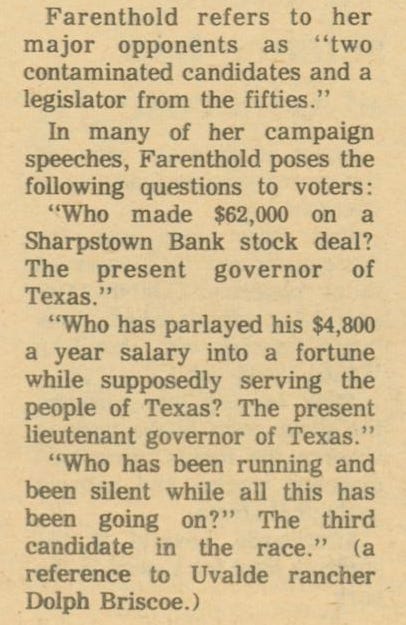
When the votes were counted in the primary, neither Smith nor Barnes even made the runoff. The establishment had been rejected outright. The runoff came down to Briscoe and Farenthold, two candidates who claimed to represent a break from the past but offered very different definitions of reform.
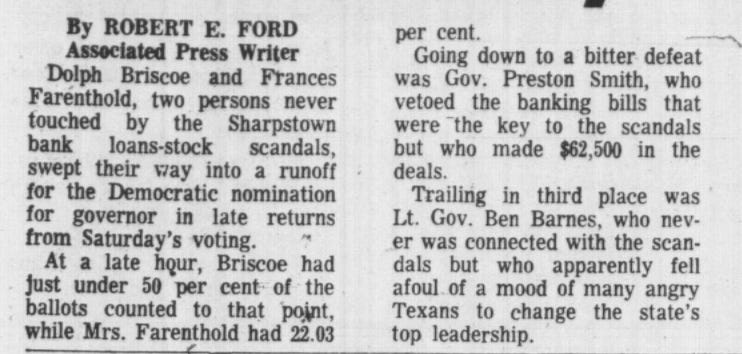
Farenthold was the voice of the reform movement, challenging the legitimacy of the old political order and demanding structural change.
Briscoe offered stability, promising to clean up government without dismantling the party itself.
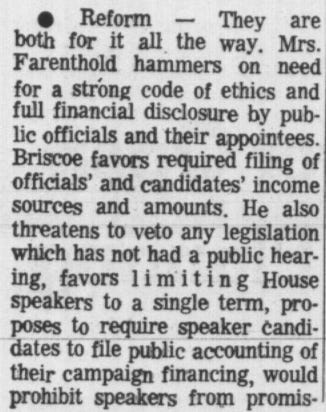

In the end, voters chose repair over revolution.
Briscoe defeated Farenthold in the runoff with roughly 54% of the vote. Sharpstown created a political environment in which Democrats were forced to publicly and repeatedly prove that they were not part of the problem.
Between the Southern Strategy and the Sharpstown scandal, this was the beginning of the end of Democratic one-party rule in Texas for a long, long time.
1984 – Kent Hance vs. Lloyd Doggett.
By 1984, the Democratic primary was about wedge issues.
The open US Senate seat that year triggered one of the closest and most divisive Democratic primaries in Texas history. Three major candidates entered the race. Kent Hance, a conservative Democrat from West Texas; Lloyd Doggett, a liberal state senator from Austin (in the modern-era, we call him progressive); and Bob Krueger, a former congressman backed by much of the party establishment. None of them had a majority. And as the race tightened, the campaigns began searching for any advantage that could fracture the electorate just enough to win.
Kent Hance found one. He was a fucker for this, and he became a Republican in 1985.
In the closing weeks of the primary, Hance made immigration the centerpiece of his campaign. He accused his opponents of supporting “amnesty” for undocumented immigrants. Yes, this is a political issue that’s been at the forefront of American politics for many of our entire lives.
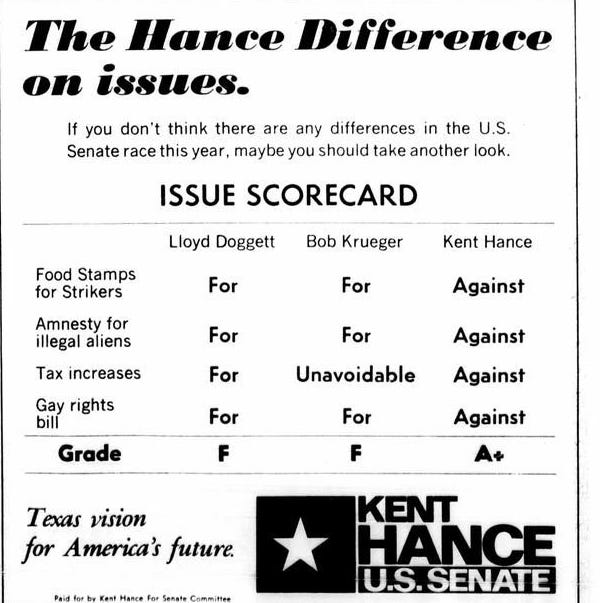
This rhetoric was effective back then, the same way it’s effective now. You were either protecting Texas, or you weren’t, because white supremacy.
The strategy worked. Hance surged into first place in the primary, knocking Krueger out of contention and forcing a runoff with Doggett.
Then, it was a confrontation between two factions of the Democratic Party that increasingly saw each other as incompatible. Conservatives and liberals (now progressives).
The runoff was brutal. Both campaigns flooded the state with attacks, each trying to define the other before voters could make up their own minds.
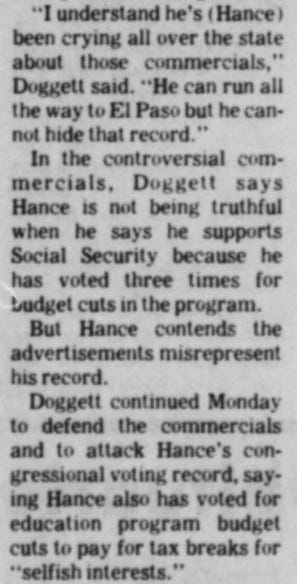
By election night, the result was sooooo close. When the final votes were counted, Lloyd Doggett had won by just 509 votes.
The primary had done its job. It had chosen a nominee. But it had also deepened the fractures inside the party at exactly the moment Texas Democrats could least afford it.
For decades, Democratic primaries in Texas functioned as the real election. But by the mid-1980s, they were becoming the place where the party weakened itself, one internal battle at a time.
2026 - The land of the unknown.
Forget about the Senate primary. There are dozens of other Democratic primaries across the state, up and down the ballot. Which is fantastic, but also is how so many other scandals are getting swept under the rug this year. Which is fine. For now. But if they win?
On the Republican side, we all know how loony they are. Their entire thing this year is that EVERYONE is a secret Democrat, or a secret liberal, or a RINO. I’m not even being hyperbolic; pretty much everyone in the Republican primary is accusing their opponents of being a secret “blue.”
Our side isn’t immune. Of course, every year we (or at least I) get warned or a heads up about a Democrat being a “secret Republican.” This year, it’s been more than five. In one race, the candidate had an article published about him in Politico. I knew about that guy months ago and reached out to him. On his public Facebook page, he wrote paragraphs and paragraphs of explanation. I was like, okay, whatever, he’s made his background and explanation public, there are better candidates in this race, who cares? I made an endorsement in that race, and it wasn’t that person.
There have been allegations of domestic violence, screenshots of misogyny on Facebook, and refusals to swear off AIPAC money in debates.
My personal favorite was the candidate who forged a Lone Star Left endorsement, and the only comment on it was a series of emojis from the candidate’s girlfriend.
History gives us two choices in moments like this.
We can focus on the ugliness. We can catalog every attack, every rumor, every betrayal, every moment where someone chose ambition over integrity. Texas has no shortage of those stories. It never has. The Democratic Party survived red-baiting, corruption scandals, recounts decided by hundreds of votes, and decades of internal fracture. None of this is new. None of this is unprecedented.
But that isn’t the only story.
Because every one of those primaries also produced people who went on to expand rights. People who protected communities. People who changed the trajectory of this state in ways that still shape our lives today. The ugliness is loud, but it isn’t the whole picture.
Right now, across Texas, there are candidates running who genuinely want to make people’s lives better. People who believe in public education, in healthcare, in dignity, in democracy itself. The attacks and the noise can obscure that. They can make politics feel like a blood sport. But ultimately, elections are about the future the voters choose afterward.
There is one day left to early vote.
I’ll be hosting a Live Chat on election night so we can watch the results come in together, talk through what’s happening in real time, and make sense of whatever comes next.
Because no matter how ugly the fight gets, the ending still belongs to us.
Vote.
February 27, 2026: Final Day to Early Vote
March 3, 2026: Primary Election
Click here to find out what Legislative districts you’re in.
LoneStarLeft is a reader-supported publication. To receive new posts and support my work, consider becoming a free or paid subscriber.
Follow me on Facebook, TikTok, Threads, YouTube, and Instagram.
I was teaching a class on how to navigate the Bexar County Election Department website. A guy mentioned the 1962 story. I told him I was born in 1961 so I had not heard of it. Lookie here; you are educating me about that story. ☺️
Interesting read. 😁
Right now I’m more concerned with WTH is trump trying to do with the Nov. elections. 😡
Who can save this Country?
I keep telling people I remember a different Texas (born here in 1962) but the reason I declared myself an independent instead of a Democrat years ago is because I also remember the infighting. I’m still not a fan of the corporate Dems or the DNC, but the modern Texas Dems give me some hope.