


All week long, I’ve been reflecting on the 250th birthday of our nation. What it means. Who we are, as a country. As a society. “All men are created equal,” written by a slaveholder, in a country that spent 89 of its 250 years with legal slavery, and then another 100 years of Jim Crow after that.
America’s birthday. The day we celebrate our birth and our freedom from the British. But freedom was never distributed equally.
Before Texas joined the United States, when it was its own country, the Texas Congress passed the Ashworth Act. This Act barred any Black person from being free in Texas. So, if a free Black person were in the Republic of Texas, they were to be captured and sold into slavery. Texas President Mirabeau Buonaparte Lamar signed this Act into law.
In most Texas cities today, there are streets and schools named after Lamar.
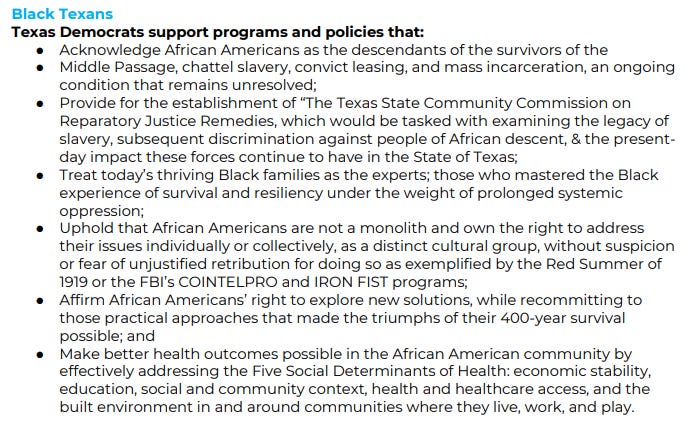
The Texas State Community Commission on Reparatory Justice Remedies.
Last week, when the Texas Democratic Party published its platform, there were several planks I said we would revisit. One of those, in particular, is for a reparatory justice commission for Black Texans. And I wanted to talk to you about this, from a historical perspective, as someone with a Bachelor’s in History who studied post-Reconstruction Texas.
The Ashworth Act was a heinous Act that they don’t teach you about in your middle school Texas history class. It ensured that Black people could never be free in the Republic of Texas. It was passed in 1840 and was part of a pattern that existed for much longer.
In 1866, after the Civil War, the 11th Texas Legislature passed Black Codes. These laws were meant to force Black labor without technically restoring slavery. Minors could be “apprenticed” to a master who could inflict corporal punishment to extract labor, with heavy fines for anyone interfering. Labor agreements lasting more than one month had to be filed with the county court, and if they didn’t show up for work, they would be sent to jail. Employers could dock wages for vague infractions such as “disobedience” or “waste of time.” And vagrancy laws allowed courts to arrest anyone deemed “idle,” fine them, and force labor if they couldn’t pay.
Convict leasing began in Texas in 1867 and didn’t end until 1910. Prison labor income was a substantial part of state revenue from 1883 to 1910. Public and press pressure forced Governor Thomas Campbell to call a special legislative session in the summer of 1910, which restructured the prison system and ended that practice.
And of course, by 1910 in Texas, hardly any Black people could vote, Confederate statues were being erected everywhere, and the Ku Klux Klan marched in every city regularly.
By the 1930s, redlining began. In Austin, the city used zoning laws to forcibly relocate minority populations to East Austin by cutting off utility services in other parts of town. In Dallas, the Home Owners’ Loan Corporation (HOLC) mapped South Dallas and areas near the Tenth Street Historic District as “hazardous.” In Houston, HOLC maps intentionally restricted Black and Tejano residents into designated “red zones,” such as the historically significant Sunnyside community. And in San Antonio, racial covenants concentrated African American and Mexican American populations primarily in the east, south, and west of the city.
“My ancestors didn’t own slaves. Why is this my problem?”
This is a common argument I see on social media from non-Black people. If you haven’t read W.E.B. Du Bois, especially if you are non-Black, you should, if you want to understand racial capitalism better. In Black Reconstruction in America, Du Bois argued that Black labor built American capitalism, and he introduced the idea of the “wages of whiteness,” the social and psychological benefits that white workers received from racial division and blocked class solidarity.
Poor white people were handed status instead of money and told that was the deal. The “psychological wage of whiteness” rewarded poor white laborers with a symbolic social status, instead of economic mobility. The social status of “supremacy,” whatever that means.

Race is the mechanism, class is the target. If a system is built to keep one group down economically, it needs the cooperation of people who don’t personally benefit either, and it buys that cooperation with status rather than wealth.
Undoing the racial wealth gap is dismantling the tool that’s kept most Texans, of every race, from building power against the people actually holding the wealth.
The numbers today.
Today, Black Americans hold 3.4% of US wealth, while white Americans hold 83.5%. Black and white Americans make up 13.7% and 57.5% of the population, respectively.
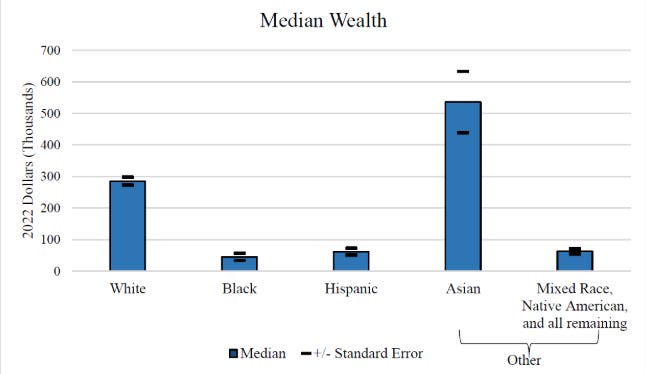
In 2022, median white household wealth was about $285,000, compared with $44,890 for the median Black household, meaning that for every $100 in white wealth, Black households held about $15.
This isn’t just a bank account problem. No equity means no cushion for a medical emergency. The same redlined, highway-demolished neighborhoods with the lowest home values also have the worst air quality and the least access to healthcare. Lower wealth means less generational ability to afford insurance, specialists, or maternal care.
Who has actually run Texas, the whole time?
Every law in this piece, the Ashworth Act, the Black Codes, convict leasing, redlining, and the freeways, was written, signed, and enforced by the same kind of man. Wealthy. White. Land owning. And in charge.
That’s not a coincidence of history. That’s the actual, uninterrupted operating system of the Texas government. Mirabeau Lamar wasn’t a random bigot who got lucky. And signing the Ashworth Act was far from his only crime. He also slaughtered dozens of Indigenous women and children prisoners. Yet, modern-day Texas history books pass him off as a “Founding Father of Texas,” a savior.
The men who leased out prisoners for profit in 1871 were “successful businessmen” with ties to the governor’s office, by design. History happened because of the people in charge. Just like on our 250th “birthday,” our current moment with our war in Iran, and our allegiance to a country that won’t stop bombing Lebanon, is happening because of the people in charge.
The vocabulary changes every few decades. It stopped saying “slavery” and started saying “states’ rights.” It stopped saying “Black Codes” and started saying “law and order.” It stopped saying “no free Black person may reside in this Republic” and started saying “voter integrity” and “urban blight.” But it’s the same coalition, protecting the same asset, which is the wealth and power of the people already holding it.
That’s the piece the “my ancestors didn’t own slaves” crowd keeps missing. You don’t need your ancestors to have personally owned anyone. You just need to have been born into a system built by people who did, and maintained ever since by their political descendants, who are still, 186 years later, wealthy white men. The oligarch. The billionaire class.
Texas has never once had to change who’s in charge to keep this going. It’s only ever had to change the language.
The Texas Democratic Party Platform.
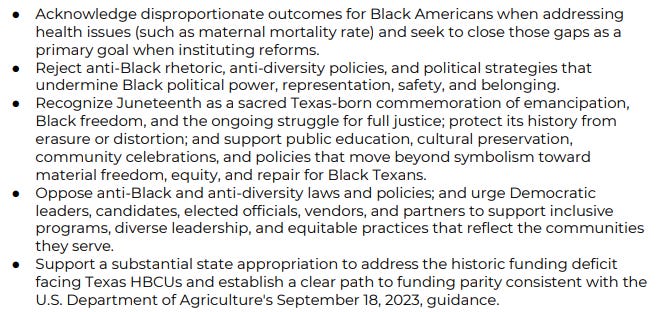
Here’s what Texas Democrats actually put in their platform:
What is this 4th of July?
Maybe it means something different to us all. Perhaps only a few of us are giving it deep retrospection, while the rest of us are like, “BBQ and beer” or even “Fuck this day.” But here we are, 250 years since a slaveholder wrote that all men are created equal, and 186 years since Texas started writing law after law proving it didn’t mean it.
The Ashworth Act. The Black Codes. Convict leasing. Redlining. The freeways. All of it signed by the same kind of man, all of it protecting the same thing. That’s a system that worked exactly as designed for nearly two centuries.
A commission to examine that record isn’t asking Texas to apologize for its birthday. It’s asking Texas to open the books. To look at the injustices that were committed over decades and centuries, and to identify those injustices and how it still impacts some communities today.
You don’t have to have owned anyone to have inherited a system built by people who did, and maintained by their political descendants ever since. That’s not guilt. It just means you live in a state that has yet to reckon with its own crimes.
America turns 250 today. And America’s record is exactly why I support a reparatory justice commission for Black Texans, and why I think you should, too. A commission is an investigation into the wrongs committed, especially by our government, and it’s long past time.
Texas still owes us the truth.
Click here to find out what Legislative districts you’re in.
LoneStarLeft is a reader-supported publication. To receive new posts and support my work, consider becoming a free or paid subscriber.
I have a history degree and I’m 6th generation Texan, and I never, ever heard of that Ashworth bullshit.
Thank you for writing today ♥️🇺🇸✌🏻
Reparations need to happen. It’s odd when someone suggests this the backlash is vitriolic.