

Obviously, this is a new series. We did the same series in 2024. We got 11 counties(ish) in before the election. So, for the rest of the summer and up until the November election, we’ll look at some of the biggest counties in Texas, the data, and what it’s going to take for Democrats not only to pull off a win there, but also statewide.
If you missed the last installment:
One in ten Texas Democrats lives in Dallas County, so heavy turnout here is a must. Not only that, but Democrats have flipped nearly every seat left running through the Big D. The only few seats they have left to flip are:
The gerrymandered pieces of TX05, TX06, and TX24 (at least two of these seats are flippable this cycle)
Small gerrymandered pieces of SD02 and SD12. SD02 is flippable this cycle.
HD108 and HD112, both flippable this cycle.
Dallas County has been quietly doing the work for years. In 2026, it is time to get loud about it. When Dallas turns out at scale, the statewide map shifts. When Dallas underperforms, Talarico and Hinojosa are explaining at midnight why Texas almost happened instead of watching Texas happen.
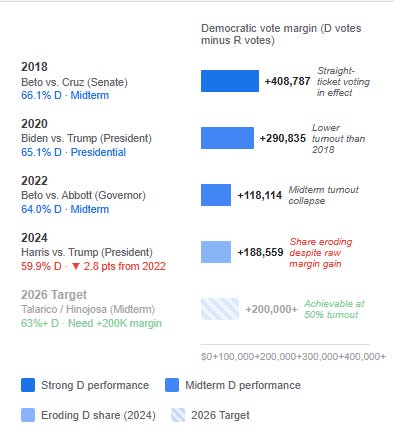
Here is the baseline. In 2024, Dallas County delivered 511,027 votes for Kamala Harris. She won the county 59.9% to 37.8%, a margin of 188,559 votes.
It is better than Beto O’Rourke’s 2022 gubernatorial margin of 167,950. And yet the Democratic share of the vote dropped 2.8 points from what Beto pulled in 2022. In 11 of 14 Dallas County House districts, Harris ran behind Beto’s gubernatorial performance. Every. Single. District. Swung negative.
The margin improved because more people voted in a presidential year. The county got more Democratic votes but became a structurally less reliable Democratic county.

Here is what it means for November. Dallas County has nearly 1.47 million registered voters. In 2022, midterm turnout hit 44%. If 2026 midterm turnout reaches 50%, which is achievable with real organizing work, that is 73,000 additional ballots, most of them in precincts that run 65-80% Democratic. That math does not work out for Ken Paxton.
The bleeding cannot continue.
We have to talk about what has been going wrong, because pretending otherwise is how Democrats keep losing races they should win.
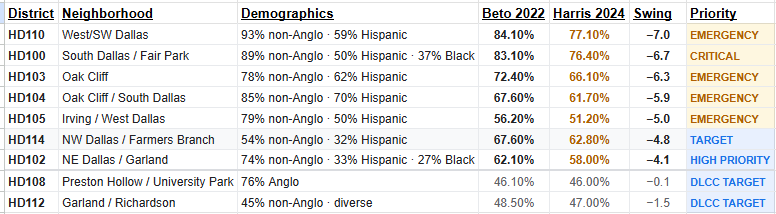
The worst numbers in Dallas County are in the working-class Hispanic communities of Oak Cliff, West Dallas, and Irving. HD110, covering communities south and west of downtown, went for Beto by 84.1% in 2022. Harris pulled 77.1% in 2024. That is a 6.9-point collapse in a district that is 93% non-Anglo and over 58% Hispanic. HD100 in South Dallas and Fair Park dropped 6.7 points. HD103 in Oak Cliff dropped 6.3. HD104, which is over 70% Hispanic, dropped 5.9.
Nobody in South Oak Cliff became a Republican. What happened is the same thing that happened in the Rio Grande Valley and in East Harris County’s Pasadena corridor. Working-class Hispanic voters stopped seeing the Democratic Party as theirs. They stayed home and didn’t vote. And when you are running 49.5% turnout in precincts that should run 65%, you are leaving hundreds of thousands of potential Democratic votes on the table every election cycle.
This is fixable. But it is not fixable with just an October Spanish mailer. It requires year-round presence, kitchen-table economic messaging, and showing up in these communities when there is no election. Irving’s Beltline Area Democrats have named their own territory as “one of the largest precinct deserts in Dallas County.” That is a problem with a solution, and the solution is showing up.
The Texas House seats we can flip.
The DLCC just put two Dallas County seats on its official target list. That is national money, research, polling, and paid communication flowing into North Texas suburban races that have been competitive for years without ever quite breaking through.
HD108: Morgan Meyer vs. Allison Mitchell.
HD108 covers University Park, Preston Hollow, and the northwest Dallas corridor. Morgan Meyer has held this seat since 2014, surviving every wave of Democrats that have been thrown at him. Harris ran 46% here in 2024. That is within striking distance in a wave environment, and Paxton is dragging down the top of the Republican ticket.
The college-educated women in this district have been the story for years. Reproductive rights, public education, and the general direction of the Republican Party under Trump have been moving these voters toward Democrats across multiple cycles. Meyer has outperformed his party at the presidential level every cycle he has been on the ballot.
HD112: Angie Chen Button vs. Zack Herbert.
HD112 covers Garland, Richardson, and the northeast suburban corridor. Button has held this seat since 2018. Harris ran 47% here in 2024. The district is 45% non-Anglo and is becoming more diverse with each cycle. Button, like Meyer, has consistently outperformed her party’s presidential margin. Unlike Meyer, her district’s demographic shift runs directly counter to the Republican base.
The DLCC named both seats for a reason. These are the two most flippable Republican House seats in Dallas County. Flip them both, plus hold every current Democratic seat, and you are a meaningful chunk of the way to the 14 seats Democrats need for a Texas House majority.
The seats we need to hold.
There are also Dallas-area Democratic seats that require active defense. Mihaela Plesa in HD70, which is technically in Collin County but part of the greater Dallas political ecosystem, is on the DLCC’s defensive watch list. She has held a competitive seat since 2022 and will face a real race again.
Meanwhile, CD30 has a new face. Jasmine Crockett is out, and Pastor Frederick Haynes III won the Democratic nomination for her old seat. CD30 is a safe Democratic territory, but new representation means new constituent relationships. A strong Haynes race helps the entire South Dallas turnout operation.
CD33 brings Colin Allred back to North Texas. Allred defeated Rep. Julie Johnson in a contentious Democratic runoff that got ugly. They need to be unified by November. Allred is a known commodity in Dallas County and brings his own organizational muscle to the race. A Allred victory in CD33 contributes to Democratic turnout infrastructure across the county.

SD02: The sleeper race on Dallas County’s doorstep.
SD02 does not get talked about enough, and that needs to change.
The district runs from a slice of Dallas County through Rockwall and Kaufman counties and out into East Texas. The Dallas County portion is majority-minority, 64% non-Anglo, over a third Hispanic, and runs solidly Democratic. The rest of the district is growing Dallas exurb territory full of suburban commuters, homeowners, and parents of school-age kids who care about property taxes and school funding more than they care about Bob Hall’s brand of reactionary MAGA politics.
Bob Hall has held this seat since 2014. He voted against Medicaid expansion, opposed school funding reform, and has spent eleven years being one of the most reliable culture-war votes in the Texas Senate. None of that history means he is safe in this environment.
Keenen Colbert is the Democratic nominee. He is a Marine Corps veteran, a first-time candidate, and the kind of person who walks into rooms Republicans thought were theirs.
The math backs it up. In 2024, SD2 had only 64.3% turnout in a presidential year. That is an enormous pool of non-participating voters in a district where the Dallas County base, the growing Latino communities in Kaufman County, and younger suburban voters are exactly the people least likely to show up without a serious ground game pushing them. This is a possible flip in a wave year. Colbert is the right candidate. Make sure Dallas County voters in SD2 know he exists.
TX05 and TX24: The gerrymandered pieces Democrats can crack.
Republicans drew these districts to be safe. In a normal cycle, they probably are. This is not a normal cycle.
TX05 is Lance Gooden’s seat. The new 2025 map pushed it southeast, taking in Mesquite, southern Garland, Lake Highlands, Kaufman County, and East Texas beyond. Trump won it 60.1% to Harris’s 38.6% in 2024. The Dallas County precincts inside TX05 are the competitive portion; the Lake Highlands and Lakewood neighborhoods, which have been trending Democratic for years, run meaningfully better than the district’s overall number. Chelsey Hockett won the Democratic primary runoff and will face Gooden in November. In a wave environment with Paxton dragging down the ticket, the Dallas County precincts of TX05 are where Hockett has to run up her margins to put pressure on the overall number.
TX24 is Beth Van Duyne’s territory. The district covers Irving, Grapevine, Colleyville, Southlake, and Richardson, and spills into Dallas County along the Irving corridor, where Van Duyne is the former mayor. Trump carried the redrawn CD24 57% to 41%. Kevin Burge is the Democratic nominee. The Dallas County and Irving portions of TX24 are where Democrats have to perform. As you read above, Irving ran 51.2% Harris in 2024 at the state House level.
Both TX05 and TX24 have Dallas County precincts in play, with Republican incumbents facing a harder environment than they have seen in years, and both races matter for the margin math. Running up the score in the Dallas County portions of these districts is how you build the overall Dallas County margin Talarico and Hinojosa need.
What it will actually take.
Here is what actually moves the number in Dallas County.
Turnout is everything else. Dallas County has nearly 1.47 million registered voters. The difference between a decent Democratic night and a great one is activation. The people who need to vote in November already largely agree with us. They are sitting in precincts that run 75-85% Democratic, and they did not vote in 2022. Their turnout of 32-44% is an indication of organizational neglect. Fix the neglect, and the votes follow.
The precinct chair infrastructure is the backbone. Dallas County just reduced its precincts from 885 to 791 due to the 2025 congressional redistricting. Of those 791 precincts, the DCDP’s own Precinct Chair Matters committee has publicly acknowledged significant vacancy gaps, particularly in South Dallas, Oak Cliff, Irving, and the southeast corridor. Half the county’s precincts may have no one whose job is to talk to their neighbors before November. Republicans will have someone in every one of those precincts. That asymmetry costs Democrats votes.
If you live in Dallas County and your precinct does not have a chair, that is your job now. The application is at dallasdemocrats.org.
The Hispanic vote is the variable that changes everything. The 2024 rightward drift among Hispanic voters in Dallas County was real. It was also concentrated in specific working-class communities that have material grievances that the Democratic Party has not adequately addressed. Trump’s second term has been doing the persuasion work that no campaign ad could. ICE raids in Oak Cliff, deportation fears in Irving, tariff-driven price increases at every grocery store in Pleasant Grove. Polling shows Hispanic voters swinging back hard to the left nationally. Dallas County’s numbers should follow, but only if the party shows up in these communities with consistent year-round organizing.
The top of the ticket drives everything down the ballot. Talarico and Hinojosa are not just running for Senate and Governor. They are the engine of Dallas County Democratic turnout. Every door knocked for Talarico in Irving is a door knocked for Terry Meza in HD105. Every phone bank shift for Hinojosa in Oak Cliff helps every down-ballot Democratic candidate in that precinct. The races are connected. The infrastructure is shared. A rising tide in Dallas County lifts every boat on the ballot.
The 2018 model showed what is possible when candidates, infrastructure, environment, and turnout come together. We came within three points of making history statewide. The environment in 2026 is better. The candidates are stronger. The organizational infrastructure is more developed than it has been in years.
The only question is whether Dallas County shows up at scale.
Ken Paxton’s gift to Dallas Democrats.
Ken Paxton is the Republican nominee for US Senate. He is also an impeached former attorney general who survived his own party’s removal effort on the thinnest of margins, a man who spent years under federal criminal indictment, and a candidate who is currently underwater in the polls against Talarico in a state Republicans have carried for president since 1976.
In Dallas County, where college-educated suburban voters in Preston Hollow and University Park have been trending toward Democrats for a decade, Paxton at the top of the Republican ticket is a gift. Morgan Meyer in HD108 cannot outperform Donald Trump by enough points to overcome Ken Paxton, who is dragging down the entire Republican brand in suburbs where accountability and the rule of law are supposed to mean something.
Paxton spent years using the powers of the Texas Attorney General’s office to pursue personal vendettas, help his political patrons, and allegedly commit the crimes he was accused of committing. Dallas County voters know his record. The ones who have been ticket-splitting toward Democrats while holding their noses and voting for Trump have now run out of excuses.
Every Republican in Dallas County is running with Paxton’s name above theirs on the ballot. Democrats should make sure every voter knows it.
Texas flips because neighbors talk to neighbors until the people writing the laws finally look like the people living under them.
Dallas County is ready. Show up.
Click here to find out what Legislative districts you’re in.
LoneStarLeft is a reader-supported publication. To receive new posts and support my work, consider becoming a free or paid subscriber.
Exactly what voteCD5 blue.org is all about. This is it. This is the blueprint. This is what we are going to make happen. We need funds. If we get funded, we can do it. Please take a minute and look at our website.
Thanks, Michelle! I just shared this to bsky. We've got a lot of work to do here in Dallas County!!! Fortunately we've got some great candidates!!! It's up to us!