


If you think this story is about what happens when bad Republican governance, corporate loyalty, and climate denial collide in Texas, you’re completely right. And how Greg Abbott’s love of billionaire money may turn one Texas town into the very first American city forced to evacuate because of climate change.
If you haven’t heard, Corpus Christi is running out of water, and according to a new report, it may run out as soon as next year, prompting citywide evacuations.
Of course, this led to a spectacular display of Abbott’s fine leadership skills of finger-pointing.
You’re wondering, how did Corpus Christi get in this situation? And why is it Republicans’ fault? Well, for decades, Corpus Christi’s water system was built around three reservoirs, Lake Corpus Christi, Choke Canyon Reservoir, and Lake Texana. Water from those lakes travels through the Mary Rhodes Pipeline to the city’s treatment plant, where it is cleaned and delivered to homes and businesses across the region.
For a long time, that system worked just fine. But the system was built for the economy Corpus Christi used to have, not the one Texas leaders later decided to build.
Over the last two decades, Corpus Christi has transformed into one of the largest petrochemical and oil export hubs in the United States.
Of course, fossil fuels. It’s Texas. Does it ever go any other way?
But the water system never caught up. The reservoirs and pipelines that once supplied a coastal city now have to support refineries, plastics plants, steel mills, and liquefied natural gas terminals.
And they were never designed for that.
When the shale boom hit Texas, the Gulf Coast became the most logical place to refine oil and gas and ship them around the world.
The Shale boom filled Corpus Christi with refineries, petrochemical plants, steel mills, LNG facilities, and export terminals. Billions of dollars poured into the region as the Port of Corpus Christi transformed into one of the largest crude oil export hubs on the planet.
For Texas politicians, this was economic growth, global energy markets, and endless press releases about the state being “open for business.” There’s a deep dive to be had on how many backroom deals Todd Hunter could be linked to.
But all of those industries require enormous amounts of water.
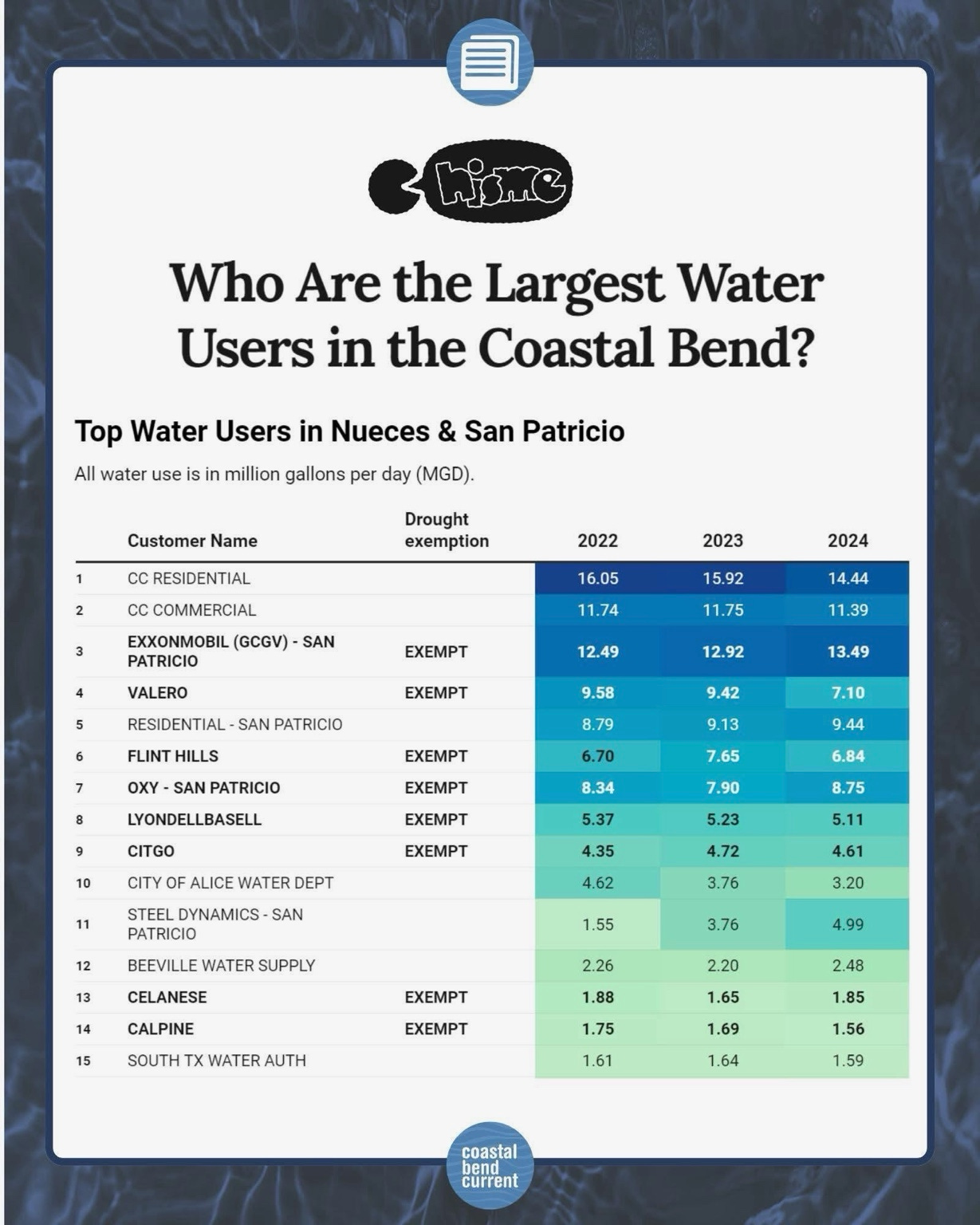
By 2018, industry already accounted for about 40% of the region’s water use.
And isn’t that just like Texas Republicans? The fossil fuel industry comes before everything, even the water of an entire city.
In 2016, Governor Abbott recognized there was a problem and traveled to Israel, where he toured one of the world’s largest desalination plants and met with officials to discuss desalination technology. Israel has spent decades building massive desalination systems because it lives with chronic water scarcity.
At the very same time, industry groups and political leaders in the Coastal Bend were beginning to push desalination as the long-term solution to support the region’s exploding industrial growth.
I think it’s important to recognize that this “water crisis” has been brewing for a long time, and Republican leadership of this state appears to have known about it for at least a decade.
They knew Corpus Christi would eventually need new water sources.
Never once did they slow down fossil fuel expansion until the water system caught up. They just did as Texas always does. Someone’s palms got greased, Abbott’s campaign for re-election got a little heavier, and hundreds of thousands more people will die of climate change because of it. Plus, if Corpus Christi doesn’t find a solution soon, we may be walking into the first city in America to be evacuated due to climate change.
But first, I want to explain how Corpus Christi got in this clusterfuck to begin with, because it’s not a simple overnight problem with a simple, overnight fix.
In March 2017, Corpus Christi city leaders sent a letter to ExxonMobil reassuring the company that the city had sufficient water supplies to meet its future needs. (They lied.) Then came the largest petrochemical investments the region had ever seen.
Six days later, the city asked the Texas Water Development Board for funding to study the feasibility of building a desalination plant.
Yep.
On one hand, city officials were telling one of the largest oil companies on Earth, Don’t worry, we’ve got the water.
On the other hand, they were going to the state, asking for help and figuring out how to create an entirely new water supply.
In 2018, Corpus Christi promised an additional water supply to Steel Dynamics, which later built a massive steel mill in the region. Another major industrial project. Another long-term water commitment.
And remember, all of this was happening before the city had secured a new water source.
Corpus Christi was doing everything it could to ensure the region remained stable and attractive for major industrial investment, even as long-term water supply questions remained unresolved.
The first desalination plan.
By 2019, City staff told the Corpus Christi City Council that water demand was about to jump sharply due to industrial projects already approved and under construction along the coast. The solution on the table was desalination.
The City Council voted unanimously to move forward with the project.
But that’s where the momentum ended. Over the next several years, the desalination plan became bogged down in political infighting, regulatory delays, environmental disputes, and disagreements over who should build and operate the plant.
Meanwhile, the clock kept ticking.
The industrial projects expected to drive water demand were already underway.
By 2022, the Gulf Coast Growth Ventures plastics complex began operations just outside Corpus Christi. The facility is a joint venture between ExxonMobil and the Saudi state oil company SABIC, and it is one of the largest petrochemical plants in the United States. Almost immediately, it became the single largest water consumer in the region.
According to reporting from Inside Climate News, the facility uses roughly as much water as all the residents of Corpus Christi combined.
And the desalination plant that was supposed to help support this surge in industrial demand? It was never built.
Then, 2023 became the hottest year on record in Texas, and the drought already stressing South Texas reservoirs only worsened. Water levels in Lake Corpus Christi and Choke Canyon kept falling as the heat dragged on month after month.
And right when the region needed decisive action the most, the desalination plan that was supposed to solve the problem turned into a political brawl.
Environmental groups raised concerns about the impact desal plants could have on the coastal bays and estuaries. Scientists questioned some of the engineering assumptions being used in project proposals. Activists organized against what they saw as a massive expansion of petrochemical infrastructure along the coast.
At the same time, the Port of Corpus Christi and the city government were fighting over competing desalination projects, each with different locations, different operators, and different political allies.
Meanwhile, the thing everyone had been warned about years earlier kept happening in the background. Industrial water demand kept rising. The refineries kept running.
The plastics plants kept producing. The port kept expanding. And the water system was still trying to catch up.
Costs explode.
By 2024, the estimate jumped to $550 million. Then it climbed again to $760 million. And by July 2025, the project’s projected cost had ballooned to roughly $1.2 billion.
The project suddenly looked like one of the most expensive water projects in Texas.
Political support collapsed almost as quickly as the price tag grew.
Council members who had once supported desal began backing away. Residents balked at the cost. The entire project became radioactive in local politics.
And once again, the clock kept ticking.
The industries that had driven the surge in water demand were already operating.
The water supply that was supposed to support them was still stuck in political limbo. Again.
By December 2024, combined storage in Lake Corpus Christi and Choke Canyon fell below 20 percent capacity, triggering Stage 3 drought restrictions across the region.
But while households were tightening their faucets, the massive industrial complex surrounding Corpus Christi kept operating as usual even as the water system that supported it began to run dry.
In September 2025, the Corpus Christi City Council voted to cancel the desalination project. By that point, the estimated cost had climbed to $1.2 billion, and the political appetite to move forward had completely collapsed.
Experts began warning that Corpus Christi could reach a water emergency as early as late 2026.
After years of delays, the region had finally run out of time.
City leaders began rushing forward with a patchwork of smaller projects designed to buy time.
Groundwater wells along the Nueces River
Pumping from the Evangeline Aquifer
Water reuse projects that recycle treated wastewater
And, once again, new proposals for desalination
Water infrastructure is not something you can build overnight. Even under ideal conditions, major projects take years of permitting, construction, and engineering work before they deliver meaningful supplies.
Even though these city council seats are listed as non-partisan, you better believe it’s Republicans making all these bad decisions, just like in our state government, and like with Greg Abbott. The GOP and bad governance go hand in hand.
Any of the projects now being rushed forward won’t produce significant water until well after the current shortage arrives.
After a decade of delay, Corpus Christi is now trying to solve a long-term water crisis on emergency time.
Lake Corpus Christi and Choke Canyon are hovering around 9–10 percent capacity. The city is already operating under Stage 3 drought restrictions, which means aggressive conservation rules are in place across the region.
According to the city’s own projections, Corpus Christi could enter a Level 1 Water Emergency within months. That threshold is the point at which the water supply is projected to fall short of demand within 180 days.
In other words, the system starts running out of room.
Without significant rainfall, the outlook gets even worse.
After years of warnings, delays, political fights, and industrial expansion, the water crisis that everyone said was coming is here.
Corpus Christi is what happens when an entire political system is built around fossil fuels, corporate loyalty, and climate denial.
Republicans spent years bragging that Texas was “open for business.”
What they never bothered to ask was whether Texas actually had the infrastructure to support that business.
When reactionaries run the government, planning stops. Their entire political worldview is reactive. They don’t solve problems before they happen. They don’t act until everything is on fire and start pointing fingers.
If Texans want to stop this from happening again, it starts with holding the politicians responsible. Vote them out. Demand real water planning. Demand climate reality. Because the next city running out of water might not be Corpus Christi, it might be yours.
April 2, 2026: Last day to register to vote (City elections)
April 20, 2026: Last day to apply to vote by mail (City elections)
April 20, 2026: First day of early voting (City elections)
April 27, 2026: Last day to register to vote (Democratic primary runoff elections)
April 28, 2026: Last day of early voting (City elections)
May 2, 2026: Last day to receive ballot by mail (City elections)
May 2, 2026: Election day! (City elections)
May 15, 2026: Last day to apply to vote by mail (Democratic primary runoff elections)
May 18, 2026: First day of early voting (Democratic primary runoff elections)
May 22, 2026: Last day of early voting (Democratic primary runoff elections)
May 26, 2026: Last day to receive ballot by mail (Democratic primary runoff elections)
May 26, 2026: Election day! (Democratic primary runoff elections)
Click here to find out what Legislative districts you’re in.
LoneStarLeft is a reader-supported publication. To receive new posts and support my work, consider becoming a free or paid subscriber.
Follow me on Facebook, TikTok, Threads, YouTube, and Instagram.
This day was coming. And these kinds of foreseeable and preventable emergencies are going to keep coming. Think of what would be in store for the people Abilene with the data center going in there. Snowmaggedon was a major hint about what is out there regarding the electric grid and its reliance on a for-profit model to provide for this life and death service.
OMG. We need a Human Right to Water law yesterday! I bet a million 💸 the corporations get to keep their production going while the citizens of corpus will be buying bottled water and skipping showers. This is nuts.
Maybe water will prove to be a bridge issue: when MAGAs run out of drinking water will they turn woke?🤷♀️