

The deadline to register to vote in Texas is October 5. If you are not registered to vote by then, you will not be able to vote in this upcoming election.
Check if you are registered to vote HERE.
With everything Republicans have done this year, between the recent “oops” at DPS and new “voter roll cleaning” laws disguised as purges, it’s always a good idea to check your voter registration status in Texas anyway. I know some people who check their registration every week.
Texas is the hardest state in America to vote in.
Today, we blame Bettencourt, Paxton, Abbott, maybe even Perry and Rove, if you want to go back far enough. But in the Lone Star State, there’s a long history of white men changing laws to make voting harder.

Texas’ first real voter registration came in 1867.
The US Army ran it under the Reconstruction Acts, and it signed up thousands of freedmen. Every county got a Board of Registration. Nearly 40,000 Black Texans voted to hold the constitutional convention that followed.
When Democrats retook the state, voter registration was on their list of things to abolish. The Constitution of 1876, which Texas still operates under today, prohibited voter registration (Article 6, Section 4). Ironic, huh? It’s the same section you’ll find the “purity at the ballot box” line that Briscoe Cain got in trouble for in 2021.
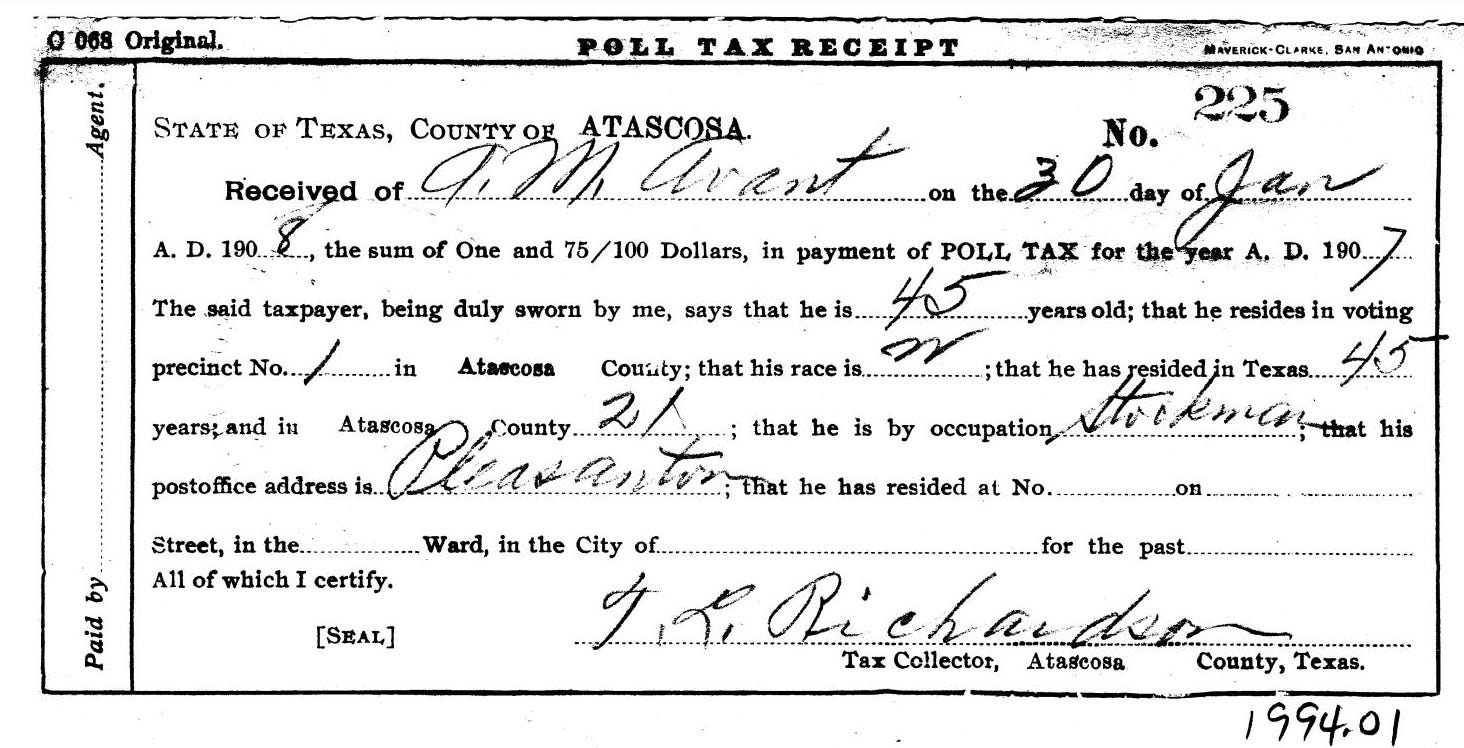
Then came the real registration system. It was from the poll tax. You had to register to vote and pay poll taxes. Texans wrote it into the constitution in 1902, and it was Alexander Watkins Terrell’s legacy.
Confederate traitor and Texas lawmaker, Alexander W. Terrell spent his legislative career calling for the disfranchisement of Black Texans. He first filed a bill to make the poll tax a voting requirement in 1879, and it took him 24 years to see it enforced under his 1903 election law. After that, Texas had no separate voter registration. Paying the tax proved your age, citizenship, and residence, and the receipts became the list of qualified voters. The tax was due by January 31, nine months before a November election. That was Texas’s first statewide registration deadline.
When the poll tax started to look vulnerable, the Legislature bought insurance. In 1949, lawmakers asked voters to drop the poll tax requirement and, just in case, passed a general registration law that would take effect only if the poll tax was repealed. Voters kept the poll tax, 172,284 to 133,550. Texas wrote statewide voter registration as the poll tax’s backup.
When courts struck down the poll tax in 1966, the November 1966 amendment wrote annual registration straight into the constitution. Every voter had to re-register every year during a four-month window that closed nearly eight months before the general election. A federal court struck that down in 1971. Then in 1975 the Legislature passed SB300, which expired every voter registration in the state on March 1, 1976. Voters got a new application in the mail, and to keep voting, they had to return it by January 31. That was the same date the poll tax used to be due.
Today your application has to be in at least 30 days before the election, the strictest deadline federal law allows. Texas is one of only eight states without universally available online registration, and Republican state lawmakers have spent years resisting it.
Why do you have to register at all?
Federal law doesn’t make you. North Dakota doesn’t require formal voter registration. You show an ID with your name, address, and date of birth, and getting that ID requires proof of citizenship. Federal law only requires election officials in every state to verify each voter’s identity and eligibility, including citizenship, and to require registrants to provide a driver’s license number or the last four digits of their Social Security number. Everything else is a choice Texas makes.
For the 2026 election, 46 states and DC offer at least one of three modern options, online registration, same-day registration, or automatic registration. Texas offers none. Neither do Arkansas, Mississippi, or South Dakota.
It’s not like nobody tried. In 2011, the Texas House passed online voter registration with one vote against it. It died when a Senate committee never took it up. In 2015, 76 House members co-authored a similar bill, a majority of the chamber. It got killed after the Harris County clerk and tax assessor-collector, both Republicans at the time, rallied opposition by claiming it would invite fraud. In 2023, lawmakers filed 10 online registration bills, and Republicans didn’t give a single one a hearing, the fourth session in a row. In 2025, House Bill 311 finally got the first hearing in a decade. The hearing came after the bill’s deadline to become law.
Automatic voter registration would be simple. When you get or update a driver’s license, the agency electronically sends your information to election officials unless you opt out.
Twenty-four states and DC do it. Georgia started in 2016 under Republican Gov. Nathan Deal. Alaska adopted it by ballot measure. West Virginia has it. Five of the governors who adopted it were Republicans.
According to the Center for Election Innovation & Research, monthly new registrations jumped 78%. The active registration rate climbed 20 points, a full 10 points above the national average. Inactive records on the voter list fell from 14% to 5%. Corrections to voter records rose 520%, mostly address updates for people who moved.
Of course, registration isn’t turnout. But you can’t vote if you’re not on the list, and in a low-turnout state, organizing starts with getting people on the list.
Texas has already built most of the pipe. More than 6 million voters have registered through the DPS license portal since it launched in 2020, and DPS requires proof of citizenship and keeps copies on file. AVR would make that process automatic, electronic, and audited, instead of the batch system that lost a year’s worth of applications.
When Democrats flip the Texas House in November, we have to pressure them to pass automatic voter registration.
Yes, I’m saying “when.” I’m manifesting. Roll with me. But automatic voter registration isn’t the only thing that needs to happen to turn us from the worst voter turnout state to the best.
We need online registration.
Same-day registration.
Pre-registration at 16.
Undo SB1, the 2021 voter oppression law.
No-excuse mail-in voting.
Laws to protect voter rolls.
Restore voter rights to people on parole and probation.
End gerrymandering.
It won’t be easy to do all of it. As we talked about earlier this week, we’re unlikely to flip the Senate, and the Lt. Governor’s race is still a toss-up. But we’re closer than ever.
The best thing we have going for us right now is that, as much as Republicans are hated in 2026, think about how much that will be magnified in 2028. At the rate MAGA is headed, the Grand Old Party is headed toward extinction like the Whigs or the Federalists.
Check. Then Check Again.
Go HERE and check your registration. Then check your spouse’s. Your adult kids’. Your parents’. The college kid who swears they registered at orientation. Anybody in your house who moved this year, renewed a license online through DPS, or got one of those letters from the county. It takes one minute per person. Texas made registering hard on purpose. Checking is the easy part.
If you’re not on the list, don’t panic, and don’t wait. Print a voter registration application and hand-deliver it to your county voter registrar by Monday, October 5, or mail it with a postmark no later than October 5. Hand delivery is safer. You’ve read this far, so you know how Texas feels about paper.
If you moved, update your address by the same deadline.
If you registered through the DPS portal and you’re not showing up, you may be one of the thousands of Texans DPS never sent to their county. Call your county voter registrar now. State officials say anyone left off the rolls because of the DPS error can still cast a provisional ballot. Don’t let them turn you away without one.
Then vote. Early voting starts October 19. Election Day is November 3.
For 150 years, every law in this story was written by people counting on you to stay home. The poll tax, the white primary, the annual re-registration, the 30-day cutoff, the purges. Fewer voters, safer seats.
The Senate race is within the margin of error. Nearly 10 million registered Texans sat out the last midterm. Texas was never a red state. It’s a state where people don’t vote.
We don’t fix any of this with a better argument. We fix it by showing up in numbers they can’t purge, can’t gerrymander, and can’t explain away. November 3. Bring your whole house.
34 days until the November election!
Last Day to Register to Vote: October 5, 2026
First Day of Early Voting: October 19, 2026
Last Day to Apply for Ballot by Mail: October 23, 2026
Last Day of Early Voting: October 30, 2026
Election Day: November 3, 2026
Did you know you can find links to all the previous Meet the Candidate articles on these lists?:
Click here to find out what Legislative districts you’re in.
LoneStarLeft is a reader-supported publication. To receive new posts and support my work, consider becoming a free or paid subscriber. Or buy me a coffee.
Follow me on Facebook, TikTok, Threads, Bluesky, YouTube, and Instagram. Or join my Facebook Group.
Love the Stepford broads huddled behind Representative Pipsqueak. They can't do anything without each other.