


What’s unfolding in Tarrant County is a demonstration of how fragile ballot access is in Texas. And how quickly “election integrity” becomes a weapon once Republicans decide they don’t want anyone else voting.
In the span of a week, the Tarrant County Republican Party moved to disqualify Democratic candidates from the primary ballot by invoking technical provisions of the Texas Election Code. The Tarrant County Democratic Party responded by applying those same standards to Republican filings, citing identical legal requirements and the same claim of strict compliance.
This moment was triggered when the Republican Party, led by Chair Tim Davis, moved to disqualify Democratic judicial candidates over filing defects while casting itself as the sole guardian of lawful elections.
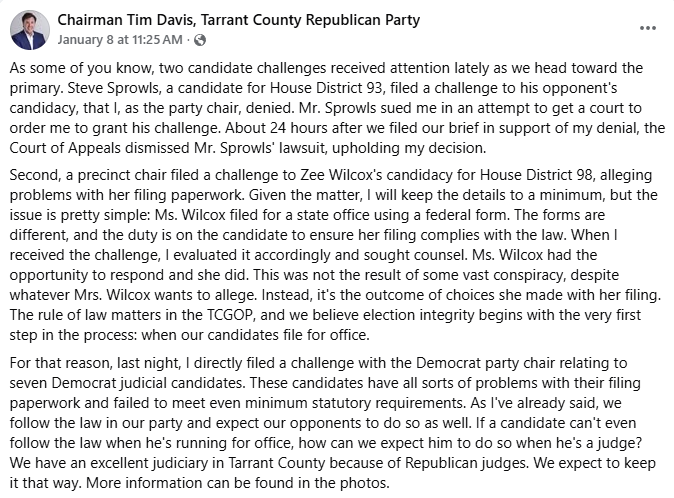
This exposes is a filing system so technical and unforgiving that it can be weaponized, selectively enforced, and escalated into partisan warfare.
Tim Davis started it.
This is the so-called genius who replaced Bo French. No relation.
On January 7, 2026, Tarrant County Republican Party Chair Tim Davis filed formal administrative challenges to the ballot applications and petition filings of seven Democratic judicial candidates. The challenges were transmitted directly to Tarrant County Democratic Party Chair Allison Campolo, invoking the Texas Election Code provisions governing candidate eligibility and ballot access.
In his filing, Davis asserted that this duty required strict enforcement. The Republican Party’s press release framed the challenges as a matter of basic legal competence. It cited alleged defects, including missing petition headers, incomplete circulator affidavits, insufficient valid signatures, duplicate or ineligible signers, and missing disclosures related to judicial experience.
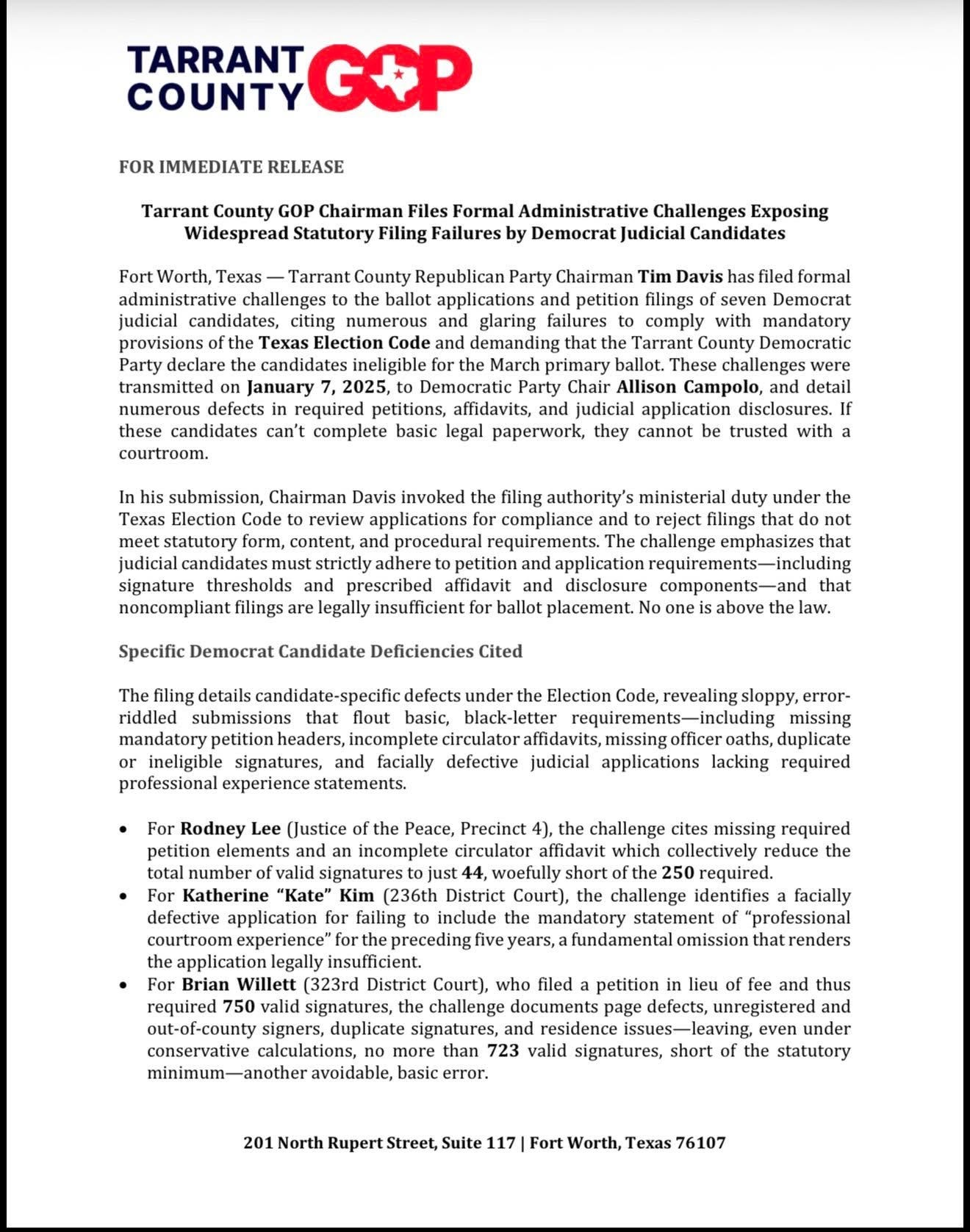
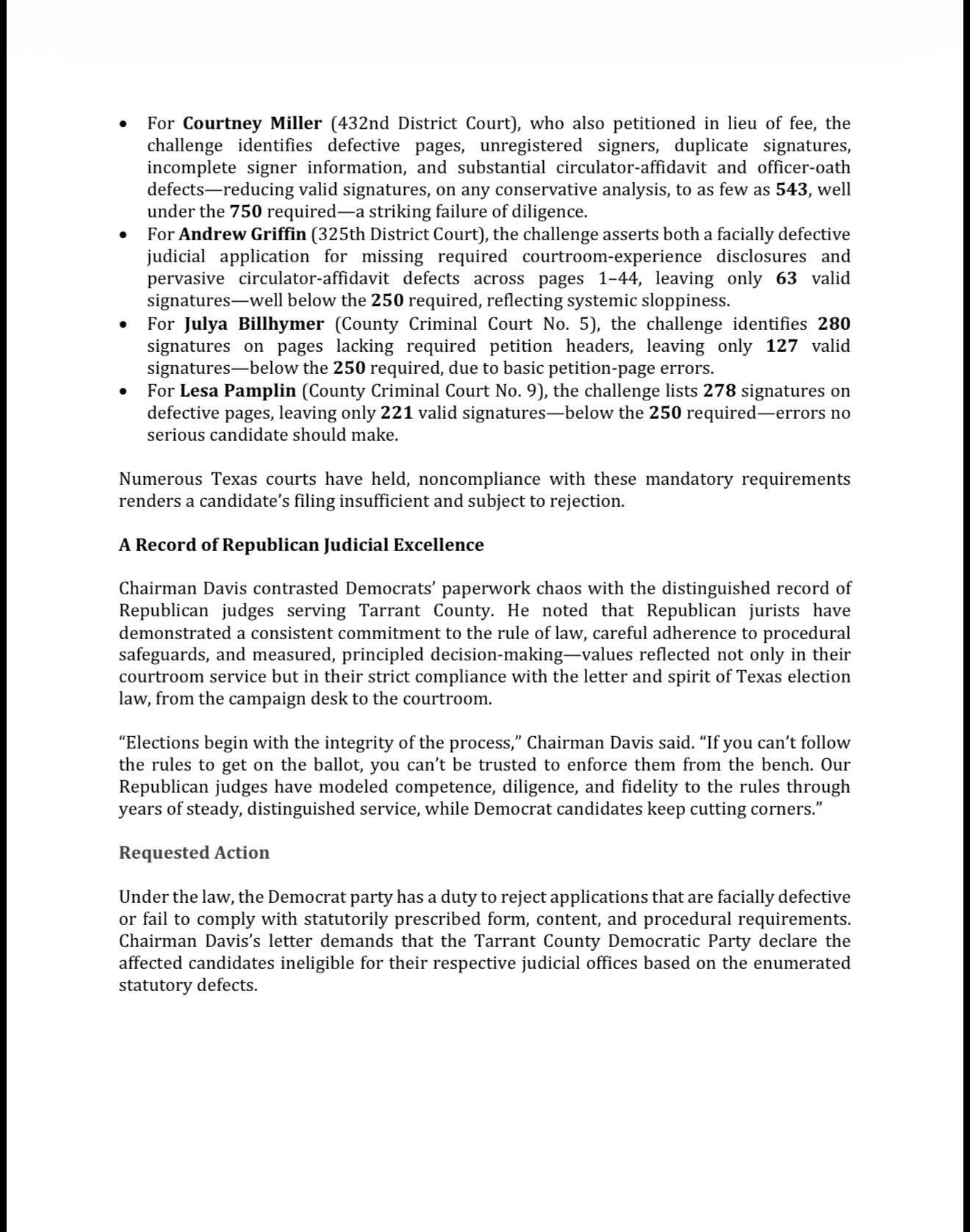
Davis demanded that the Tarrant County Democratic Party declare the seven candidates ineligible for the March primary ballot, citing what he described as facially defective filings and legally insufficient petitions under Texas law.
The Tarrant County Democratic Party responded.
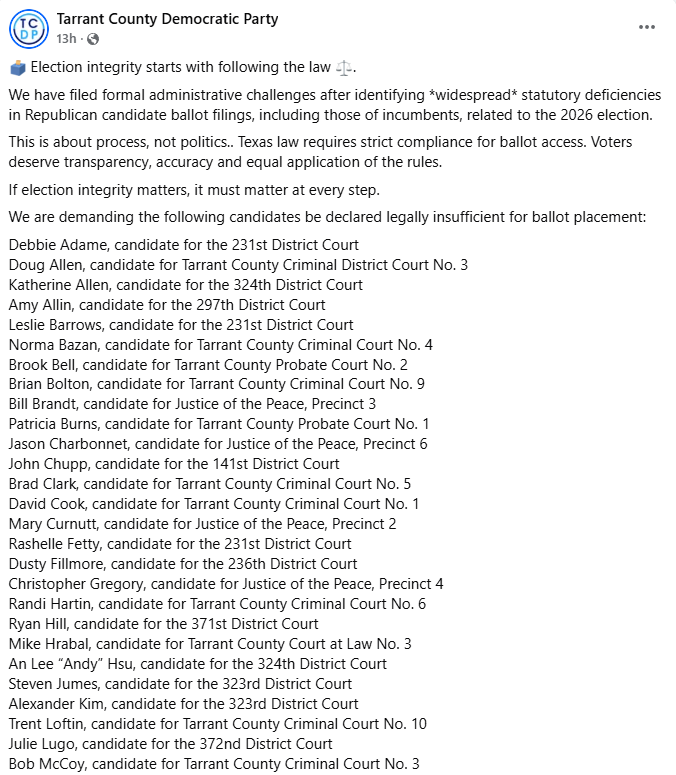
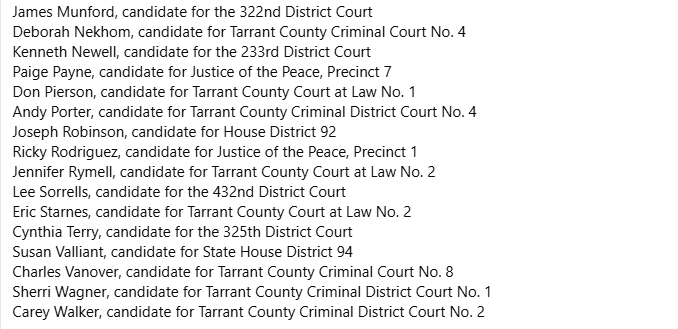
On January 12 and 13, the Tarrant County Democratic Party filed formal administrative challenges to the ballot applications and petition filings of dozens of Republican candidates, including incumbents, across judicial and legislative races.
43 candidates to be exact.
The filings were submitted to the Tarrant County Republican Party filing authority, Chair Tim Davis, pursuant to the same Texas Election Code provisions cited in the earlier Republican challenges.
Like the GOP action before it, the Democratic Party’s filing invoked the filing authority’s ministerial duty to review candidate applications for statutory compliance and to reject filings that fail to meet required form, content, and procedural standards. The challenges assert that Texas law requires strict compliance and that filings that do not meet those requirements are legally insufficient for placement on the ballot.
The scope of the Democratic filing was significantly broader. The filing emphasized that these deficiencies rendered entire petition pages invalid under Texas law, resulting in signature counts that fell below statutory minimums.
But the substance of the Democratic allegations diverged sharply from the Republican framing. The challenges did not focus solely on numerical shortfalls or incomplete paperwork. They alleged altered candidate information on petition pages after voters had signed; scratched-out and replaced dates on voter signatures and circulator affidavits; missing or invalid notarizations; and the use of “wet signature” stickers in place of direct signatures.
The filing further alleged conduct by the candidates themselves, including instances in which a sitting judge certified that he personally witnessed signatures that were not collected in his presence, as well as at least one candidate who does not live in and is not registered to vote in the district he seeks to represent.
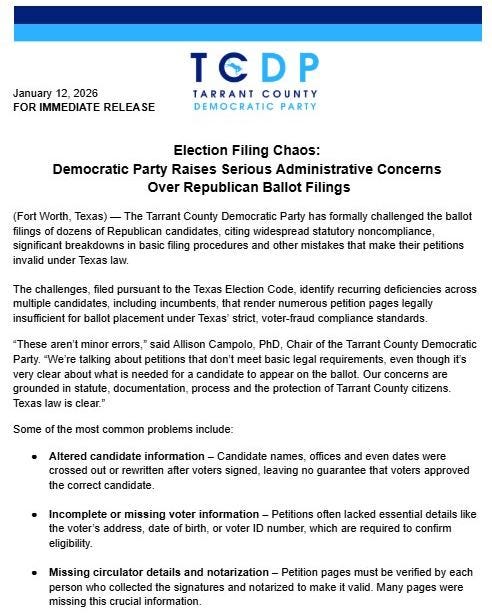
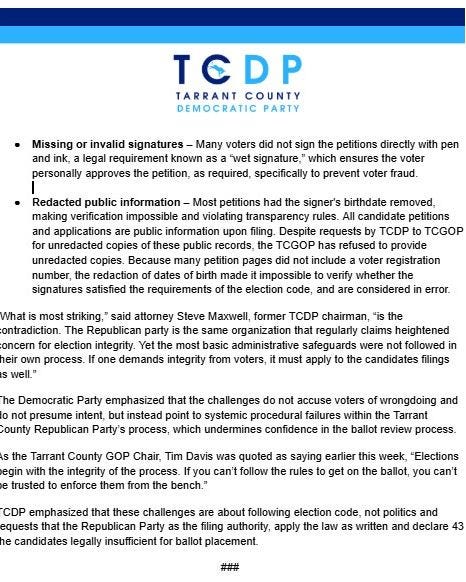
In public statements, Democratic Party leadership framed the challenges as a response grounded in statutory enforcement rather than partisan retaliation.
The statement emphasized that voters were not accused of wrongdoing and that the purpose of the challenge was to ensure equal application of the law, particularly after Republicans publicly asserted that strict compliance is essential to “election integrity.”
It honestly tickles me when Republicans screw themselves.
What does the Texas election law actually say/do?
Under the Texas Election Code, a candidate’s name only appears on a ballot if statutory conditions are met and those conditions are specific and mandatory. Texas law sets clear deadlines and forms for candidate applications and petitions, and the filing authority must determine whether those requirements are satisfied before accepting a candidate for ballot placement.
To qualify for a place on the primary ballot, a candidate must:
Submit a completed application by the statutory filing deadline.
Include either a filing fee or a petition with the number of signatures required by law.
Ensure that any petition pages and accompanying affidavits comply with statutory form and content requirements.
The Election Code allows no amendments after filing; if an application does not meet requirements on its face, the filing authority must reject it.
Chapter 141 of the Election Code governs candidate petitions. Each petition must include a circulator affidavit executed before a person authorized to administer oaths, affirming that the circulator:
Read applicable statements to each signer before they sign,
Witnessed each signature,
Verified each signer’s registration status.
Failure to meet any of these statutory duties, such as incomplete affidavits, bubbles filled incorrectly, or signatures not properly witnessed, can render all signatures on a page invalid and materially reduce a candidate’s valid signature count.
Beyond petitions, the Code also sets eligibility criteria. A candidate must have resided in the jurisdiction for a statutory period and be a registered voter in that territory by the filing deadline.
The party chair or other designated official serves as a ministerial filing authority. That means the authority reviews the face of the application and petitions against statutory text and must either accept or reject based on whether the filing on its face satisfies the Code. They cannot reshuffle or correct defects after the deadline.
If a citizen’s name is missing, an affidavit is unsigned, a date is altered, or the circulator requirements are unmet, the ballots can be challenged and potentially invalidated.
Republican hypocrisy.
When Chair Tim Davis justified the initial Democratic challenges, he did so in absolute terms. The Republican position was that the law demands strict compliance, that filing authorities have no discretion once deficiencies appear, and that failure to meet technical requirements disqualifies a candidate outright. That standard was presented as foundational to “election integrity.”
Once that position was taken publicly, it applied everywhere.
If strict compliance is the rule, it cannot stop at party lines.
If filing authorities must reject defective applications as a matter of law, they cannot excuse altered petitions, invalid affidavits, or eligibility failures simply because the candidate carries the right letter next to their name.
And if judicial candidates are to be judged on their ability to follow the law before taking office, that expectation applies equally to Republican judges and incumbents.
The challenges filed against Republican candidates rely on the same Election Code provisions, the same ministerial duties, and the same logic of disqualification Republicans used days earlier. The difference is who the rule now reaches.
You don’t get to call paperwork mistakes disqualifying when Democrats make them and harmless when Republicans do. Once Republicans made strict compliance the standard, that standard applied across the board.
Voters are the ones who lose out.
When candidates are challenged weeks after filing deadlines, the result is confusion. Voters follow races, donate money, and make plans to vote, only to learn later that a name may be removed because of paperwork they never saw and had no role in completing.
Filing challenges trigger administrative reviews, appeals, and often court fights that stretch deep into the election calendar. In some cases, candidates are knocked off the ballot after early voting has begun or after ballots have already been mailed. By then, the damage is done, even if a court later intervenes.
This structure turns party chairs and filing authorities into gatekeepers of democracy.
Republicans set up the law this way to intentionally sabotage Democrats on the ballot, but it backfired this time because they’re sloppy and most of their candidates are stupid. (There goes the first “stupid” of 2026. My goal is to keep it under five for the year.)
This is the cost of a system that treats ballot access as a weapon instead of a public trust.
What comes next?
Each of the challenges now on file must be reviewed individually. Texas election law does not permit blanket rulings or party-wide determinations. Every candidate named in a challenge is entitled to a separate evaluation of their application, petition pages, and affidavits against the statutory requirements in effect at the time of filing.
That review process can trigger additional steps. Candidates may respond to challenges, filing authorities must issue determinations, and adverse rulings can be appealed.
Timing is the central constraint. Even when courts intervene, the election calendar does not pause.
All of this unfolds before voters are asked to make a single choice. The outcome of these challenges will determine who appears on the ballot long before the public weighs in.
What this episode reveals is yet another failure of the Republican system that governs ballot access in Texas.
A process designed to ensure orderly elections has become a tool that can be deployed strategically, escalated quickly, and enforced selectively.
When “election integrity” is reduced to technical compliance and wielded as a political weapon, it stops serving voters and starts serving power. Decisions that shape the outcome of elections are made through paperwork challenges rather than public debate, and through filing authorities rather than the ballot box.
Until ballot access is treated as a public trust instead of a partisan lever, moments like this will keep repeating. Because democracy is under attack from a Republican government that has learned to rule by bureaucracy instead of consent.
February 2, 2026: Last Day to Register to Vote
February 17, 2026: First Day to Early Vote
March 3, 2026: Primary Election
Click here to find out what Legislative districts you’re in.
LoneStarLeft is a reader-supported publication. To receive new posts and support my work, consider becoming a free or paid subscriber.
Follow me on Facebook, TikTok, Threads, YouTube, and Instagram.
Tarrant County Republicans are either panicky or drunk on their own power - probably some combination of both. It's not great that the candidates have to go through all this gaming of the rules. That gamesmanship is a feature, not a bug for Republicans.They are not used to having Democrats running for all the judge spots in Tarrant County. I think that unnerved them. They thought it was really clever to knock as many off the ballot as they could so Republicans could run unopposed in the general election.I also think they genuinely thought Tarrant County Democrats would just let them roll over us.
Alison's aggressive and quick response is no doubt setting them back on their heels.Hooray for her!
I think I read somewhere Steve Bannon has taken a personal interest in local Tarrant County races, apparently seeing it as a "must win" county for control of Texas. If Bannon thinks he can just come down here and walk all over Tarrant County Democrats he is in for a rude awakening.
Well the Dallas GOP is even worse, precinct level voting on Election Day, even though there is no reason. We have been doing all county voting for years. It has to do with suppression, not integrity. Vote Early.