

We’re in a moment in American history where the stakes are way too high for “safe” Democrats and resume politics. We’re watching the federal government lean further toward authoritarianism, while establishment Democrats keep pretending this is just another election cycle.
In a moment like this, it would be a profound mistake to hand power back to Democrats who have a track record of conceding to the very machinery we’re trying to stop. Funding ICE while it expands, rubber-stamping fossil-fuel giveaways, voting yes on surveillance, and sending offensive weapons into wars they won’t even name honestly. This is not a time for corporate-aligned careerists who manage decline with better speeches. It’s a time for morally grounded progressives who will draw hard lines, tell the truth about what’s happening, and fight like the future depends on it.
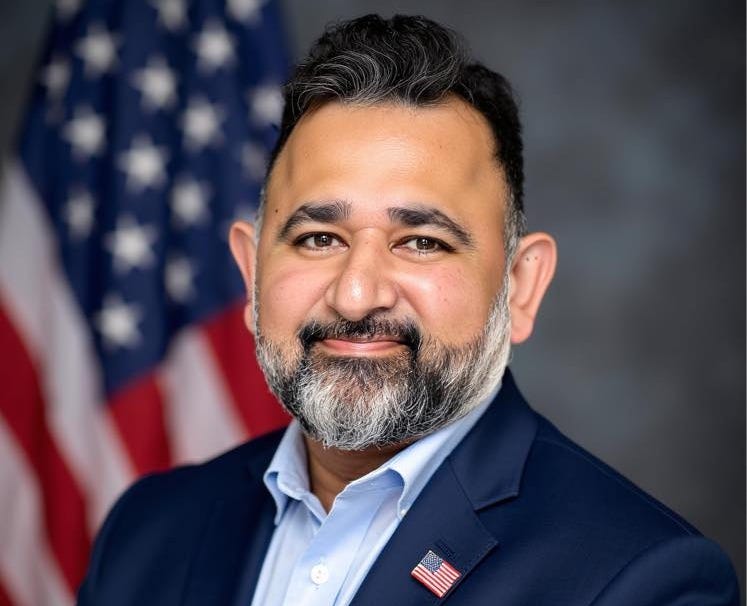
This is why Lone Star Left is endorsing Zeeshan Hafeez for TX33.
The establishment Democrats in the race are not qualified to meet the moment.
I’ll briefly address this, then move on to why I think Hafeez is better suited, but I think it’s important to address, since the two other establishment Democrats come with big names and huge wallets. Both Colin Allred and Julie Johnson are disqualified from this moment because of their voting histories, not their personalities.
The habitual votes that funnel money into ICE and detention infrastructure while oversight remains weak. The silence when moral clarity is required on war, occupation, and human rights abuses abroad. And the dependence on corporate donor networks that guarantee capitulation when real reform is on the line. These are both of their habits of convenience that too often become the policies that hurt our communities.
By contrast, Zeeshan Hafeez’s positions meet the moment with commitments that directly respond to these emergencies.
On immigration enforcement, he supports abolishing and prosecuting ICE, ending for-profit detention, and framing the entire system around due process and basic human rights rather than militarized raids. His stance recognizes that surveillance and enforcement disproportionately target marginalized communities and refugees, including the families he works with here in North Texas, and that federal overreach is first and foremost a civil liberties issue that demands a people-centered response.
In Zeeshan Hafeez’s own words.
Below are some policy questions I asked Hafeez, based on previous reader polls, and his answers.
Q: Do you support a Green New Deal or similar large-scale federal climate action plan?
I support a Green New Deal, a large-scale federal climate action plan, and it is a core pillar of my agenda. My commitment to bold climate action is not rhetorical. It is central to my campaign, deeply held, and laid out in detail on my website, ZeeshanforTexas.com.
Climate change is an existential crisis that demands action at the scale of the threat. In Texas, we are already living with the consequences: extreme heat, flooding, grid failures, polluted air and water, and rising health risks. For too long, Big Oil interests have dominated policy, delaying action while communities pay the price. Incrementalism has failed. A Green New Deal framework treats climate change as the emergency it is and mobilizes the full capacity of the federal government to respond.
My vision for a Green New Deal is comprehensive. It includes a rapid transition to clean, renewable energy; massive investment in grid modernization, energy storage, and efficiency; and a national commitment to climate resilience through flood control, heat mitigation, clean water infrastructure, and disaster preparedness. These investments are not only about emissions reduction. They are about protecting lives, lowering energy costs, and strengthening our infrastructure against a changing climate.
Equally important, climate justice is central to this agenda. Low-income communities and communities of color have borne the brunt of pollution and climate risk for generations. A Green New Deal must enforce strict accountability for polluters, end the practice of treating certain neighborhoods as sacrifice zones, and prioritize frontline communities for investment, cleanup, and public health protections.
Climate action is also an economic strategy. By investing in our environment, we can create millions of high-quality, high-paying union jobs, revitalize domestic manufacturing, and ensure American leadership in the clean energy economy. This transition can and must benefit workers and communities, not just corporations.
I am deeply passionate about this issue because it sits at the intersection of public health, economic justice, and intergenerational responsibility. A Green New Deal is how we protect our communities today and guarantee a livable, sustainable future for generations to come.
Q: Should Congress pass a federal $17/hour minimum wage, indexed to inflation?
Congress should not settle for a $17 per hour minimum wage. We should push for nothing less than a truly livable wage of at least $20 per hour, indexed to inflation and the local cost of living. This is my top policy priority, and it is laid out clearly on my website because I believe deeply that dignity at work is the foundation of a just and stable economy.
Wages have fallen dramatically behind the real cost of housing, healthcare, food, transportation, and childcare. A $17 wage, while an improvement over the status quo, still leaves millions of full-time workers unable to meet basic needs, especially in high-cost regions and cities. Setting the minimum too low simply locks in inadequacy and guarantees another political fight in a few years. A livable wage must start at $20 nationally and rise automatically with inflation and regional cost-of-living differences so it remains meaningful everywhere people live and work.
This is not just a moral issue. It is sound economic policy. When workers earn a true living wage, reliance on public assistance declines, health outcomes improve, employee turnover drops, and local economies grow through increased consumer spending. Businesses benefit from a more stable and productive workforce, and taxpayers stop subsidizing poverty wages through public programs.
I also support eliminating all subminimum wages, including for tipped workers and people with disabilities. No one who works full-time should be poor, and no worker should be excluded from basic wage protections. In particular, I support closing the loophole in Section 14(c) of the Fair Labor Standards Act, which allows some employers to pay workers with disabilities far below the minimum wage. Equal work deserves equal pay. Disability, job type, or reliance on tips should never be used as a justification for exploitation.
If Congress is serious about fairness, dignity, and long-term economic stability, it must stop compromising at wage levels that still leave families struggling. A $20 minimum wage, indexed to inflation and cost of living, combined with the elimination of all subminimum wages, is the minimum necessary to make work truly livable in today’s economy, and it is a fight I am fully committed to leading.
Q: Do you support universal, publicly funded healthcare (i.e., Medicare for All or a similar single-payer system)?
I support universal, publicly funded healthcare through Medicare for All, because healthcare is a right, not a privilege. In a wealthy country, access to care should never depend on income, employment, or zip code.
This is not a secondary issue for me. Passing Medicare for All is one of my top three policy priorities. I am deeply committed to it because our current system is fragmented, expensive, and unjust. Millions of people are uninsured or underinsured, families delay care because of cost, and employers are forced to shoulder the burden of providing healthcare in a system that was never designed to work efficiently or fairly.
A universal public system guarantees comprehensive coverage for everyone, including primary care, mental health services, maternal care, prescription drugs, preventive services, and long-term care, while preserving the freedom to choose doctors and providers. It eliminates medical debt, ends surprise billing, and ensures care is available when people need it, not only when they can afford it.
Medicare for All is also sound economic policy. It dramatically reduces administrative waste, gives the public real leverage to lower prescription drug prices, and provides cost certainty for families and small businesses. It frees workers from job lock, supports entrepreneurship, and improves overall public health, which lowers long-term healthcare costs across the system.
My support is informed by lived experience and professional background. I come from a family of physicians, I have worked in healthcare and health technology, and I have seen firsthand how delays, denials, and network restrictions put patients at risk. I have also seen how innovations like telehealth can expand access when paired with universal coverage that removes financial barriers.
Healthcare should be centered on patients, not corporate profit. Treating healthcare as a universal right is essential to dignity, economic security, and a functioning democracy. Medicare for All is the most direct, efficient, and humane way to achieve that goal, and I am fully committed to fighting for its passage.
Q: Do you support ending qualified immunity and instituting federal police accountability standards?
I support ending qualified immunity, instituting strong federal police accountability standards, abolishing ICE, and enforcing real accountability across all law enforcement agencies at every level of government.
Qualified immunity has become a legal shield that too often blocks accountability when constitutional rights are violated. It denies victims and families access to justice and sends the message that certain government actors are above the law. Ending qualified immunity is necessary to restore a basic democratic principle: authority comes with responsibility, and power without accountability is dangerous.
Accountability must also be uniform and enforceable. I support federal legislation that establishes clear national standards for all law enforcement agencies, including limits on use of force, bans on chokeholds and other dangerous restraints, mandatory de-escalation, duty-to-intervene requirements, and transparent reporting of misconduct. Constitutional rights should not depend on which city, state, or agency someone encounters.
Oversight and enforcement are essential. I support expanding the Department of Justice’s authority to investigate patterns and practices of abuse, strengthening national data collection on stops, arrests, detention, and use of force, and tying federal funding to compliance with civil rights and accountability standards. Agencies that violate the law must face real consequences, not symbolic reprimands.
This commitment to accountability applies to all law enforcement agencies, without exception. That includes local police, state agencies, federal law enforcement, and immigration enforcement. As I have stated clearly, ICE must be abolished. It is a uniquely unaccountable agency whose structure, tactics, and lack of oversight have led to systemic civil rights abuses. But abolishing ICE alone is not enough. Every law enforcement agency must operate under clear rules, civilian oversight, transparency, and constitutional limits.
This is not anti-law enforcement. It is pro-constitution and pro-public safety. Most officers want to serve honorably, and strong standards protect them by setting clear expectations and removing bad actors who endanger communities and undermine trust.
My legal background informs this position. Rights without remedies are meaningless. If government actors can violate constitutional rights without consequence, the rule of law collapses. Ending qualified immunity, abolishing ICE, and enforcing accountability across all law enforcement agencies are necessary steps toward a system of public safety that is lawful, fair, and worthy of public trust.
Q: Do you support federal student debt cancellation and tuition-free public college?
I support federal student debt cancellation and tuition-free public education, and I believe we must go further by fixing the entire education and workforce pipeline from kindergarten through advanced degrees.
Student debt has become a generational crisis and an economic anchor holding millions of people back. People did what they were told to do, pursued education to improve their prospects, and were left with decades of debt instead of opportunity. Cancelling federal student debt would provide immediate relief, stimulate the economy, and allow people to start families, buy homes, and take entrepreneurial risks instead of servicing loans.
But debt cancellation alone is not enough. We must end the system that created the crisis. That includes shutting down for-profit diploma mills that rely on predatory lending, deceptive recruitment, and poor educational outcomes while extracting billions in federal aid. Public dollars should never subsidize exploitation. Strong oversight, accountability, and borrower protections are essential.
I support tuition-free public education from K–12 through postsecondary education, including any public community college, trade school, or public university, extending all the way from kindergarten through PhD programs. Education is a public good, and access to it should be based on talent and effort, not family wealth. This also means major federal investment in K–12 education, including raising teacher salaries, reducing class sizes, modernizing facilities, and ensuring every child has access to high-quality education regardless of zip code.
Free public college must include trade schools and vocational programs, not just traditional academic paths. Preparing people for skilled trades, healthcare, technology, and emerging industries is essential to a resilient economy.
I also support ongoing reinvestment in workers who need retraining or retooling due to job displacement, especially as automation and AI reshape the economy. Workers should not be punished for technological change they did not create. Publicly funded retraining, credentialing, and continuing education programs must be available throughout a person’s working life so people can adapt, learn new skills, and transition into new careers with dignity and stability.
This is both an equity issue and an economic strategy. An educated, adaptable workforce strengthens productivity, innovation, and long-term growth. In a wealthy country, no one should be denied education because of cost, trapped by debt for seeking opportunity, or left behind as the economy evolves. Making public education truly free, ending predatory practices, and investing in lifelong learning are essential to building an economy that works for everyone.
The world is on fire. Literally, politically, morally.
Authoritarian power is consolidating at home and abroad. Surveillance is expanding. Immigration enforcement is growing more violent and less accountable. Wars are being normalized, climate collapse is being managed instead of stopped, and the space for dissent is shrinking. This is not a stable moment that calls for caution. It is a moment that demands courage.
If Democrats are headed toward their own “Tea Party moment.” It will start in primaries like this one. It will start when voters decide that complicity is no longer acceptable, and that silence is not neutrality.
That is what makes this race in TX33 so important. Zeeshan Hafeez is offering clarity. On immigration, climate, healthcare, labor, foreign policy, and civil liberties, his positions reflect an understanding of the scale of the crisis we are in. He is willing to say what too many establishment Democrats won’t, and to draw lines where others blur them for convenience.
The two establishment Democrats in this race are the biggest obstacles to that kind of shift. Not because they are villains, but because they represent the habits that have brought us here, donor dependence, risk aversion, and a politics that treats moral urgency as a liability. In a moment like this, that is not enough.
There is a fourth candidate in this race, Carlos Quintanilla, and voters should take the time to learn about all the options on the ballot. But the real danger in this primary is consolidation around candidates who cannot, or will not, meet the demands of this moment.
If Democrats are serious about resisting authoritarianism, defending human rights, and building a future that is livable and just, that work begins here. It begins by choosing candidates who are prepared to fight, not manage decline.
That is why Lone Star Left is proud to endorse Zeeshan Hafeez for Congress in Texas’s 33rd District.
You can learn more about Zeeshan Hafeez on his website, Facebook, Instagram, Twitter, Threads, TikTok, and Bluesky.
If you’re in the Dallas area and able, consider volunteering.
And if you can spare it, consider donating.
History is not asking Democrats to be careful. It’s asking who is willing to stand up.
February 2, 2026: Last Day to Register to Vote
February 17, 2026: First Day to Early Vote
March 3, 2026: Primary Election
Click here to find out what Legislative districts you’re in.
LoneStarLeft is a reader-supported publication. To receive new posts and support my work, consider becoming a free or paid subscriber.
Follow me on Facebook, TikTok, Threads, YouTube, and Instagram.
Thanks for introducing us to a good progressive candidate. I am impressed with his policy positions, which he has articulated well on his website particularly at the link below, which compares his position with that of the other two leading Democratic candidates on issues pertaining to political reform.
Hope our Democratic candidates running for public office follow his example and clearly articulate their policy positions on their website.
I signed up for modest monthly contributions at his website.
Is there a reason why you don’t ask in such an interview if the candidate supports common sense gun safety reforms, which is supported by a majority of Americans?
https://www.zeeshanfortexas.com/Political-Reform
Great Article! I want him for CD35! One of the 4 in CD35 told me that they have to run more in the center. I told them; I don’t want to vote for a careful candidate. 😤
Waiting to see if you know anything about the candidates. I think NEBCD will have them speak at our Feb. 14(?). OMG! I might not attend! 🤦🏽♀️ Today’s meeting had like 30 judges, clerks, etc on the ballots. We meet every second Saturday.