

This series is called Meet the Candidates. Over the next two months, I’ll spotlight a handful of Democratic races each month, mainly in the Legislature and in Congress. These aren’t endorsements. They’re introductions, a way to understand who’s running, the districts they hope to represent, and what’s at stake for people across Texas.
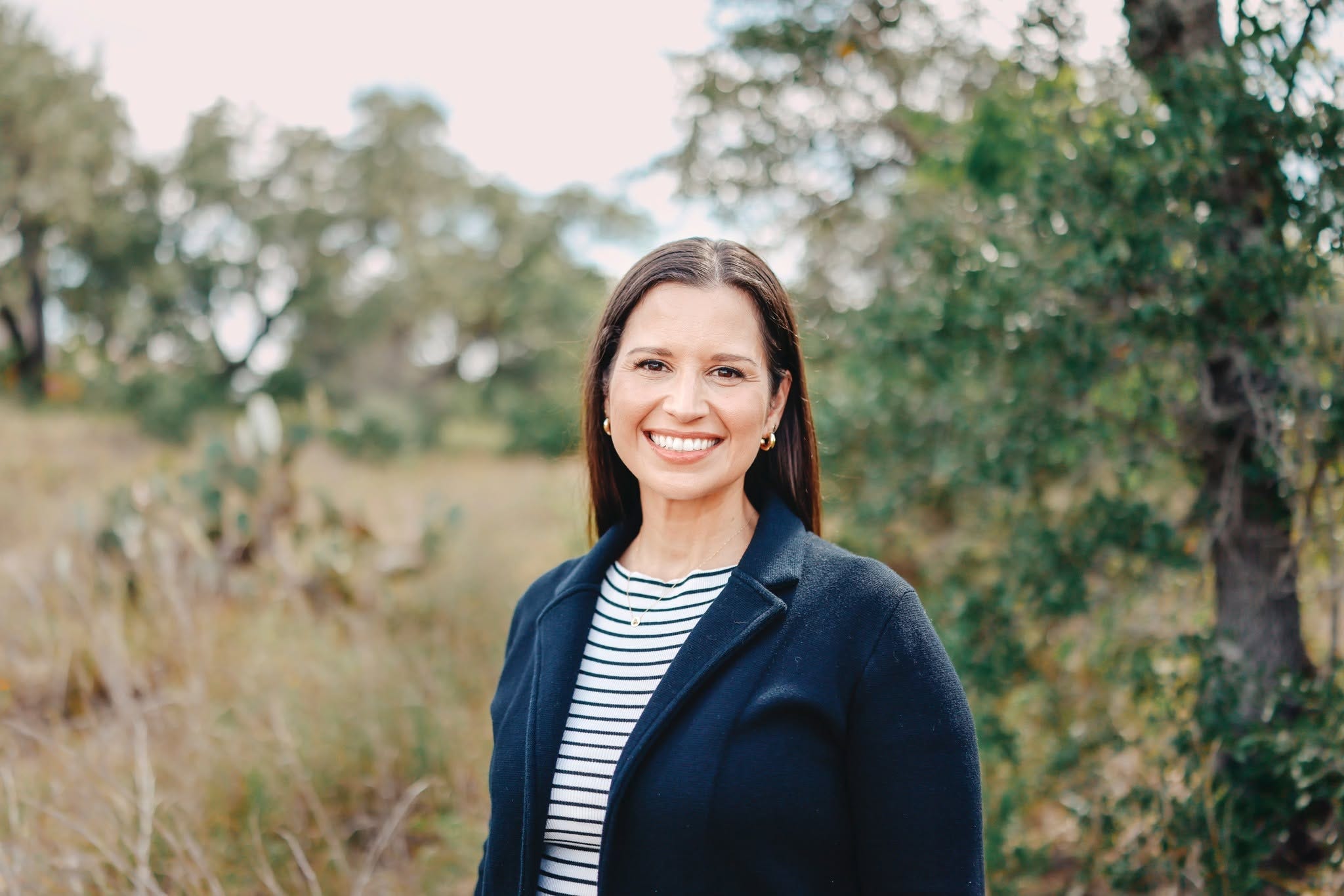
Who is Caitlin Rourk?
Caitlin Rourk is the Democratic nominee for Texas’s 10th Congressional District, a sprawling stretch of 13 counties running from the Austin suburbs out through the rural expanse toward Houston. She’s an Army officer, a mom of two, and someone fed up with watching a Congress built for the loudest and richest who ignore everyone else.
Both of Rourk’s grandfathers fought in WWII, then came home and helped rebuild the country’s infrastructure. Her parents were public school teachers. She’s spent more than a decade living and working in Central Texas, and her career has bounced between the private sector, public policy, and the military.
Rourk describes a lifelong pull toward service, earning her commission as a Military Intelligence Officer through Army Officer Candidate School. She served full-time in the Texas Army National Guard at Joint Forces Headquarters in Austin. She was on the ground for natural disaster response, the COVID-19 crisis, civil unrest operations, and multiple border mobilizations. She also served in the US Army Reserve.
Rourk’s pitch is that Congress needs more parents, veterans, and neighbors, and fewer people fluent only in the language of special interests. It’s not a complicated message, but it’s one this district hasn’t heard much from the people actually representing it.
The district.
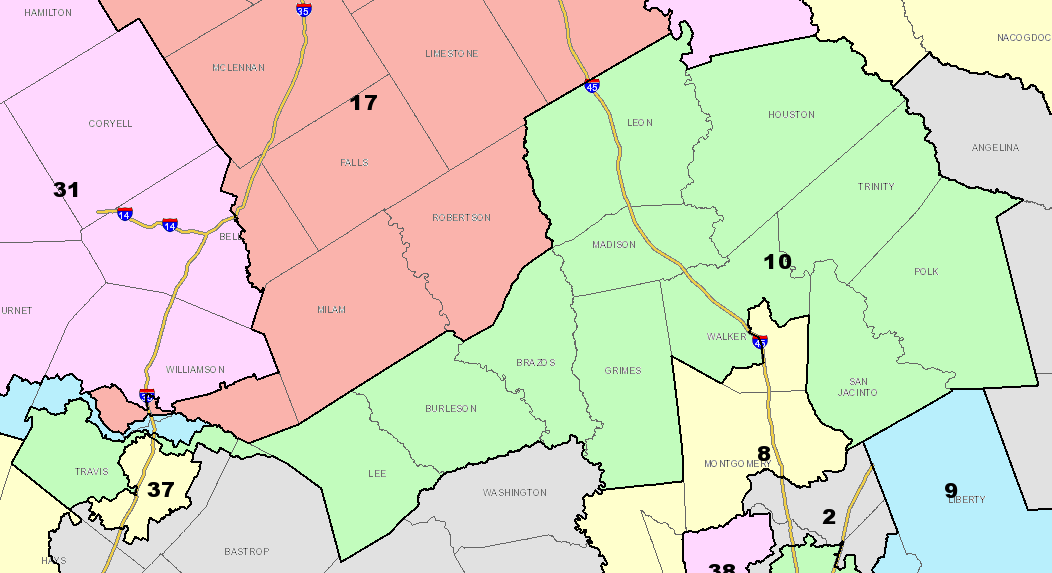
TX10 got completely rebuilt in the 2025 mid-decade redistricting. The seat is an absurd gerrymander that snakes from Austin and includes Brazos, Walker, Grimes, Burleson, Lee, Leon, Madison, Houston, Polk, San Jacinto, Trinity, plus slivers of Bastrop. Demographically: 59.8% Anglo, 21.1% Hispanic, 10.4% Black, 6.9% Asian by total population. And the voting-age numbers skew even whiter (62.5% Anglo VAP).
As of March 2026, Cook, Inside Elections, and Sabato’s Crystal Ball still rated it Solid or Safe Republican, or a +10 (R), but in this environment, Democrats are feeling BIG under a +10 (R). This was not drawn to be competitive. There isn’t a Democrat in Texas who agrees with that assessment right now… well, maybe the pessimists.
The facts:
Brazos County (College Station/Bryan) is the wild card. This is a university town with a growing professional and academic class sitting inside otherwise deep-red farmland.
Travis County’s slice is reliably Democratic, just not big enough to carry the district alone.
Everything else is rural, white, and about as movable as the Alamo.
The Hispanic population (21.1%) is nearly double its share of registered voters. Spanish-surname registration sits around 10% of the rolls. That’s an organizing target. A huge chunk of that population isn’t on the voter rolls yet.
2024 general turnout: 66.6%. 2022 midterm turnout: 51.6%. That drop-off is the whole ballgame… if this district behaves like a normal midterm, Republicans coast. If anger, base enthusiasm, and a genuinely bad GOP field push turnout closer to presidential-year levels, the math gets less comfortable for the incumbent party fast.
Trump’s net approval nationally is sitting around -20, among the worst of any president at this point in a term dating back to Truman, and the generic congressional ballot has Democrats up roughly 6-7 points.
Historically, that kind of environment produces real seat losses for the president’s party. Democrats are now leading Latino voters by 23 points on the generic House ballot, more than double their 2024 margin, and in Texas specifically, Trump’s disapproval among Latino voters has hit 67%, with Democrats opening a 54-28 generic ballot lead. Trump’s net approval is near a record low.
A wave year turns “impossible” into “expensive for Republicans to ignore.” It means Rourk’s military/bipartisan profile is built for exactly the kind of district-crossover voter this seat would need actually to move. This is not a top-tier pickup, but it’s the kind of seat that turns purple on the way to turning blue somewhere else, and Rourk running a credible campaign here forces resources the GOP would rather spend elsewhere. This seat could surprise everyone.
The Republican.
Chris Gober. We talked about him. He’s the multi-millionaire who directed the gerrymander that created TX10, which he now runs. He was also Elon Musk’s lawyer, and his firm did the legal work that let Viktor Orbán’s propaganda operation set up shop in the US.
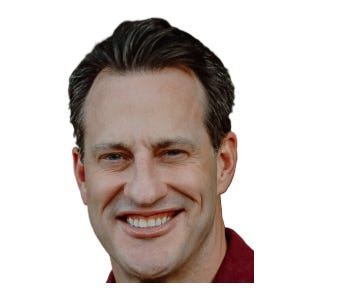
Gober likes to introduce himself as a small-town boy from Throckmorton, Texas (population 700-something), hardscrabble Texas grit, the whole bit. What he leaves out is that his parents owned the bank that owned the oil wells, so when he talks about working the oil fields, he means he pushed pencils for the family business. He also doesn’t mention that Throckmorton has a documented history as a sundown county, one that ran Black residents out and kept them out for the better part of a century, which is a strange well to draw “timeless conservative values” from.
In Caitlin Rourk’s own words.
Below are some questions I asked Rourk, based on previous reader polls, along with her answers.
Q: Should Congress pass a federal $17/hour minimum wage, indexed to inflation?
I support raising and indexing the federal minimum wage so it better reflects the cost of living and the economic realities facing working families. I’m open to a $17/hr figure, provided it’s phased in responsibly and accounts for the impact on small businesses and different regional economies.
Q: Would you support major tax reform, including raising taxes on billionaires and large corporations?
Yes, making the tax code work for working families will require closing loopholes and ensuring the wealthiest Americans and large corporations pay their fair share.
Q: Do you support ending U.S. military aid to countries with ongoing human rights abuses, including Israel and Egypt?
I support conditioning U.S. military aid on compliance with U.S. and international humanitarian law, regardless of the country receiving it. When governments engage in human rights abuses, the United States should be willing to suspend or withhold assistance. We can’t keep writing blank checks. In Israel’s case, I support withholding offensive weapons while maintaining narrowly defined defensive assistance. The same human rights and accountability standards should apply to Egypt and every other recipient of U.S. military aid.
Q: Should Congress ban corporate PAC money and implement public campaign financing?
Yes, I support strengthening campaign finance laws to limit the role of big money and Super PACs in politics. It’s part of a broader reform agenda I’m running on to return power and accountability to the people we represent, including more transparency around dark money and lobbying, banning members of Congress from trading individual stocks, and strengthening ethics and disclosure rules. Running for office has also shown me firsthand how broken our campaign finance system is. Stronger public financing would reduce the influence of a small handful of wealthy donors while allowing candidates to spend less time raising money and more time engaging with and solving problems for their constituents.
Q: Do you support DC statehood, Puerto Rico self-determination, and expanding voting rights through federal law?
Yes, I support expanding and protecting voting rights through federal law. I support DC statehood so its residents have voting representation in Congress, and I support Puerto Rico’s right to self-determination so its people can decide their own political future.
Bonus Question: How will you engage and energize disillusioned or low-turnout voters, especially young people, communities of color, and the working class?
Our campaign has taken a “deep canvassing” approach to voter engagement. Instead of showing up with a script and trying to convince someone, we start with questions: What’s been on your mind? What’s worrying you? What do you wish people in Washington understood about your community? This has allowed us to have long conversations with disillusioned voters not just about policies or me as a candidate, but about voting at all – and how we can make change together in a system that can often feel like it’s written you off. Listening - actually listening - has been our key here, because many of these communities feel especially unrepresented
Rourk’s answers tell you she wants billionaires taxed, PACs out of politics, and aid to human-rights abusers conditioned regardless of who’s asking.
That’s a message built for the kind of voter TX10 is stuffed with, and Republicans have spent a decade assuming would never show up. That includes veterans, parents, working people who’ve been organized around instead of organized for.
R+10 in this environment isn’t nothing, and it isn’t everything either. It’s a district where Trump’s underwater by 20 points, where Hispanic voters are swinging back harder and faster than either party expected, and where turnout decides who wins. Gober is betting his fortune says otherwise. Rourk is betting that showing up in Bryan and Huntsville, one conversation at a time, beats a man who had to buy his own nomination.
We’ll find out in November. Until then, the seat is exactly as competitive as the people willing to work it make it. Donate, or if you’re in the district, go knock some doors.
You can learn more about Caitlin Rourk on her website, Facebook, Instagram, and Bluesky.
52 days until the November election!
Did you know you can find links to all the previous Meet the Candidate articles on these lists?:
Click here to find out what Legislative districts you’re in.
LoneStarLeft is a reader-supported publication. To receive new posts and support my work, consider becoming a free or paid subscriber.
Follow me on Facebook, TikTok, Threads, Bluesky, YouTube, and Instagram. Or join my Facebook Group.
She has so many positives it would be hard to vote against her.