

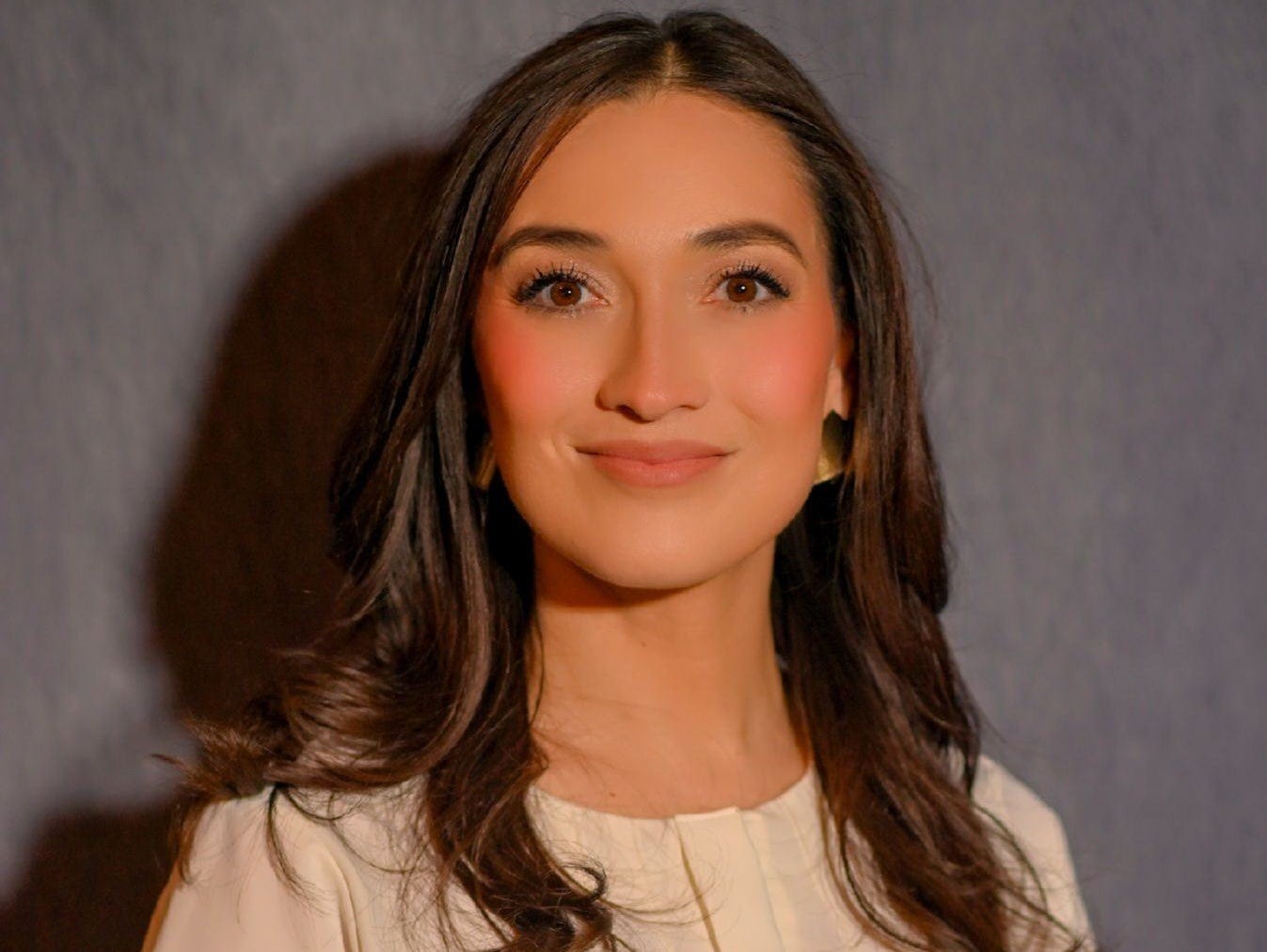
This series is called Meet The Candidates. Over the next seven months, I’ll spotlight a handful of Democratic races each month, mainly in the Legislature and in Congress. These aren’t endorsements. They’re introductions, a way to understand who’s running, the districts they hope to represent, and what’s at stake for people across Texas.
Who is Diana Loya?
Diana Loya is coming in from lived experience, and that distinction matters in a district like this. She immigrated to the United States as a child and learned English while figuring out where she belonged. That’s a throughline in her campaign around making sure people who are usually sidelined actually have a voice, and it’s rooted in that early experience of navigating systems that weren’t built for her.
She’s also part of a military family. Her husband deployed to Iraq shortly after they met, and while he was overseas, she raised their daughter, worked, and continued her education. That’s the kind of unglamorous labor that informs how she talks about service, as something that happens every day without recognition.
Professionally, Loya has spent about two decades in public education. Classrooms, campuses, working with teachers, students, and families. She later earned a master’s in Educational Leadership and took positions where she could actually push for change inside the system.
That perspective carries into how she defines leadership. Listening, showing up, and being accountable to the people who live with the consequences of policy decisions. She consistently centers educators, veterans, working families, farmers, and small-town communities.
The district.
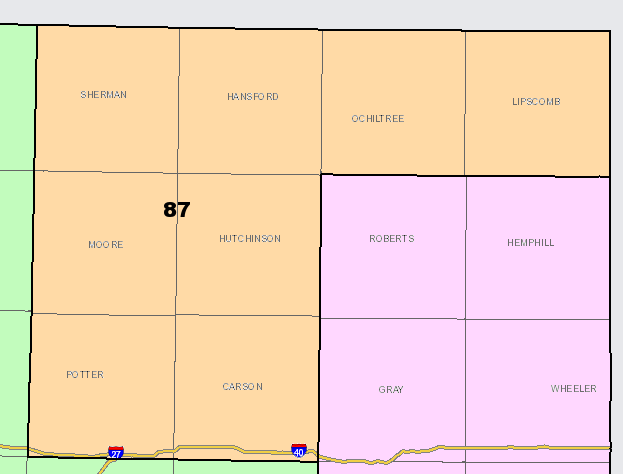
If Democrats want to flip HD87, they have to start by being honest about what this district is and what it is not.
This is not some secretly blue seat waiting to be discovered by a better mailer. It is a hard-red Panhandle district that Donald Trump carried with 78.7% in 2024, while the Democratic House nominee took just 20.7%. Republicans won the state House race here by more than 31,000 votes. That is not a narrow loss.
At the same time, this is not a district Democrats should write off forever.
HD87 is more complicated than the topline suggests. The district is 54.3% non-Anglo overall, though the voting-age population is basically split down the middle, 50.1% Anglo to 49.9% non-Anglo. Hispanics make up about 40% of the total population. Potter County, which includes much of Amarillo in the district, is by far the biggest population center, and several communities in Moore, Ochiltree, Hansford, Sherman, and Lipscomb counties have very large Latino populations.
Most of these areas didn’t even hit 55% turnout in 2024, in a presidential election year.
So what would it actually take?
First, Democrats would have to stop treating this as a generic rural district and start treating it as a working-class, heavily Latino, partly Amarillo-based Panhandle district with real economic pain. The district has a poverty rate of 17.7%, per capita income well below the state average, lower rates of bachelor’s attainment, and a workforce concentrated in manufacturing, agriculture, construction, retail, and education and health services. This is exactly the kind of place where a strong Democrat should be talking nonstop about public schools, hospital closures, property taxes, wages, water, housing strain, and who gets left behind when Austin governs for donors and culture-war addicts instead of actual communities.
Second, Democrats would need a serious turnout project in the Latino communities that are already there (and not a last-minute parachute operation). Democrats are not flipping this district by shaving a point off the GOP in Bushland. They are flipping it, if they ever do, by building durable turnout and trust in Amarillo’s district share, Dumas, Cactus, Perryton, Spearman, Booker, Stratford, and other places where the electorate does not currently look like the full district population.
Third, they would need a candidate who fits the district culturally without sounding like a Republican in softer packaging. That means somebody who can talk naturally about schools, veterans, rural hospitals, and farm economics, but also connect those issues to state policy choices. Diana Loya’s biography gives Democrats a better opening on that front than the party often has in seats like this. English learner, educator, military family, working mom, Panhandle-rooted. That is the kind of profile that can at least get a hearing from voters who would tune out a more conventional Democrat on sight.
Fourth, Democrats would have to improve their standing with both Latino and Anglo working-class voters. And 2026 might just be the year for that. Because the VAP is still slightly Anglo-majority, and a district that voted nearly 80 percent Republican is not moving left through demography alone. Any real path would require running up the score more in Latino communities while also cutting into the GOP margin among white voters who are being hammered by the same school underfunding, hospital instability, farm pressure, and property-tax squeeze as everyone else.
HD87 is flippable only in the long term, and only if Democrats stop approaching Panhandle districts like abstractions. The ingredients are there for a better Democratic performance than the party is currently getting. A diverse population. Heavy working-class economics. Underfunded public institutions. Large Latino communities. A candidate profile that makes sense for the region. But none of that matters without an organization strong enough to turn demographic possibilities into actual votes.
For now, the district is still deeply red. But it is not politically simple. And that is where a serious Democratic strategy would have to begin.
The incumbent.
If Diana Loya’s campaign is built around lived experience, the incumbent Caroline Fairly’s (R) is built around inherited privilege.

Fairly did not come up through local organizing, public service, or even the kind of slow, grinding community work that usually defines rural politics. She came in with a last name and a financial network. The 27-year-old daughter of billionaire Alex Fairly, she entered this race with the kind of built-in advantage most candidates in districts like this could never dream of. Her daddy bought her this seat, and she’s been granting the billionaire class government favors ever since.
Because what you see in Austin is not an independent, grounded voice for the Panhandle. You see a legislator whose alignment is consistent with corporate interests and oil money. The same donor class that already has a firm grip on Texas politics is tightening its grip further.
Meanwhile, the actual needs of the district, underfunded schools, strained rural hospitals, property tax pressure, working families trying to stay afloat, keep getting pushed to the side or actively made worse.
And that’s the disconnect. HD87 is a working-class, rural district facing real economic strain, but its representation looks as if it were assembled in a boardroom. Fairly works strictly for the billionaire class, while harming the people who elected her into office in the first place.
Fairly’s record reflects that her priorities are consolidating power, pushing ideological agendas, and protecting the interests of people who will never have to worry about losing their homes, their healthcare, or their livelihoods.
That’s the real contrast in this race. Not just Democrat versus Republican, but representation rooted in lived reality versus representation shaped by wealth, access, and insulation from the consequences of policy.
In Diana Loya’s own words.
Below are some questions I asked Loya, based on previous reader polls, along with her answers.
Q: Should Texas end tax subsidies and abatements for large corporations?
I don’t think we should blindly give tax breaks. We should be strategic. We should support businesses that truly invest in our communities, but stop deals that don’t deliver real value. We should also invest in our small businesses, especially here in HD 87.
Q: Do you oppose school vouchers and efforts to privatize public education?
I’m strongly opposed to school vouchers because I’ve spent over 20 years inside our public schools, and I’ve seen what our students need to succeed. Taking funding away from public schools doesn’t solve problems; it creates more of them, especially for our rural communities and our most vulnerable students.
Q: Should Texas guarantee free school meals to all K–12 students, regardless of income?
Most families who can afford it will continue to send lunches with their children; that’s already happening. However, the current system only reaches a small number of students and leaves many others in between without consistent access to meals. When kids are in school, they should focus on learning, not being hungry. We need to guarantee no child is left hungry.
Q: Do you support automatic voter registration and same-day registration in Texas?
I absolutely support automatic voter registration and same-day registration in Texas because voting should be accessible for every eligible citizen.
Q: Do you support publicly financed elections to reduce corporate and PAC influence?
I wholeheartedly support this. When campaigns rely heavily on large donors or PACs, it raises real concerns about influence and accountability. Public financing helps ensure that elected officials are working for the people, not for whoever funded their campaigns.
Bonus Question: What does being a Democrat mean to you in 2026?
To me, being a Democrat today means standing with working-class families and bringing hope back to our communities. It means choosing unity over division and people over politics. It’s not about extremes. It’s about humanity. It’s about fighting for our students, our families, and the communities we call home.
That’s the choice in HD87.
One path continues what the district already has. A politics shaped by wealth, insulated from consequence, aligned with donors and power brokers who will never live with the outcomes of the policies they push. The other is an attempt, still early, still uphill, to root representation in the people who actually make up the district and keep it running.
And to be clear, this is not an easy flip. It’s not even a likely one in the short term. But that doesn’t mean it isn’t a meaningful race. Because races like this are where parties either build something real or continue to coast on assumptions that haven’t held up in years.
If Democrats are serious about competing in places like the Panhandle, this is what it looks like. A candidate who fits the district. A message grounded in material conditions, not abstractions. A long-term commitment to voters who have been written off, ignored, or talked at instead of talked with.
Whether that’s enough in 2026 is an open question.
But the more important question is whether anyone is willing to do the work required to make districts like HD87 competitive at all.
You can learn more about Diana Loya on her website and Facebook.
April 20, 2026: Last day to apply to vote by mail (City elections/SD04 Special Election)
April 20, 2026: First day of early voting (City elections/SD04 Special Election)
April 27, 2026: Last day to register to vote (Democratic primary runoff elections)
April 28, 2026: Last day of early voting (City elections/SD04 Special Election)
May 2, 2026: Last day to receive ballot by mail (City elections/SD04 Special Election)
May 2, 2026: Election day! (City elections/SD04 Special Election)
May 15, 2026: Last day to apply to vote by mail (Democratic primary runoff elections)
May 18, 2026: First day of early voting (Democratic primary runoff elections)
May 22, 2026: Last day of early voting (Democratic primary runoff elections)
May 26, 2026: Last day to receive ballot by mail (Democratic primary runoff elections)
May 26, 2026: Election day! (Democratic primary runoff elections)
Click here to find out what Legislative districts you’re in.
LoneStarLeft is a reader-supported publication. To receive new posts and support my work, consider becoming a free or paid subscriber.
This is the formula for democratic success. Democratic candidates must connect with working people, one voter at a time.
Thanks Michelle! Just shared on bsky.