

Lone Star Left stays free, always, no paywall. Free to read isn’t free to produce. This runs entirely on paid subscribers. No PAC money, no campaign checks, nobody’s donor class getting a vote in what gets written. If this series has taught you something about a race you’d never have heard about otherwise, consider becoming a paid subscriber.
This series is called Meet the Candidates. Over the next three months, I’ll spotlight a handful of Democratic races each month, mainly in the Legislature and in Congress. These aren’t endorsements. They’re introductions, a way to understand who’s running, the districts they hope to represent, and what’s at stake for people across Texas.
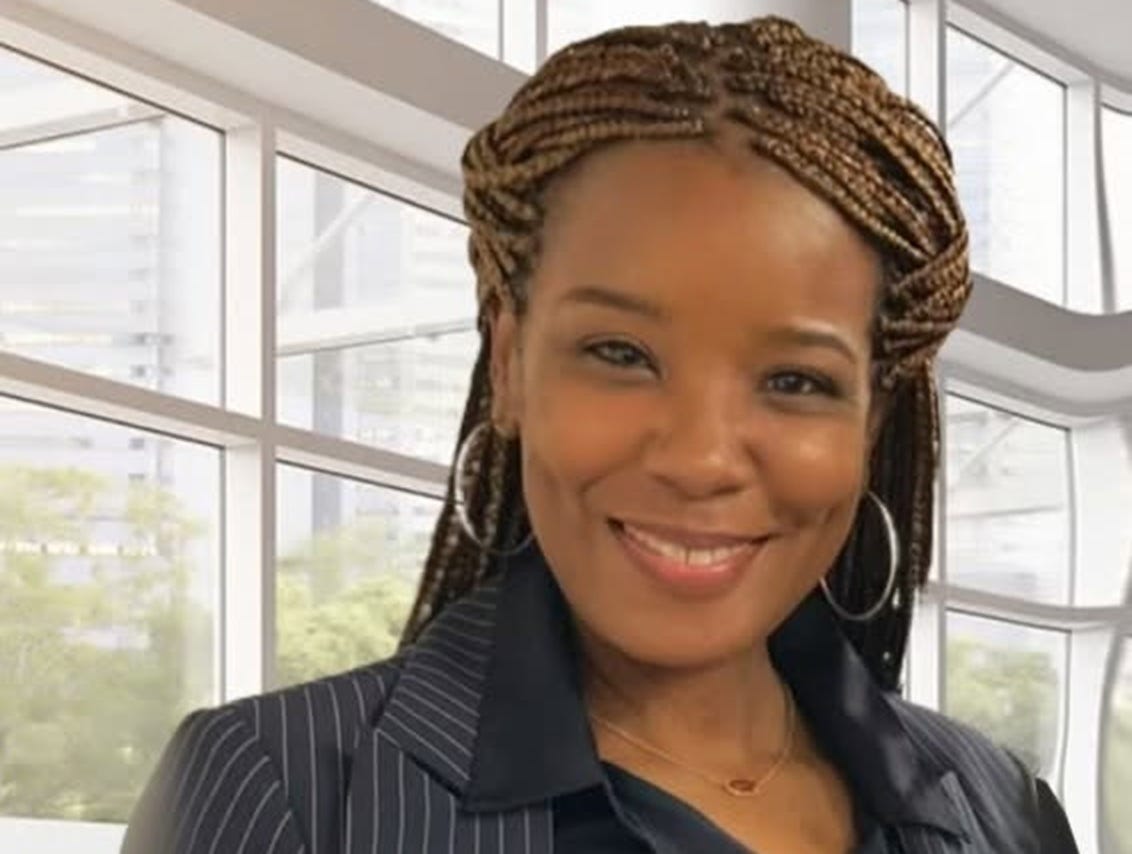
Who is Erica Gillum?
Erica Gillum is a lifelong Texan, a businesswoman, realtor, real estate coach, and investor. She spent the last two decades building something out of not much.
She grew up watching her father, a fourth-generation small businessman. He served as Mayor of Hempstead in 1983 and later sat on the Waller County Commissioners Court. Gillum took the same path decades later, landing on Hempstead City Council in 2020 and moving into the mayor’s office in 2022, where she stayed until 2024.
While she was there, Gillum secured over $9 million in drainage and infrastructure. A deal with H-E-B guaranteed a quarter of the new distribution center jobs go to residents. Caterpillar Mustang landed in Hempstead on her watch, which she credits for strengthening the city’s tax base.
Gillum leans hard into faith and self-reliance as campaign language. The line she keeps coming back to is that the real divide in this country isn’t left versus right. It’s top versus bottom. And right now, in this moment, that’s what speaks most to working Texans.
The district.
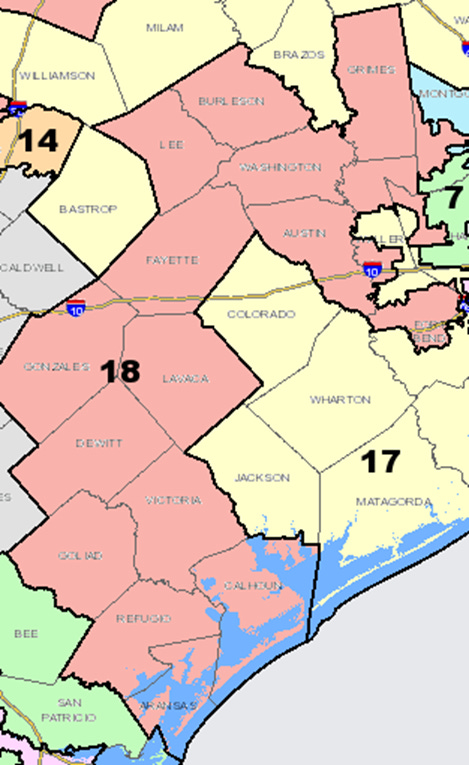
Senate District 18 is enormous. It’s 18 counties stitched together from the Gulf Coast up through the Brenham prairie and into the western edge of the Houston sprawl. You could drive from Port Lavaca to the outskirts of Katy and never leave it.
This district has two very different economies living inside one Senate seat. Small farming and ranching counties that have voted red for a generation, and a fast-growing exurban slice of Fort Bend County that looks nothing like them.
The population is 62% people of color. Hispanic residents make up 30.6%, Black residents 17.3%, Asian residents 13.3%. On paper, that’s a majority-minority district. On the ground, it doesn’t vote like one, and we’ll get to why.
Homeownership runs at 66.7%, ten points above the state average. Poverty sits at 10.6%, well under the state’s average. It’s a district of homeowners, small business owners, and retirees. 15.1% of the district is 65 or older, compared to 13.4% statewide.
Here’s the county breakdown that actually explains the politics. The district’s single largest population center is 45% of Fort Bend County. That slice is 73.8% non-Anglo. It is also the only real growth engine in the district, with 30% of its housing built since 2010. If Democrats have a future in SD18, it lives in that Fort Bend wedge, not in the rural counties.
Victoria County, the second-biggest chunk at 91,319 people, is 43.1% Anglo and 47% Hispanic, and Hispanic voters along this stretch of the coast have been trending red for years. However, many campaigns and groups are hoping to swing them back left this year. The small counties run 60% to 73% Anglo and vote accordingly. Waller County, Gillum’s home turf and 73% inside the district, is 63.2% non-Anglo with the highest Black population share in SD18 at 28%. That’s Gillum’s actual base, and it’s a small one against the sheer size of everything else.
2024 general election, in District 18, Trump beat Harris 62.6% to 35.3%. Cruz beat Allred 59.7 to 37.8. Every appellate and Supreme Court race on the ballot broke for the Republican by 29 to 30 points. This district votes red from the top of the ballot to the bottom.
Now the flip math. Harris got 148,753 votes in this district in 2024. Trump got 263,788. A gap of 115,035 votes on a turnout of 421,232. Closing that in one cycle takes a genuinely historic swing, not a good year.
Here’s why that’s worth taking seriously anyway. In 2024, Trump won 55% of the Latino vote statewide. That shift is reversing, fast. And it’s not just polling. When Taylor Rehmet flipped SD9 in that January special election, a district Trump carried by 17 points, nearly 80% of the Hispanic voters who turned out voted for him. That’s a swing of roughly 26% off 2024.
That’s the ballgame for the coastal Hispanic counties sitting inside SD18. All counties that broke hard for Trump two years ago. If even half of the SD9 swing shows up here in November, that’s tens of thousands of votes moving back into play in a district where the Democratic floor has been mostly the same for a decade.
It still doesn’t flip the seat by itself. But stacked on top of the Fort Bend wedge and a Waller County operation that actually shows up, it starts to look like the first real dent Democrats have put in this seat in years.
And there’s a piece of this that isn’t just demographic drift. Lois Kolkhorst has a record on maternal health that directly harms a large portion of this district.
Erica Gillum is not favored to win SD18 in November. But what's different about this cycle is that the pieces required for a real dent, the Fort Bend wedge, a Hispanic vote in genuine motion, an incumbent with a terrible record, are all actually present at the same time. We should be treating this as a base-building cycle worth real investment.
The incumbent.
There isn’t one positive thing Lois Kolkhorst has ever done for Texas. Not ever. She was named one of the “Worst Legislators” in Texas by Texas Monthly magazine in 2017. And has made a career out of legislating favors for billionaires, cutting the social safety net for children living in poverty, and taking on a radical anti-Earth agenda.

Worst of all, Kolkhorst is one of the people most responsible for the piles of dead women stacking up in our state. In 2011, Kolkhorst voted to slash Texas family planning funding by 66%. Eighty-two clinics closed their doors. These weren’t abortion clinics, whatever the talking points want you to believe. They were the front door into healthcare for millions of Texas women. Cancer screenings. Birth control. STD testing.
Then the bodies started showing up in the data.
Texas maternal mortality went from 18.6 deaths per 100,000 live births in 2010 to 38.7 in 2012. It nearly doubled in two years. Researchers published the findings in Obstetrics and Gynecology and said flat out they couldn’t explain a spike like that “in the absence of war, natural disaster, or severe economic upheaval.” No other state came close. Texas hit numbers researchers said weren’t seen anywhere else in the country.
Black women paid for it hardest. They made up 11% of Texas births and nearly 29% of the pregnancy-related deaths.
Lois Kolkhorst has chaired the Senate Health and Human Services Committee this entire time. She controls nearly $80 billion in healthcare spending and oversight of every health agency in this state. She had the gavel when the clinics closed. She had the gavel when the data came out. She has the gavel right now.
This is a story about a woman who voted to gut the healthcare access of poor and working-class women, watched hundreds of them die because of it, and kept her committee chairmanship anyway. The Legislature, in its own words, mostly punted. Kolkhorst didn’t. She kept showing up, kept getting reappointed, kept voting the same way.
A body count with a Senate seal on it. And come November, she’s asking the women of District 18 to send her back to Austin to keep doing it.
In Erica Gillum’s own words.
Below are some questions I asked Gillum, based on previous reader polls, along with her answers.
Q: Do you support a statewide minimum wage increase to at least $15/hour?
Most definitely! Yes. Too many Texans who work full-time still can’t afford the basics. With the cost of living rising while wages have remained stagnant, no one who works hard every day should have to choose between paying rent, buying groceries, or seeing a doctor. I also support a thoughtful implementation that gives small businesses time to adjust.
Q: Do you oppose school vouchers and efforts to privatize public education?
Yes. I oppose school vouchers that divert public dollars away from our public schools. Education is personal to me; my daughter is an educator, my mother retired from education, and my father is a retired college professor. I’ve spent a lifetime hearing both the successes and the frustrations of our schools. We should fully fund public education, raise teacher pay, and invest in the resources every student and classroom needs to succeed.
Q: Should Texas end tax breaks and regulatory loopholes for oil and gas companies, including exemptions from emissions reporting and waste disposal standards?
Yes, End tax breaks that don’t create jobs or investment, and reinvest those dollars in infrastructure, workforce training, and energy innovation. Close outdated loopholes on emissions reporting and waste disposal so taxpayers aren’t left paying for pollution or abandoned wells. That’s a pro-business, pro-taxpayer approach that rewards responsible companies, protects communities, and strengthens Texas’s economy over the long term.
Q: Do you support closing or downsizing state prisons and redirecting that funding to community-based alternatives like mental health care, housing, and youth programs?
Yes. It’s time to stop pouring billions into a system that too often fails to make our communities safer. Downsize prisons where it’s safe to do so and redirect those resources to mental health care, addiction treatment, affordable housing, youth programs, quality education, and job training. When we invest in people instead of just punishment, we reduce crime, strengthen communities, and create lasting public safety. That’s a smarter use of taxpayer dollars.
Q: Do you support repealing all abortion bans and codifying the right to abortion in state law?
I respect the value and dignity of every human life. I also believe the best way to reduce abortion is through prevention, not punishment. That means expanding access to education, contraception, quality healthcare, and the resources families need to thrive.
At the same time, I believe decisions about pregnancy are deeply personal and should be made by individuals, their families, and their healthcare providers, not the government. We can value life while respecting personal freedom.
My goal is to support policies that prevent unintended pregnancies, strengthen families, improve maternal and child health, and protect the right of every person to make their own healthcare decisions.
Bonus Question: How do you plan to engage and energize young and working-class voters?
First, I won’t pretend to understand their struggles from a distance. I am a working-class voter myself, so I have known what it feels like to worry about paying the bills, affording healthcare, buying groceries, or wondering whether homeownership will ever be within reach. These aren’t political talking points to me; they’re everyday realities.
When it comes to young voters, we have to stop talking at them and start talking with them. Too often, people assume they know what young people need instead of inviting them into the conversation. My commitment is to listen first, to be transparent, and to meet young people where they are.
That means showing up on college campuses, trade schools, job fairs, and community events. It means engaging student organizations and speaking with graduating seniors about civic engagement and the policies that will shape their future. It also means reaching them where they already communicate, through social media and digital platforms, in ways that are informative, honest, and engaging.
Young people need to understand that the decisions made today directly affect their future. Whether it’s the cost of college and trade schools, housing affordability, healthcare access, women’s rights, voting rights, or the funding of public education, these issues aren’t problems for someone else; they will shape the opportunities available to this generation.
For working-class families, my message is simple: I see you because I am one of you. Our working class includes teachers, nurses, doctors, pharmacy technicians, medical assistants, retail workers, office staff, construction workers, first responders, and countless others who keep our communities running every day. These are the people who make our economy work, yet too many feel like government has forgotten them.
People deserve to understand how government decisions affect their daily lives, from the price of groceries and gas to healthcare costs, housing, utility bills, and the ability to support their families without having to work multiple jobs just to make ends meet.
Politics often fails because it doesn’t connect policy to people’s everyday lives. My goal is to change that. Every decision made in government has a real impact on someone’s paycheck, someone’s rent, someone’s healthcare, or someone’s child’s future. We have to communicate those connections clearly and honestly.
Most importantly, I want people to know they have someone fighting for them every single day. While you’re working, raising your children, paying your bills, and trying to build a better future, I want you to know your representative is working just as hard on your behalf.
That is how we rebuild trust. We listen. We show up. We tell the truth. We stay engaged. And we never forget that public office is about serving the people, not serving ourselves.
Erica Gillum is running on a question nobody in Austin bothers asking working people anymore. Who is this government actually for?
On one side, a Realtor and former mayor from Hempstead who knows what it’s like to worry about rent. On the other, a Senator who wears diamonds to hearings where she votes against the people, wondering if they can afford their next prescription, and who has chaired the committee overseeing Texas’s maternal mortality crisis for the entire time it’s been the worst in the country.
Nobody should tell you Erica Gillum is favored to win this seat in November. She isn’t, and I won’t do false hope. But the math here is moving for the first time in a decade. The Hispanic vote along this coastline is genuinely up for grabs, and Fort Bend keeps growing whether Lois Kolkhorst likes it or not.
If you live in District 18, or know someone who does, Gillum needs volunteers, and she needs money, and she needs both before Kolkhorst’s $3.1 million war chest gets spent on ads nobody in this district can counter. If you don’t live here, share this piece. Somebody in Victoria or Gonzales or Waller needs to hear that a Democrat is finally showing up asking for their vote.
You can find out more about Erica Gillum on her website, Facebook, or TikTok.
94 days until the November election!
Did you know you can find links to all the previous Meet the Candidate articles on these lists?:
Click here to find out what Legislative districts you’re in.
Hope the people in her area read this.
Thank you, Michelle! Just shared on bsky. I'm a little under the weather today.