

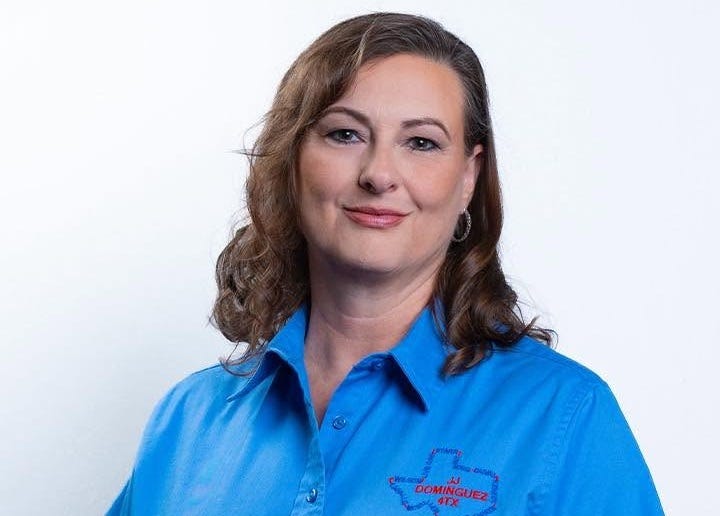
This series is called Meet the Candidates. Over the next two months, I’ll spotlight a handful of Democratic races each month, mainly in the Legislature and in Congress. These aren’t endorsements. They’re introductions, a way to understand who’s running, the districts they hope to represent, and what’s at stake for people across Texas.
Who is JJ Dominguez?
Jennifer “JJ” Dominguez has spent nearly thirty years as a Licensed Clinical Social Worker. She currently chairs the Wilson County Democratic Party.
Dominguez grew up in Illinois, moved to Texas twenty years ago, and put down roots in Floresville, a rural community in the district she’s now trying to represent. She married into a family with a Mexican immigrant father-in-law, and together they raised four kids who, between them, are a Navy Seabee, an Army veteran, an engineer, and an Activities Director at a skilled-nursing facility.
Her interest in public service started in high school, when a government teacher pushed her to graduate early and take an internship at the Illinois State Capitol. She went on to serve as a Page in the Illinois Senate. Then she went on to spend fourteen years as a dialysis social worker in rural Texas, sitting with patients while they figured out how to survive both a terminal diagnosis and a mountain of medical bills. She’s currently providing therapy to immigrants trying to build a life here.
The district.
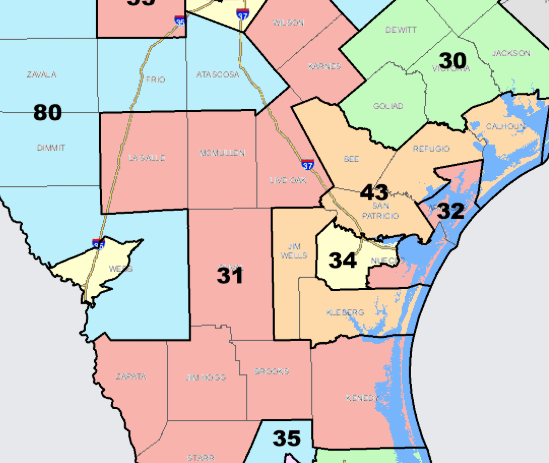
HD31 covers eleven counties strung across South Texas from the Eagle Ford Shale down to the Rio Grande, including Starr, Zapata, Jim Hogg, Brooks, Duval, La Salle, McMullen, Live Oak, Karnes, Kenedy, and Wilson. The total population is 72% Hispanic. Fourteen-year-olds and under make up 27% of the district. This is a young, brown, working-class district that Republicans have owned for one reason. Ryan Guillen switched teams in 2021 for a 1.5 million payoff, the moment redistricting made switching profitable, and hasn’t really had a formidable challenger since.
Median household income in this district runs well below the state average. Nearly a quarter of the population, 24.5%, lives in poverty. Educational attainment tells the same story. Only 17.4% of adults hold a bachelor’s degree, compared to 33.8% statewide, while a quarter of the district didn’t finish high school. More than half the district (55.8%) speaks a language other than English at home. This is not a district built for a party whose signature domestic policy achievement is siphoning public school money into private school vouchers for people who can already afford private school.
Public sector employment runs almost 23%, well above the state’s 14%, so state budget fights and public sector layoffs land harder here than in most districts. More than a third of households (34.2%) draw Social Security income, and households on SSI run more than double the state rate.
Starr County alone holds 35% of the district and the single largest bloc of votes. It is 97.8% Hispanic. Wilson County, JJ’s home turf and the seat of the county party she chairs, holds 49,753 people but flips the demographic script entirely. 56% Anglo, only 40.5% Hispanic, and the most reliably conservative pocket in the district. Everything else is small, rural, and 75% to 98% Hispanic. Starr County is the whole ballgame.
Turnout in 2024 was 58%. Registration rate against VAP is nearly 89%, which means the problem here was never getting people on the rolls. It’s getting them to the polls and giving them someone worth showing up for.
Here’s the sobering math is in 2024, Guillen ran unopposed. The last time Democrats actually fielded a candidate, 2022, Martha Gutierrez lost to Guillen 71.24% to 28.76%. I’m not sure she even had a website. For comparison, top-of-ticket Democrats in 2024 ran ahead of that. Colin Allred took 34.7% against Cruz; Kamala Harris took 31.3%. So the district’s ceiling for a generic, reasonably funded statewide Democrat sits in the low-to-mid thirties, while the last actual HD31 candidate underperformed even that.
What does it actually take to flip this seat? Assume turnout close to 2024’s 70,000-plus in a wave year, or lower in an ordinary midterm, that math still requires finding somewhere in the neighborhood of 15 to 20 additional points of vote share compared to the 2022 baseline.
First, this is a true midterm with Abbott and the voucher fight on the ballot in every school district in this state, including one where 93% of kids go to public school. That is a mobilizing issue in a way presidential-year abstractions aren’t.
Second, the party is banking on Hispanic voters, who cratered toward Trump in 2020 and 2024, snapping back toward Democrats in a non-Trump midterm. If that thesis holds anywhere in Texas, it holds in a district that’s 72% Hispanic with a candidate who’s spent 28 years doing direct social work in these same rural counties. If it doesn’t hold, HD31 is exactly where that failure will be most visible, because Starr County alone can swing the outcome.
Third, Dominguez is the sitting Wilson County Democratic Party chair running in the one county in this district where Democrats are structurally weakest, which means she’s spent years building exactly the kind of local infrastructure a 2022-style blowout suggests never existed.
None of that guarantees a flip. It means this is a real investment and that Dominguez needs both real money and the Hispanic-vote reversion the party is counting on actually to materialize in the numbers.
The incumbent.
Traitor and party switcher, Ryan Guillen, served nine terms as a Democrat, from 2003 to 2021. In October 2021, Greg Abbott signed new maps that made HD31 dramatically more Republican than the version Guillen had just won by 17 points. Six weeks later, Guillen stood in a Floresville coffee shop, flanked by Abbott and House Speaker Dade Phelan, and announced he was switching parties. That election cycle, this South Texas House candidate pulled in over $1.5 million in donations.
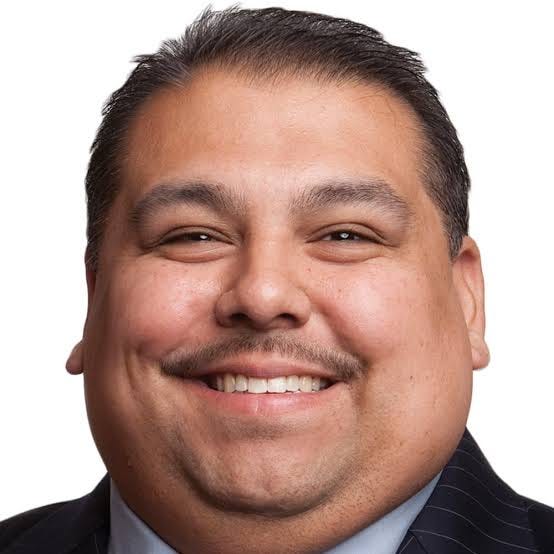
His soul was for sale, and he made it that much harder for the rest of Texas to trust the “Conservative Democrats” along the border. And most of us saw the switch coming, which is another reason why it’s hard to trust the Democrats who vote like him. As a sitting Democrat, Guillen was one of only seven House Democrats to vote for permitless carry. He backed the state’s near-total abortion ban. He voted to bar transgender student-athletes from competing consistent with their gender identity. And when House Democrats broke quorum in 2021 to fight the GOP’s voting restrictions, Guillen stayed home. He did all of this while still technically wearing a “D” next to his name, which means the party switch was in the making for a long time.
Abbott said it at the press conference. “Everybody has known that Ryan Guillen is really a Republican who is attached to the wrong label.”
By using Abbott’s logic, progressives need to work much harder to get Richard Raymonds and Eddie Morales of the world primaried out before they switch, too.
I digress, because the Guillen situation still infuriates me, and it should infuriate you. Guillen spent his legislative career chairing committees under four different Speakers. He built his seniority, relationships, and name recognition that comes with that as a Democrat, using Democratic voters’ trust. Then, when his political position was threatened, he sold his soul without even blinking.
HD31 is a 72% Hispanic, 24.5%-poverty district, and half the time nobody even bothered to put a name on the ballot against him. That’s not a district Republicans earned. That’s a district Democrats forfeited to a man who sold his own out from under them the moment it stopped being convenient to stay.
In JJ Dominguez’s own words.
Below are some questions I asked Dominguez, based on previous reader polls, along with her answers.
Q: Do you support a statewide minimum wage increase to at least $15/hour?
Yes. As an AFL-CIO COPE-endorsed candidate, I support raising the minimum wage in Texas to at least $15/hour. Based on the education they provided candidates earlier this year, I would argue that the statewide minimum wage should be closer to $21/hour. The hourly rate needs to be indexed for inflation. By raising the statewide minimum wage, it would offer significant benefits to workers, communities and the broader state economy. Low-wage workers struggle to meet basic needs like childcare, housing, food, and other necessities. Employers in Texas who voluntarily pay higher wages often find that it attracts and retains workers, leading to better employee morale and reduced turnover. Increased wages for low-wage workers boost consumer spending, which can stimulate local economies. Raising the minimum wage will narrow wage gaps based on gender and race/ethnicity, as women and people of color are disproportionately represented in low-wage jobs.
Q: Do you oppose school vouchers and efforts to privatize public education?
Yes. The voucher program stripped away $1 billion from the 5.4 million public school children to benefit 102,037 children in private or homeschool programs (57% of which were already enrolled in these programs). In House District 31, there have only been 143 student applications awarded. The current representative sold out to Republican pressure to vote for the voucher program, despite the fact that within the 11-county district there is only one PreK to fifth-grade school accepting the vouchers. It will be difficult to reverse the damage done by the voucher program. It will require zeroing out the funding during the biennial budget period, repealing Senate Bill 2, and abolishing the Texas Education Freedom Accounts.
Q: Should higher education in Texas be free or debt-free at public institutions?
Yes. I look forward to the opportunity to partner with Senator Zaffirini to revisit SB43, which sought to establish the Texas Promise Grant Program, offering free or significantly reduced tuition at public institutions of higher education for students from households with incomes under $100,000. The companion bill, HB5299, authored by Representative James Tallarico, aimed to provide additional financial assistance and incentives for students attending two-year public higher education institutions like junior colleges, technical institutes, and state colleges. Both bills originally died in committee and will need further Democratic support to regain traction during the next Legislative session.
Q: Should Texas guarantee free school meals to all K–12 students, regardless of income?
Yes. I expect these efforts to be led by the soon-to-be elected Ag Commissioner, Clayton Tucker. Free school meal legislation can be based upon New Mexico’s SB4, which was passed in March 2023. By providing free school lunches to all students, it will end lunch shaming and improve children’s educational outcomes. Representatives Armando Walle and Toni Rose have led school lunch reforms in the past, and I look forward to connecting with them to revitalize support for free school meals. Food insecurity doesn’t end when the school year is over. Within HD31, there are over 30, 627 (76%) kids eligible for summer food assistance, which Governor Greg Abbott cut as part of his $60 million line-item veto. In the incumbent’s home county of Starr, 93% of the kids could have benefited from the summer EBT program.
Q: Do you support automatic voter registration and same-day registration in Texas?
Yes. Not only should Texas support automatic voter registration and same-day registration, but countywide voting should also be mandatory. Texas should operate its elections on an opt-out versus opt-in model. Whenever a person gets a driver’s license or identification card, their information should automatically be sent to the elections office for registration. Counties should have electronic poll books at all locations to safely sign up new voters, and they should be provided with ballot-on-demand printers.
Q: Should local police be barred from enforcing federal immigration law?
Yes. The Task Force Model of the federal 287(g) Program should be barred. This model requires local officers to actively enforce immigration law, question individuals, and assist in field operations outside the jail, such as during routine traffic stops or patrols. The Warrant Service Officer model should remain in place. This model allows deputies to serve and execute ICE administrative warrants within the county jail on individuals already in custody, but they cannot make arrests or interrogate people in the community.
Bonus Question: Who are your political role models, living or dead?
Jane Addams is a deeply meaningful political role model for me because her life brought together two things that define my own path: social work and service to the community. She understood that lasting change comes from listening to people, advocating for those whose voices are often overlooked, and turning compassion into action. As a Social Worker myself, I am inspired by her belief that we have a responsibility to address the conditions that make it difficult for people and communities to thrive. Having my middle name, Jane, in her honor makes that connection especially personal. Her commitment to social justice, civic engagement, voting rights, and public service reminds me that leadership is not about power—it is about using your voice and your position to create opportunities for others.
HD31 is red because for most of the last decade, nobody bothered to give voters a reason to show up and vote otherwise.
JJ Dominguez has spent three decades doing the work Guillen only talks about, sitting with dialysis patients, counseling immigrants, building a county party in the one place Democrats are weakest. Whether that’s enough to close the gap depends on turnout, on money, and on whether the Hispanic-vote reversion the party is banking on actually shows up in Starr County.
That’s not a guarantee. It’s a real race with a real candidate, in a district Democrats have no business continuing to forfeit.
You can learn more about JJ Dominguez from her website, Facebook, and Instagram.
59 days until the November election!
Did you know you can find links to all the previous Meet the Candidate articles on these lists?:
Click here to find out what Legislative districts you’re in.
LoneStarLeft is a reader-supported publication. To receive new posts and support my work, consider becoming a free or paid subscriber.
Follow me on Facebook, TikTok, Threads, Bluesky, YouTube, and Instagram. Or join my Facebook Group.
Thank you for featuring the amazing JJ! Just a slight correction- JJ stepped down as party chair in December to campaign for TX state rep. Our current party chair, Sarah Guevara, has taken up the mantle and continues the work of motivating Wilson County Democrats to get to the polls AND to run for county offices. 💙
Thank you, Michelle! Just shared on bsky. GO JJ, GO!!!