


This series is called Meet The Candidates. Over the next nine months, I’ll spotlight a handful of Democratic races each month, mainly in the Legislature and in Congress. These aren’t endorsements. They’re introductions, a way to understand who’s running, the districts they hope to represent, and what’s at stake for people across Texas.
Who is John Lira?
John Lira grew up in a working-class, fourth-generation Mexican American family. After graduating from East Central High School, he joined the United States Marine Corps and served in Iraq. When he came home, Lira worked as an intelligence analyst, a policy expert, and eventually a senior presidential advisor for AmeriCorps. At the Small Business Administration, he helped veterans start businesses and create jobs.
Now he’s running for Congress in Texas’s 35th District for the same reason he’s done everything else. Family.
Lira wants his daughter to grow up in a Texas where hard work still means something, where healthcare doesn’t bankrupt you, where a decent job can buy a decent life. That’s the lens he brings to this race.
The district.
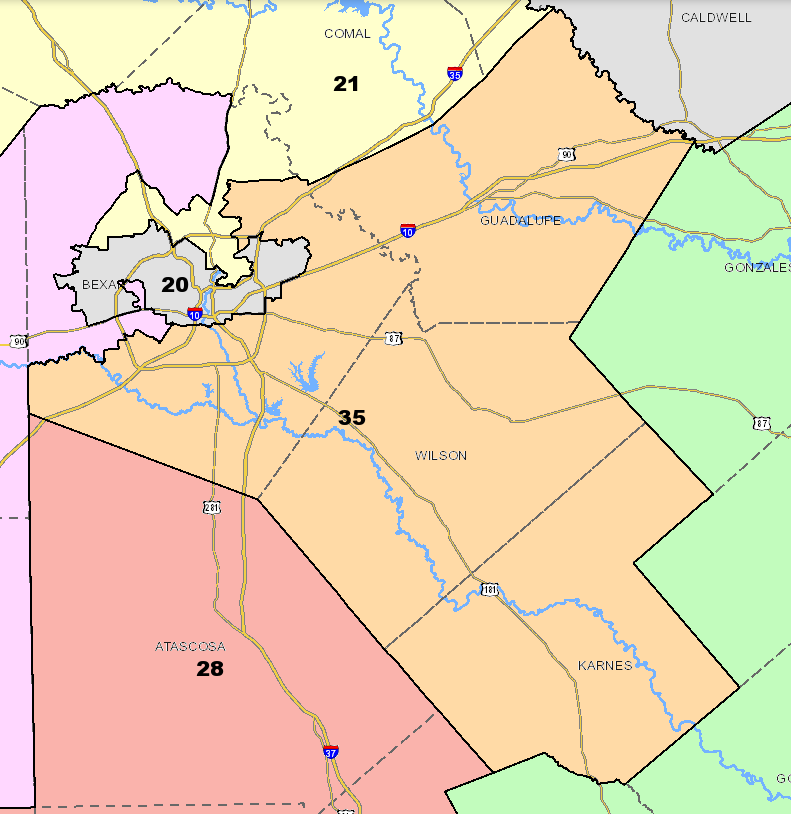
Texas’s 35th Congressional District is one of the most demographically Democratic districts in the state. On paper, it’s a majority-minority seat with a Voting Age Population that is roughly 65% non-white, and more than half Hispanic. That’s the kind of district Democrats usually win comfortably. But the partisan lean tells a more complicated story. Based on the 2025 redistricting, the district actually votes about 51% Republican to 47% Democratic.
I 100% expect this district to be blue in November, based on current Hispanic polling of Trump’s approval numbers.
The VAP has lagged badly in past cycles, especially among younger and Hispanic voters. Republicans have been able to stay competitive here because their older, whiter, higher-propensity voters show up at much higher rates. Democrats win TX35 when it looks like a high-turnout electorate with strong Latino engagement. Republicans win it when turnout drops and the electorate skews older and more conservative.
So what will it take for Democrats to win in November? First, they need a candidate who can speak fluently to working-class concerns instead of running a generic national Democratic campaign. This district is full of veterans, union households, service workers, and small-business families. Economic messaging matters more than culture-war positioning. Second, Democrats have to invest heavily in Spanish-language outreach and neighborhood-level organizing in San Antonio. Third, they need to overperform with Latino men, a group that has drifted rightward in recent cycles. And finally, they need to treat TX35 like a true battleground.
The incumbent.

Basically, it’s complicated.
Greg Casar is the current incumbent for TX35, but next year he’s moving to TX37 when the new maps go into effect. And TX37’s current incumbent, Lloyd Dogget, is finally retiring. So, that makes TX35 an open seat.
Maybe it’s not that complicated, but with the redistricting, there was some moving around.
Lira has three primary opponents.
In John Lira’s own words.
Below are some questions I asked Lira, based on previous reader polls, along with his answers.
Q: Do you support a Green New Deal or similar large-scale federal climate action plan?
Yes. Protecting our environment means safeguarding our economy. I support the goals behind large-scale climate action, and I believe addressing climate change must be a priority for every Congress, no matter which party is in power. We are already seeing the impacts in Texas through stronger storms, dangerous heat, floods, and deep freezes that destroy homes, disrupt communities, and put families at risk. Climate change is not a future problem. It is a real and growing threat to our safety and our economy. Congress must protect our land, water, and natural resources while preparing for the energy demands of the future.
I support bold investments in clean and renewable energy that create good-paying union jobs and strengthen our economy. Texas already leads the nation in wind and solar power, and we can build on that success with smart investments in new technology, energy storage, and grid reliability. Clean energy means lower costs for families, healthier air for our communities, and strong job opportunities for workers. I also support investments in disaster prevention and early response programs so that no more lives and homes are lost, as we experienced in Kerrville the summer of 2025.
I support a fully funded and staffed Environmental Protection Agency and strong environmental standards that hold polluters accountable. Climate action should be about building a healthier, safer, and more economical future for everyone.
Q: Should Congress pass a federal $17/hour minimum wage, indexed to inflation?
YES. I support policies that raise the national minimum wage and index that wage to inflation.
Q: Would you support major tax reform, including raising taxes on billionaires and large corporations?
Yes. For too long, our economy has been rigged to reward the wealthy and well-connected while working families struggle to get ahead. I would support and advocate for proposals to make big corporations and the wealthy pay what they truly owe in taxes. I support a fairer system that reduces the tax burden on the middle class. Right now, the system is rigged to have the wealthy pay more while the middle class carries the tax burden for billionaires. I believe capital gains should be taxed similarly to income, and in closing loopholes like deferring capital gains.
With a more just tax system, the revenue would be used to fund key priorities in Texas like education, infrastructure projects, health care, Social Security, and well-paying jobs for working people. I support a sustainable social security system for our seniors. Congress must raise or eliminate the social security cap for high-income earners to ensure they continue to contribute through the entire year. It simply asks those who have gained the most from our economy to keep paying the same fair rate that everyone else already pays and ensures Social Security remains strong for generations to come.
Q: Do you support ending U.S. military aid to countries with ongoing human rights abuses, including Israel and Egypt?
Yes. U.S. military assistance must be consistent with American values, international law, and our long-term strategic goals. I do not support the unconditional transfer of offensive weapons to any country when there is evidence of human rights abuses or harm to civilians. Aid should come with clear standards, including the protection of innocent lives, respect for humanitarian law, access for relief organizations, and a genuine commitment to de-escalation and diplomacy.
America’s role should be to support peace, not prolong wars. Our partnerships must strengthen regional stability and hold all governments accountable to basic human rights. Military support should be focused on defense and civilian protection, not actions that risk escalating conflict, deepening humanitarian crises, or undermining pathways to peace and security.
Q: Should the U.S. demilitarize the southern border and repeal harmful immigration policies?
Yes. Our southern border should be a place of commerce, culture, and connection, not fear and militarization. Immigration is a civil and humanitarian issue, not a military one. There is no justification for deploying Marines to perform law enforcement duties against families seeking safety and opportunity. The harsh, punitive policies of the Trump era have separated families, denied due process, and created an atmosphere of intimidation that hurts border communities economically and socially
Congress must halt the illegal, aggressive, and antagonistic tactics by I.C.E. immediately. We must also repeal policies like family separation, mass deportations of peaceful residents, and asylum restrictions that put vulnerable people in danger. Congress must restore due process, end the indefinite detentions, protect DACA and TPS recipients, and establish new pathways for refugees and legal immigration. Enforcement should focus on real threats like traffickers and violent criminals, not workers and families who contribute to our communities. Americans demand a humane, fair immigration system that strengthens our economy, protects human dignity, and reflects our values as a nation built by immigrants.
Bonus Question: Who are your political role models, living or dead?
Congressman Charlie Gonzalez is one of my most important political role models. He was the first member of Congress I ever met, and his leadership had a major impact on my life. Charlie represented San Antonio with integrity, independence, and a deep commitment to working families. He showed me what it means to stay grounded in your community, speak with principle, and serve people who are often overlooked. Even in retirement, he remains a mentor whose example continues to guide me.
Senator Ruben Gallego is both a role model and a battle buddy. We deployed together as Marines to Iraq in 2005, and our bond was forged in combat. Ruben understands leadership under pressure. He has been a strong voice for veterans, workers, and Latino communities, and he supported my first run for Congress. His journey from the battlefield to the U.S. Senate reminds me that service does not end when the uniform comes off.
I also draw inspiration from President Theodore Roosevelt. His history with San Antonio and his choice to live a rugged frontier life reflected his strength, service, and resilience. Roosevelt was a progressive leader who protected national parks, strengthened labor rights, and took on powerful corporate monopolies. He believed the government should work for the people, not just the wealthy. That spirit of bold leadership and standing up to concentrated power continues to shape how I think about public service today.
TX35 is about to be one of the most interesting races in Texas.
It’s an open seat in a district that looks like a battleground, but should be a win for the right Democrat in this election cycle. Whoever wins the primary will be walking into a general election that requires real organizing, real turnout, and a message that connects with working families instead of just party loyalists.
John Lira is making the case that he’s built for exactly that kind of fight.
He’s running as a Marine veteran, a public servant, and a Southside kid who believes government should actually make life easier for the people doing the work that keeps Texas running. His answers to my questions show a candidate who is unapologetically pro-worker, pro-immigrant, pro-climate action, and willing to take clear positions on issues that matter to Democratic primary voters.
Whether that message is enough to win a crowded primary is the question voters in TX35 will decide. Because in Texas politics, the most important thing any voter can do is pay attention.
And this is a race worth paying attention to.
February 17, 2026: First Day to Early Vote
March 3, 2026: Primary Election
Click here to find out what Legislative districts you’re in.
LoneStarLeft is a reader-supported publication. To receive new posts and support my work, consider becoming a free or paid subscriber.
Follow me on Facebook, TikTok, Threads, YouTube, and Instagram.
I can’t wait to see who wins in CD35. I have told 3 of them that as soon as I know who wins; we need to get out the vote for Nov.
I only understand Bexar County but I’m willing to learn from the other county Democratic parties of Guadalupe, Wilson and Karnes. If you read this please Person Message me. 🙏🏼
Thanks, Michelle! Already shared on Bsky.