

This series is called Meet the Candidates. Over the next three months, I’ll spotlight a handful of Democratic races each month, mainly in the Legislature and in Congress. These aren’t endorsements. They’re introductions, a way to understand who’s running, the districts they hope to represent, and what’s at stake for people across Texas.
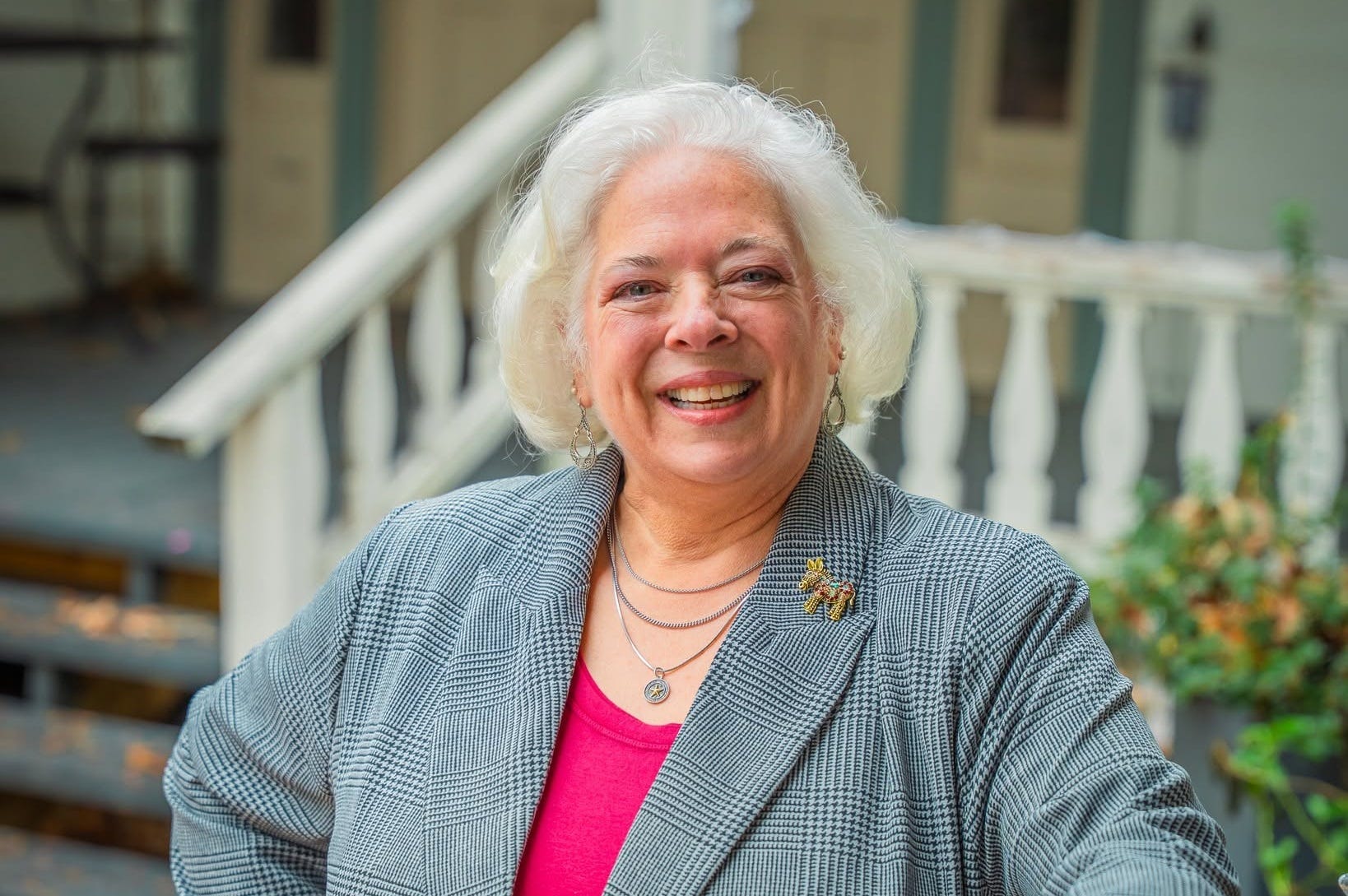
Who is Laticia Ambroz?
Laticia Ambroz has lived in Texas for over 60 years. She’s from Quitman, out in Wood County, deep in the piney woods of East Texas. She and her spouse raised three kids. Now she’s got eight grandkids and a great-grandbaby on the way.
Growing up, her mother taught her a simple but powerful lesson. Always leave things better than you found them. That’s her whole campaign. And when Ambroz looks at the state of Texas government right now, she says she can’t in good conscience leave it to her grandchildren, or to yours, without doing something about it.
Here’s the part that matters. Ambroz is running in Senate District 1, a nineteen-county stretch of deep East Texas covering Bowie, Gregg, Harrison, Smith, Titus, Wood and more, currently held by Republican Bryan Hughes. The last Democrat to even show up on the ballot against him was Audrey Spanko, back in 2020. This isn’t a swing district. It’s a district Republicans have gotten used to not having to defend.
So why run somewhere the deck is stacked six ways from Sunday? Because somebody has to, and because Ambroz isn’t pretending otherwise. Her pitch is refreshingly unglamorous. Revitalize the East Texas economy, fight for a living wage, get rural healthcare within driving distance of the people who need it, fund public schools like they matter. It’s the kind of platform that used to be called common sense before that phrase got weaponized by the other side. Ambroz wants it back.
The district.
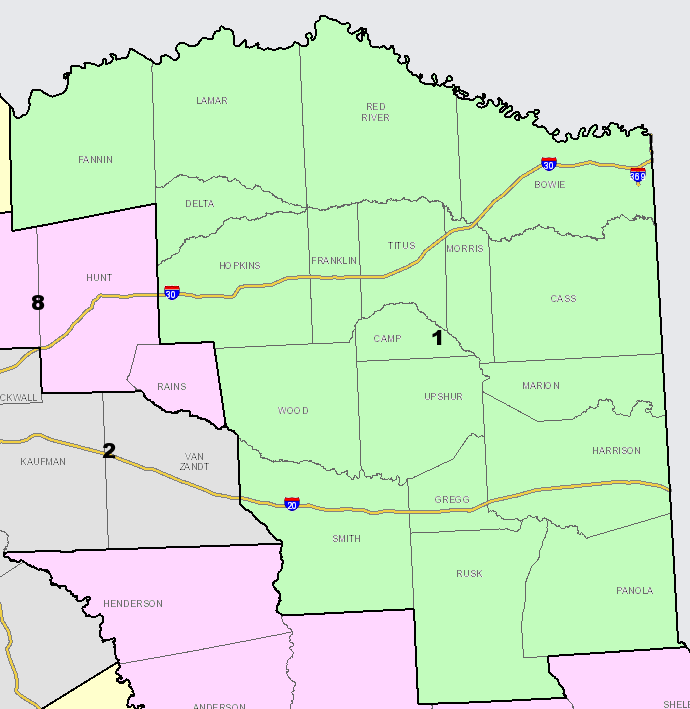
Is District 1 winnable in 2026? Almost certainly not, not with the current partisan lean and Hughes sitting comfortably unopposed the cycle before. But “unwinnable” and “not worth covering” aren’t the same thing, and a Democrat willing to put her name on the ballot in a district this red deserves the same fair hearing as anybody running in a toss-up.
Here’s what these nineteen East Texas counties are actually made of. Four counties do the heavy lifting. Smith County (Tyler) alone carries about a quarter of the entire district. Gregg County (Longview) adds another 124,239. Bowie County (Texarkana) brings 92,893. Harrison County (Marshall) chips in 68,839. Those four counties together are well over half the district. Everything else, Cass, Panola, Rusk, Upshur, Wood, Camp, Franklin, Delta, Red River, Marion, Morris, Titus, Fannin, Hopkins, Lamar, is small-town and rural East Texas, none of them cracking 70,000 people on their own.
If Democrats are looking for where the bodies actually are, it’s Tyler and Longview. That’s the floor of any real strategy here.
This district is old. 18.5% of the population is 65 or older, against 13.4% statewide. Working-age adults (18-64) are underrepresented at 57.7% versus 61.6% statewide. That shows up again in the household data: 35.1% of households here draw Social Security income, compared to 25.4% statewide. This is a retiree-heavy district, and retirees vote. Reliably.
Racially, it’s 62.9% Anglo, 37.1% non-Anglo. Black residents make up 17.0% of the population, actually higher than the state average of 14.1%. Hispanic residents are 16.7%, well below the state’s 39.7%. But that Hispanic population isn’t evenly distributed either. Titus County is the outlier of the entire district: 57.1% non-Anglo, 43.8% Hispanic, driven almost certainly by the poultry processing industry around Mount Pleasant.
Spanish-surname voter registration is only 6.8% of registered voters districtwide, against a state average of 24.7%, even though Hispanic residents are 16.7% of the population. That’s a registration and organizing problem. There’s a gap between who lives here and who’s on the rolls, and closing it, even partially, is base math.
Per capita income is $33,672, a full seven grand below the state’s $40,752. Only 22.8% of adults 25 and up hold a bachelor’s degree or higher, versus 33.8% statewide. This is a working-class, non-college district, and it is not a wealthy one. Poverty sits at 14.4%, slightly above the 13.8% state rate, and single-parent families make up 51.3% of families in poverty, with women heading the overwhelming majority of those households.
2024 general election: Trump 76.6%, Harris 22.5%. Cruz 74.7%, Allred 23.5%. Down the entire ballot, every statewide Democrat lands in that same 20-23% band, Supreme Court, Court of Criminal Appeals, Railroad Commission, all of it. This is a straight-ticket district. Nobody’s splitting tickets for a good Democrat down-ballot. Turnout was 63.5%, meaning roughly 405,000 people showed up, and roughly three out of four of them voted a straight Republican line regardless of the specific race.
This is not a competitive seat in 2026.
Forget flip math. Focus on three things. First, Tyler and Longview are where turnout operations get built, because that’s where the population is and where a Democratic floor already exists at the county level even if it’s thin. Second, the Spanish Surname VR gap in Titus County and beyond is real, uncontested organizing turf, registration work that doesn’t require converting a single Republican, just registering people who are already there. Third, message on the material conditions, income below the state average, education access below the state average, a manufacturing and healthcare workforce that depends on public investment staying intact. Culture war framing is a losing bet in a district like this. Kitchen-table economic populism, rural hospital access, wages, cost of living, is the only politics that has any shot of moving a number that currently sits at 23%.
Ambroz isn’t going to flip SD1. Nobody is, not this cycle. But if the goal is building infrastructure for the next decade instead of just showing up to lose gracefully every four years, this data tells you exactly where to plant the flag.
The incumbent.
Being a third-generation city girl myself, there’s one thing in the Texas Legislature that always gets under my skin. And that’s these country hillbilly lawyers who grew up deep in Klan Country, who run for office for the sole purpose of taking our state back to Jim Crow, while enriching all of their oil-loving, country club buddies back home. And if there ever were one, that would be Senator Bryan Hughes.

In 2021, when Republicans were ramming through SB1 and all of their voter-suppression laws, Hughes spearheaded a provision to keep Black churches from voting on Sunday (Souls to the Polls). After a ton of public pressure, that provision was stripped from SB1, but by golly, he sure did try it. It was Bryan Hughes who put it there, specifically him.
In the same session, Hughes fronted the ban on teaching critical race theory in Texas schools, along with an attempt to bar Texas corporations from adopting board diversity quotas.
Some Democrats described SB7’s provisions as “the new Jim Crow,” saying the bill amounted to voter suppression targeting Black voters specifically. Hughes’s response wasn’t to engage with that. He called it unfortunate that Texans were injecting “national political stuff” into what he framed as a straightforward policy discussion.
Hughes told CNN half a dozen times that the Texas Attorney General’s office had 400 open voter fraud cases, calling it documented fact beyond question. The actual number of pending voter fraud charges in Texas was 43, with only one stemming from the 2020 election in which more than 11 million Texans voted. He inflated the crisis by nearly tenfold on national television to justify a bill critics say targets Black and disabled voters.
And really, it’s only the tip of the iceberg with Hughes. He loves to write laws that will harm marginalized communities most.
In Laticia Ambroz’s own words.
Below are some questions I asked Ambroz, based on previous reader polls, along with her answers.
Q: Do you support a statewide minimum wage increase to at least $15/hour?
Absolutely, this is basic to helping Texas families survive. A livable wage is essential to a healthy economy. If people, moms and dads, are not having to work multiple jobs to make ends meet, they have more time to spend at home supporting their children-with homework, enjoying family meals, and instilling family values. Raising the minimum wage ensures that families and individuals can afford groceries, rely less on state benefits, and can keep a roof over their heads. Increasing the minimum wage to $15/hour should just be the starting point. People need to be able to afford housing, food, and medical care, which means a wage that keeps up with inflation, and we need to aggressively figure out how to slow inflationary costs.
Q: Should Texas end tax subsidies and abatements for large corporations?
This should be #1 on our list. Texas government is selling the People of Texas short. The State of Texas is so vast and has so many natural resources; in our own right, we are a wealthy state. We need industry to continue to be a healthy and wealthy state, but careful consideration has been thrown out the window. Why are we giving everything away? Why do we continue to line the pockets of the billionaires who are bleeding us dry? If you want to do business in Texas, Corporations must pay their fair share in taxes, be responsible stewards of our natural resources, and provide good-paying jobs and benefits for the people of Texas. If corporations cannot do this, then Texas does not need them. The Lone Star State should attract corporations that want to be partners with us.
Q: Do you oppose school vouchers and efforts to privatize public education?
This is the worst! 95% of our school children are in public schools. Our schools are already underfunded; the student-to-teacher ratio needs to be addressed, and teacher salaries need to be adjusted for the professionals that they are. This is our future, the future of Texas, and every child in Texas deserves the best education that we can provide. Texas is sadly lacking in education, and private and public schools are not the answer. Do not let Austin politicians run our public schools; they are not educators, and the school system should not be a for-profit entity, which is what they will turn it into.
Q: Should Texas guarantee free school meals to all K–12 students, regardless of income?
Yes, Children learn better with a full belly. School breakfast and lunch should be provided. This is a very small price to pay for quality schools.
Q: Do you support closing or downsizing state prisons and redirecting that funding to community-based alternatives like mental health care, housing, and youth programs?
Yes, so many of the people incarcerated need mental health assistance, and incarceration is not the answer. Getting the help needed beforehand and assisting in therapy and training would be a good start. Addressing affordable housing is a must across the board, and keeping our youth involved, educated, and supported is essential. People are lonely and looking for a place to belong, we need to provide that place, we need to support programs that provide that place.
Bonus Question: What does being a Democrat mean to you in 2026?
Being bold, thinking outside the box, considering all available options; actions speak louder than words.
Here’s what you’re actually looking at in SD1.
A retiree-heavy, working-class district that Trump carried by 54 points, represented by a man who spent every session trying to keep Black churches from voting on Sunday, banning honest history in classrooms, and lying to CNN about voter fraud by a factor of ten. Bryan Hughes is the honest face of what the state party has become when nobody’s forced to answer for it.
Laticia Ambroz is not going to beat him in 2026. Pretending otherwise insults both her and you. But somebody has to be on that ballot saying a $15 minimum wage isn’t a radical idea, that gutting corporate tax abatements while East Texas families choose between groceries and gas is a policy failure and not an act of God, that a fully-funded public school beats a voucher scheme every single time. Somebody has to be the name Democrats in Bowie, Smith, and Gregg County see when they open their ballot, so the muscle doesn’t atrophy completely between now and the year this district finally becomes contestable.
That’s infrastructure. It’s registration drives in Titus County where the Spanish surname numbers don’t match the population. It’s a floor in Tyler and Longview that doesn’t currently exist. It’s making sure the next Ambroz, or the one after her, isn’t starting from zero.
Hughes is betting nobody’s watching this district closely enough to notice what he’s spent a decade building. Ambroz is betting he’s wrong.
You can find out more about Laticia Ambroz from her website, Facebook, or Instagram.
86 days until the November election!
Did you know you can find links to all the previous Meet the Candidate articles on these lists?:
Click here to find out what Legislative districts you’re in.
We have to start somewhere in East Texas. Get the Hispanics registered, turn out the working class and build on that next election and the next.....
Thank you, Michelle, and thank YOU, Laticia, for taking this on!!! This Texan is truly appreciative.