

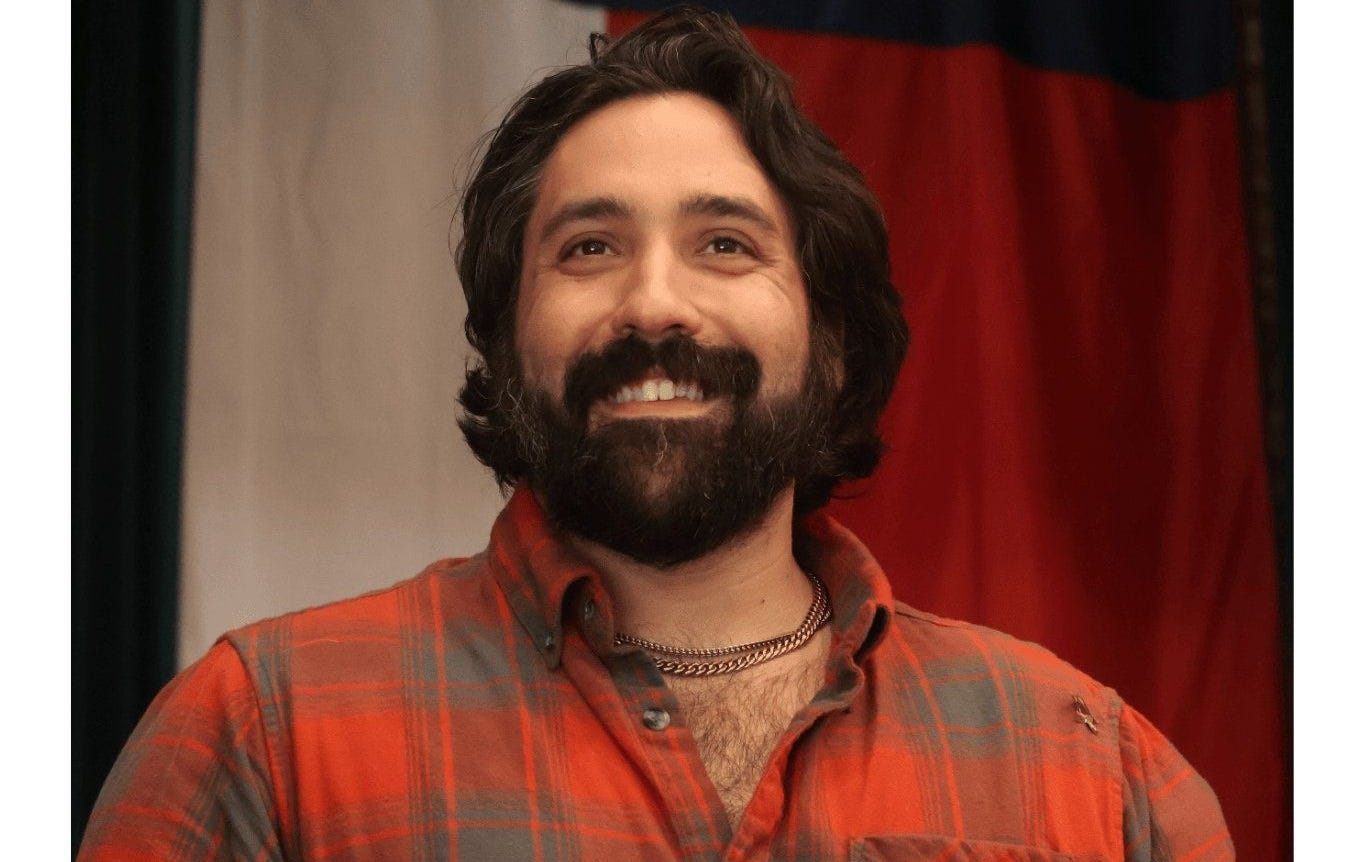
This series is called Meet The Candidates. Over the next eight months, I’ll spotlight a handful of Democratic races each month, mainly in the Legislature and in Congress. These aren’t endorsements. They’re introductions, a way to understand who’s running, the districts they hope to represent, and what’s at stake for people across Texas.
Who is Riley Rodriquez?
Riley Rodriquez is a working-class Texan from Abilene who’s spent most of his life doing the kinds of jobs that actually keep this state running. Rodriquez grew up in West Texas with a ranch-hand father and a probation officer mother, learning early what it means to work hard and stretch a paycheck.
Before running for office, Rodriquez cowboyed, worked in the oilfield, and eventually started his own small service business in District 28. While building that business, he also continued working toward a degree at Texas Tech. His campaign leans heavily on that lived experience. Rodriquez talks openly about what it means to live paycheck to paycheck, to worry about gas prices, housing costs, and the ups and downs of an oil-driven economy.
In this race for the Texas Senate, Rodriquez is pitching himself as a candidate for working Texans. And he’s running on the idea that someone who’s lived the economic pressures facing working families might approach those fights a little differently than the usual political class.
The district.
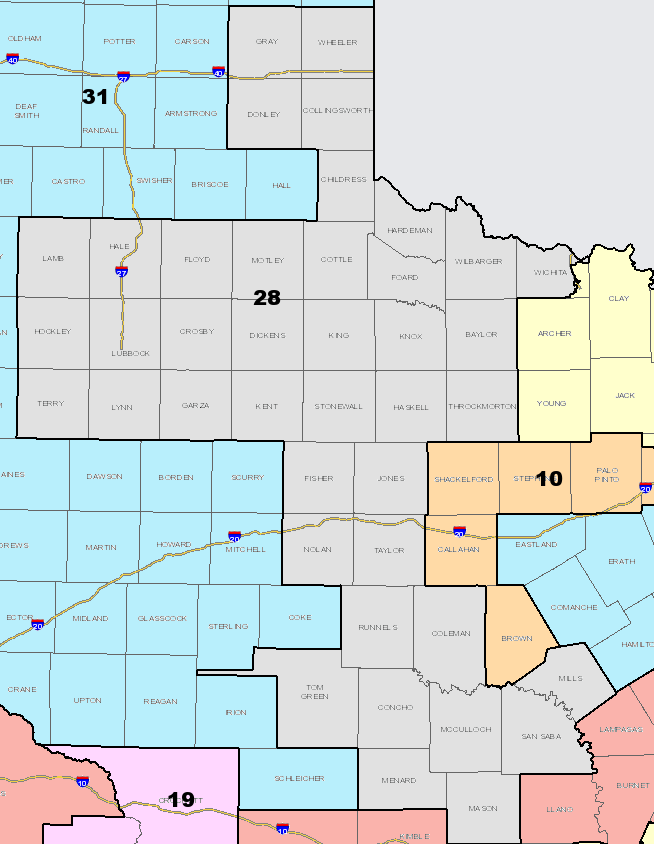
SD28 is a classic giant West Texas district. It is sprawling, rural, and culturally conservative, with population centers in places like Taylor County/Abilene and Tom Green County/San Angelo, plus part of Wichita County, surrounded by a long list of smaller counties that lean older, whiter, and more Republican. On paper, the district is still majority Anglo. The voting-age population is about 58.1% Anglo, 29.9% Hispanic, 7.4% Black, and 36.8% Black + Hispanic combined. That matters because this is not some monochrome district, but it is still built in a way that gives Republicans a structural edge.
Economically, SD28 shows 15.1% of residents living in poverty, a per capita income of $32,960, and a housing stock that is notably older than the state overall, with 41.5% of homes built before 1970. It also has a higher-than-state share of workers in agriculture/mining, and a very large share in education, health care, and social assistance. People are heavily car-dependent, and commute patterns suggest a district built around local and regional hubs rather than big-city transit or white-collar remote work. In other words, this is exactly the kind of place where a labor-populist message can make sense if somebody knows how to deliver it.
That’s how I would describe Rodriquez’s messaging. Labor-populist, and I think it works well with the messaging we’re seeing from the top of the ticket.
That said, flipping SD28 would still be hard as hell. The biggest problem for a Democrat is not just persuasion. It is the map plus turnout plus geography. In the 2021 plan data, District 28 had about 555,061 registered voters, and in 2022, only 249,608 people voted, which works out to about 45.0% turnout.
On the plus side, multiple overlapping candidates in West Texas have been coordinating for months already, and that’s going to help them all out.
So what would it take for someone like Rodriquez to flip it?
First, he would have to run up the score in the hubs. Abilene, San Angelo, and every precinct where younger, Latino, and Black voters, students, teachers, hospital workers, and service workers are concentrated.
Second, he would need to cut the Republican margin in the rural counties, not necessarily win them. Just lose them by less.
Third, he would need a message that is not generic state-party mush, but something grounded in the district’s actual conditions. Rising costs, rural hospital survival, public schools, water, housing, small business pressure, and corporate extraction. That kind of message fits the district profile much better than a consultant-crafted performance about bipartisanship.
The path would be something like a rural populist coalition. And I definitely get those vibes from Riley Rodriquez.
The incumbent.
Senator Charles Perry made the news for joking about shooting immigrants.

I just don’t know if that can be topped. By anything. Ever.
He also thinks that children are using cat litter in school bathrooms.
Here’s a video of him saying we should imprison asylum seekers:
Charles Perry is your everyday Texas Republican.
In Riley Rodriquez’s own words.
Below are some questions I asked Rodriquez, based on previous reader polls, along with his answers.
Q: Do you support a statewide minimum wage increase to at least $15/hour?
Yes, I 2400 a month for 40 hours a week is the least we can do. I recommend an increase in the poverty level limit. Nobody is getting by 35k a year, much less 25k.
Q: Should Texas end tax subsidies and abatements for large corporations?
Yes, if a small business couldn’t afford to pay its full taxes they would be closed down. The same goes for corporations with billions in capital.
Q: Should Texas end tax breaks and regulatory loopholes for oil and gas companies, including exemptions from emissions reporting and waste disposal standards?
Absolutely, oil companies treat the land and their workers like trash, and it’s time they were held accountable.
Q: Would you support redirecting state subsidies from fossil fuels to fund community-owned solar, wind, and battery projects in low-income and rural areas?
Yes, with tougher accountability towards those industries. More environmental regulations for all of them, as well as mandatory upkeep scheduling, evaluated by third-party experts not involved with the company.
Whether it's oil and gas or green energy, corporations are not to be trusted in any way and should be heavily regulated with penalties up to and including prison time.
Q: Should local police be barred from enforcing federal immigration law?
Yes, this sews fear and distrust in the community. If someone is in trouble, they are less likely to call the police.
Bonus Question: How do you plan to engage and energize young and working-class voters?
By being in front of them, young voters have been told for years that we are lazy, whiny, and we just don't want to work, all while working 2 or 3 jobs, racking up college debt, and being priced out of life.
Young people don't want to hear it anymore; we want solutions.
Running as a Democrat in West Texas is never the easy path.
Everyone knows that. But elections are not just about what the map looks like on paper. They are about whether anyone is willing to show up, talk to people where they live, and make the case that things do not have to stay the way they are.
Rodriquez is clearly trying to run that kind of campaign. A working-class candidate, talking about working-class problems, in a district full of working people.
Will that be enough to flip SD28? That remains to be seen. But races like this are how coalitions get built. Every vote earned, every rural county margin narrowed, every new voter brought into the process moves the needle a little further for the next race.
And if nothing else, Texans in District 28 deserve a real conversation about the future of their communities. About wages, housing, hospitals, schools, and who actually benefits from the decisions made in Austin.
That conversation only happens if someone is willing to run.
And Riley Rodriquez is.
You can find out more about Rodriquez on his website, Facebook, Instagram, and Threads.
April 2, 2026: Last day to register to vote (City elections/SD04 Special Election)
April 20, 2026: Last day to apply to vote by mail (City elections/SD04 Special Election)
April 20, 2026: First day of early voting (City elections/SD04 Special Election)
April 27, 2026: Last day to register to vote (Democratic primary runoff elections)
April 28, 2026: Last day of early voting (City elections/SD04 Special Election)
May 2, 2026: Last day to receive ballot by mail (City elections/SD04 Special Election)
May 2, 2026: Election day! (City elections/SD04 Special Election)
May 15, 2026: Last day to apply to vote by mail (Democratic primary runoff elections)
May 18, 2026: First day of early voting (Democratic primary runoff elections)
May 22, 2026: Last day of early voting (Democratic primary runoff elections)
May 26, 2026: Last day to receive ballot by mail (Democratic primary runoff elections)
May 26, 2026: Election day! (Democratic primary runoff elections)
Click here to find out what Legislative districts you’re in.
LoneStarLeft is a reader-supported publication. To receive new posts and support my work, consider becoming a free or paid subscriber.
Follow me on Facebook, TikTok, Threads, YouTube, and Instagram.
Looks like a winner to me.
Thank you, Michelle! Shared on bsky!