

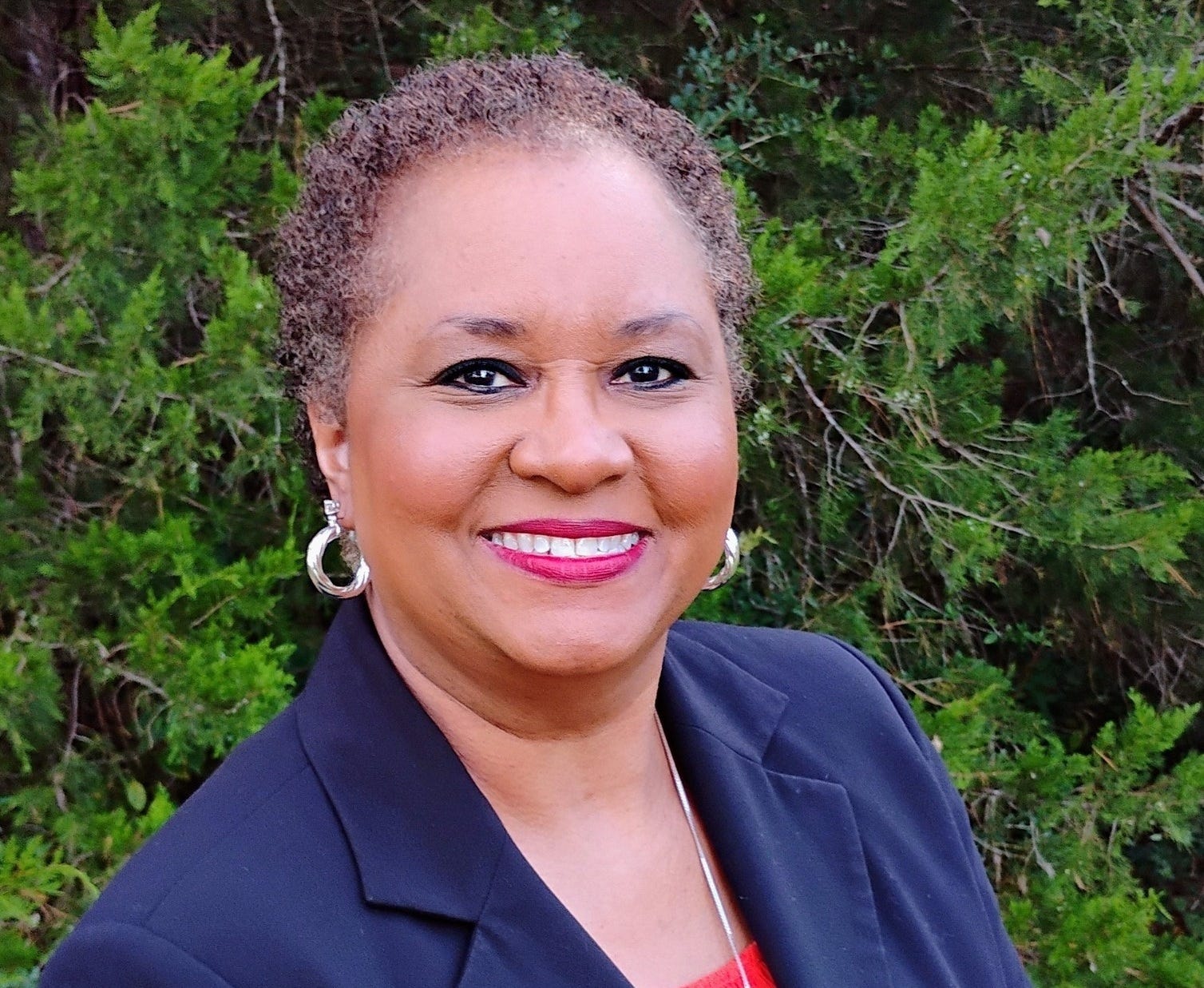
This series is called Meet The Candidates. Over the next seven months, I’ll spotlight a handful of Democratic races each month, mainly in the Legislature and in Congress. These aren’t endorsements. They’re introductions, a way to understand who’s running, the districts they hope to represent, and what’s at stake for people across Texas.
Who is Roxanne Lathan?
Roxanne Lathan is a longtime East Texan, born in Houston, raised in the region she now wants to represent, who built her life around family, faith, and public education. After marrying a Texas state trooper in the late ’80s, she spent decades raising her daughters before stepping into the classroom in 2004, eventually retiring as an elementary school principal.
Lathan is running on lived experience. Schools that lack sufficient resources. Families stretched thin trying to cover groceries, healthcare, and housing. Communities that keep getting told to wait their turn while the Legislature finds money for everything else.
Her campaign leans into that frustration. Lathan frames herself as someone who’s finally in a position to give back, and she’s zeroing in on bread-and-butter issues, like wages, jobs, education, and cost of living.
The district.
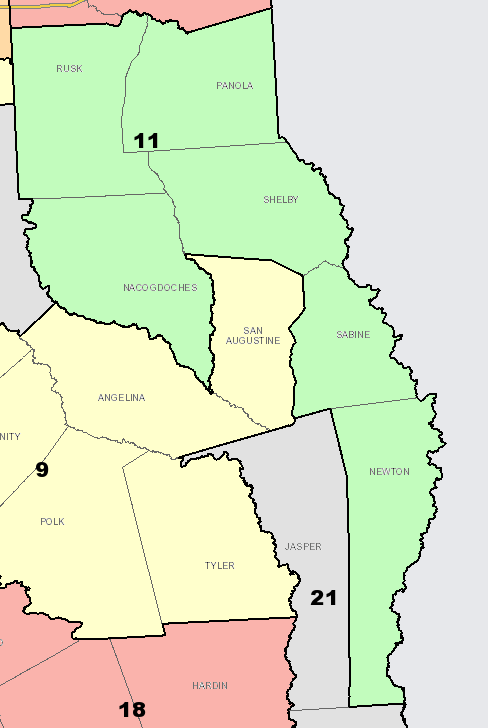
This district is so far in East Texas, it kisses Louisiana. On paper, HD11 is not one of those districts Democrats circle first when they’re building a flip map. This is still a deep-red East Texas seat.
In the 2024 presidential results, Trump took 77.8% here, to Harris’s 21.5%, and Cruz took 76.2%, to Allred’s 22.3%. That is a structurally Republican district.
And yet, there are still a few things worth understanding about it.
Nacogdoches is the population anchor, but the district also includes a mix of older rural communities, working-class families, retirees, and a sizable Black and Hispanic population spread across multiple counties. The district is about 63.2% Anglo overall, with a combined Black and Hispanic population of 33.2%. Nacogdoches, Rusk, and Shelby are the places where the nonwhite share is notably higher and where any Democratic path would have to start.
Economically, this is the kind of district Democrats should be able to talk to better than they usually do. Poverty is high at 18.5%, well above the state rate. Per capita income trails the state significantly. A large share of households are under $50,000 a year. The district has many people working in education, health care, retail, manufacturing, and other sectors that are directly affected by wage stagnation, school underfunding, hospital strain, and rural disinvestment. That is fertile ground for a real economic populist message.
So the ins and outs of HD11 are basically culturally conservative, heavily Republican, but not necessarily ideologically unreachable on economics. It is older than the state overall, more working class than the state overall, more rural, and more economically stressed. The problem for Democrats is not that there is no pain here. The problem is that Republicans have long owned the district's identity layer.
That means flipping it in a wave year would require more than just “better turnout.”
First, Democrats would need to run up the margins in Nacogdoches and cut the GOP advantage in places like Rusk and Shelby. In a district this red, shaving margins matters almost as much as expanding your base.
Second, the campaign would have to be relentlessly local and relentlessly economic. Cost of living. hospital access. school funding. water. wages. jobs. small-town survival. Not a generic state party script. Not a cable-news Democrat script. A district like this has to hear, over and over, that the people in power have had years to improve daily life and have not done it.
Third, a wave election would have to be real enough to scramble the usual partisan gravity. In a normal year, HD11 is not flippable. In a strong Democratic wave, it could become more competitive than people expect only if there is major anti-Republican energy, a turnout surge among Black voters and younger voters, meaningful persuasion among economically frustrated white voters, and a candidate who feels rooted in the district rather than imported into it.
That is the case for Roxanne Lathan. She reads like a community candidate. Teacher. principal. Grandmother. East Texas. Kitchen-table message. That profile makes more sense for HD11 than a nationalized Democrat ever would.
Still, to be blunt, this is an uphill climb. A wave could narrow it. A strong candidate could overperform. Democrats could make Republicans spend money here that they did not want to spend. All of that matters. But “flip” and “truly in play” are not the same thing. HD11 is the kind of seat where a good Democrat in a wave year can test whether East Texas populism has any room left to grow. If the margin tightens meaningfully, that tells us something important even if the district does not fall this cycle.
The incumbent.
Joanne Shofner’s race in 2024 was one of the many races across Texas that I found in paticularly amuzing. The long-time incumbent before her, Travis Clardy (R), refused to vote for school vouchers as they would hurt his district. But then came in Greg Abbott with $450,000 and Texas Lawsuit Reform with $725,000 to buy that race and make sure they had another vote for vouchers. Yes, she voted for vouchers. It wound up being a $1.3 million House race.
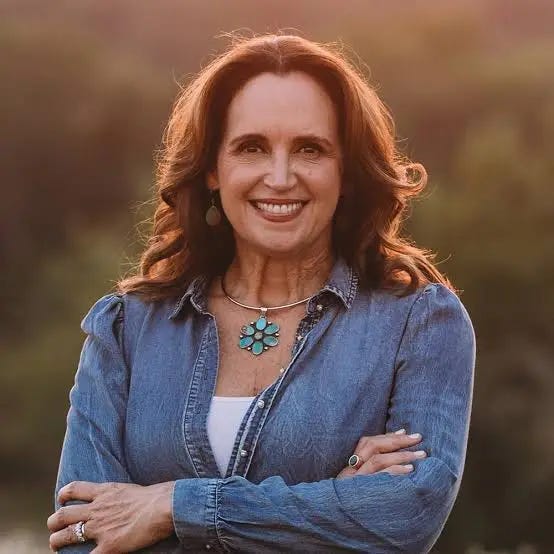
Poor Schofner. I’m not sure if she still smokes, but when she speaks, she has one of those gristly voices that you can tell she was a heavy smoker for probably many decades.
Schofner is a far-right extremist who spent her first session in office voting against the interests of her district. She has voted to harm public schools, cut rural health, and target the civil liberties of her neighbors. Another rank-and-file Republican.
In Roxanne Lathan’s own words.
Below are some questions I asked Lathan, based on previous reader polls, along with her answers.
Q: Do you support a statewide minimum wage increase to at least $15/hour?
Yes, I support raising the statewide minimum wage to at least $15 per hour. No one working full-time should struggle to afford basic necessities like housing, food, healthcare, and transportation. The current minimum wage has not kept pace with the rising cost of living, especially in communities across Texas where working families are feeling the strain of inflation and stagnant wages. Raising the minimum wage is a practical step toward restoring dignity to work and ensuring that hard work is fairly compensated. Even in states led by conservatives, leaders have recognized the need to act. Voters in Florida approved a pathway to a $15 minimum wage under their Alligator Alcatraz governor. If Florida can take that step, then Texas—now the eighth-largest economy in the world—has both the capacity and the responsibility to do the same. This is about fairness, economic strength, and ensuring Texas works for everyone—not just those at the top.
Q: Should Texas end tax subsidies and abatements for large corporations?
Yes, I believe Texas should end excessive tax subsidies and abatements for large corporations. While strategic, limited incentives can sometimes play a role in economic development, too often these subsidies shift the tax burden onto working families and small businesses while large, profitable corporations receive generous breaks. That is not a level playing field, and it undermines public trust when everyday Texans are asked to do more while corporations do less. Texas is one of the largest economies in the world, and we should be investing our resources in priorities that benefit everyone—strong public schools, infrastructure, healthcare access, and support for small businesses that are the backbone of our communities. When corporations benefit from our workforce, roads, and public services, they should contribute their fair share. Ending unnecessary subsidies is about accountability, fairness, and making sure taxpayer dollars are used to strengthen communities—not pad corporate profits.
Q: Do you oppose school vouchers and efforts to privatize public education?
Yes, I oppose school vouchers and efforts to privatize public education. Public schools are the foundation of our communities, especially in rural and small-town Texas, where they often serve as the heart of the community. Being a retired principal in public education, I am against the voucher scam. Voucher programs divert critical public funding away from neighborhood schools and send it to private institutions that are not held to the same standards of accountability, transparency, or accessibility. That weakens the very system that the vast majority of Texas children rely on. Instead of siphoning resources away, we should be fully funding public education—investing in teachers, improving facilities, expanding career and technical programs, and ensuring every student has access to a high-quality education regardless of where they live. Strong public schools create opportunity, support local economies, and prepare the next generation for success. Protecting and strengthening public education is essential to the future of Texas.
Q: Should Texas guarantee free school meals to all K–12 students, regardless of income?
Yes, I support guaranteeing free school meals to all K–12 students in Texas, regardless of income. No child should have to worry about where their next meal is coming from while trying to learn. Hunger directly impacts a student’s ability to focus, perform academically, and fully participate in school. Providing universal free meals ensures that every child starts the day ready to learn, without stigma or barriers tied to family income. This is also a smart investment in our future. When students are well-nourished, attendance improves, behavior stabilizes, and academic outcomes rise. Universal school meals reduce administrative burdens for schools, support working families, and strengthen communities. In a state as large and economically powerful as Texas, we have the resources to make sure every child is fed, supported, and set up for success.
Q: Do you support automatic voter registration and same-day registration in Texas?
Yes, I strongly support automatic voter registration and same-day registration in Texas. Voting is a fundamental right, and our system should make it easier—not harder—for eligible citizens to participate. Automatic registration helps ensure that more Texans are included in the democratic process, while same-day registration provides flexibility for people who may miss deadlines due to work, family responsibilities, or other barriers. Expanding access to voter registration strengthens our democracy by increasing participation and making sure every voice can be heard. When more people are engaged, our government becomes more representative and accountable. Texas should be leading the way in protecting and expanding voting rights, not putting up obstacles to them.
Bonus Question: Who are your political role models, living or dead?
My greatest political role model is my father, the late Rev. Eligha Walker, Jr. In the early 1990s, he served as president of the local NAACP and led a courageous effort to remove the Confederate flag from police uniforms and patrol car decals in Nacogdoches. It was a deeply difficult and divisive time—there were Ku Klux Klan marches in support of keeping the flag, and even local leadership initially refused to make a change. But my father never backed down. He stood firm in his convictions, spoke out against injustice, and remained committed to doing what was right, even when it was unpopular and came with personal risk. Because of that persistence and moral clarity, the city council ultimately voted to remove the Confederate flag. They recognized that continuing to display it was harmful—not only to the community’s values, but also to Nacogdoches’ future, including its tourism and the reputation of Stephen F. Austin State University. My father taught me that leadership means standing up for dignity, fairness, and truth—no matter the opposition. His example continues to guide me, and it is the standard I strive to live up to in public service.
If Democrats are serious about building a durable majority in Texas, it has to include places like this.
Places where people are working just as hard, struggling just as much, and getting just as little out of the people who have represented them for decades.
Roxanne Lathan is running the kind of campaign that tests whether Democrats still know how to talk to working-class voters outside the metro bubble. Schools. wages. healthcare. Food on the table.
Will that be enough to flip HD11 this November? It’s a tall order.
But if she can cut into the margin, force Republicans to defend a seat they take for granted, and prove that this message can land in East Texas, that matters. A lot more than people think.
Because every seat like this that gets closer is one step toward a map where Republicans can’t just write off half the state, and where Democrats don’t either.
And if there is a wave coming, the first sign won’t be in the places we expect.
It’ll be in districts like this.
You can find out more about Roxanne Lathan on her website, Facebook, Instagram, TikTok, and Twitter.
April 20, 2026: Last day to apply to vote by mail (City elections/SD04 Special Election)
April 20, 2026: First day of early voting (City elections/SD04 Special Election)
April 27, 2026: Last day to register to vote (Democratic primary runoff elections)
April 28, 2026: Last day of early voting (City elections/SD04 Special Election)
May 2, 2026: Last day to receive ballot by mail (City elections/SD04 Special Election)
May 2, 2026: Election day! (City elections/SD04 Special Election)
May 15, 2026: Last day to apply to vote by mail (Democratic primary runoff elections)
May 18, 2026: First day of early voting (Democratic primary runoff elections)
May 22, 2026: Last day of early voting (Democratic primary runoff elections)
May 26, 2026: Last day to receive ballot by mail (Democratic primary runoff elections)
May 26, 2026: Election day! (Democratic primary runoff elections)
Click here to find out what Legislative districts you’re in.
LoneStarLeft is a reader-supported publication. To receive new posts and support my work, consider becoming a free or paid subscriber.
Thank you, Michelle! She sounds terrific, but I understand how red that area is. Still-- her messaging sounds great! Already shared on bsky. (wish I didn't have a duplicate word in the post)