


This series is called Meet the Candidates. Over the next two months, I’ll spotlight a handful of Democratic races each month, mainly in the Legislature and in Congress. These aren’t endorsements. They’re introductions, a way to understand who’s running, the districts they hope to represent, and what’s at stake for people across Texas.
Who is Sandy Ibanez?
Sandy Ibanez is a fifth-generation Tejana who grew up in Fort Bend County. Her family experienced hardship when she was young, and remembers what it’s like when the power got shut off because the bill wasn’t paid, when the food on the table depended on a church pantry or a neighbor who noticed.
Ibanez went through Fort Bend ISD’s public schools, then on to the University of Houston’s Bauer College of Business, where she picked up a BBA in Management and Entrepreneurship through the Wolff Center. She followed that with an MBA from Western Governors University and, more recently, the Rice Advanced Management Program.
Along the way, she taught in Fort Bend ISD, worked her way into executive leadership at a Texas fintech company, and now works in commercial real estate. She also built two women’s networking and mentorship groups to get more women into leadership.
Ibanez is running because she’s angry at a system that keeps voting to strip away the exact programs that got her family through the hardest years. FAFSA. Medicaid. Utility assistance. College access programs. All of it is on the chopping block in Austin, aimed at the same working families she grew up in and still teaches, mentors, and does business alongside.
She’s talking openly about the cost of child care and elder care hitting families from both directions, the exhausting math millennials and Gen Z are doing just to approximate the stability their parents had, and the entirely reasonable conclusion a lot of Texans have reached that the political system currently in charge simply does not care whether they succeed.
The district.
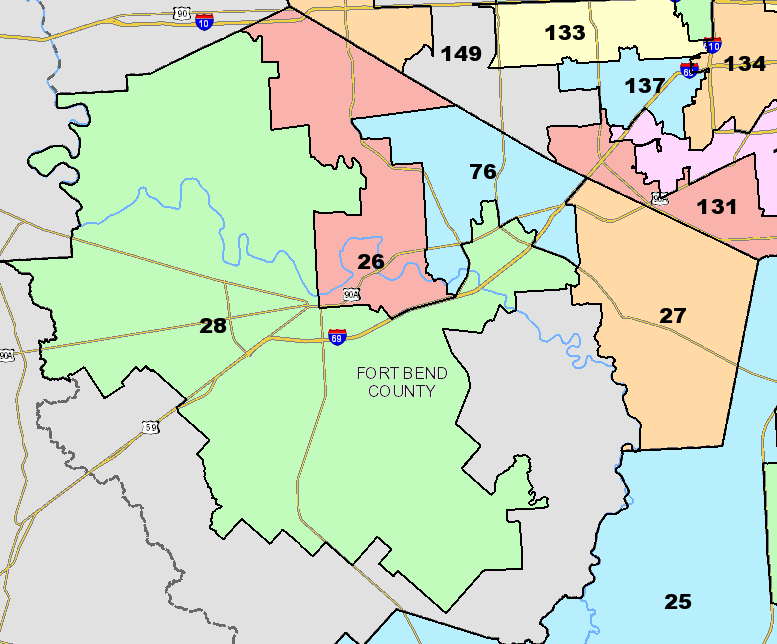
HD28 sits entirely in Fort Bend County, and the numbers make it hard to keep pretending this is a Republican stronghold.
Anglos make up 37.0% of the district. Hispanic residents are 27.7%, Asian residents 21.2%, Black residents 14.2%. Nearly two in five households speak a language other than English at home. This is also one of the more educated districts in the state. 51.7% of adults 25 and older hold a bachelor’s degree or higher, against 33.8% statewide, and only 6.6% lack a high school diploma, half the state rate.
It’s also a district doing comparatively well financially, which makes the GOP’s austerity pitch even harder to justify here. Per capita income is $52,434, compared with a state figure of $40,752. Poverty sits at 8.0%, nearly half the statewide rate of 13.8%. A third of households pull in $200,000 or more a year. Homeownership is 78.9%, well above the state’s 56.7%, and the average home is worth $466,086. This is a district full of people who worked hard, built something, and are now watching the same party that claims to champion that work ethic try to gut the programs that got a lot of these families here in the first place.
HD28 is people raising kids, building equity, and staying put, in housing built mostly since 2010, which tells you this is newer suburban growth, not an old-money enclave.
In 2024, Harris took 40.3% here against Trump’s 57.1%. Allred did slightly better at 43.1% against Cruz’s 54.4%. Then you get to the State House race. Gates won 60.6% to Rocha’s 39.4%, a 21-point spread, wider than either race above it, on the same ballots. Nobody’s been running a real campaign for this seat, and Republicans have counted on that silence to keep it safe.
The generic ballot in 2026 has Democrats up somewhere between 6 and 9 points nationally, with Trump’s approval hovering in the high 30s and the unpopular Medicaid cuts in the 2025 reconciliation bill polling at -59 net, worse than ACA repeal ever tested. That’s wave territory, and waves are turnout stories, which is exactly the mechanism that could finally close a 21-point downballot gap built on nothing but low information.
What would it take?
Three things. A campaign that treats the State House race like it matters instead of letting turnout do all the work; closing the Spanish Surname voter registration gap, which sat at 17.7% against a 24.7% state rate as of 2024, in a district where Hispanic residents are more than a quarter of the population; and turnout that doesn’t collapse the moment there’s no presidential race to drag people to the polls.
HD28 isn’t a hard sell. It’s educated, comparatively wealthy, heavily non-Anglo, and full of families with something to protect. The only thing that’s kept it red is that nobody’s bothered to ask those families for their vote directly. That’s a fixable problem, and 2026 is shaping up to be the year someone finally fixes it.
The incumbent.
Back in 2016, during his Republican runoff for the Railroad Commission, then–state Rep. Wayne Christian publicly branded HD28 incumbent Republican Gary Gates a “slumlord” and pointed to Gates’ history of a troubled city loan and a court fight over safety conditions at a crime-ridden apartment complex he owned in Houston.

And then there’s the pandemic-era landlord behavior that tells you everything you need to know. A Houston Chronicle analysis found Gates filed at least 104 evictions across 34 apartment complexes in and around Houston after Texas’ disaster declaration in 2020, with nearly three-fourths ending in judgments against tenants.
More recently, Gates has been unusually blunt about the power imbalance he benefits from. In 2025, reporting on Texas eviction policy fights, the Houston Chronicle quoted him saying it’s “very, very easy” to evict a tenant in Texas, and acknowledging, out loud, that he already has “an incredible advantage,” while noting he owns more than 30 apartment complexes across Harris County.
“Follow the money” matters, because he’s not just a landlord; he’s a landlord writing laws.
In Sandy Ibanez’s own words.
Below are some questions I asked Ibanez, based on previous reader polls, along with her answers.
Q: Do you support a statewide minimum wage increase to at least $15/hour?
Yes. Texas’ minimum wage has remained at $7.25 since 2009. I support raising the statewide minimum wage so that full-time work provides a more realistic path to economic stability while recognizing the needs of workers and small businesses.
Q: Do you oppose school vouchers and efforts to privatize public education?
Yes. I oppose using public education dollars to subsidize private schools at the expense of the public school system. Texas should fully fund public schools, support teachers and staff, and ensure every student has access to a high-quality education.
Q: Should Texas guarantee free school meals to all K–12 students, regardless of income?
Yes. Students should not have to learn while hungry. I support expanding access to free school meals so that every child can focus on learning rather than whether they can afford lunch.
Q: Should Texas end tax breaks and regulatory loopholes for oil and gas companies, including exemptions from emissions reporting and waste disposal standards?
Texas should not give any industry a free pass from reasonable health, safety, environmental, or reporting requirements. I support reviewing industry-specific exemptions and ensuring that companies follow clear, enforceable standards while protecting Texas’ energy economy and reliability.
Q: Do you support closing or downsizing state prisons and redirecting that funding to community-based alternatives like mental health care, housing, and youth programs?
I support investing in mental healthcare, substance-use treatment, housing stability, and youth programs as part of a broader public-safety strategy. Where evidence shows that community-based programs can safely reduce incarceration and recidivism, Texas should invest in those alternatives while maintaining appropriate protections for public safety.
Q: Do you support publicly financed elections to reduce corporate and PAC influence?
I support greater transparency and accountability in campaign finance and am open to public-financing models that are constitutional, administratively workable, and designed to broaden participation. Texans should be able to clearly understand who is funding political campaigns.
Bonus Question: What does being a Democrat mean to you in 2026?
To me, being a Democrat means believing that government should work for people and that everyone deserves an opportunity to build a good life. It means investing in strong public schools, affordable healthcare, good jobs, infrastructure, and communities while protecting individual rights and making government accountable to the people it serves.
HD28 is a district full of people who did everything right, built equity, raised families, sent their kids to good schools, and got represented by a man who increased his wealth by evicting people during a pandemic.
Gates is out of step with the values the district’s own numbers suggest it actually holds. Work hard, build something, take care of your neighbors. He built his political career doing the opposite to the people renting from him.
Ibanez is on the basic premise that government should function for the people living under it.
HD28 has spent years being taken for granted by a party that assumed a slumlord’s name on the ballot was enough, propped up by a downballot silence nobody bothered to break. That silence doesn’t hold in a wave year, not with Hispanic voters swinging back left, and not with Medicaid cuts polling underwater.
HD28 is ready. The only question left is whether Democrats finally show up.
You can learn more about Sandy Ibanez on her website, Facebook, Instagram, and TikTok.
44 days until the November election!
Did you know you can find links to all the previous Meet the Candidate articles on these lists?:
Click here to find out what Legislative districts you’re in.
LoneStarLeft is a reader-supported publication. To receive new posts and support my work, consider becoming a free or paid subscriber.
Follow me on Facebook, TikTok, Threads, Bluesky, YouTube, and Instagram. Or join my Facebook Group.
Great informative article. Looking forward to more and hoping Ibáñez wins!