

This series is called Meet the Candidates. Over the next two months, I’ll spotlight a handful of Democratic races each month, mainly in the Legislature and in Congress. These aren’t endorsements. They’re introductions, a way to understand who’s running, the districts they hope to represent, and what’s at stake for people across Texas.
Who is Shiloh Salazar?
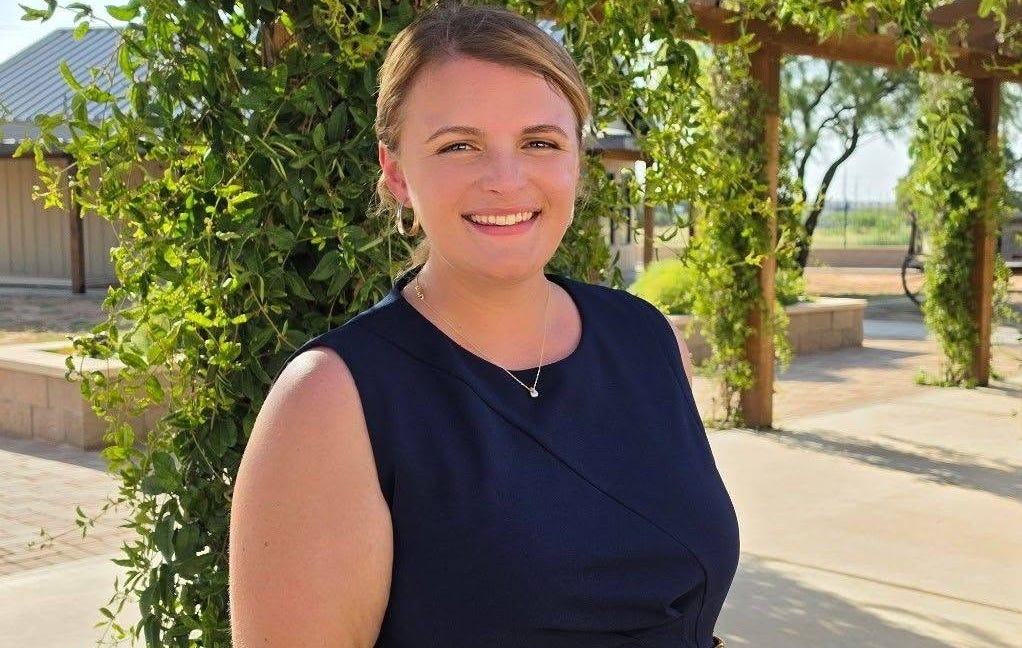
Shiloh Salazar is a mom, small business owner, former educator, and lifelong West Texan who’s had enough of watching corporate interests get a seat at the table. In contrast, working families get the short end of the stick.
Salazar spent years organizing and showing up on public schools, early childhood programs, water security, agriculture, healthcare access, economic stability, the unglamorous stuff that actually determines whether a rural community survives. She’s testified about early intervention programs on Capitol Hill. She’s stood up at community meetings packed with residents furious about a data center project. She’s the reason there’s a paper trail on FCI Big Spring’s closure and what it’s doing to the families who depended on those jobs. This campaign is built on a record of actually being in the room.
She’s also a parent of a child with special needs. That’s not a talking point Austin Republicans can fake, no matter how many times they slap “family values” on a bill that guts the programs families actually need.
Her platform reads like a checklist of things Texas Republicans have spent a decade underfunding or ignoring. Protecting public schools, investing in rural healthcare, strengthening agriculture, planning honestly for a water future, and backing paid family leave and affordable childcare.
Salazar’s whole pitch is people-first solutions rooted in West Texas, not culture-war talking points imported from a cable news green room.
The district.
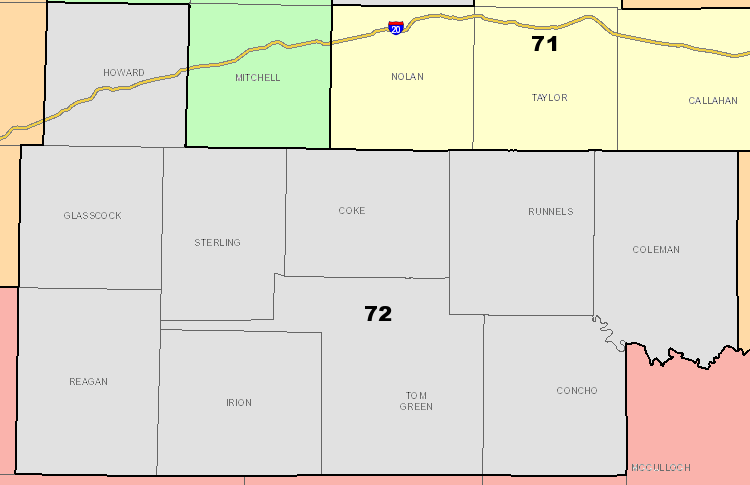
HD72 covers Coke, Coleman, Concho, Glasscock, Howard, Irion, Reagan, Runnels, Sterling, and Tom Green counties, basically the Concho Valley and the ranch and oilfield country around it, anchored by San Angelo (Tom Green County, roughly two-thirds of the district’s population) and Big Spring (Howard County). It is Drew Darby’s seat.
Demographics are 51.8% Anglo and 48.2% non-Anglo. Hispanic residents make up 40.3% of the district. Median household income runs well under the state average. Per capita income is $34,894 versus a state figure of $40,752, and nearly 22% of households earn under $25,000 a year.
It’s an older district. 17.1% are 65 or older versus 13.4% statewide, and it’s a heavily veteran district; over 11,000 veterans call it home. The economy runs on agriculture, ranching, and oil and gas (7.4% of employment versus 2.3% statewide) and on government jobs (18.6% of the workforce versus 14.1% statewide, driven in no small part by FCI Big Spring before the feds gutted it).
Housing is cheap by state standards. The average owner-occupied home value is $221,027 versus $366,039 statewide, but rent burden is brutal. 34% of renters pay more than a third of their income to keep a roof over their heads.
So this is a poorer, older, heavily rural, heavily veteran district with real pockets of Hispanic and Black population concentrated in specific counties, especially Howard and Reagan, sitting inside a state that is trending the other way politically even as its demographics shift.
In 2024, Trump led by 56 points here, Cruz led by 51 points, and Drew Darby ran unopposed. Turnout was only 62.1%. Darby also ran unopposed in 2022.
I’m not going to sit here and tell you this is a swing district, because it isn’t. The biggest goal in this election cycle should be to move the margins as far left as we can and see where we land, but this district would need a fundamental realignment to flip.
To make real gains, Salazar should focus where coalitions already exist, like Howard and Reagan Counties. They’re already majority non-Anglo with heavy Hispanic populations. That’s turnout work, and turnout is exactly where rural Democratic campaigns bleed out.
She has to run on material conditions since this district is poorer than the state average, older, more dependent on government jobs, and just got hit with a federal prison closure that gutted Big Spring’s employment base. That’s the actual local economy that may have a chance of cutting through in a district where “Democrat” has been a slur for two decades.
Democrats would be doing themselves a lot of favors to exploit the local fights the GOP has created. The Dove Creek data center fight, the water transparency mess, the “sanctuary county for the unborn” ordinance. These are all local controversies where the incumbent’s party is on the unpopular side, and where Salazar has already shown up in person.
Salazar’s campaign looks less like a Hail Mary and more like the first real investment anyone’s made in finding out what this district actually looks like when someone bothers to organize it. It’s a really good thing, but it isn’t easy.
The incumbent.
Drew Darby (R), an attorney and businessman, runs Drew Darby and Associates Law Firm and owns Surety Title Company out of San Angelo. He’s held HD72 since 2007. He chairs House Energy Resources, sits on House Administration and State Affairs, and got a seat on the special committee investigating the July 2025 flooding disaster. In a district built on oil, gas, and increasingly on data centers hungry for both power and water, chairing Energy Resources is a savvy bit of self-preservation.
And I didn’t catch on to how much until, in 2025, he had the gall to imply that the oil industry is taxed TOO MUCH.
Too much. Like killing millions of people a year and destroying our planet deserves less tax.
Before Austin, he chaired the San Angelo Water Advisory Board and the Lake Nasworthy Advisory Board. This is a man who has literally chaired the region’s water planning bodies and now, decades later, is presiding over a district where residents are showing up to town halls furious about opaque data center deals and where Salazar is out there saying West Texas needs “honest water policies now.” Darby’s been the water guy all along.
In Shiloh Salazar’s own words.
Below are some questions I asked Salazar, based on previous reader polls, along with her answers.
Q: Do you support a statewide minimum wage increase to at least $15/hour?
I support this, but I actually think we need more of a sliding scale because in some areas even 15 is not enough. As someone who lives in West Texas, in the rural areas, I’m tired of a one-size-fits-all when it comes to things like the economy.
Q: Do you oppose school vouchers and efforts to privatize public education?
As a former public school educator at a Title I school, I’m against vouchers. I have a daughter who was in special education with a district that had only online therapists because they couldn’t afford to hire someone to keep them in rural West Texas. I’m actually in favor of doing a sales tax on the data that data centers acquire and store, and using that sales tax to fund our schools.
Q: Should higher education in Texas be free or debt-free at public institutions?
100%. As a student who’s parents worked in public service and just over the threshold of too much for aid but not enough to help support me through getting a degree, I became an unconventional student who took classes online a little here a little there when I could afford them because we lived in that predicament. It wasn’t that I didn’t want a degree; I’m still a few classes shy of that degree because money got tight, but we were always just over that threshold and never quite made enough to keep going.
Q: Should Texas guarantee free school meals to all K–12 students, regardless of income?
100%. Again, I live in a Title I area where over 69% of the population is below the poverty line. I was pregnant, making only 669 a month working at the ISD, feeding kids some of my pregnancy snacks because lunch wasn’t enough, and they knew dinner would be short-handed. If we are going to force families to send their kids to school 8 hours a day, we better feed those babies.
Q: Should Texas end tax breaks and regulatory loopholes for oil and gas companies, including exemptions from emissions reporting and waste disposal standards?
Yes. We should go one step further and make sure that they are not doing in-house testing, and make sure a third party is testing and sending those results in a way that can be requested as open records if a need should arise. We should also be taxing oil and gas a lot more on the routes they take and helping rural counties that are primarily oil industries keep up with the county roads that were not made to handle that load. For example, in 2019, Howard County had $ 57 million dollars worth of road damage to county roads and had one of the worst safety ratings on those roads in the state of Texas. Many roads were deemed deadly because of their conditions, yet Howard County doesn’t have the tax base to fix those roads.
Bonus Question: What does being a Democrat mean to you in 2026?
Look, I’m running in 10 counties, and only 3 have party chairs; of those 3, they’re very small and not very active. I am in an R+56 area. I don’t have time to worry about the title or the party. To me, I’m a Democrat because I’m pushing to get people back at the kitchen table and talk about what we are going through and how we can work together and fix it. I don’t play party politics, though. I will call out both sides when they aren’t doing the right thing. I have told thousands of voters I don’t need you to become a Democrat; I need you to vote for the person that actually cares. Being a democrat out here means you get hated the moment you open your eyes, until you put the party aside and start talking about an electric bill that’s $500 that we both can’t afford.
Shiloh Salazar is running because the electric bill is $500 and nobody in Austin is losing sleep over it.
Meanwhile, Drew Darby, who’s had nineteen years and a chairmanship over the region’s own water board to actually fix something, spent 2025 arguing the oil industry gets taxed too much while his district’s roads crumble and his constituents ration lunch money.
HD72 isn’t flipping this cycle. That was never the pitch. But somebody finally showed up to find out what happens when you organize a district everyone else wrote off, and that alone is worth paying attention to. Watch this one.
You can learn more about Shiloh Salazar on her website, Facebook, or TikTok.
45 days until the November election!
Did you know you can find links to all the previous Meet the Candidate articles on these lists?:
Click here to find out what Legislative districts you’re in.
LoneStarLeft is a reader-supported publication. To receive new posts and support my work, consider becoming a free or paid subscriber.
Follow me on Facebook, TikTok, Threads, Bluesky, YouTube, and Instagram. Or join my Facebook Group.
I have been following her on Facebook, and she is so refreshingly down to earth and solutions-oriented. She would be an awesome addition to the Texas Legislature.
I fervently hope this is the year Republicans realize how often they vote against their own interests by voting for the person with an R next to their name. See the light and vote for the person who will represent ALL of their constituents.