

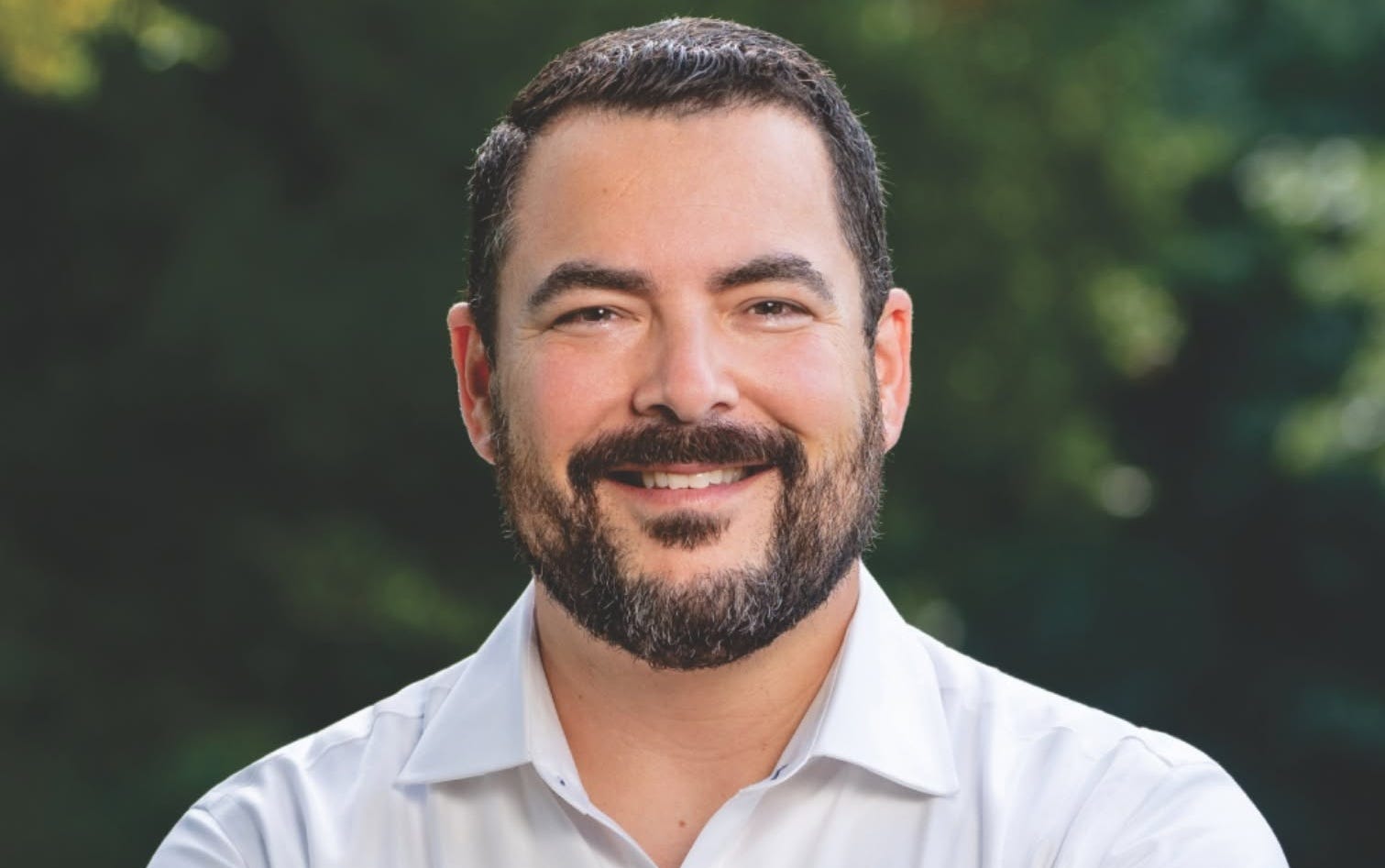
This series is called Meet the Candidates. Over the next three months, I’ll spotlight a handful of Democratic races each month, mainly in the Legislature and in Congress. These aren’t endorsements. They’re introductions, a way to understand who’s running, the districts they hope to represent, and what’s at stake for people across Texas.
Who is Zach Herbert?
Zach Herbert is a theology major turned lawyer, turned Marine, turned small business owner, turned public school dad, turned homeowner with opinions about Austin. He’s running as a Democrat who happens to have been a Marine, and he’s not shy about drawing a straight line from each chapter to a policy position.
Theology school taught him inclusiveness. Law school taught him to fight for people with no power. The Marines taught him leadership by example. Running a small business taught him what it actually costs to give your employees health insurance and still make payroll.
Herbert is raising kids in Texas public schools and a homeowner in HD112, so “local control” is whether his neighborhood’s decisions get overruled by a legislature two hours away. That’s important to him.
Policy-wise, Herbert is running a fairly standard progressive platform. Medicaid expansion, a livable minimum wage, reproductive rights framed explicitly around bodily autonomy, local control against legislative preemption, small business support tied to worker benefits, and a gun safety position that leads with the Second Amendment.
The district.
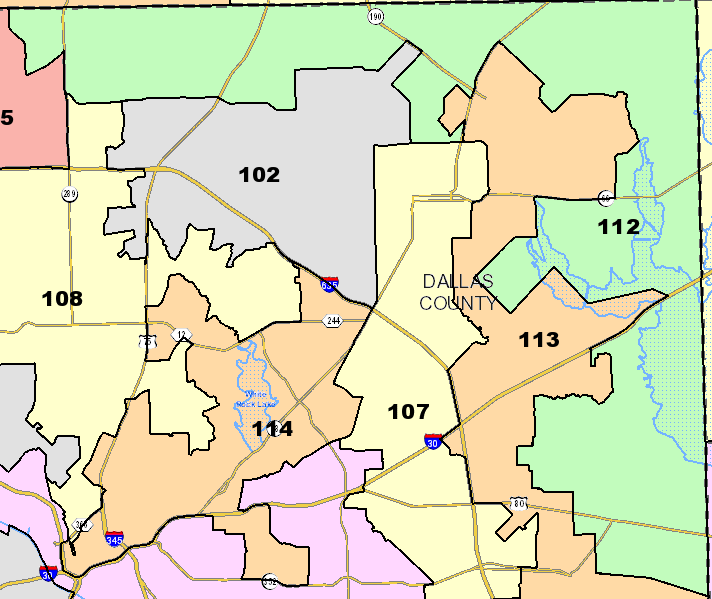
HD112 sits in the northeast Dallas suburbs around Richardson, and it’s one of the DLCC’s target seats. This isn’t a red district. It’s a district ready to flip, one that has previously missed it only by a hair.
Look at 2024. Trump beat Harris here 50.4% to 47.0%, 3.4 points; but scroll down the ballot. Colin Allred beat Ted Cruz in this district. Won. 50.2% to 47.8%. Voters in HD112 pulled the lever for Trump and then turned around and fired their Republican senator’s opponent in favor of the Democrat.
Classic ticket-splitting. Now look at the actual legislative race. Angie Button beat Avery Bishop 53.9% to 46.1%, a 7.8-point margin, nearly five points worse for Democrats than the Senate race. Same district with the same voters. Button ran ahead of Trump.
HD112 is 52.7% Anglo, 47.3% non-Anglo, with a meaningful and growing Asian population (12.5%, nearly double the state rate) alongside Black (15.1%) and Hispanic (19.2%) residents. This is a diverse, suburban, highly educated district. Nearly half the adult population (49.3%) holds a bachelor’s degree or higher, compared to 33.8% statewide. Per capita income is $55,699, compared with a state average of $40,752.
Homeownership sits at 65.1%, well above the state’s 56.7%, and the average home value is $475,899. These are people with equity, with property tax bills, with a direct financial stake in whatever the Lege does to their appraisal caps and their school funding formulas. Renters here aren’t cheap either: 82.5% of renter households pay $1,250 or more a month, and gross rent as a share of income is squeezing renters harder than owners across the board.
Turnout in 2024 was 69.3%, a full eight points above the statewide rate of 61.3%. It’s a high-propensity district that needs to be moved.
Democrats need to close a 7.8-point gap, and the Allred/Cruz result already proves there are enough ticket-splitters in HD112 to do it if the Democratic candidate is credible enough to earn their vote independent of the top of the ticket. Button’s overperformance of Trump proves she’s a strong incumbent, which means Herbert’s task is less about persuading Republicans on ideology and more about persuading soft partisans and independents that he’s a known, safe, credible alternative before Election Day.
Herbert’s profile as a veteran and business owner gives him a shot at actually converting some of those Trump-Allred split-ticket voters into voters who vote their pocketbook and their kid’s public school teacher down ballot.
The incumbent.
Angie Chen Button’s (R) branding does a lot of heavy lifting, and it should be dismantled. Button is a “good” Republican. The small business type. The CPA who worked at Texas Instruments for four decades, who talks about trade and workforce development instead of culture war, who Texas Monthly once named a best legislator for shepherding childcare funding. She’s not Bryan Slaton. She’s not screaming about litter boxes in bathrooms. She’s reasonable, or so the story goes.
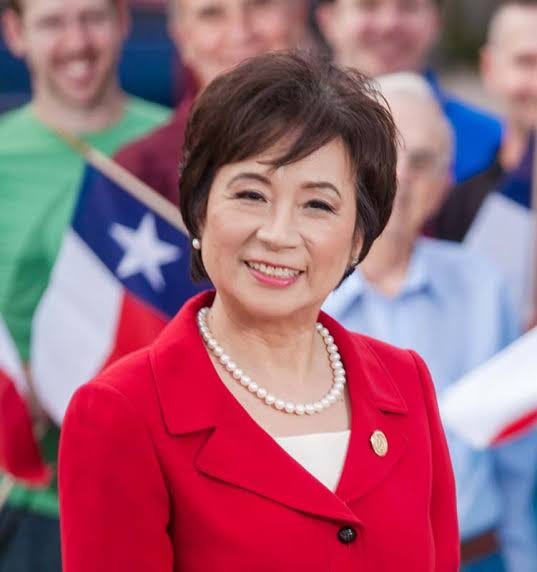
But reasonable people don’t spend their careers as Greg Abbott’s most reliable vote in a district Abbott needs to hold to push his agenda through. Button has close ties to Abbott, and he’s counted on her specifically to help deliver school vouchers, the single most destructive policy aimed at Texas public education in a generation. She was endorsed by Abbott in her own primary explicitly because she backed his voucher push, and last session she voted yes on SB2, the bill that carves $1 billion out of the state budget to fund private school tuition, no accountability, no public oversight, straight out of the pockets of the same public schools 60% of District 112 kids actually attend.
A legislator who helps starve public schools to fund private tuition for families who can already afford it isn’t moderate. She’s just as extreme as any other Republican.
Oh, and then she turns her own family’s flight from persecution into a rhetorical cudgel. When Button needs to kill a Democratic bill, like expanding Medicaid, raising the minimum wage, or funding public schools instead of vouchers, she reaches for the ghost of Mao. Government healthcare becomes “socialism.” A living wage becomes the first domino toward “government control.” It’s the oldest trick in the Texas GOP playbook. But Button puts her personal narrative on it. Because who’s going to call out a woman whose family fled communism for invoking, well, communism?
Here’s the con. What her parents survived in China wasn’t a robust social safety net. It wasn’t Medicaid expansion, a minimum wage hike, or a school district that could actually pay its teachers. It was one-party authoritarian rule, religious persecution, a government that came after people for what they believed, not what benefits they collected.
Conflating that with Texas Democrats wanting to make sure a diabetic in Richardson can afford insulin is an insult to what her own family actually went through. It cheapens a real story of authoritarian violence by hitching it to a policy fight about whether working people should have healthcare. That’s the bait and switch. She’s not protecting you from the thing her family survived. She’s protecting insurance companies and private school lobbyists, and borrowing her parents’ trauma to do it.
In Zach Herbert’s own words.
Below are some questions I asked Herbert, based on previous reader polls, along with his answers.
Q: Should Texas end tax subsidies and abatements for large corporations?
Yes. Giving corporate handouts while cutting school funding and refusing to expand Medicaid makes no sense. For too long, Texas residential property owners have been footing the bill while large corporations post record profits and don’t pay their fair share. Further, these same corporations are buying bills in Austin that benefit their bottom line and take away local control.
Q: Do you oppose school vouchers and efforts to privatize public education?
Yes. This is nothing more than a concerted effort to defund our schools. The only people this law benefits are the affluent families that already attend private schools. I have spoken with families who qualified for the TEFA account but couldn’t find a school willing to accept their child with special needs. Why are we giving taxpayer money to schools that don’t have to follow the same rules as public schools? Private schools can turn kids away for any reason, don’t have to follow the same testing or curriculum requirements as state schools, and they don’t have to account for the money they do get from the state through this voucher scam. We should focus on fully funding public schools, revamping the allotment to be enrollment-based and inflation-indexed, and eliminating state takeover.
Q: Should Texas end tax breaks and regulatory loopholes for oil and gas companies, including exemptions from emissions reporting and waste disposal standards?
Yes. I acknowledge that this great state was built on oil and gas. However, it has also created a reliance that has been detrimental to our politics, people, and climate. We need to move away from turning a blind eye to oil and gas regulation, which allows companies to control our lawmakers and elected officials.
Q: Do you support closing or downsizing state prisons and redirecting that funding to community-based alternatives like mental health care, housing, and youth programs?
Our prison system is severely strained and approaching the maximum limit. When combined with local county jails, nearly half of the adult incarcerated population in Texas involves nonviolent individuals. Lowering penalty levels for nonviolent offenses like drug possession, expanding mental health and substance abuse diversion programs, and improving community supervision programs will save taxpayers money and greatly reduce the inmate population. Studies have shown that making illegal behavior more illegal does not deter criminal behavior. Addressing the underlying reasons for the behavior, however, does. So my answer is: address the underlying problem, and then we will reduce the strain on our prison system.
Q: Do you support automatic voter registration and same-day registration in Texas?
Yes. We should not be placing restrictions on access to the ballot box. This effort to go after “voter fraud” has been debunked. Extensive research, studies, and audits have found that this is nonsense and so minuscule that it cannot alter election outcomes. Any effort to restrict voting access couched in the “voter fraud” excuse is nothing more than voter suppression and a dangerous attempt at keeping power.
Bonus Question: How do you plan to engage and energize young and working-class voters?
I was just talking to a dad like me the other day. He has a first grader at the same elementary school as my two younger ones. We commiserated about how hard it is to find time to attend political events, rallies, etc. Parents of young ones like us are glad to just make it out to vote. I’ve tried to make my events family-friendly. I have been having “Scoops with Zach” events at local parks (with playgrounds) throughout this campaign. I invite the neighborhood, the local ice cream truck comes, and we all meet under a pavilion to talk about the issues that affect us most. We have had a great response to these events, with around 30-50 people attending each one. I have done 7 so far, with plans to do another 6 before the election. I find Sundays at 3 PM to be the sweet spot to allow everyone a chance to come. If we do more stuff like that- meeting the voters where they are, telling them to bring their kids- then we will energize and engage the younger and working-class crowd.
HD112 is ready to flip; it’s just waiting for the right Democrat.
Herbert is running on insulin costs, school funding formulas, and whether the guy at the elementary school pickup line can afford his kid’s asthma medication. That’s not a hard sell in a district with a 49% college-educated electorate and homeowners watching their appraisals climb. It’s a 7.8-point gap, and Button’s own voters already crossed party lines once to fire Ted Cruz.
The rest is just whether Herbert can get in front of enough of them before November. Seven ice cream socials down, six to go.
You can learn more about Zach Herbert on his website, Facebook, or Instagram.
66 days until the November election!
Did you know you can find links to all the previous Meet the Candidate articles on these lists?:
Click here to find out what Legislative districts you’re in.
LoneStarLeft is a reader-supported publication. To receive new posts and support my work, consider becoming a free or paid subscriber.
Follow me on Facebook, TikTok, Threads, Bluesky, YouTube, and Instagram. Or join my Facebook Group.
We like Zach a lot. That is our District and he is doing all he can to meet the voters. I particular look that he doesn't take things at face value but looks beyond to find reasons things happen and how the problem can be solved responsibly.
Republicans are so corrupt…