

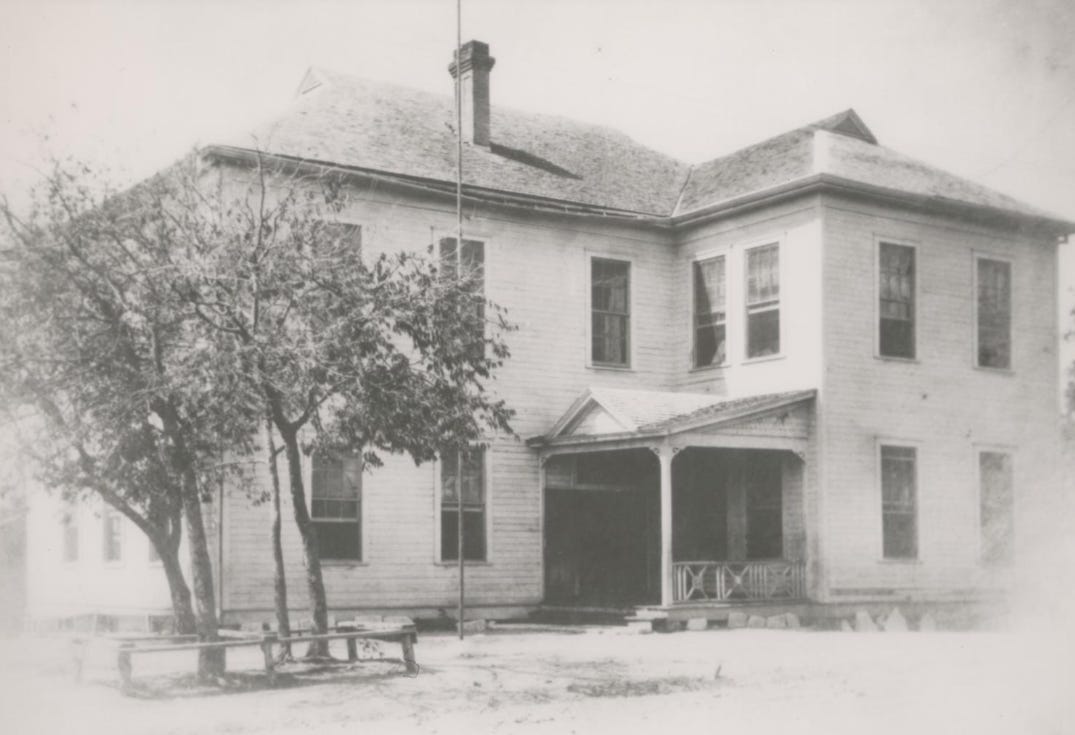
The Republicans are in a tizzy. They’re seeing all the bills that Democrats are filing and spreading propaganda in response. But of all the crybaby rants I’ve heard over the last week, none has upset the GOP as much as SB376 by Borris Miles.
SB376 by Borris Miles creates a new state agency called the Texas Freedman’s Bureau. This agency would help Texans trace their ancestry to determine whether they are descendants of “freedmen.” If they are, they get an ID card and future legal help in filing reparations claims.
No new money is used to create this agency. It does not create a reparations program to pay descendants.
Why does reparations anger Conservatives so much?
The visceral reaction to reparations from Conservatives is something psychologists should study. Not only do they object, but it also makes them angry. Of course, Conservatives also say that systemic racism doesn’t exist.
I found this interesting study from Pew Research Center:
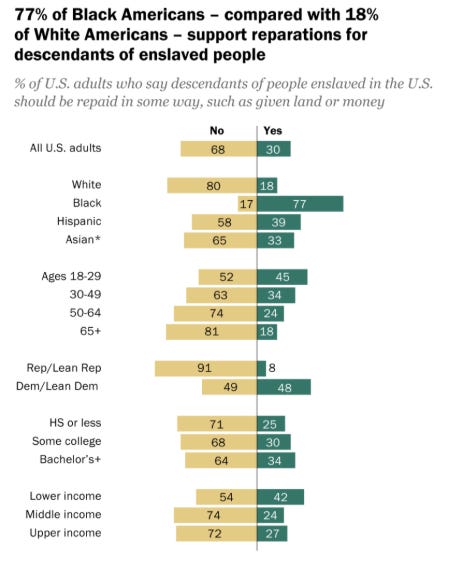
While 91% of Republicans are against reparations, 49% of Democrats are also against it. That number surprised me. Paying reparations to Black Americans is that loud, bold sentence that white Americans benefited from injustice. Perhaps that’s why so many Conservatives are against it, because admitting their ancestors were bad is somehow a slight on them.
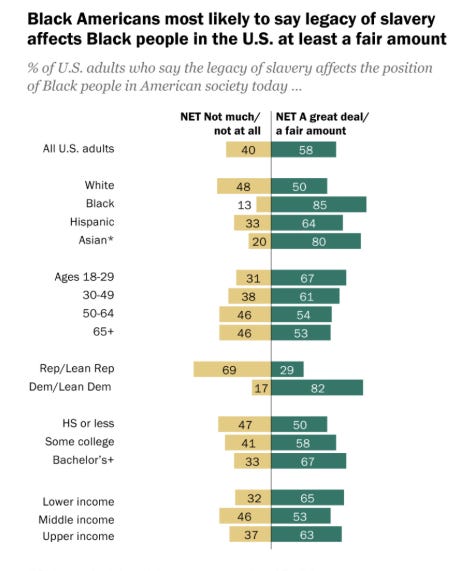
But do you know what Democrats agree with? That the legacy of slavery still impacts Black Americans today.
In 2024, a study found that negative racial attitudes predict opposition to reparations. It isn’t really about the cost. It really boils down to racism and racial bias.
Which brings us back to the cost of this program: $0. It doesn’t get its own budget. All it does is build a database and print ID cards.
The legacy of slavery and Black America.
When enslaved people in Galveston were set free on Juneteenth in 1865, that didn’t just flip a switch to equality, far from it.
Immediately, the South began enacting Black Codes in 1865 and 1866. These laws paved the way for Jim Crow. Some of these Black Codes included Vagrancy Laws, which stated that if you were Black and unemployed, you would be fined, imprisoned, or “hired” out. Other laws restricted free Black men from voting, serving on juries, and bearing arms.
Between 1867 and 1912, Texas ran a convict leasing program. This rented mostly Black prisoners out to plantations and railroads. Often, these prisoners were incarcerated for minor or fabricated crimes. It was forced labor for private companies.
In 1877, after Reconstruction failed, federal troops pulled out of the South, and all hell broke loose. The Equal Justice Initiative documents more than 4,400 racial terror lynchings between 1877 and 1950. However, my work with the Center for Greater Southwestern Studies on Interethnic Violence tells me that 4,400 is likely a severe undercount.
In 1896, Plessy v. Ferguson made separate but equal the law of the land.
In 1902, Texas adopted poll taxes. The Terrell Election Laws followed in 1903, which made it nearly impossible for Black people to vote.
In 1923, Texas passed all-white primaries, banning Black people from voting in Democratic primaries.
In Texas, mostly until the 1960s and 1970s, dozens of sundown towns stood. These were places where Black Americans weren’t allowed after dark. Today, several sundown towns in Texas still stand. And I don’t mean Vidor.
As progressives, we praise FDR and the New Deal because it elevated so many farmers and families. But it shut out Black Americans. Redlining happened, that pushed racial covenants, and Black workers were mostly excluded from minimum wage and Social Security because of their job titles.
While Brown v. Board desegregated public schools in 1954, most Texas schools didn’t integrate until the late 1960s and early 70s. And that was only after the Texas government banned the NAACP from operating in the state, went through years of court battles, and then allowed it to return.
Congress finally passed the Civil Rights Act of 1964, the Voting Rights Act of 1965, and the Fair Housing Act in 1968. That was the first time in American history that laws actually matched the promise of the Constitution. How many people do you know today who were alive in the 1960s?
But it didn’t last long.
In 1971, Nixon started the War on Drugs. By 1986, Ronald Reagan enacted the Anti-Drug Abuse Act, which set a 100-to-1 sentencing disparity between cocaine and crack. Bill Clinton’s 1994 Crime Bill fueled over-policing, which devastated communities of color.
Barack Obama was elected in 2008, and since then we have watched Conservative lawmakers and judges attack everything from the decades before that tried to fix it. In 2013, Shelby v. Holder gutted preclearance. In 2023, SCOTUS ended affirmative action. And in Texas, there has been one attack after another on diversity and on Black history.
Our government has spent hundreds of years ensuring Black Americans never get a fair shake. The least we can do is give back what was taken.
How do we know that this legacy has impacted Black Americans?
Wealth is typically passed down through families, but America has spent most of its existence with laws in place that prevented the accumulation of Black wealth. As a result, Black families have the lowest median net worth of any group, at $36,800. White families hold six times more.
Home equity is the main way middle-class Americans build wealth, so locking Black families out of mortgages in the New Deal and postwar boom fed directly into the wealth gap today.
A 2018 study tracked 20 million children and found that Black children have a much lower rate of upward mobility than white children, as well as a higher rate of downward mobility. One of the key findings was that in 99% of the US, Black boys earn less in adulthood than white boys who grew up in families with a comparable income.
Perhaps the most telling of all are the health disparities. The maternal mortality rate for Black women is significantly higher than that of any other group.
Why should non-Black Americans support reparations?
You can count me as part of the 18% of white Americans who believe Black people deserve reparations. Not because I feel guilty, but because I’ve read the receipts.
McKinsey estimated that the racial wealth gap cost the US economy $1 trillion to $1.5 trillion between 2019 and 2028. Citigroup put the cost of racial disparities at $16 trillion over 20 years. Reparations are meant to close that gap, but every single one of us is paying for it right now.
Book recommendation: The Sum of Us by Heather McGhee
Over the last 75 years, our lawmakers have disinvested in public goods, services, and protections out of fear that people of color would disproportionately benefit. That includes areas such as healthcare, schools, and labor protections. What we’re left with is a crumbling public infrastructure, in decline for decades.
Reparations could break that cycle and make public investment politically possible again.
It’s obvious, but wealth gaps feed poverty, poor health outcomes, and reliance on social programs, which all taxpayers pay for. Building family wealth now would reduce the costs of those services in the future.
What next?
Senator Miles’ bill won’t cost the taxpayers any extra money. It isn’t reparations, but it’s a step in that direction. If the federal government, or even the state government, establishes a reparations program at some point, those eligible for it would already have been identified. It would require far less administrative work in the future.
There would have to be a study to figure out where the money would come from and why. But if we can spend $1 trillion on the military-industrial complex, then I’m sure we can figure it out.
The study on reparations already has a bill number in Congress, H.R. 40. It’s been filed every single year since 1989.
Republicans are clutching their pearls over Senator Miles’ bill, but it doesn’t issue a single check. It builds a database, prints ID cards, and helps people with paperwork using existing resources. That’s it.
Meanwhile, the Federal Reserve reports that Black families were the only group to lose wealth between 2022 and 2025. Their median net worth fell to $36,800. White families sit at $332,100.
That gap happened because our state and federal government wrote it into law, one Black Code, poll tax, and white primary at a time. Admitting that as a fundamental part of the American story costs nothing. Eventually fixing it will cost something. But pretending it never happened is the most expensive option of all.
January 12, 2027: The 90th Legislative Session begins.
Click here to find out what Legislative districts you’re in.
LoneStarLeft is a reader-supported publication. To receive new posts and support my work, consider becoming a paid subscriber.
Follow me on Facebook, TikTok, Threads, Bluesky, YouTube, and Instagram. Or join my Facebook Group.
I back HB 376 by Borris Miles💪100%
Michelle when you use the word conservative to describe a group of people… may I have a definition.
I don’t find that the definition I know applies. Save the country money, hold values and moral standards, for the rule of law, and doesn’t like change. That doesn’t apply AT ALL to the current regime. ☺️.
By the way; while I agree 100% with you. I do worry about the debt it could cause. However; I do agree that if they continue to pay for wars.
Might as well. SMH.
DJT and his regime are ABUSE And FRAUD!
Our Country might never recover from the damage. 🤬