

Early voting started in Texas for the Constitutional Election and the special elections in Tarrant and Harris Counties. Dates to know:
Last day to apply for a ballot by mail: October 24, 2025
Early voting (in-person) period: October 20 – October 31, 2025
Election Day: Tuesday, November 4, 2025
Yesterday, Texas warned that 3.5 million people would lose SNAP benefits in November if the government shutdown continued, which prompted the following Threads post.
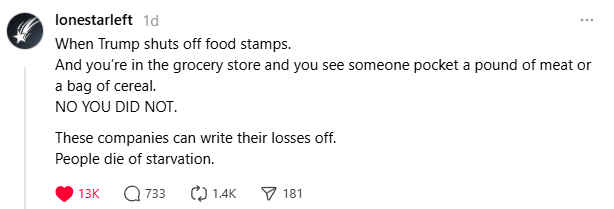
Most people understood the point and agreed. But I was swarmed by replies from Republicans and obvious bots, calling people on food stamps lazy, bragging about how hard they work, and promising to report “thieves.” So let’s ground this in facts about who’s on SNAP, what Texas is facing right now, and why “just go to a food bank” isn’t a real plan when the safety net itself is fraying.
A few people accused me of “advocating theft.” Let’s get something straight, what I was actually advocating is human decency. There’s a difference between endorsing theft and refusing to criminalize hunger.
When we refuse to report a starving person for taking food, we’re not “advocating theft.” We’re choosing solidarity over surveillance.
What SNAP and hunger actually look like in Texas.
In FY2023, 4 in 5 SNAP households included a child, an older adult, or a person with a disability; children were ~39% of participants, older adults ~20%, and non-elderly disabled ~10%. Most benefits go to these households.
Texas exposure right now: If the shutdown continues, about 3.5 million Texans, including ~1.7 million children, could miss next month’s benefits.
Texas already leads the nation in people facing hunger, with a food insecurity rate of ~17.6%, affecting about 5.3–5.4 million Texans (1 in 6 households). Child food insecurity is even higher.
Food banks are already strained. The Houston Food Bank reports an $11M federal funding cut, and local outlets have covered the resulting shortages. Statewide reporting indicates that regional banks are receiving ~40% less food than last year in some areas. These systems cannot instantly absorb millions of newly hungry people.
Corporate retail chains in the US lose billions annually to “shrinkage,” much of it from employee error, supplier miscounts, or spoilage. Yet no one calls that theft or moral collapse. But when someone in poverty tries to eat, suddenly it’s a crisis of ethics?
Why are ethics debates always framed like this?
Why do we question if it’s moral to steal bread if your family is starving? But we don’t question whether or not it’s moral to let bread rot in warehouses while families are starving?
In America, we’ve been taught to moralize poverty instead of questioning power. Maybe that’s the whole point.
If you convince working people that hunger is a personal failure, you’ll never have to answer for a system that allows it.
Despite working harder than ever, most people in this country still live paycheck to paycheck. Meanwhile, billion-dollar grocery chains destroy food to protect “market value,” and politicians lecture families about budgeting.
Those who don’t know history are doomed to repeat it.
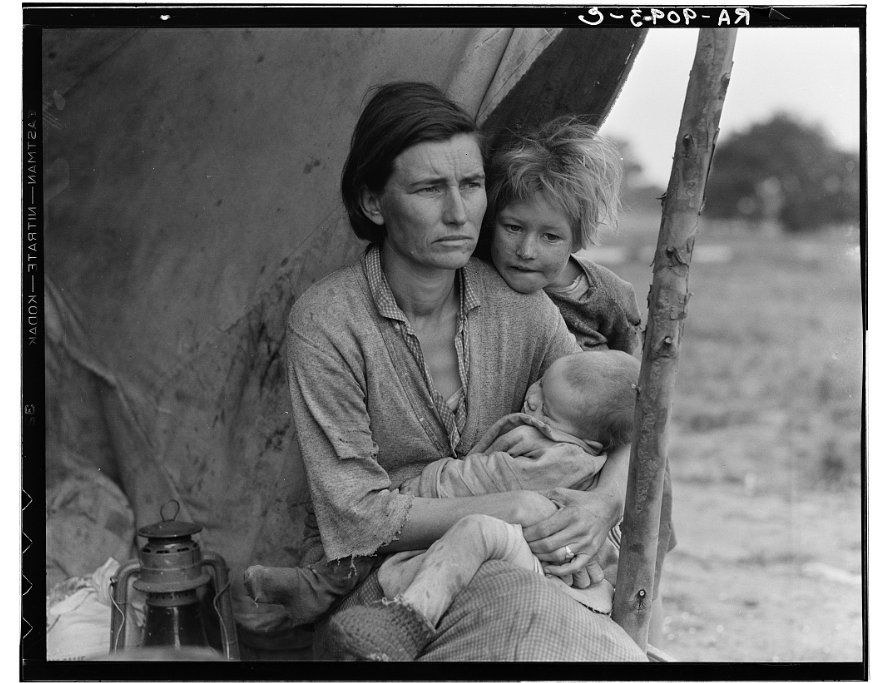
During the Great Depression, widespread hunger and malnutrition took hold of America, even as farm surpluses rotted. From the Library of Congress:
“Although few starved, hunger and malnutrition affected many,” fueling breadlines and public anger.
The Library of Congress’s Federal Writers’ Project collected thousands of life histories from working people during the Great Depression. I’ve read (and saved) through many of these, but one that stands out is “Rank and File,” which focuses on the people who kept the country running, ordinary Americans trying to survive extraordinary times.
Over and over, they talk about work without food. Men walking miles to mills that had closed months earlier, mothers stretching beans through the week, children fainting in school because breakfast had vanished from the table. They didn’t stop working, but the system stopped working for them.
If the Great Depression proved one thing, it’s that “hard work didn’t equal prosperity.” In the 1930s, hunger swept through our country at a time when our country prized production over people. The same hands that built cities were left standing in breadlines.
We’ve seen what mass hunger does to a country. In 1932, 20.5% of American schoolchildren were reported malnourished.
The photographs and interviews from the 1930s are warnings. If you cut off benefits in a state where one in six households is already food insecure, you get breadlines.
Unironically, the first food stamps program in America was created under FDR during the Great Depression.
What’s my point?
Hiring has just reached its lowest levels since 2009. But on the upside, in 2024, senior citizens bought more homes than Gen Z and Millennials combined. If you have some feelings about that trend don’t worry, investors bought up 1/3 of all homes in the second quarter of 2025.
Things must be good in America, because both corporate profit and the stock market are at all-time highs. Which is actually kind of funny when you think about how the wealthiest 10% of Americans own 93% of stocks.
Jobless claims have reached the highest level since 2021, a sign that layoffs are increasing. And worker confidence has sunk below pandemic levels.
Under Trump’s economy, grocery prices have skyrocketed, and there appears to be no end in sight. Because of tariffs and deportations, and now the shutdown, our food supply is at risk.
While all of this is happening, Republicans are shutting off food stamps for people who are already in need and at the same time tearing down part of the White House to build a $200 million ballroom.
An actual current photo of the White House circulating on social media:

So, my point is, I made that post on Threads yesterday after seeing the news about Texans losing their SNAP benefits, and I couldn’t stop thinking about those stories from the Great Depression. Kids fainting in school from malnutrition, families trying to make soup out of nothing. That’s what I saw in my head when I thought, “If you see someone stealing food, mind your business.”
And while our side generally got it, people who believe in community, compassion, and human survival, Republicans did not. My comments were full of folks bragging about how they work three jobs, how they’ve stood in soup kitchen lines, how they’ve struggled too. But instead of aiming their anger upward, they aim it sideways or down, at people even poorer than themselves. That’s propaganda hard at work.
Class consciousness is the realization that people in your position, regardless of race, religion, or gender, share the same struggles. Rent that eats your paycheck. Student loans that never go away. Wages that don’t rise with the cost of groceries. Those are features of a system designed to funnel wealth upward.
The top 10% own 93% of the stock market. The rest of us are fighting over crumbs, and arguing about who “deserves” to eat them. That’s how the oligarchs win.
And while those of us left of center tend to get this, because empathy is baked into our politics, Republicans are fully propagandized. They’ve been trained to see compassion as weakness and greed as virtue. They’ll defend billionaires who wouldn’t cross the street to spit on them.
Breadlines and community gardens.
Starting in November, Republicans plan to literally cut off food for millions of people in this country. It’s happening right now in Texas. History tells us exactly where this leads, and it’s nowhere good. Breadlines didn’t appear overnight in the 1930s, they started with cuts, with indifference, with people pretending hunger was a moral issue instead of a political one.
Find your community now. Reach out to your neighbors. Make plans. Even if you’re not at risk, make sure others in your circle are okay. Because if the government decides hunger is acceptable collateral damage, it’s up to us to keep each other alive. And if you see someone stealing food, mind your damn business.
While they cut food for the poor and build ballrooms for the powerful, we’ll be at the polls deciding what kind of country we want to live in. The fight is the difference between a neighbor who eats and a neighbor who starves. Between breadlines and community gardens. So vote, organize, show up, and look out for one another. Because no one’s coming to save us but us.
November 4: Constitutional/TX18/SD09 Election
Click here to find out what Legislative districts you’re in.
LoneStarLeft is a reader-supported publication. To receive new posts and support my work, consider becoming a free or paid subscriber.
Follow me on Facebook, TikTok, Threads, YouTube, and Instagram.
The working poor are worried. I grew up in an area of the Hill Country which is prosperous and even high-faluting now, but back in the 60's, it was rural poverty. My husband grew up in a West Texas oil town when there were lots of good jobs in oil and gas. He never saw the wages of poverty like I did. My family was not poor, but many of my classmates were.
It brought tears to my eyes to think of the kids I saw coming to school hungry. I remember seeing kids with bow legs from rickets. I remember a girl who was blind in one eye. That might have been something seeing a doctor could have remediated. I remember one boy, wearing the same pair of glasses year after year held together with tape and paper clips. I saw a kid come to school without shoes. That was life in Kyle TX until about the 80's. Read the first volume of Robert A. Caro's biography of Lyndon Johnson. The Hill Country had still not pulled out of its deep poverty by the time Lyndon was president. [I have other stories about Lyndon and the White House helicopter flying over our ranch.]
And the people back then most vocally looking down on the poor were those who were just one lost paycheck away from being in the exact same position. Many times, heaping contempt on the poor is really an expression of fear that they will be next. And/or it is a way to distance themselves from the [unnecessary] shame of poverty. Of course, most of the trolls Michelle encountered are just pure trolling. But sometimes, those bragging about working three jobs and never taking handouts are protesting over much about their deepest fear.
Poverty [or society's treatment of it] messes with people's minds. A zero-sum mindset continues for generations. They see anything "given" to someone else as something coming straight out of their pocket. And Republicans in power want to create an underclass once again because people with this zero-sum mindset are easily manipulated through fear of the other.
I am not so sure we can't get rank and file Republicans to rebel against what Republicans are fixing to do to them. After all, these same yahoos' great-grandparents and grandparents voted for FDR.
Inequality of wealth in the U.S. now exceeds levels that led to the Great Depression. The best selling book "1929" is warning for today about how greed, incompetence and corruption can devastate an economy. Right now the government should be strengthening social safety nets and increasing financial guard rails, but it's doing the exact opposite.