

This morning, after I dropped the kids off for school, I decided to take a history expedition to Dallas and visit a few famous gravesites. And on my way home, as the dashboard of my car kept drawing my eyes to that 115° temperature, I reminded myself how everything is political. And many of the political problems we have are the same political problems we faced in 1979, 1951, and 1934.
My first stop was in West Dallas, at Bonnie Parker’s grave.
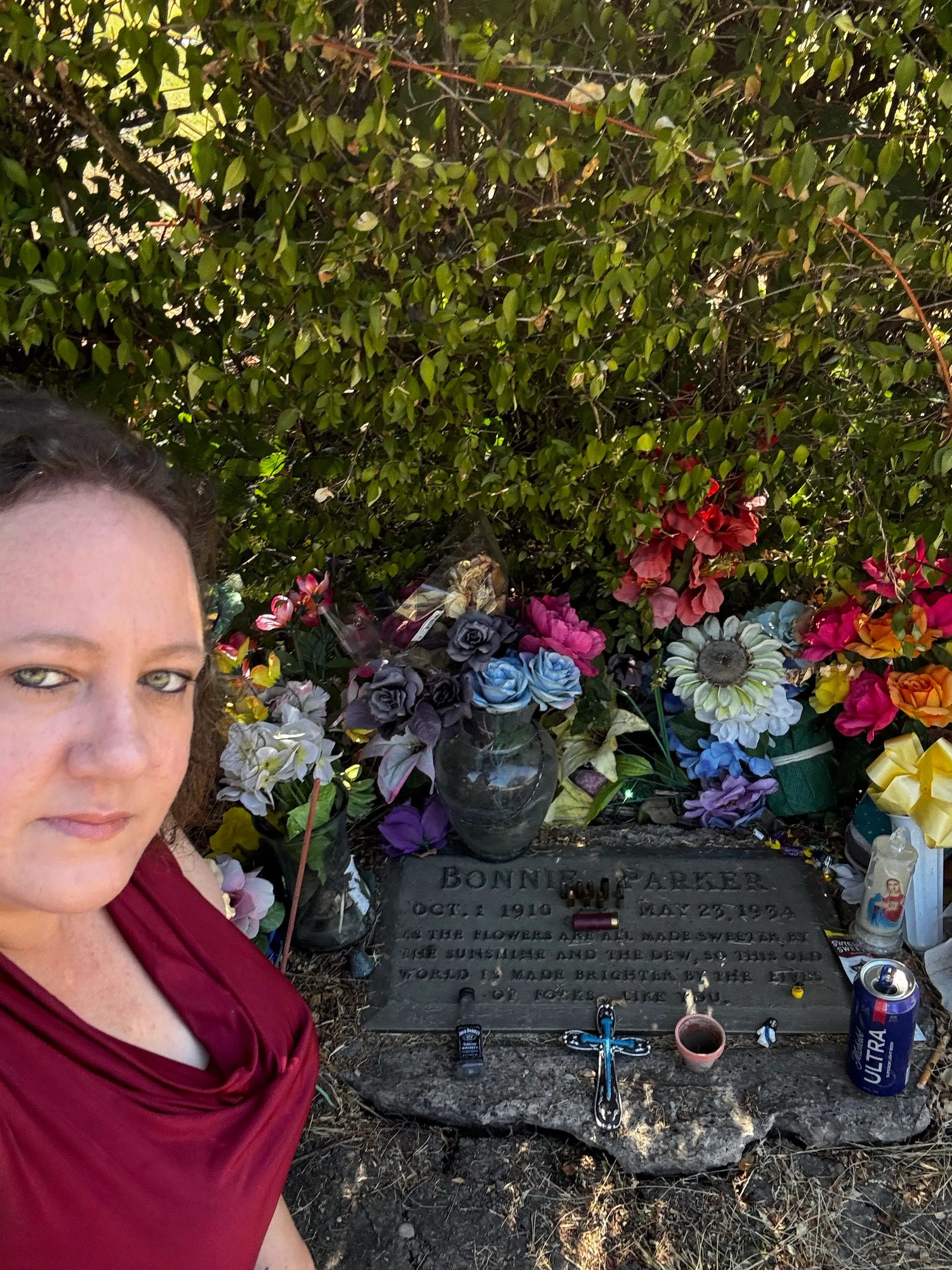
If you’re unfamiliar with Bonnie Parker’s history, her origin story is poverty. Her mother was a widow and a seamstress, but Bonnie dropped out of high school and married her first sweetheart (not Clyde) just days before her sixteenth birthday. And perhaps it was growing up in poverty that set her on the path she wound up on, which led to the end of her life at only 23 years old.
Poverty is political.
Of course, that was around 100 years ago. In 2024, the state’s poverty rate hit 13.4%, the lowest on record since 2010. Sounds like progress. It is progress, technically. It’s also 4.1 million people, and it’s still worse than the national average of 12.4%.
Child poverty sits at 17.9%, which is real improvement from 24.6% a decade ago, and it still means almost one in five Texas kids is growing up the way Bonnie did. Poverty among adults over 65 is going the wrong direction entirely, up from 10.9% to 12.3% over that same stretch. The people who built this state’s boom are aging into the same hole its children are being born into.
Texas has the highest uninsured rate in the country, for kids and adults both, and it’s not close. 21.6% of working-age adults and 13.6% of children were uninsured in 2024, both roughly double the national rate. Texas is one of only ten states that still refuse to expand Medicaid, which means there’s a whole tier of Texans who make too much for Medicaid and too little to afford ACA coverage. That’s a policy choice, renewed every session.
Texas has no state minimum wage above the federal $7.25 an hour, unchanged since 2009. Full-time, that’s $15,080 a year, which doesn’t clear the poverty line for a parent with one kid, let alone two. A widowed seamstress raising a daughter in West Dallas in the 1920s and a single mom working full time in West Dallas today are closer to each other, financially, than either of them is to the Legislature that sets the rules.
Other Texas statistics about poverty you should know:
Texas now leads the nation in food insecurity for the third straight year, with a 19.4% rate affecting 6.06 million people. Source
Texas has surpassed California for three consecutive years as the state with the largest food-insecure population in the country. Source
1 in 4 children in the Dallas-Fort Worth area now face hunger. Source
Texas has the highest rate of senior food insecurity in the nation, at 13.6%. Source
Texas’ SNAP payment error rate could cost the state up to $709 million a year starting in fiscal year 2028 under new federal cost-shifting rules. Source
More than half of Texas’ 4.1 million renters are now “cost-burdened,” spending over 30% of income on rent. Source
Median rent in Texas grew 9.1% (inflation-adjusted) over the last five-year census period, while median household income grew just 3.1%. Source
81% of extremely low-income Texas households spend more than half their income on housing. Source
For every 100 extremely low-income renter households in Texas, only 26 affordable homes are available. Source
This is what thirty years of Republican rule has done to Texas.
The next stop on my list.
I have an ancestor buried not far from the cemetery where Bonnie Parker is buried, and at that same cemetery is the final resting place of famed baseball legend Mickey Mantle. So, I stopped by my relative’s grave, then headed to the mausoleum to see the final resting place of the New York Yankees Hall of Famer.
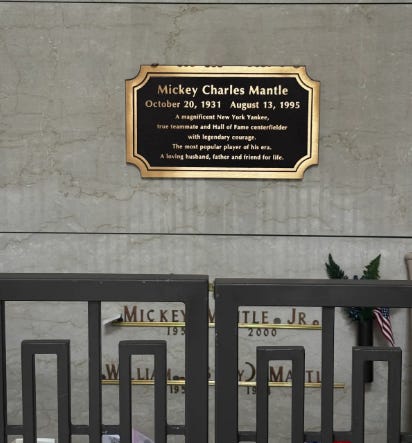
Mickey Mantle’s plaque calls him “the most popular player of his era.”
Maybe that’s true if you don’t ask who his era left out.
Mantle came up in 1951, four years after Jackie Robinson broke the color line in Brooklyn. The Yankees didn’t field their first Black player, Elston Howard, until 1955, one of the last teams in the league to integrate, and only after ownership ran out of excuses.
That’s the thing about golden eras. They’re only golden for the people the camera was pointed at.
Popularity is political.
Trump built an entire movement on that exact sentiment. “Make America Great Again” never specifies which America. Clean-cut, small-town, God and country, before things got complicated. Complicated, in this case, meaning Black players in the majors, women in the workforce, anyone visibly queer, anyone who wasn’t white and Christian getting a say in what “American” meant.
In December 2025, Governor Abbott stood at the Governor’s Mansion and announced a statewide partnership to put Turning Point USA chapters, branded “Club America,” in every high school in the state. He said it was about a “restoration of who we are as a country.” Lieutenant Governor Dan Patrick put a million dollars of his own campaign money behind it. There are already more than 500 chapters in Texas high schools, and Abbott made clear that any district that resists should be reported to the Texas Education Agency for meaningful disciplinary action.
Restoration means backward. You restore something back to what it already was. Abbott is telling you the destination on purpose.
This is the same governor pushing a mandatory conservative youth club into every high school in the state, having signed Senate Bill 12 earlier that year, banning LGBTQ+ student clubs outright. One kind of student organizing gets a governor’s mansion press conference and a state agency’s enforcement muscle behind it. The other gets legislated out of existence. That’s a state government deciding which kids get a restoration and which ones get erased, in the same calendar year.
Mickey Mantle’s plaque says “the most popular player of his era.” Some would argue it was Jackie Robinson. Texas Republicans have already decided which kids get to be on the plaque.
Then there was the one I stumbled on by accident.
At the same cemetery as my ancestor and Mickey Mantle, I was driving out when I stumbled upon this grave. Of course, I had to stop. It was huge and fancy, but also very cold and uninviting. The one thing that stood out most to me was that, unlike the other graves I visited, there were no flowers. It was the grave of Ross Perot.
A lot of us (depending on your age) remember Ross Perot as that big-eared guy who ran for president in 1996. But long-time Lone Star Left readers know that I’ve long had a personal beef with Ronald Reagan, and when I think about Ross Perot, I think about the 1980 presidential election and the Iranian Revolution.
In December 1978, two of Perot’s employees at Electronic Data Systems were jailed in Tehran, swept up in the unrest leading into the Iranian Revolution. Perot asked the State Department for help. They moved too slowly for him. So he built his own operation, hired retired Army Colonel Arthur “Bull” Simons, trained a team of his own employees at his lake house outside Dallas, and personally flew into Tehran under a cover story that he was delivering NBC news tapes.
The rescue plan itself fell apart, but the men got out anyway. A mob, organized in part by an EDS employee, stormed the prison during the chaos of the revolution, and Chiapparone and Gaylord walked free and made their way to Turkey.
Perot said private citizens have “an obligation” to act when the government won’t.
Within weeks of the November 1979 seizure of the US embassy and its 52 hostages, NBC reported that Perot had been quietly pulled into informal, unofficial rescue-planning schemes for the new crisis, including a scrapped plan to hide tracking signals inside donated Dallas Cowboys game tapes.
Those embassy hostages stayed captive for 444 days, through the ugly final year of Jimmy Carter’s presidency, through his loss to Ronald Reagan that November, and were released within minutes of Reagan’s inauguration. Perot became the guy private industry could point to and say, “Look, when the government fails you, a rich man with a chartered jet can just go get it done himself.”
It’s also the exact logic every billionaire has used since to justify substituting personal wealth for public institutions, and Texas didn’t have to wait for Elon Musk to see it happen at home.
Money is political.
In 2021, Governor Abbott announced Texas would crowdfund its own border wall after the Biden administration paused federal wall construction. The state’s private donation fund stalled at about $1.25 million for two months. Then one man, Timothy Mellon, a Wyoming billionaire and grandson of a former Treasury Secretary with no ties to Texas, wired $53.1 million in stock. That was 98% of the entire fund.
By early 2026, the wall was finished, well 82 miles of it, at a cumulative cost north of $2.5 billion, funded by a mix of state appropriations and donated money, Mellon’s stock included.
It didn’t stop at the border.
This month, the Texas Comptroller’s office released the first hard numbers on the state’s brand-new voucher program, officially called Texas Education Freedom Accounts, the $1 billion program Abbott spent three legislative sessions ramming through. 70% of students had already been attending private school or being homeschooled before a dollar of public money touched them. Only 30% came from public schools, the group the program was supposedly built to rescue.
I told you so. Actually, I told you so four separate times.
In January 2025, before the bill even had momentum, I wrote that SB2 would disproportionately benefit wealthier families who could already afford private school tuition, and that the $10,000 to $11,500 grants would fully cover tuition for exactly the families who needed it least. In February, when SB2 cleared the Senate on a party-line vote, I flagged that Senate Republicans were deeply tied to the billionaire donors and special interests pushing vouchers, and that every Democratic transparency amendment got voted down in lockstep. In March, during the 23-hour House committee hearing, we watched Gina Hinojosa force a GOP witness to admit the whole program would create a stratification system where access depends entirely on what a family can already afford. And in April, when the House passed its version, I called it a billion dollars in public money handed to private schools and unregulated vendors with no income cap and no fraud protection strong enough to matter.
It was the plan working exactly as designed.
Money is still political.
And back to that 115° temperature gauge.
In 2021, the US Energy Information Administration (EIA) estimated that Texas produced 663.5 million metric tons of carbon dioxide (CO2), 13.5% of the country’s total. This is more than double the carbon emitted by California, the second-largest producer. Texas’s CO2 levels have increased by almost 85% since 1970 across all sectors, including transportation, homes, and businesses.
Texas emits more CO2 than Saudi Arabia, Canada, Mexico, and many other countries.
The State of Texas is disproportionately responsible for climate change, more than any other state in America and much more than many countries.
But Texas Republicans refuse to act because, since 2014, the oil and gas industry has handed Greg Abbott more than $26 million, Kelcy Warren’s pipeline company made $2.4 billion off the 2021 blackouts that killed over 200 Texans, and the industry showers legislatures with campaign cash the moment each session ends.
Climate change is also political.
I drove home past three graves and one thermometer, and every single one of them told me the same thing.
Politics isn’t something happening to you from far away. It’s the temperature. It’s the wage. It’s who gets remembered as popular and who gets left off the plaque. It’s who gets to play private hero and who gets stuck holding the tax bill. It’s a $1 billion voucher program disguised as choice and a border wall bought by a man in Wyoming who’s never seen it.
Poverty is political. Popularity is political. Money is political. Climate change is political. Every damn thing is political, whether you clock it or not, and pretending otherwise is just letting someone else decide for you.
So vote. In every election, every year, all the way down the ballot, not just the ones with a president on it. Because if you don’t, I promise you, Texas Republicans will find a new way to screw you next, and they’ll make sure it’s legal, funded, and somebody’s already gotten rich off it before you even notice.
Rest in peace, Bonnie. Rest in peace, Mickey. Rest in whatever you’re resting in, Ross.
The rest of us have work to do.
75 days until the November election!
Did you know you can find links to all the previous Meet the Candidate articles on these lists?:
Click here to find out what Legislative districts you’re in.
I particularly enjoyed the section about “Poverty is Political”! Every word true and accurate! This is the ultimate republican state. Every act is for and by the people who can buy it all.
I’m not counting on TX turning blue, but it sure would be nice!👍
Great Article! I wish I could MAKE every Texans Read it. ☺️
I’ll just 🙏🏼🙏🏼🙏🏼 they will.
Poverty is Political BUT I am prof that it doesn’t have to be.
Politics can be productive!
Let’s turn this ship so that the middle class grows bigger that the both the poor and wealthy.
Like Jim Hightower says “My daddy used to say, “Everybody does better when everybody does better.”