

This past weekend in Texas, two special elections were held, where in both cases the progressive Democrat on the ticket won 🥳. But the data from both elections couldn’t be more different, and they offer clues about what may happen in March and again in November. Let’s get into it.
TX18 - Christian Menefee
Menefee was sworn into Congress today. Menefee’s swearing in now gives Congressional Republicans a ONE-vote margin. 😁
Harris County Attorney Christian Menefee defeated former Houston City Councilmember Amanda Edwards, 68.38% to 31.62%, in a low-turnout special election. Menefee received 16,174 votes to Edwards’s 7,478. Total turnout was only 23,652 voters, but the margin was not close by any measure.

Edwards finished the campaign with roughly $1.5 million raised, while Menefee ended with about $2.1 million. On paper, both candidates were well funded, but the composition of their funding was very different and reveals a lot about the coalitions behind them.
Edwards’s donor base leaned heavily toward traditional high-dollar, establishment networks. 95% of her funding came from individual donors, but only 6% came from small donations of $200 or less. A striking 94% of her individual contributions were large donations of $200 or more, and she also accepted corporate PAC money.
Menefee, by contrast, ran on a more grassroots-oriented funding model. 93% of his money came from individuals, but a much larger share (23%) came from small donors under $200, with 77% from large donors. He took no corporate PAC money at all.
Despite Edwards’s deep ties to the Harris County Democratic establishment and donor class, she was ultimately out-fundraised and dramatically out-organized.
Special elections usually have predictably low turnout that’s skewed toward the most engaged, most ideological voters. As the most recent Harris County Attorney, Menefee already held a countywide office, had an active public profile, and was involved in high-profile progressive fights against Greg Abbott and Ken Paxton. Edwards, while well known in Houston political circles, had not held office recently and lacked the same day-to-day presence in voters’ lives.
This race was a classic progressive vs. moderate establishment contest.
Menefee ran openly as a progressive Democrat. Edwards ran a more traditional, pragmatic Democratic campaign. TX18 chose a new-generation progressive over an old-school establishment Democrat by a landslide, even in a low-turnout environment.
The overall turnout of the TX18 special election was 5.6%.
Five point six.
In one of the bluest congressional districts in the state, in the middle of the largest Democratic county in Texas, fewer than one out of every seventeen registered voters bothered to show up.
This is a flashing red warning light. Especially considering that Harris County is Greg Abbott’s number one target this year. And this isn’t a new flashing red light.
In 2024, even with a presidential election on the ballot, Harris County Democratic turnout lagged way behind expectations.
We keep acting surprised when our numbers come in low, but the truth is, we’ve spent years neglecting the most basic building block of party infrastructure. Precinct chairs. Right now, hundreds of Harris County precincts have no Democratic leadership. No neighbor knocking on doors. No one is building community year after year.
Volunteers are great. Fundraising is the literal job. But precinct chairs aren’t prioritized. For too long, the Harris County Democratic Party has treated grassroots organizing as an optional add-on rather than a core mission.
That’s why Lone Star Left is endorsing Traci A. Gibson for Harris County Democratic Party Chair.
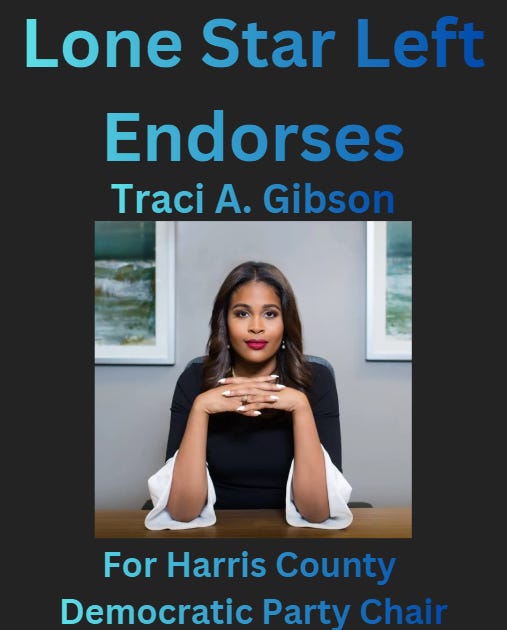
She understands that elections aren’t won at downtown fundraisers or with unreliable volunteers. They’re won in living rooms, church halls, and apartment complexes. We need a party chair who is obsessed with filling every precinct position, training volunteers, and rebuilding a countywide machine that actually talks to voters, ALL voters, year-round.
A 5.6% turnout is an indictment, even in a special election. And if we want 2026 and 2028 to look any different, we need new leadership willing to do the unglamorous, essential work of organizing from the ground up.
You can find out more about Traci Gibson on her website.
SD09 - Taylor Rehmet
Now, everyone across the country is shocked that we flipped this district, but I saw how hard Democrats worked to flip it. They knocked on 20,000 doors, made half a million calls, and a whole bunch of other stuff. It was an impressive ground game operation.
Taylor Rehmet, a progressive Democrat, union leader, veteran, and first-time candidate, defeated far-right MAGA Republican Leigh Wambsganss by a margin of 57.2% to 42.8% in the Texas Senate District 9 special election runoff.
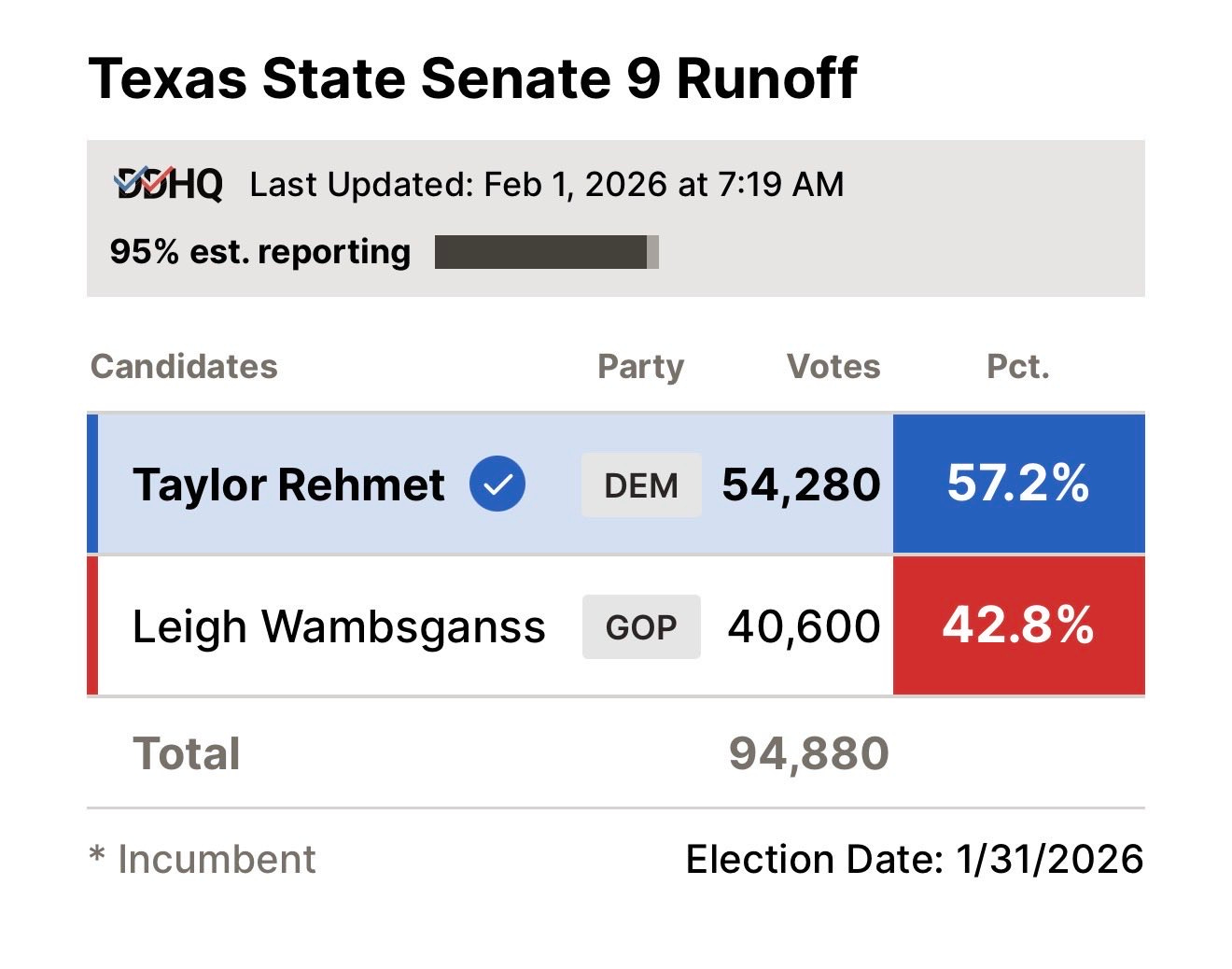
That’s a 14-point win in a district Donald Trump carried by 17 points in 2024, and that former Republican Senator Kelly Hancock won by 20 points just two years earlier.
A progressive Democrat just won a Trump +17 district by double digits.
“Republicans must have crossed over.”
“This was just a weird special election fluke.”
“Democrats can’t replicate this.”
But when you actually look at the data, a very different picture emerges.
Chris Tackett broke down exactly who turned out in this runoff, earlier today. Here’s how the electorate broke down by voter history:
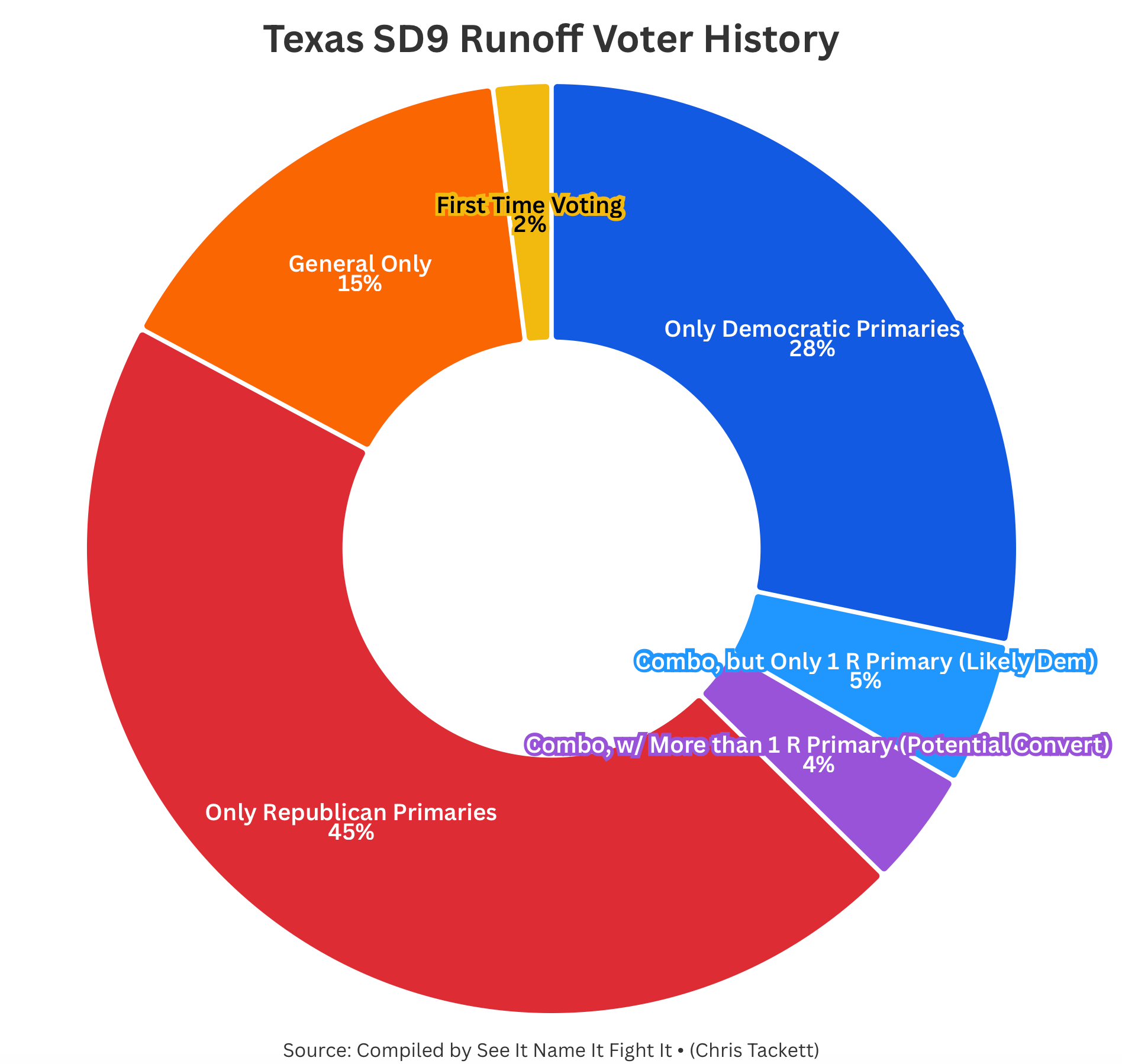
At first glance, that 45% “only Republican primaries” number looks huge. And pundits immediately jumped on it as proof of massive GOP crossover. But in Texas, that number is misleading.
Texas doesn’t have party registration. For decades, Democratic-leaning voters in red areas have been forced to vote in Republican primaries to have any voice at all. If you want to stop the craziest MAGA candidate in a deep-red district, the only meaningful place to do it is the GOP primary, which is why the Republican Party of Texas is fighting so hard to have closed primaries.
That means primary history in Texas often reflects strategic voting behavior, not ideology.
So instead of just looking at which primaries people voted in, Tackett looked at voter scores. When you sort the runoff electorate by those scores, the picture snaps into focus. Here’s how SD-9 voters actually scored:
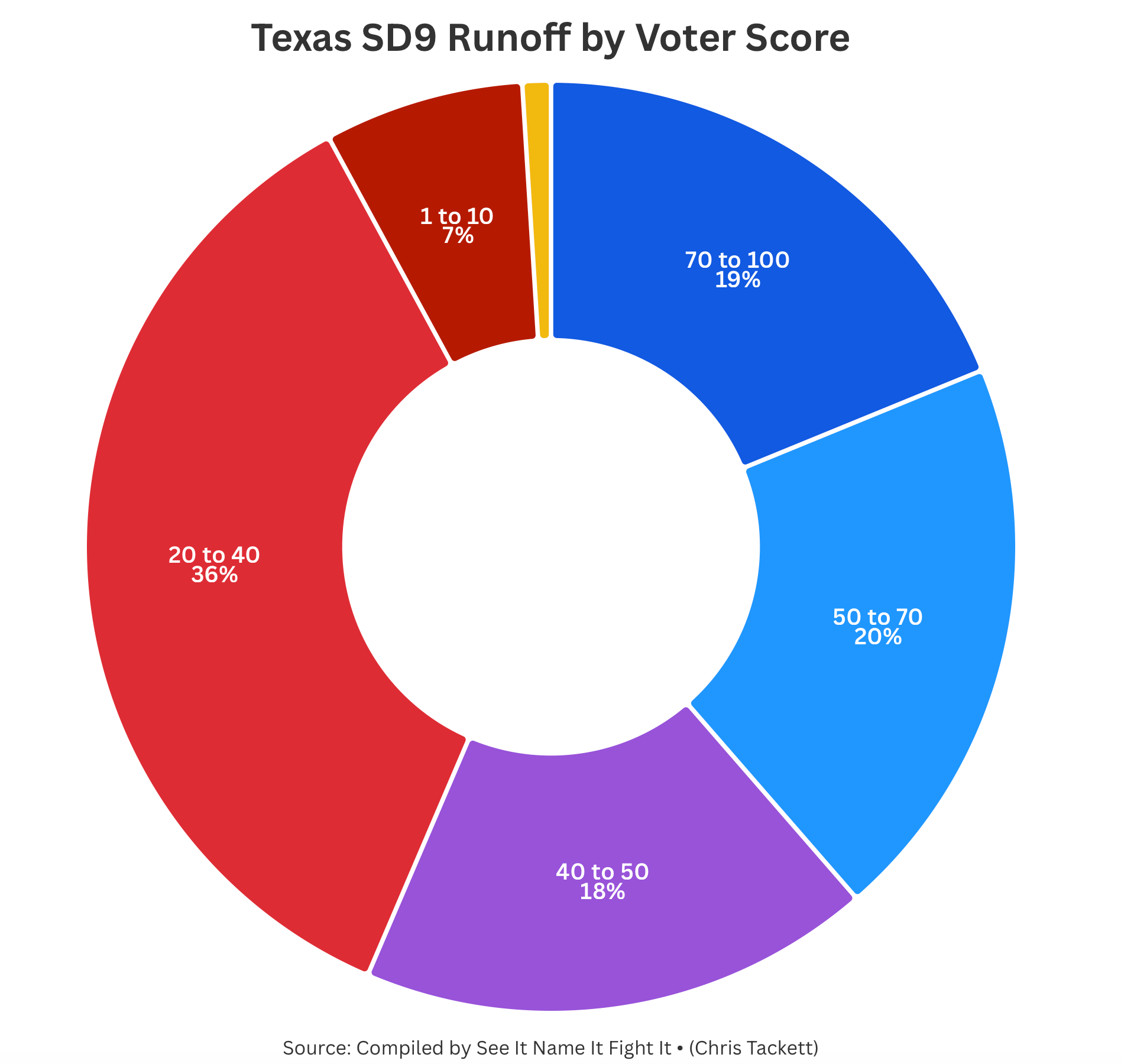
57% of voters scored 40 or higher, indicating a moderate to strongly Democratic lean.
And what was Rehmet’s final vote share? 57%.
The voter score matched the election result almost perfectly.
Maybe some Republicans crossed over. Of course, some did. Leigh Wambsganss is an extreme, far-right culture warrior who made Kelly Hancock look like a moderate.
But the data shows the core of this victory wasn’t Republicans suddenly becoming Democrats. It was:
Long-ignored Democratic voters finally energized
Moderate independents choosing sanity over extremism
Strategic primary voters coming home
A low-turnout special election where motivated progressives actually showed up
This was a base-building win, not a fluke.
Further reading:
Chris Tackett: The Texas SD09 Runoff
And the money?
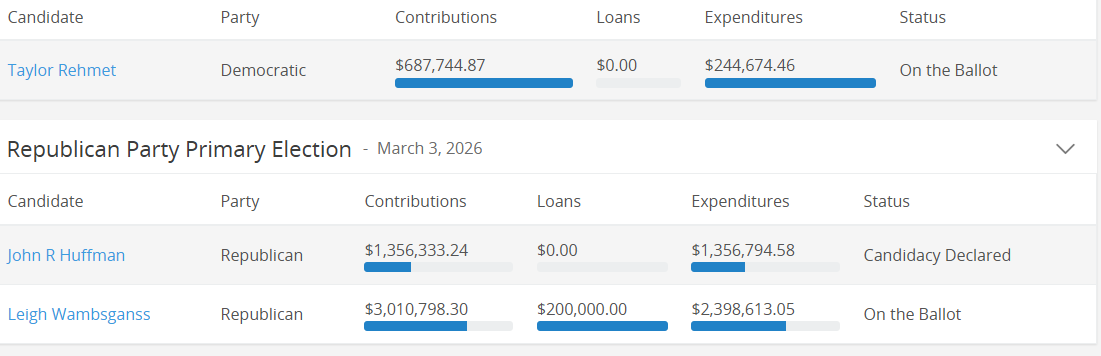
MAGA right dumped an obscene amount of cash into this race. Wambsgnass spent over TWO MILLION DOLLARS trying to keep this seat red.
Taylor Rehmet spent less than a quarter of a million. And still won by fourteen points.
Even better? Rehmet ran as an unapologetic progressive, a union leader, a veteran, and a populist. That message resonated in a district the political class had written off as permanently red. And voters responded.
Tarrant County is the bellwether of Texas politics.
Rehmet proved something Democrats desperately need to internalize, something I’ve been saying for years:
You don’t win Texas by chasing mythical moderate Republicans. You win by energizing the voters who already exist but have been ignored for decades.
As Tarrant goes, so goes Texas. And if Democrats overperform across the state the way Rehmet did this last weekend, this would be our Congressional map in November:
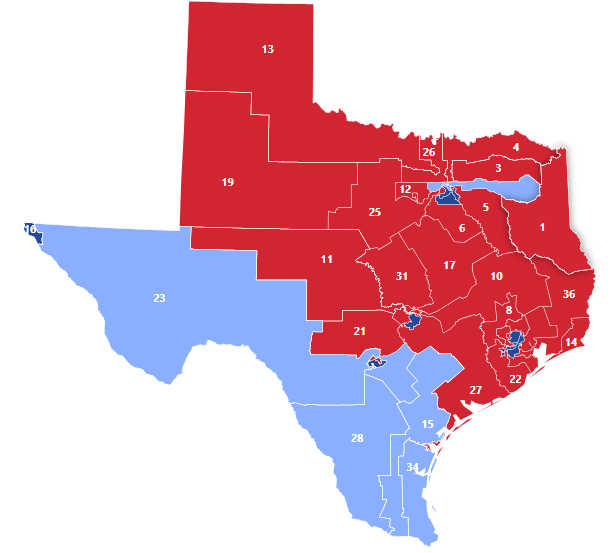
Remember last year when we talked about the possibility of a “Dummymander?” This is it.
We’d also flip the Texas Legislature, both sides, and win most statewide races.
Democrats worked really hard to pull off Rehmet’s victory. It has to be mirrored statewide.
The road from here.
So what do these two very different elections tell us, with the March primaries only weeks away and November right behind them?
First, they tell us that Texas Democrats have real momentum, but only when we do the work.
In Houston, we saw what happens when turnout collapses, and party infrastructure is weak. Even in one of the bluest districts in the state, only 5.6% of voters showed up. A progressive won, yes, but the numbers should scare every Democrat who cares about Harris County’s future.
In Tarrant County, we saw the opposite. We saw what happens when organizers knock tens of thousands of doors, when volunteers make hundreds of thousands of calls, and when a candidate gives people something worth voting for. We saw a progressive Democrat win a Trump +17 district with clarity and conviction.
Those two stories together are the lesson. Progressives can win in Texas.
Democrats can win in Texas. But only if we build real machines instead of relying on hope and demographics.
March is now just a month away. Across the state, we have progressive candidates running in Democratic primaries who need exactly the kind of energy that carried Taylor Rehmet to victory. The SD9 runoff proved that Texas voters are not as conservative as the maps make them look. It proved that an unapologetically progressive message can break through, even in places the pundits have already written off.
If you are a Texas progressive, March is your moment. Vote. Volunteer. Knock doors.
Make calls. Don’t assume someone else will handle it. And then comes November.
The Rehmet win shows what is possible on a statewide scale if Democrats replicate that intensity everywhere. If turnout in Dallas, Houston, San Antonio, Austin, the Valley, and the suburbs looks anything like what we saw in Tarrant County last weekend, the political map of Texas changes overnight.
These special elections were a preview. One showed our weakness. One showed our potential.
Now we get to decide which version of Texas shows up in March and in November. The path is there. The voters are there. The energy is there. All that’s left is to show up.
February 2, 2026: Last Day to Register to Vote
February 17, 2026: First Day to Early Vote
March 3, 2026: Primary Election
Click here to find out what Legislative districts you’re in.
LoneStarLeft is a reader-supported publication. To receive new posts and support my work, consider becoming a free or paid subscriber.
Follow me on Facebook, TikTok, Threads, YouTube, and Instagram.
And you have always understood why I go seriously bonkers when Dallas Dems say a certain city council person a Republican cause he voted in a republican primary when I know him personally and he definitely does not the Republicans, but oh they know? Yup, when in Dallas County, in our gerrymanders suburbs we have to vote republican because we won’t have a democratic in the race or because the dem is actually awful and the republican will in anyway. But now we have real dems! Yup, you and Chris got it right . Those of us on the ground all know. It is because we knocked on doors for over a year in Tarrant County. Will Dallas Dems knock on doors? Oh I asked, and who came and knocked when I asked? Tarrant young dems. Who knocked in Grand Prairie? Not Dallas, me and Danny Minton.
Amen, Amen! Party infrastructure which is organized and activates latent voters just waiting for someone to give them someone to vote for plus precinct chairs and precinct adoptive chairs who tell them where and when to vote is the way.
Something everyone should note here is that the Tarrant County Party facilitated a systematic "adoption" of un-chaired precincts by other precinct chairs not in Taylor's district. While these precincts might not have been as heavily worked as someone's own precinct, they were worked. Even if these voters did not get a door knock, they got a lit drop. Un-chaired precincts may have gotten an email. They probably got a phone call.
On a different note, I will probably never have the answer to this, but what, pray tell, did Leigh do with all that money?