


Texas has 5.1 million people walking around without health insurance. That’s more than the entire population of South Carolina. It’s more people than live in the city of Los Angeles proper. And for over a decade, the official position of the Republicans running this state has been, “too bad.”
We’ve watched Texas Republicans do this dance since 2013. Somebody proposes taking federal money to cover working people who can’t afford insurance. Somebody else calls it socialism, or a slippery slope, or fiscally reckless, and then everybody goes home and the Rainy Day Fund gets a little fatter. Meanwhile, a waitress in Amarillo skips her mammogram because she can’t afford the copay, and an electrician in Lubbock rides out a kidney stone because the ER bill is less terrifying than the one from an actual doctor’s visit, and rural hospitals keep closing their doors one county at a time. And each year hundreds of Texans die because they didn’t have access to healthcare.
So here comes Vikki Goodwin, with an actual plan. A three-tier system with a funding mechanism, an enrollment structure, and a plan for exactly who gets covered and how.
I’m going to walk you through what it does, what it costs, and what Republicans in this state have turned down to avoid doing something like it for the last thirteen years.
Note: While universal healthcare is the preferable option, that has to come from the Federal Government. And until we kick the Republicans out of DC, Vikki Goodwin’s Texas Care Plan is the best and most viable option we have in front of us.
The Texas Cares Plan.
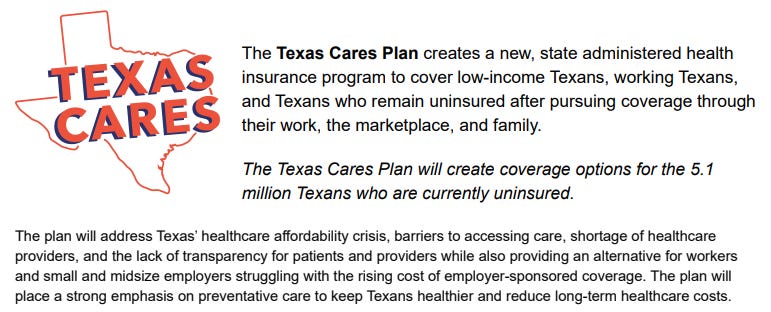
Today, Vikki Goodwin unveiled her Texas Cares Plan and will tour the state this week, talking about her plan and access to healthcare.
Let’s start with the basics. Three tiers. Here’s what each one does.
Tier I: Medicaid Expansion. Covers Texans making up to 138% of the federal poverty line. The federal government picks up 90% of the tab. Texas covers the other 10%, plus administrative costs. This is the same deal 40 other states already took, and Texas Republicans have spent over a decade refusing it out of what I can only describe as pure ideological spite. More on that in a minute.
Tier II: Lone Star Basic. Covers Texans between 138% and 200% of the poverty line, the people who make too much for Medicaid and not enough actually to afford what’s on the marketplace. This one’s funded through the federal Basic Health Program, which is a mechanism that already exists and that Texas has never bothered to use. Currently, federal subsidy dollars for these folks flow straight to private insurers. Under Lone Star Basic, 95% of that money would go to the state instead, to fund the program directly. Same federal dollars, just cutting out the middleman who’s been profiting off it.
Tier III: Lone Star Preferred. Open to all Texans, not income-restricted. This is the actual public option, a state-run plan that competes with the private market instead of just subsidizing it. It’s funded by a one-time draw from the Rainy Day Fund, which currently sits at a record $25 billion and does nothing but collect interest, plus ongoing revenue from a new tax on legal cannabis sales (which Democrats will legalize once in office). Premiums scale with income. The idea is that once enough people opt in, the program pays for itself through premiums and cannabis tax revenue.
Now, I want to flag something here. The cannabis tax revenue figure attached to this tier, $267.7 million, comes from a Whitney Economics study commissioned by the Texas Hemp Business Council. That’s an industry-funded estimate, not an independent fiscal note. It’s not disqualifying, but it’s not neutral either.
Put together, the three tiers are aimed at the 5.1 million Texans currently walking around without coverage of any kind.
The whole plan leans hard into preventative care, and there’s a reason for that beyond the usual “an ounce of prevention” throat-clearing you hear from every candidate with a health plan. Under Lone Star Preferred, an annual checkup comes with no copay and no deductible, because the design philosophy is to catch problems in a doctor’s office instead of an emergency room. The plan also puts specific emphasis on maternal health, with early and continuous prenatal care aimed at closing the gap in outcomes for Black women in Texas, who have been dying and nearly dying from preventable complications at rates that should embarrass every single person who’s ever stood on a courthouse lawn talking about “protecting life.”
The money Republicans left on the table.
Texas is one of ten states left in this entire country that still hasn’t expanded Medicaid. Ten. As of 2023. North Carolina, a state that has spent years trying out Texas on culture-war nonsense, managed to expand Medicaid before we did.
The result of that decade-plus of refusal is exactly what you’d expect. Texas has an 18% uninsured rate. The national average is 8.6%. We are the worst, by a wide margin, in the richest country on earth, in a state that never stops bragging about how well things are going here.
The commonly cited number is that Texas is leaving $10 billion a year in federal Medicaid money on the table. That number traces back to a 2013 projection from Billy Hamilton, a former deputy comptroller of Texas, commissioned by Methodist Healthcare Ministries. PolitiFact rated the broader $100 billion claim built on that number “Mostly True” when Beto ran on it, so it’s not junk. But it’s over a decade old, and more recent research from the Bush School and the Episcopal Health Foundation puts the current figure closer to $5 to $6 billion a year.
So which number’s right? Depends on what year you’re modeling and whose spreadsheet you trust. I’m not going to pick the bigger, scarier number just because it makes a better pull quote. The honest answer is Texas is forgoing somewhere between $5 and $10 billion a year, and even the low end of that range is real money that could be covering real people instead of sitting in Washington waiting for a state that’s too proud to ask for it.
Either number you land on, the underlying fact doesn’t move. Republicans have had over a decade to take this money and chose, over and over, not to.
Rick Perry called the Affordable Care Act a “criminal act” back when the ink was still wet, and that framing Texas Republicans have repeated ever since. Greg Abbott picked up that same line running for governor in 2014, and he has not moved an inch since. Not during a pandemic. Not during a rural hospital closure crisis.
Here’s the part that should make you angriest, though, because it’s not even a story about Republican obstruction anymore. It’s a story about Republican obstruction with actual bipartisan cover, ignored anyway.
In 2021, 76 members of the Texas House, a majority of the chamber, signed onto a bill to draw down Medicaid expansion funding. That’s not some fringe progressive wish list. That’s a working majority of the people’s elected representatives saying yes, let’s take the money. It never got a floor vote. Never got a hearing. Leadership declined to let it happen, because in this state, having the votes has never been the same thing as having the power.
And it’s not a one-time thing. Every session since has run the same play. File the bill, watch it die quietly in committee, repeat. The last time Medicaid expansion even got a real hearing at the Capitol was 2019. That’s how far removed this issue is from anything resembling live debate in Austin, even though most Texans, including plenty of Republicans, want it.
How Goodwin proposes to pay for it.
Here’s where I want you to pay close attention, because this is the part Republicans always skip when they start clutching their pearls about “fiscal responsibility.”
Tier I costs Texas nothing new. Zero new state dollars beyond the standard 10% match that comes with any Medicaid expansion, which, again, is money we’ve been eligible to draw down since 2012 and haven’t. This isn’t a spending proposal. It’s a proposal to stop leaving federal money on the table out of spite.
Tier II isn’t new spending either. It’s a redirect. Right now, 95% of that federal subsidy money flows straight to private insurance companies as a thank-you for covering people in the marketplace. Under Lone Star Basic, that same money goes to the state instead, to fund coverage directly. Same dollars, different destination, and the destination this time is actual Texans instead of a shareholder report.
Tier III is the only piece that requires the state actually to put skin in the game, and even then, it’s a one-time draw. It comes out of the Rainy Day Fund, which currently sits at a record $25 billion, plus revenue from a new cannabis tax to keep it running afterward.
Twenty-five billion dollars. Sitting there and earning interest. While Republicans in this state have spent over a decade telling you, with a straight face, that covering 5.1 million uninsured Texans is too fiscally reckless to consider. Meanwhile, hundreds of people die in Texas each year without access to healthcare.
Republicans hoard a record surplus and call themselves the party of fiscal discipline while an 18% uninsured rate sits parked in the highest slot in the entire country. 🙄 That’s a choice. Goodwin’s plan is asking Texas to spend a sliver of its own savings account on its own people, one time, and then let the program largely pay for itself in the future.
Here’s your choice.
Vote for Vikki Goodwin, and you get a Lieutenant Governor who wants to legalize cannabis and use the proceeds to make sure poor and working Texans can see a doctor before their treatable condition turns into an emergency room bill they’ll spend the rest of their life paying off. That’s it. Cover people. Stop wasting money prosecuting a plant.
Vote to keep Dan Patrick in that seat, and you get a man who wasn’t even born in this state throwing felony charges at nineteen-year-olds for a joint in their pocket, while cancer patients who can’t afford treatment die in the streets. Not hypothetical. That’s happening right now. In the richest state in the union, under his watch, that’s the deal on the table.
November’s coming. Don’t sit this one out.
77 days until the November election!
Did you know you can find links to all the previous Meet the Candidate articles on these lists?:
Click here to find out what Legislative districts you’re in.
Thank you, Michelle! I'm waiting to share this one due to the primary results coming in & the bsky issues in my area.
This is an obvious slam dunk.
Republicans aren’t bright enough to get onboard…