

Before we jump into it, tomorrow I have a big endorsement coming (not the Senate race), so make sure you check back in for that huge announcement!
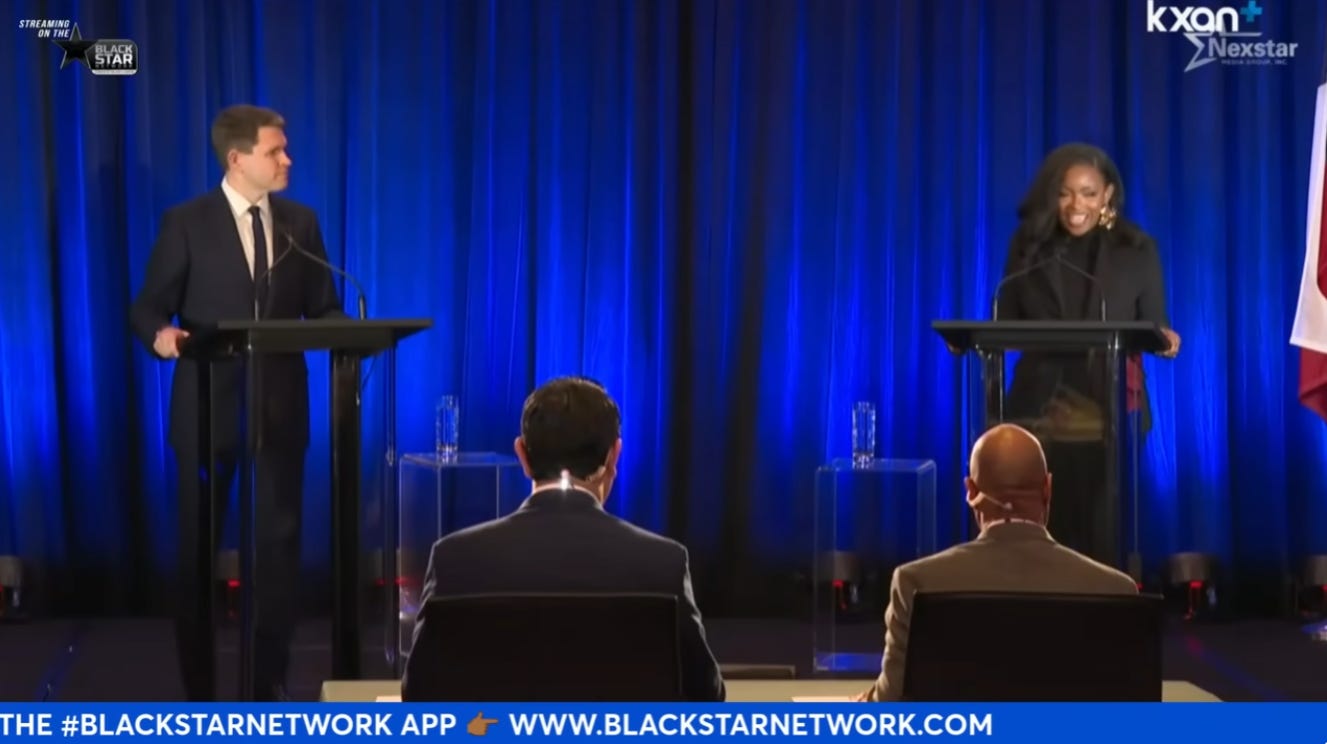
Let me tell you this, I hate this Senate race. Obviously, we all love both James Talarico and Jasmine Crockett, and this debate was actually boring. I truly hope they don’t have any more. But it’s peeled back some uncomfortable realities of a high-profile Democratic primary like this, which we haven’t had to deal with in Texas for a while.
A lot is going on surrounding this race. Online rhetoric has reached a fever pitch, and not in a productive way. Both candidates have been criticized for positions seemingly further to the right of the base. Meanwhile, it appears that the DC establishment has its hooks in more and more in Texas every day, and there may be people behind the scenes who are orchestrating that takeover.
Abolish ICE.
It should be noted that several Congressional candidates have taken the position of abolishing ICE and prosecuting its agents.
A January 24th YouGov poll shows that 62% of Democrats strongly support abolishing ICE.
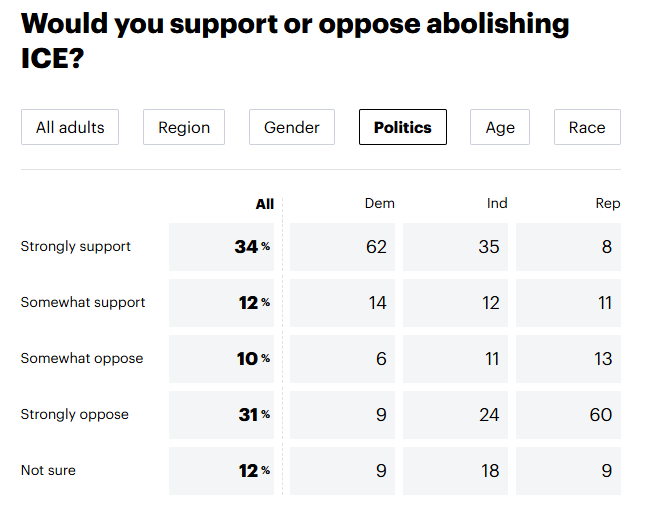
However, during the debate, both Talarico and Crockett condemned the Minneapolis shooting and ICE’s heavy presence there, but both stopped short of saying “abolish ICE.” Talarico did seem more adamant about cutting funding, but both said they support bringing impeachment proceedings against Kristi Noem.
Universal Basic Income (UBI)
Here at Lone Star Left, we’ve talked about UBI before and how it might become a need in the future, once the robots take all our jobs. SEE: Lina Hidalgo’s Vision: Anti-Poverty In An Automated Future
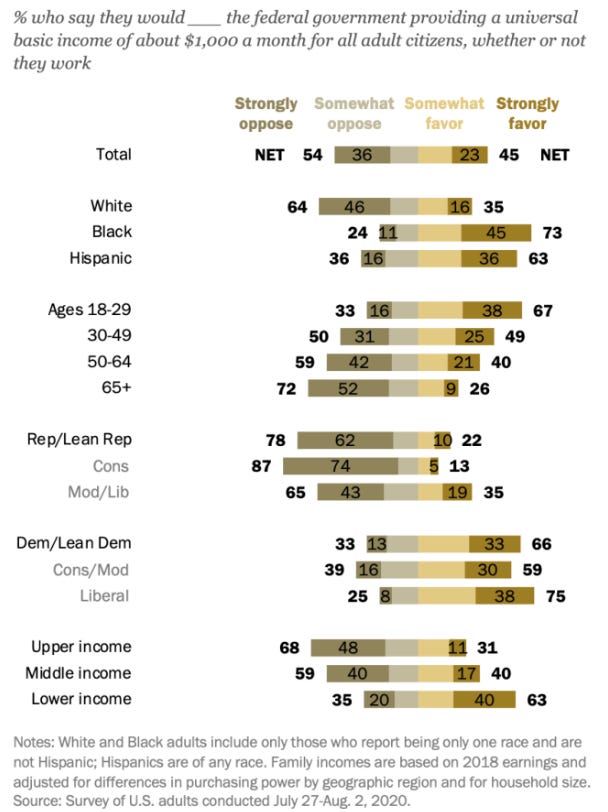
In a study done last year, researchers found that opposition to universal basic income is fueled by racial prejudice. Pew Research Data found that the younger, more diverse, and more liberal a person is, the more they favor UBI.
Neither candidate outright said they were in favor of or against UBI. Talarico said he was encouraged by the pilots’ success. Crockett said this issue was still under study, and her priority was raising wages first.
UBI, though, could supplement low wages, but it is often discussed in terms of when our society will face mass job losses in the coming years due to AI.
Gaza/Israel.
A Quinnipiac University poll showed 60% of voters oppose sending more US military aid to Israel, including 75% of Democrats and 66% of independents.
Crockett leaned on a legal-enforcement frame. Her core argument was that the United States already has laws governing how military aid can be used, and if international law is being violated, we should stop the money.
Talarico responded that Israel has a right to defend itself, but Prime Minister Netanyahu does not have the right to wage war on civilians, restrict aid, or use famine and collective punishment as tactics. He explicitly said that, as a senator, he would use every bit of US financial and diplomatic leverage to end the death and destruction in Gaza.
At the debate, Crockett said we should enforce existing law. Talarico said we should condition aid and ban offensive weapons. On a brutal moral and political issue like this, that difference matters to Democratic voters.
We recently spoke about both of their history on this. SEE: Talarico, Crockett, And The Democratic Base On Israel And Palestine
And those are just a few of the issues where, during this debate, both candidates landed to the right of where much of the Democratic base currently is.
Noticeably. And in a primary like this, those small gaps matter because they reveal how candidates are navigating pressure from donors, consultants, and national party expectations, not just voters.
Let me make this also clear: KEN PAXTON WANTS TO KILL YOU. Either candidate is a million times better than Ken Paxton, so this isn’t a knock on either, as much as an analysis of their policies.
What bothered me more than the policy hedging, though, was the unnecessary intra-party sniping.
I didn’t love how Jasmine Crockett took swipes at James Talarico, implying that he’s being guided by DC strategists, as if she herself isn’t working with DC consultants. What was the point of that attack?
Because here’s the thing, this is a Democratic primary. Voters are allowed to compare records, values, and judgment.
Over the last several weeks, Crockett’s campaign ecosystem has bled into social media in a way that should concern anyone who actually cares about Texas Democratic politics.
Influencers, many of whom don’t appear to have any real connection to Texas races beyond the money flowing, have been flooding timelines with misleading claims about Texas Democrats, mischaracterizations of down-ballot races, and coordinated attacks on Talarico supporters.
Worse, some of that content has gone beyond policy disagreement and into moral smearing, with people being labeled racist for supporting Talarico over Crockett. It’s so deeply unserious.
I’ve liked both of these candidates. I still do. But this race has started to show the downside of a high-profile primary under national pressure. Consultant-driven narratives, social-media pile-ons, and strategic outrage that ultimately do more harm than good.
Texas Democrats need clarity, honesty, and a party that understands the difference between fighting Republicans and tearing each other apart.
And right now, that line is getting blurred, and voters are noticing.
All in all, which candidate was most progressive?
By the way, if you missed the debate: (I’ve watched it three times now so that I could give you my assessment below.)
On ICE: I think Talarico was. He was more explicit about tearing it down/replacing it and taking funding back into communities. Crockett used maximal rhetoric (“rogue,” “clean house,” Proud Boys”) but was less clear about the concrete lever.
AI/workers: I would also give this one to Talarico. He answered the union question directly (workplace surveillance, hiring/promo decisions, enforcement/regulation). Crockett’s data center + grid/water angle is Texas-smart, but it’s less “shop-floor power” specific.
Billionaire taxes: Talarico again, but only slightly. He’s more explicitly class-war populist (“billionaires buying power,” corporate tax too). Crockett’s solution is framed like restoring a previous bipartisan-ish equilibrium.
UBI: Neither. Talarico sounded more open, but neither gave the clear progressive “yes, and here’s why” that UBI-friendly left voters want.
Federal workers: Talarico won this one and really used the right language. His answer was the clearest pro-labor agenda, including restoring jobs, raising wages, and protecting bargaining. Crockett only described real minority-party mechanics (lawsuits/oversight).
Healthcare: Tie. Both are in universal-coverage territory. No clear winner.
Heat protections/filibuster: Talarico. He’s the only one who cleanly said abolish the filibuster to pass worker protections. Crockett is carveouts/reform.
Gaza/Israel: Even though I think they both failed in this answer, if I had to pick one, I would go with Talarico, because he said ban offensive weapons/use US leverage. Crockett’s “enforce existing law” is real, but less of a red-line commitment.
War powers/Venezuela/Iran: Tie. Talarico is more anti-imperial / anti-corruption (oil execs, imperialism framing). Crockett is more political-mechanics (majority, war powers votes, cross-party coalition). Progressives tend to reward Talarico’s framing, but also flinch at his “rogue administrative state” phrasing. Crockett gets dinged for naming Republicans.
Impeachment: Crockett won this policy. She was specific and aggressive (“more than enough,” and named tariffs when pressed). Talarico’s refusal to name an article reads procedural/cautious and less aligned with progressives’ current appetite for explicit accountability.
Supreme Court reform: Crockett wins here, as well. She’s the only one clearly in the “yes, expand the court” lane (plus term limits + ethics). Talarico is open/noncommittal.
Campaign finance/donor credibility: Talarico won, with a caveat. His position (ban corporate PACs, ban super PACs, ban stock trading) is more structurally progressive than Crockett’s “I took capped money, and I’m not bought” defense. But his Sands PAC exception is a real brand stress test, and progressives will still side-eye it.
Where do we go from here?
This is a fight between two Democrats who broadly agree on the direction of the party but differ on how power is built, wielded, and sustained in a hostile national environment.
That’s why this debate felt so flat on substance and so sharp on posture.
James Talarico is running as a movement-builder. His instincts are structural. He talks about billionaires buying power, institutions being captured, and the need to change rules so working people can actually win. His progressivism comes into focus most clearly when the question is who holds power and how we take it back.
Jasmine Crockett is running as a combatant. Her instincts are confrontational. She frames politics as an emergency response, and to be fair, she’s not wrong about the emergency. Her progressivism shows up in her willingness to escalate rhetorically, to name abuses in real time, and to operate inside the chaos without flinching.
Both of those models have strengths. Both have limits.
What worries me is not that voters are debating these differences. That’s healthy. What’s not healthy is when a primary starts drifting into manufactured distrust, influencer-driven pile-ons, and moral delegitimization of fellow Democrats.
Calling Talarico supporters racist is not persuasion. Importing national influencer scripts into Texas races is not organizing. And turning a Democratic primary into a loyalty test is not how we beat Ken Paxton.
This race will end one way or another. And when it does, Texas Democrats will still need each other, the labor left, the racial justice left, the anti-corruption left, the “just give me healthcare and stop the fascists” left.
If there’s a takeaway here, it’s this:
Progressives should be demanding clarity, not carnage.
And coalition, not character assassination.
We can argue about filibusters, PAC money, and Gaza policy. We should. But we cannot afford to normalize the idea that disagreement inside the party is betrayal.
Because if we do, the only people who win are the ones who are already buying the system, and they’re counting on us to tear each other apart before November ever comes.
And voters? They’re watching.
February 2, 2026: Last Day to Register to Vote
February 17, 2026: First Day to Early Vote
March 3, 2026: Primary Election
Click here to find out what Legislative districts you’re in.
LoneStarLeft is a reader-supported publication. To receive new posts and support my work, consider becoming a free or paid subscriber.
Follow me on Facebook, TikTok, Threads, YouTube, and Instagram.
Michelle, Thank you for your comprehensive analysis. You laid it all out there so well--there is a lot that I still need to learn about these two candidates and the politics that surround this race.
My biggest thing is letting the primary play out in an unmanipulated way. Let the voters decide instead of Democratic Party powers that be or Republican operatives or people from out of state who are heavily invested in the personalities of these two and see it as an online drama whereas for us, the outcome has real impact on our actual lives. May the best candidate win. I have a theory of the case for winning in the general election, but I could be wrong. It's just my opinion. Let the candidates make their cases. I'll be watching.
I thought the debate was good and I wasn't bored. It gave me some insights into the candidates' thinking and styles. I pretty much agree with Michelle and noticed the same things she did. This is a choice which seems to come down to a personal preference as the candidates are pretty much on the same page policy-wise. Many primary voters like myself will decide their preference based on what they think will work against the Republican in the general. As far as my decision point, I am focused on the Republican playbook of using Democrats as foils for their negative partisanship. Republicans don't try to govern well. They simply define their voters identity for them and drive them to the polls based on identity signalling and negative partisanship.
This is pretty much all they have right now because their base is wavering as Republicans continue to actively hurt their base with stuff like vouchers. Therefore, it is coming and we better have a plan to dodge Republicans' trap and not be the foil for their negative partisanship narratives. Crockett is most likely their preferred foil. She could defeat that with some good political skills, but I'm not convinced being reflexively antagonistic is the way to do that. It's one thing to "fight". It's another thing to dismiss substantive and constructive criticism out of hand and attribute it to either racism or bad character on the part of voters.
The thing I am weighing is how each candidate will thread the needle of a statewide race when Republicans have undermined and tarnished the Democratic brand to the point that Democrats have to prove the negative that they aren't wild-eyed radical extremists. My question is how effective in the general will combativeness and online likes from people who don't vote here be in defeating the Republican? Talarico has that "kill them with kindness" vibe of teachers and preachers who are seeking to persuade a hostile audience. I sense he is reading the situation with independents and Republicans fairly well with this kill them with kindness tactic. The first step should be to not make the discussion about oneself by performing outrage and scolding as people do online.
I'd be interested in any insight there might be as to whether these influencers, trolls and Republican operatives are discouraging voters, both Independent and Republican, who might contemplate voting for a Democrat. Both these candidates are very digitally savvy. They should be better at meeting the challenge of winning in an environment of Republican baiting and online trolling than an older candidate might. But, I don't have any frame of reference to gauge who's better at managing an information war from the right while trying to win a primary in the Democratic party.
Finally, FWIW, I was annoyed by Crockett consistently overshooting her time, just as I am by all debates when the candidates do this and the moderators don't enforce the time rules.