


One position that I’ve always really agreed with James Talarico on, even before he launched his Senate bid, was the need for universal early childhood education and childcare. If you don’t have children in childcare, or haven’t for many years, infant care (for ONE baby) can cost as much as $1,500 per month.
If you’re new here, hyperlinks lead to sources.
When you look at how families with children are increasingly living in poverty and stagnant wages, it’s no wonder that the birthrate in America is plummeting. America is no longer having enough children to replace itself. We’ve halted immigration. And now that Trump has ruined our standing on the world stage, it may be a decade or more before immigration levels return to normal. America is facing its first population decline in history.
Of course, this raises many other questions about our future.
If fewer people are born, who will replace the workforce?
What happens to Social Security and Medicare when fewer workers are supporting more retirees?
Does a shrinking population slow economic growth, or force us to rethink what “growth” even means?
While Republicans’ answer to the plummeting birth rate has been to abolish abortion, many states continue to see declining birth rates. Nobody can afford to have children. About the abortion ban, in the very near future, we should expect Democrats to take control and for that not to be an issue anymore (fingers crossed).
If we want to move toward a society where people can afford to have children and participate fully in the workforce, then we need universal childcare, and we need to start treating it like the economic infrastructure it is.
It’s already happening in other parts of the country.
In New Mexico, lawmakers just made universal childcare permanent, guaranteeing access regardless of income and backing it with long-term public funding. They didn’t treat childcare like a temporary program or a budget afterthought. They treated it like roads, like schools, like something a functioning economy depends on.
In New York City, leaders are taking a phased approach, expanding free childcare for two- and three-year-olds and steadily building toward universal access. It’s not fully there yet, but the direction is clear. Build the system, expand capacity, and meet families where they are.
That’s the difference. Other places are asking how to make this work. Texas isn’t even asking whether it should exist at all.
It should exist.
High-quality early childhood education consistently leads to better long-term outcomes for kids.
A 2017 meta-analysis of 22 rigorous studies found that children who attend early education programs are less likely to be placed in special education, less likely to repeat a grade, and more likely to graduate from high school.
And it doesn’t stop there. The National Academies of Sciences, Engineering, and Medicine reviewed decades of research and reached the same conclusion. When early care and education is high quality, it is strongly linked to better educational outcomes, higher earnings, improved health, and greater long-term stability.
This is one of the most important points in the entire debate.
The benefits don’t always show up immediately in standardized test scores, which is often what critics latch onto. But they show up later, in graduating, finding stable work, staying healthy, and avoiding systems that are far more expensive for society in the long run.
In other words, early childhood education changes the trajectory of children's lives.
Universal childcare also helps parents stay attached to the workforce and earn more.
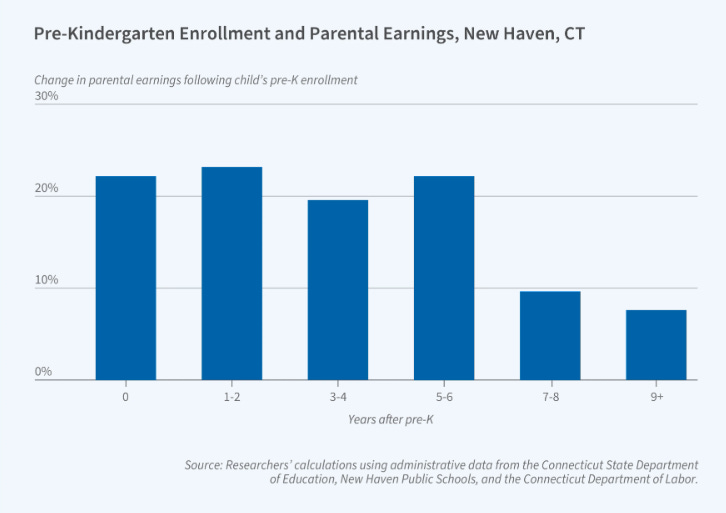
One recent study comes out of New Haven’s extended-day universal pre-K program. Researchers found that when a child enrolled, parents’ earnings rose by 21.7% during the pre-K years, or about $5,461 a year on average. Parents also worked 12.8 more hours per week in the following year, and the earnings gains persisted beyond the child’s initial enrollment period.
A separate 2025 NBER paper found that when universal pre-K was implemented, public pre-K enrollment rose by about 10% over five years; total pre-K enrollment increased by 6.6%; labor-force participation rose by 0.8%; and employment rose by 0.9%. The researchers also found reduced unemployment, suggesting that expanded childcare makes it easier for caregivers to find and accept jobs.
So when people talk about universal childcare as if it is just another social program, they are missing the bigger picture. It is a labor-market policy. It is a family economic policy. And it functions as a stimulus, because when parents can work, earn, and remain in the labor force, the whole economy benefits.
There is also a strong economic case for high-quality early childhood investment itself.
James Heckman and his coauthors found that the HighScope Perry Preschool program generated estimated annual social returns in the 7-10% range. Heckman’s broader birth-to-five framework has reported returns around 13% for high-quality early childhood investments, driven by long-term gains in education, health, earnings, and social outcomes.
RAND’s summaries of the evidence point in the same direction. Their reviews find that well-designed early childhood programs can increase later earnings and educational attainment while reducing crime, delinquency, special-education use, welfare reliance, and other downstream public costs.
In other words, this is not just spending. It is an investment, and one that pays society back over time.
One important caveat (and it actually strengthens the argument).
Universal childcare is not magic if it is poorly implemented.
The experience in Quebec is often cited as a warning. When the province rapidly expanded subsidized childcare, it increased maternal labor force participation. More parents were able to work. But some studies also found negative effects on children’s noncognitive outcomes and later-life behavior, largely tied to the speed of the rollout and uneven quality across providers.
The takeaway is not “don’t do universal childcare.” The takeaway is, don’t do it badly.
Because the goal is not cheap warehousing for children, the goal is high-quality care. Stable staffing. Well-paid workers. Enough capacity so families can actually access it without long waitlists or inconsistent care.
New Mexico’s model reflects that lesson. Instead of rushing a bare-bones expansion, the state tied universal childcare to ongoing funding, provider reimbursement systems, workforce development, and transparency measures. In other words, they are not just expanding access. They are building a system designed to sustain quality over time.
Because if you are going to do this, you have to do it right. That includes both quality and access for all communities, including rural.
But how do we pay for it?
Especially when we’re already struggling to fund public schools adequately, which is a whole separate article, but it’s also the wrong place to start this conversation.
Because we’re already paying for the absence of childcare.
We pay for it when parents (especially mothers) are forced out of the workforce or into lower-paying, more flexible jobs. We pay for it in lost productivity, in slower economic growth, and in businesses that can’t find or keep workers.
We pay for it when children enter school behind and need additional support. We pay for it in higher special education costs, in strained classrooms, and in systems trying to catch up on gaps that never should have existed in the first place.
We pay for it later in life, too. In lower earnings. In higher reliance on public assistance. In increased costs tied to healthcare, the justice system, and social services.
The question isn’t whether universal childcare costs money.
The question is whether we want to keep paying for failure or invest in something that actually works.
Because right now, we have a system where families absorb the cost individually, often at the breaking point, while the broader economic consequences ripple outward anyway.
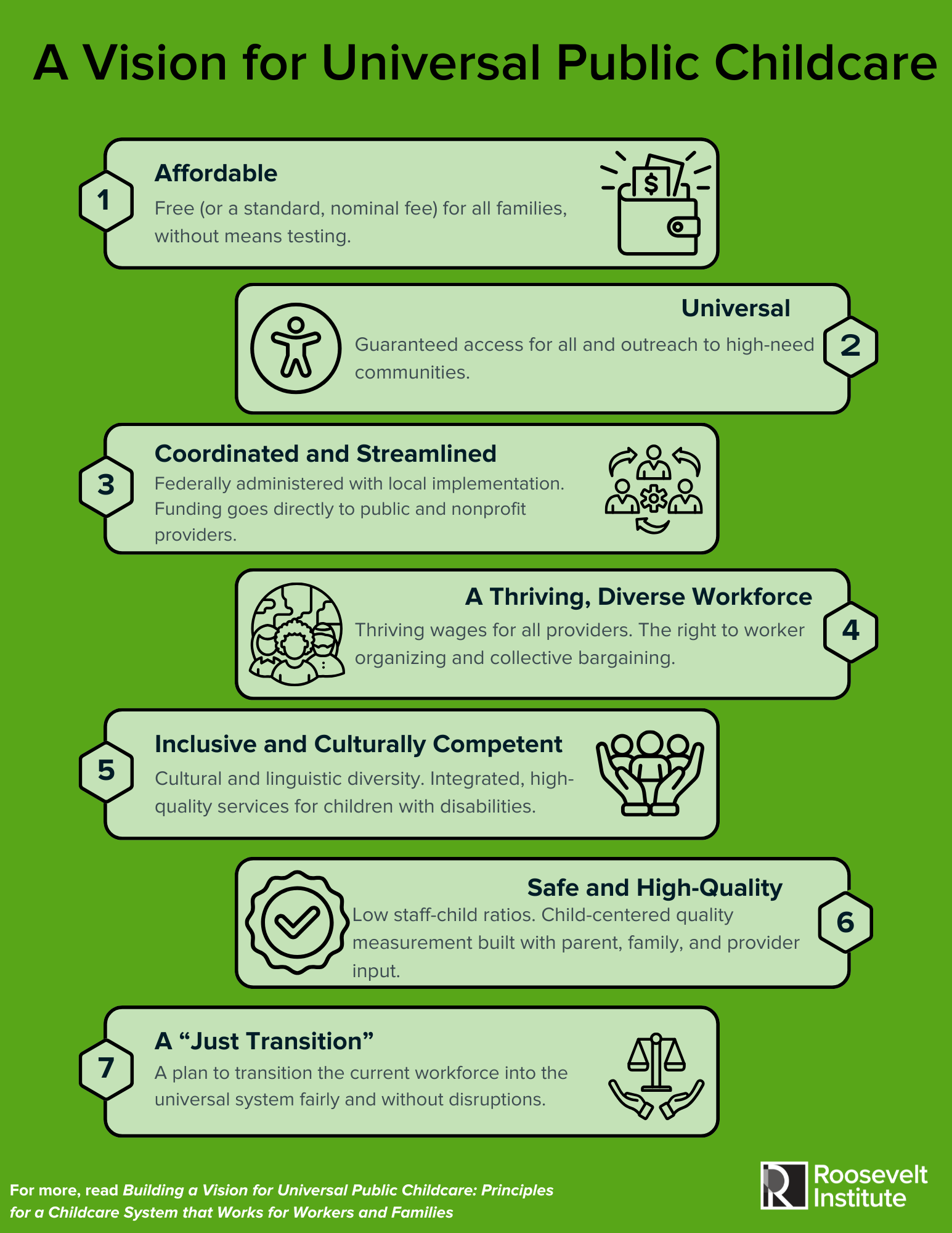
Universal childcare doesn’t create a new expense out of thin air. It restructures costs we are already carrying into something more efficient, more stable, and more equitable. Then the question becomes for lawmakers, should it be handled at the state or federal level? The Roosevelt Institute thinks it should be handled at the federal level and modeled after New Mexico, but there’s no reason Texas couldn’t also make it work on a state level.
We know what works. We know the long-term outcomes for children.
We know the economic impact on families. We know what happens when childcare is accessible, and we know what happens when it isn’t.
The only real question left is whether we’re willing to act on that knowledge.
Because this is about what kind of country we are trying to build.
A country where having children is financially out of reach for working families is not sustainable. A country that forces parents to choose between earning a living and raising their children is not functioning. And a country that understands these problems but refuses to solve them is making a choice.
Plenty of other countries have already made theirs.
They’ve decided that childcare is not a private burden to be carried alone, but a shared investment in the future. They’ve decided that families deserve stability, that children deserve opportunity, and that an economy works best when people can fully participate in it.
The question now is whether we’re willing to make the same decision.
April 2, 2026: Last day to register to vote (City elections/SD04 Special Election)
April 20, 2026: Last day to apply to vote by mail (City elections/SD04 Special Election)
April 20, 2026: First day of early voting (City elections/SD04 Special Election)
April 27, 2026: Last day to register to vote (Democratic primary runoff elections)
April 28, 2026: Last day of early voting (City elections/SD04 Special Election)
May 2, 2026: Last day to receive ballot by mail (City elections/SD04 Special Election)
May 2, 2026: Election day! (City elections/SD04 Special Election)
May 15, 2026: Last day to apply to vote by mail (Democratic primary runoff elections)
May 18, 2026: First day of early voting (Democratic primary runoff elections)
May 22, 2026: Last day of early voting (Democratic primary runoff elections)
May 26, 2026: Last day to receive ballot by mail (Democratic primary runoff elections)
May 26, 2026: Election day! (Democratic primary runoff elections)
Click here to find out what Legislative districts you’re in.
LoneStarLeft is a reader-supported publication. To receive new posts and support my work, consider becoming a free or paid subscriber.
Follow me on Facebook, TikTok, Threads, YouTube, and Instagram.
A wonderful article, and SO timely! At some point in the near future there will be a blue administration and the possibility of real change in the nation.
It may take Texas a while to catch up, but so many people now are beginning to understand that the billionaires are not on the side of working people.
GREAT Article! I agree with you 100% and have been saying this since at least 1982! When I learned in college the importance or quality child care. Then in 1986 I started to teach a High School class on Teaching Young Children (It was a Career Tech class). The class was 2 periods long so that once we did initial training; the students would go to area daycares (public schools) to train to become Teachers of Young Children. I learned so much about the importance of teaching children. One important fact (at that time/not sure if it’s still true) children learned 80% of what they will learn in their life time by 8 years old. That means 9 years to adults only have 20%!
Anyway, I applied it to my 3 boys. They went to the best daycare center in Bexar County. (At that time) It was expensive. It was most of my salary. My husband didn’t want to at first but I told him then I stay home and raise them or we will not have any children. Many people asked me; why work? (For retirement)
I really don’t think I would have given them the education they needed to be as successful as they are. It truly takes a village.
My husband used to play the lottery until I told him half of that money would go to open a great daycare for the poor people. I have seen how economics plays a huge roll on the education of children. I sure would love to equalize that. It would make for a Great Country, if we did.
Bexar County does a bit of this. I just don’t know how good it is. The program is called PreK for SA. But I think they only pay partial or sliding scale.