


The newly drawn Congressional Districts have caused all of the Establishment Democrats in North Texas to play musical chairs. This has landed Marc Veasey out of a job and Julie Johnson and Colin Allred vying for the same seat, TX33. But they aren’t alone, also running up-and-coming progressive underdog, Zeeshan Hafeez, as well as local activist, Carlos Quintanilla.
Both Johnson and Allred have gone completely Liberal in this race, heavily playing on identity politics, shying away from any serious policy other than, “Trump bad.”
And perhaps this is a good opportunity to talk about this specific topic I’ve seen come up online, as it pertains to certain Congressional members and Legislators, it’s the argument that they always show up for their district. And because they show up for their district, their constituents, and their down-ballot candidates, that somehow absolves them of negative criticism for their votes in office.
We don’t elect people to Congress so they can cut ribbons or pose for selfies at community events.
We elect them to use power. To pass laws that materially improve people’s lives. To fight for affordable healthcare, higher wages, safe housing, labor protections, reproductive freedom, civil rights, and an economy that doesn’t grind working people into dust while corporations rake in record profits.
“Showing up” is the bare minimum. Voting is the job.
And voting against major Democratic priorities or repeatedly voting “nay” on high-profile House floor items like a leading Democratic bill on ethics and campaign finance reform does real harm. Both Allred and Johnson should live with the consequences of their legislative choices.
But this reflexive defense, that a member can’t be criticized because they attend local events or help down-ballot candidates, confuses accessibility with accountability. Being present is not the same thing as being effective. And loyalty to the party brand is not the same thing as loyalty to the people who sent you to Washington in the first place.
This should be the standard. Not “at least they’re better than a Republican.” Power exists to be used. And voters are obligated to ask how it’s being used on their behalf.
What does TX33 look like now, and who are its voters?
Honestly, it looks like the Republicans spilled their coffee on the map.
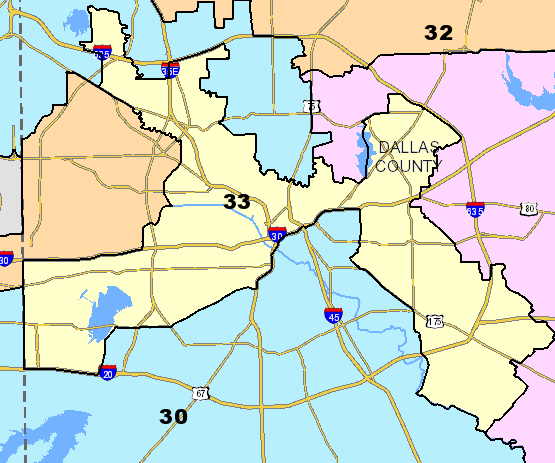
TX33 is now a Dallas County, heavily non-Anglo, majority-Hispanic district with a large combined Black+Hispanic share, and in 2024 had a turnout of 53.5%. (Does that mean Allred wasn’t popular in this district?)
TX33 is a working district. And when representatives from districts like this vote to protect corporate and billionaire taxes, or quietly go along with budget deals that starve schools while defense contractors and private equity clean up, that harm lands exactly where they claim to be “showing up.” No amount of ribbon-cutting or district events makes up for votes that funnel resources upward. In TX33, voters feel the consequences of economic policy long after the campaign signs come down.
Let’s talk about Julie Johnson’s votes since she’s been in Congress.
Most recently, she voted to condemn socialism, even though 66% of Democrats have a positive view of socialism. Johnson has never voted to condemn fascism, but she could only bring herself to vote ‘present’ on honoring Charlie Kirk (so, I guess that’s something.)
Johnson voted YES on the “Increasing Investor Opportunities Act,” letting closed-end funds load up more heavily on private equity and other private funds, while limiting the SEC’s ability to restrict how those products are sold and listed. This bill increases Wall Street access. Johnson also voted YES on the so-called “Protecting American Energy Production Act,” a Republican bill designed to handcuff any president from ever putting a national pause on fracking unless Congress signs off first.
Julie Johnson voted YES on HR 1949, the “Unlocking our Domestic LNG Potential Act of 2025,” a Republican bill to loosen the federal approval process for LNG exports by stripping DOE’s authority and shifting the system toward faster approvals. Johnson voted YES on the REFINER Act, which is basically how fossil-fuel policy gets laundered through “studies” and “reports.”
Johnson voted YES on the CLARITY Act, which put a framework around crypto trading, but it also hands the industry a more straightforward path to treat many assets as “digital commodities” with the CFTC as the main regulator and carve-outs from SEC registration in defined cases.
Johnson voted YES on HR 884, a Republican bill that doesn’t change federal elections at all. Noncitizens already can’t vote in federal races. This vote was about overruling DC’s local decision to allow certain legal residents to vote in municipal elections and on ballot initiatives.
I could keep going. And if this race heads to a runoff, I probably will. Because these aren’t one-off votes or isolated lapses in judgment. They’re a pattern. Julie Johnson regularly crosses the aisle to vote with Republicans on corporate finance, crypto deregulation, and fossil fuel expansion, all while representing a SAFE BLUE district that does not need a conservative hedge in Washington.
What about Colin Allred?
While Allred hasn’t been in Congress for a minute, votes are forever. And you know, safe blue districts are supposed to be where Democrats use leverage, not where they play it safe. They’re supposed to be where representatives take bold positions because they don’t have to fear Republican challengers.
Colin Allred voted YES on the Next Generation Pipelines Research and Development Act. This bill invests federal dollars in the long-term expansion and durability of pipeline infrastructure, including pipelines serving liquefied natural gas facilities and liquid fuel storage. Allred voted YES on the “Crucial Communism Teaching Act,” performative Cold War nonsense Republicans use to keep the base angry while they refuse to fund schools, childcare, or healthcare.
Allred supported building a border wall and voted with the MAGA wing of the Republican Party to condemn President Biden on the border conspiracies that the GOP started. When a bill for universal school lunches was filed in Congress, 100 Democrats co-signed it, but Allred was not one of them.
He voted YES on the No Bailout for Sanctuary Cities Act, the classic GOP cudgel to define “sanctuary jurisdictions” and use federal funding as a weapon to force compliance with immigration enforcement priorities.
And again, I could keep going.
If this race heads to a runoff, there are plenty of other Allred votes worth putting under a microscope. Because, like Julie Johnson, the pattern isn’t random. It’s consistent. It’s the same political instinct over and over. Take the safest position available, borrow Republican framing when it’s convenient, and then campaign as a progressive when the primary voters show up.
And I didn’t even get into the foreign policies of either.
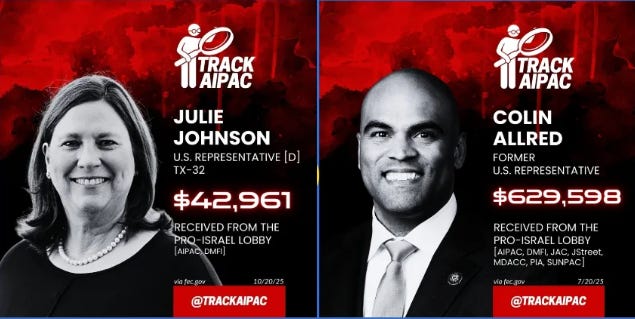
Note: A group of friends was discussing how Julie Johnson has made millions in the stock market since being in Congress, and a $42,000 donation from AIPAC isn’t that big of a deal. My response to that is, if it’s just pennies, why still take it, knowing how controversial it is?
Let’s be clear about what that means in a district like TX33.
This is not a swing district that needs a “moderate Democrat” to survive. This is a safe, blue, working-class district where voters have earned the right to demand more than symbolism and “at least I’m not Trump.” If you’re asking for the Democratic nomination here, you’re asking for a base that wants material results and moral clarity.
So when Johnson’s and Allred’s defenders say they’re “pragmatic” or “electable,” I’m not hearing strategy. I’m hearing a justification for the same old Democratic habit of negotiating with ourselves before Republicans even enter the room. And the result is predictable, a record that prioritizes optics and triangulation over the kind of fighting posture safe blue districts are supposed to enable.
There are votes and positions in both Johnson and Allred’s records that deserve the same scrutiny on war, defense contracting, and the moral compromises Democrats keep asking voters to swallow.
For now, the takeaway is that SAFE BLUE voters deserve better than Democrats who cross the aisle for corporate power and Republican framing and then expect applause because they showed up to a fundraiser.
The third option.
Zeeshan Hafeez is the only candidate in this race who is actually running as a progressive, not just campaigning like one.
He is a first-generation American who lives in the district, and he is the only candidate who has:
Has pledged not to take corporate PAC (or AIPAC) money.
Will fight for a $20 minimum wage, indexed to inflation.
Supports clean energy and a Green New Deal.
Has given public support for Medicare for All.
This matters.
Because Hafeez is not backed by the same constellation of power that has already decided who is “allowed” to win, he’s not sitting on a massive war chest. He’s not being ushered through the race by party leadership. And he’s not being insulated from accountability by the argument that voters should settle for what they’re given.
Julie Johnson has the backing of establishment Democrats, including Hakeem Jeffries. Colin Allred has long enjoyed support from the local Black political establishment. Both have deep donor networks. Both have name recognition. Both have institutional permission.
And that’s the point.
This race isn’t just about ideology. It’s about whether Democratic voters in a SAFE BLUE district are allowed to choose something different, or whether the party has already decided for them.
Johnson and Allred are asking voters to trust that incrementalism, triangulation, and corporate-friendly voting records will somehow lead us out of the moment we’re in.
That brings us back to the question that actually matters.
Will Julie Johnson or Colin Allred help this country move forward from the political, economic, and moral crises we’re living through, or will they manage decline more politely? Will they challenge power, or accommodate it? Will they use this seat as a mandate, or as a holding pattern?
SAFE BLUE voters don’t owe anyone their silence. They don’t owe anyone their loyalty. And they certainly don’t owe anyone their vote just because party leaders say it’s their turn.
Are safe blue districts a place to reward caution and career management, or a place to test whether power can actually be used to improve people’s lives?
Voters in TX33 get to answer that question. Not party leadership. Not donors. Not Washington. Them.
February 2, 2026: Last Day to Register to Vote
February 17, 2026: First Day to Early Vote
March 3, 2026: Primary Election
Click here to find out what Legislative districts you’re in.
LoneStarLeft is a reader-supported publication. To receive new posts and support my work, consider becoming a free or paid subscriber.
Follow me on Facebook, TikTok, Threads, YouTube, and Instagram.
Wow reminds me of the democrats we have in NYC. We have Congressman Adriano Espaillat who represents NY-13 which is D+32. It is one of the most bluest districts in the entire city yet he took a lot of stances connected to AIPAC until he decided to abandon the train to endorse Zohran Mamdani. DSA is preparing to run a candidate against NY-13 and tbh we might as well because we cannot take the risk of a shady politician taking advantage of our movement for his political career. Espaillat is not a ally towards progressive values and there is a chance he can just turn if we do fall out. DSA is not an organization that tries to run shady candidates. Our candidates run with the trust with the membership and its a valued resource. We dont run candidates in congress unless the full membership feels they can trust our candidates and they remain committed to helping better folks lives.
Michelle-You are so knowledgable. Please write the book: "Texas Politics for Marginal Dummies."