


Today, we’re going to have fun with numbers! 😁 One of my biggest pet peeves in Texas politics is the question that refuses to die. How will this statewide candidate appeal to rural voters? Closely followed by its equally tired cousin, Democrats could flip Texas if they just spent more time in rural communities.
I’ve spent years trying to debunk this myth in a dozen different ways. Charts. Maps. Turnout data. Registration numbers. And yet, with every new election cycle, it pops back up like clockwork. A fresh race hits the calendar, and suddenly we’re back to pretending Texas Democrats are losing because they didn’t spend enough time in piddly-wink towns with two stop signs and a run-down Dairy Queen.
So let’s talk about the data. The actual numbers show where Texas Democrats live, where Republicans dominate, and where millions of Texans don’t vote at all. Because when you look at the math, it becomes painfully clear how upside-down this conversation has been for years.
Texas Democrats are not losing because they’ve ignored rural Texas. They’re losing when urban turnout drops, suburban margins slip, and campaign resources get wasted chasing a handful of votes in places with a hundred Democrats total. At the same time, hundreds of thousands of Democratic voters in our cities get treated like an afterthought. (In the past, anyway.)
If we’re serious about winning statewide, it’s past time to stop arguing about where Democrats should be and start reckoning with where they actually are.
First, how did I classify each county (and why)?
I wanted to clearly label each county as urban, suburban, exurban, and rural before I got into the math of it all. But who am I to arbitrarily decide which counties are urban and which are rural, so I needed an official source. Counties were classified as urban, suburban/exurban, or rural using the USDA Rural–Urban Continuum Codes, a county-level framework cited by the Texas Comptroller.
Urban counties are those inside metro areas. Suburban and exurban counties are non-metro but economically tied to a nearby metro. Rural counties are non-metro and not metro-adjacent. This reflects how counties actually function, not how “rural” they feel.
And I hesitated with the Texas Comptroller’s definitions because some of the counties that end up classified as “metro” under this framework are small. Wise. Chambers. Hudspeth. Wilson. If you know Texas geography, your instinct might be to squint at that label and think, Really? Metro? These places don’t look like Houston, Dallas, or Austin, and no one is confusing them for downtown anything.
But here’s the thing, it’s about how counties actually function. Under the framework used by the Texas Comptroller, counties are classified as “metro” if they are part of a metropolitan system, meaning they’re economically tied to a nearby urban core through commuting patterns, labor markets, and media regions. That’s why a smaller county can be considered metro-adjacent or metro-linked even if it still feels rural on the ground. These counties don’t operate like truly rural Texas, and they don’t behave like it politically, either.
This matters because lumping metro-adjacent counties in with truly rural ones artificially inflates the importance of “rural outreach” while obscuring where Democratic votes actually come from. If a county’s economy, workforce, and population are tied to a major city, it makes far more sense to analyze it as part of that urban system than to pretend it’s politically interchangeable with remote, non-adjacent rural Texas.
For this analysis, I’m using 2022 data (the most recent midterm election) because it provides a clean, high-turnout, non-presidential snapshot of Texas voting behavior. Midterms strip away some of the noise of presidential cycles and give us a clearer look at where party bases actually exist, where turnout collapses, and where growth is (or isn’t) happening.
Now that we’ve established how counties are classified and which election data we’re working with, we can get to the fun part. The numbers! And once you see them laid out, it becomes tough to argue that Texas Democrats are losing because they haven’t spent enough time chasing votes in places where there simply aren’t many Democratic voters to begin with.
(Keep scrolling for a link to the spreadsheet with my numbers.)
Where are Texas Democrats?
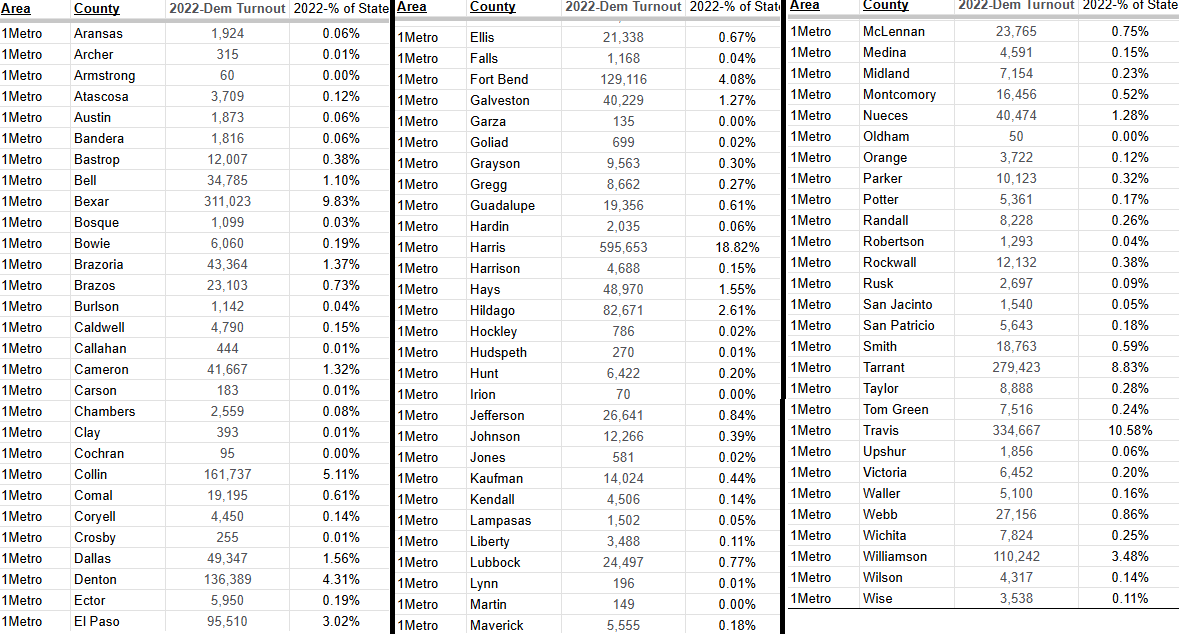
94.47% of Democratic voters live in urban/metro areas.
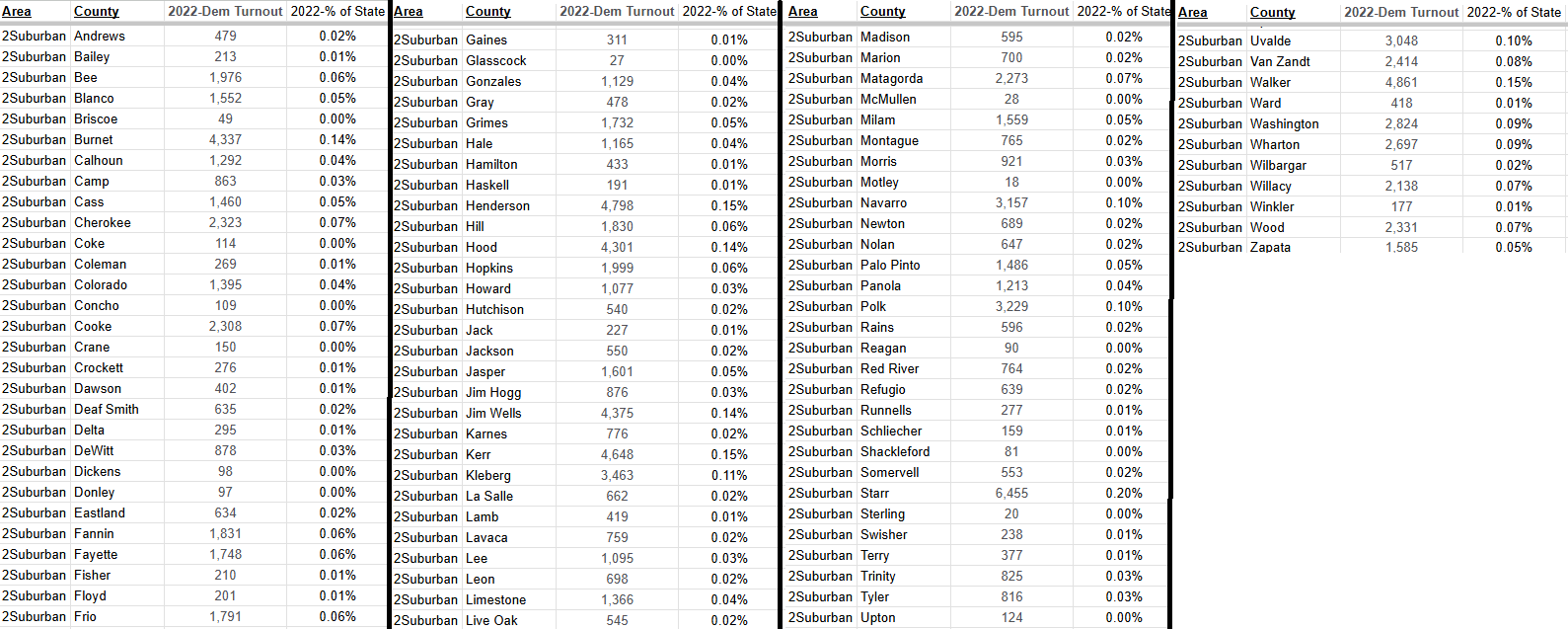
3.87% of Democratic voters live in suburban/exurban areas.
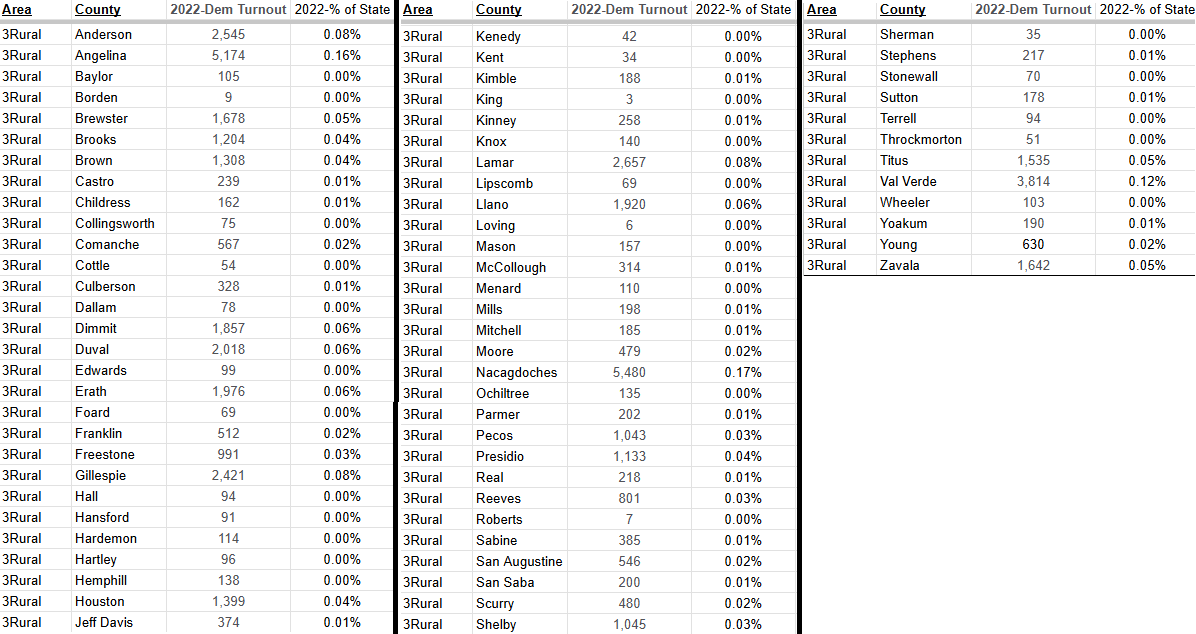
1.67% of Democratic voters live in rural areas.
If you want to check out my full spreadsheet and math, you can find that HERE.
So, a quick recap:
94.47% of Democratic voters live in urban/metro areas.
3.87% of Democratic voters live in suburban/exurban areas.
1.67% of Democratic voters live in rural areas.
But what about non-voters? Where do they live?
In case someone said, “Well, if Democrats put more effort into rural areas, that number would be higher,” I did the same exercise to find out where all the non-voters live. And it’s on the same spreadsheet (along with the Republican data\), if you want to check it out.
89.75% of non-voters live in urban/metro areas.
7.27% of non-voters live in suburban/exurban areas.
2.98% of non-voters live in rural areas.
And yeah, I figured we should look at where Republicans are, too, while we’re at it, because it’s good information to know.
85.43% of Republican voters live in urban/metro areas.
10.3% of Republican voters live in suburban/exurban areas.
4.27% of Republican voters live in rural areas.
Here’s what the numbers tell us.
Texas Democrats are overwhelmingly an urban party. Not sort of. Not “lean urban.” Over ninety-four percent of Democratic voters live in urban or metro counties. Rural Texas, meanwhile, accounts for less than two percent of the Democratic electorate statewide. That’s not a messaging problem. That’s math.
This is where the “Democrats should focus more on rural voters” argument immediately falls apart.
Even if Democrats somehow doubled their support in rural Texas, it would barely move the needle statewide. There simply are not enough voters there to justify the level of strategic obsession rural outreach receives every cycle.
Nearly 90 percent of non-voters live in urban and metro counties. Less than 3 percent live in rural counties. That means the biggest pool of untapped voters in Texas is not hiding out in remote rural communities waiting for a better pitch. It’s sitting in cities and metro areas where turnout is inconsistent, access is uneven, and campaigns chronically underinvest in the hardest work, which is sustained urban turnout operations.
In other words, the voters Democrats need most are already where Democrats already are, they just aren’t voting.
Republican voters tell a similar story, though with a different balance. Even the GOP, often framed as a “rural party,” draws the vast majority of its votes from urban and metro counties. Rural Texas matters culturally and symbolically to Republican politics, but electorally, it’s not where their numbers come from either.
So when campaigns talk about “winning rural Texas” as the key to flipping the state, what they’re really doing is chasing a narrative instead of confronting reality. Texas elections are decided in cities and metros.
If Democrats want to win statewide, the path is not paved with diner stops and photo ops in counties with a few hundred Democratic voters. It runs straight through urban turnout, suburban margins, and the millions of Texans who already live in Democratic strongholds but don’t show up on Election Day.
None of this means rural voters don’t matter. They do.
Every Texan deserves to be heard, represented, and respected, no matter where they live. Rural communities have real needs, real challenges, and real stakes in the future of this state.
But elections are not won on symbolism. They are won on arithmetic.
Rural Texas is not being ignored because Democrats don’t care. It’s being overemphasized because too many political conversations confuse geography with vote share. When less than two percent of Democratic voters live in rural counties, and less than three percent of non-voters do, pretending that rural outreach is the key to winning statewide is not just misguided, it’s a strategic dead end.
If Democrats want to win Texas, the work is not in chasing an imaginary rural wave. It’s in turning out the millions of voters who already live in urban and metro counties, shoring up suburban margins, and investing seriously in places where Democratic voters already exist but participation lags.
That doesn’t mean writing off rural Texans. It means telling the truth about where elections are actually decided and finally aligning strategy with reality.
Because Texas isn’t lost in the countryside, it’s being decided in the cities.
February 2, 2026: Last Day to Register to Vote
February 17, 2026: First Day to Early Vote
March 3, 2026: Primary Election
Click here to find out what Legislative districts you’re in.
LoneStarLeft is a reader-supported publication. To receive new posts and support my work, consider becoming a free or paid subscriber.
Follow me on Facebook, TikTok, Threads, YouTube, and Instagram.
I remember the analysis after 2018 when statisticians said if just over 20,000 in Dallas, Houston, Austin, San Antonio had voted, Beto would have won. So yes, we want to acknowledge rural voters but concentrate on the non-voters in Urban Areas.
But also, Candidates only think the urban areas are the big counties. How many big candidates came to Ellis County in 2024? Zero. How many came to Irving, zero. And I am in Dallas County. Remember I told you no one walked doors in Irving except a few of us and you can see why Collin overwhelming over performed in Irving. Cause he was the only candidate I had lit for. And they ran my lists. I was talking to Republicans. Now that was the problem. That assumed Democrats had already been spoken to. But they hadn’t. Can you imagine what numbers would have been like if big giant blue Irving had actually turned out? Yeah. The Dallas consultants don’t want that to happen. That is why I am getting so much push back. I can tell you right now why all our city council candidates the past few years have lost. I am not a fancy campaign consultant, I am just a retired middle aged lawyer. I looked at the publicly available data and I figured it out and we won. We figured out the message at the doors when we talked to voters about what they wanted city council to do. Fix the damn voucher scam! Yeah city council has nothing to do with vouchers. It doesn’t matter. Voters aren’t rational, neither am I. I am passionate. And voters know I am fighting for them. So all the big slick consultants can go back to wherever they came from. I am a Texas Democrat.