


Texas Democrats are watching the Senate primary between Jasmine Crockett and James Talarico turn into something ugly online. It’s been racialized to the point that people are treating Texas politics like it’s a comment-section blood sport, and it’s not helping either candidate, and it’s sure as hell not helping Texas.
I’m not going to amplify the worst actors in this mess. I’m not naming the influencers who have been spreading false claims and orchestrating a smear campaign. I’ve watched them do it to candidates, to organizers, and yes, to me. That’s not the story. The story is what this kind of behavior does to our coalition.
Because here’s the big picture most people keep dodging:
Texas isn’t a persuasion problem. It’s a participation problem.
Look at who actually votes in Texas. Look at who doesn’t. Look at the last midterm electorate and what it tells us in plain English. When our coalition stays home, Republicans win, even when their policies are wildly unpopular.
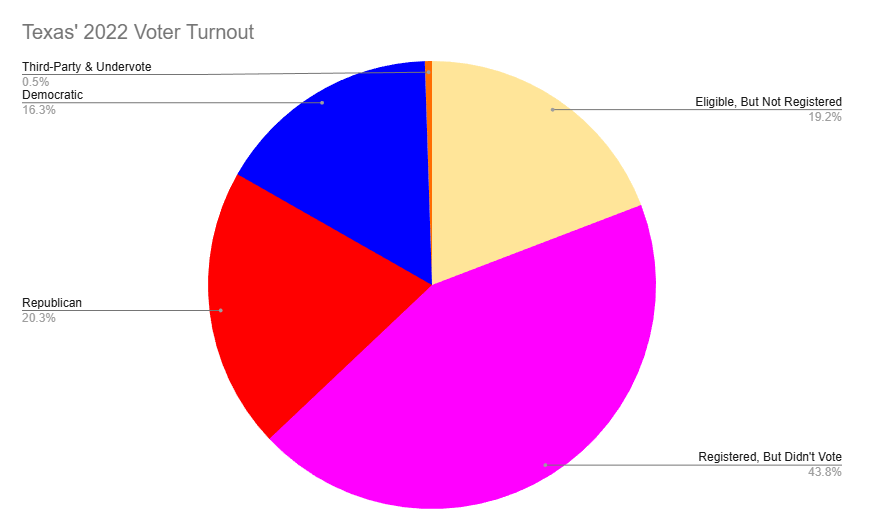
And the coalition math isn’t mysterious. In the last statewide midterm, white voters went heavily Republican. Black voters went overwhelmingly Democratic. Latino voters leaned Democratic. Asian voters were competitive but slightly Democratic. That’s not “identity politics.” That’s just the electorate.
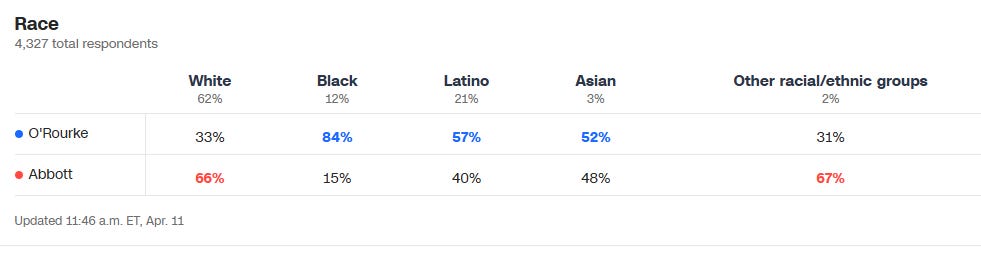
So no, the lesson here isn’t that Democrats should light each other up on the internet over who is “allowed” to speak, who is “authentic,” or who is “pandering.”
The lesson is that Democrats win Texas by turning out the voters who already agree with us, especially the people this state has trained, for decades, to believe their vote won’t matter.
Crockett’s strategy is aimed at re-engaging disillusioned Black voters, including people who’ve been ignored, disappointed, and written off by politics for years. Black Texans are part of the backbone of the Democratic Party in this state, and anyone pretending otherwise is either ignorant or lying.
Talarico’s strategy is aimed at consolidating the Democratic base with a populist, working-class message, the kind that gives people a reason to vote that isn’t just fear of Republicans, but a promise of lower bills, higher wages, clean government, funded schools, and open hospitals.
Both approaches have strengths. Both campaigns have made mistakes. This is a primary, that’s normal. My issue is with the misinformation machine trying to turn a primary into a hatred factory.
What’s not normal is turning it into a racial cage match that convinces regular voters that Democrats are more interested in policing each other than fixing Texas.
The way some of the online discourse has spiraled is so detached from real life that I asked my own Black family members if I was missing something because I’m white.
They looked at me like I’d lost my mind.
They told me they know what’s in my heart. They told me to stop letting strangers on the internet define reality. And they reminded me of something I already know. Most of the loudest internet accounts don’t know the candidates, the state, or the work.
Here’s my rule for readers going forward:
If someone is feeding you “information” that is divisive, personalized, and mean, especially if it makes you hate your neighbor more than you hate the people poisoning our schools, emptying our hospitals, and gutting our wages, that is not analysis.
That is manipulation.
In Texas, one out of every four kids goes to bed hungry. We have rural communities where getting to a hospital is a crisis by itself. We have maternal outcomes that should shame every man in power in Austin. We have a grid that fails, a housing market that bleeds working families, and a government that treats cruelty like a hobby.
That’s what this election is about.
This is my home. I’ve spent years tracking turnout, watching strategies succeed and fail, and telling Texans the truth even when it’s unpopular. I’m not going to be bullied off the field by newcomers who confuse attention with authority.
If you support Crockett, talk about her plan. Talk about turnout. Talk about what she’ll fight for.
If you support Talarico, do the same. Talk about his plan. Talk about turnout. Talk about what he’ll fight for.
But if you’re here to racialize the primary, smear people with lies, and turn Texas Democrats against each other?
You’re not helping Texas.
You’re helping Republicans.
How do we know who Texas Democrats are?
Texas Democrats are the people who show up to the unsexy meetings. They’re at the county conventions, the precinct chair elections, the platform committees, the resolutions debates, the volunteer trainings, the blockwalking launches, and the fights over rule changes that nobody on Twitter even knows exist.
Because in Texas, we don’t just elect candidates, we elect the party’s bones. We elect precinct chairs, the most important office nobody talks about. We elect county chairs, SD and HD caucus leaders, convention delegates, platform and resolutions committees, and members of the State Democratic Executive Committee. Those people collectively decide what the party prioritizes, what it funds, what it organizes around, and what it demands of candidates.
So if you want to know what Texas Democrats actually believe, start with the Texas Democratic Party Platform. That’s a document adopted by delegates from across the state. Look at what local parties and delegates are doing at conventions, the resolutions that pass, the fights that happen, and the coalitions that form. Pay attention to who is winning internal party elections.
The simplest litmus test for a real Texas Democrat is easy.
When you’re trying to separate actual analysis from influencer cosplay, ask if they’re talking about turnout infrastructure or just opinions? Real Texas Democratic politics is precinct chair recruitment, voter registration, blockwalking, training, local coalitions, issue campaigns tied to the Legislature, convention fights, platform priorities, and the daily grind of organizing.
Influencer Texas Democratic politics is something very different. It’s “here’s what Texans want” based on a timeline, constant outrage with no organizing, telling you to hate your own coalition, and measuring politics by who can ratio who.
A lot of so-called experts tell you what Texans want based on their personal opinions or their friend groups. I’d rather tell you what Texas Democrats want based on what they literally passed, elected, and organized for. And yes, there’s another convention coming up this year, and I’ll be covering both the Democratic and Republican conventions again, with the same rigor as last time.
Progressive populism is on the rise in Texas, and it has been for the past few years. This is something that we’ve talked about a lot here on Lone Star Left, and it’s been proven time and time again, including with Taylor Rehmet’s recent win.
If someone claims to be an expert on Texas politics but never talks about the rise of economic populism in this state, never mentions the grassroots energy building in county parties, and never connects their preferred candidate to the actual platform Texas Democrats have adopted, you should ask yourself a simple question. Do they really know Texas at all?
Because the story here isn’t online drama, it’s the growing movement of working-class Texans demanding lower bills, better wages, real healthcare, and clean government. Any analysis that ignores that shift, or pretends it doesn’t exist, isn’t analysis. It’s just noise with a Texas accent.
I started Lone Star Left because I love this state and I believe it can be better.
I’ve sat through the boring meetings, read the platforms, crunched the turnout numbers, and watched ordinary Texans build something real from the ground up. That’s the Texas I’m betting on, not the one screaming at itself on social media.
We are closer to change than most people realize. But we’ll only get there if we refuse to let division distract us from the goal. Show up. Organize. Vote. And don’t let anyone convince you that fighting each other is more important than fighting for Texas.
February 17, 2026: First Day to Early Vote
March 3, 2026: Primary Election
Click here to find out what Legislative districts you’re in.
LoneStarLeft is a reader-supported publication. To receive new posts and support my work, consider becoming a free or paid subscriber.
Follow me on Facebook, TikTok, Threads, YouTube, and Instagram.
I love Lone Star Left in general and especially this post. Thank you for this spot-on analysis of the situation. As a precinct chair, I find your description of the hard work of grassroots Democratic Party organizing so accurate. We must stay focused. I'll vote for one of these in March but I'll also be ready to work equally hard for either candidate in November.
I see the division in my county right now (and the “small town” city council politics here is a ridiculous soap opera), but I am determined to not let it get to me. It may be unfollowing a few people on Facebook and a lot of positive self-talk, but I am really getting to know the candidates and making voting decisions on WHO is the best candidate to represent us in November. Forums, interviews, platforms and conversations.
I keep referring friends and acquaintances to your work, Michelle. It is a great resource for us here in Texas!
There are also newspaper interviews, League of Women voter’s guides, and more.