

I didn’t become a political writer the easy way. I was a teenage mom, then a single mom in my twenties, and years of corporate work that paid well and cost me my sanity. Sandy Hook broke something open in me in 2012. I ended up in Moms Demand Action during the Open Carry Tarrant County years, and got pulled into running Living Blue in Texas. Thirteen years later, it’s still just me and Dr. Jo from the original crew. In 2020, I cashed out my 401(k) and went back to school, and became the writer I’ve always wanted to be. My one rule I won’t break is no paywalls. I remember being the broke 25-year-old who couldn’t afford information to know what her own government was doing to her. Nobody reading this has to be that person. No PAC money. No dark money. No corporate sponsors. Just readers.
Which is why I need to say this. A man got mad at me for refusing to turn this platform into a weapon against their local Democrats, with whom they personally have a grudge. I don’t take marching orders from anybody, and I especially don’t take them from a man who thinks a woman with an audience owes him her voice. This is the entire point of not taking PAC money or dark money.
If you want independent Texas political writing (on the left) to keep existing, become a paid subscriber. It’s the only thing keeping this free for the people who can’t pay.
And because nobody tells me what to write, today we’re going to talk about a murder mystery that’s been weighing heavily on my mind. It happened 153 years ago, on the steps of the Texas Capitol, during a legislative session, to a current sitting legislator.
The world is on fire right now, and we’re living through it, so it feels new and scary. But there’s always been a fire in Texas.
February 19, 1873, 7:30 pm.
It was payday, back before debit cards and direct deposits. The members of the 13th Legislature spent the afternoon cashing their per diem at the Treasury, and Louis Franke was among them.
Franke had $260 in his pocket. He left the House chamber and started down the front steps of the old Capitol, headed for the Land Office, where the Immigration Committee, of which he was the Chair, was waiting for him.
Two men were sitting in the shadow of the east portico column. A House clerk walking up the same steps a few minutes earlier had noticed them, close together, talking low. He couldn’t make out their faces.
A few minutes later, a clerk from the Department of Education came running into the Hall asking if anyone knew a Mr. Franke, because he was in bad shape down by the steps. Somebody went out and found him. Franke was still sitting up. He said he’d been knocked down and robbed.
He didn’t live to see morning.
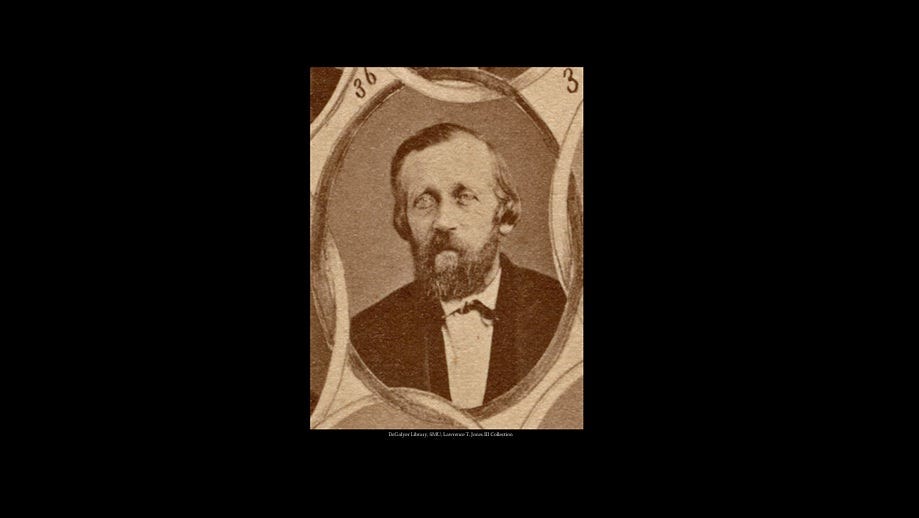
Louis Franke, born Ludwig Carl Ferdinand Francke in 1818 in what’s now Germany, got involved in opposition politics in 1840s Europe, and decided the smart move was to leave before the authorities decided it for him.
In 1872, at the tail end of Reconstruction, Fayette and Bastrop counties sent him to the Texas House. He chaired the Immigration Committee. He sat on Agriculture and Stock Raising, Redistricting, and Public Lands and Land Office.
He served for a little over a month.
Witness accounts.
He was carried into the room of Gustave Hoffman, a fellow member of the House, around eight o’clock that night. Two men, S. Robb and Col. Nelson, brought him. Senator Flanagan had been the first to find him. Hoffman testified under oath at the inquest the next day. Franke arrived badly bruised, bleeding heavily, and still able to talk. He told Hoffman two men had knocked him down and robbed him. He said he didn’t know their names.
Dr. B.E. Hadra examined him that night. His testimony was also under oath. A broken leg. Two wounds to the head, one made by something dull, one by something sharp enough to interrupt the skin between them. A depression of the skull above the right temple. Hadra’s stated opinion was that these wounds killed him.
They did, at 4:30 the next morning.
His watch was still on him. Untouched. So was seven dollars in coins. The only thing missing was the $260 in paper currency he’d drawn that afternoon, folded up and ready to carry home.
The morning after, police found a painter with red on his shirt and deemed it probable cause. Arrested him on the spot. Turned out to be paint, not blood, and they let him go. Two soldiers were next publicly accused by rumor and had to go to the newspaper office themselves to clear their names in print.
Then came Williams and Spaulding. Two men, arrested on suspicion, held under guard, were named in the paper. Then, nothing. They stop existing in the story, which tells you everything about how seriously anyone was tracking this once the initial panic died down.
Meanwhile, there was an actual trail. Blood and footprints led from the Capitol steps around the Executive office to a wood pile, then over a fence toward Sussman’s grocery, where two men matching witness descriptions had bought beer that same night with a fat roll of cash.
Four days later, a Dallas Herald correspondent covering the story from Austin said that the men actually being arrested had neither the motive nor the nerve for a crime like this, while whoever really did it was, in his words, coolly looking on and enjoying the farce. He predicted, correctly, that nobody would ever be caught and blamed the bungling of the people in charge of finding them.
The Texas Legislature moved fast.
Three days after Franke died, Senator Joseph Sayers introduced a joint resolution authorizing the governor to offer a $5,000 reward for the capture and conviction of the killers. It passed the Senate 20 to nothing. It passed the House 69 to nothing.
The reward was passed unanimously. The men who killed Louis Franke were never identified.
It’s a pattern you’ll recognize if you’ve been paying attention to Texas government for longer than five minutes. Grand gestures are cheap. Actual accountability is the expensive part, and it’s the part they always seem to run out of budget for.
A sitting member of the Texas House of Representatives was beaten to death within sight of the Capitol steps, and the state’s own investigators never found the murderer.
But then, there are the parts that become fact and the parts that become legend.
I came across this story because I was interested in the 13th Legislature from a historical perspective. The 13th Legislature was the first legislative session after the Amnesty Act of 1872, which restored political rights to over 150,000 former secessionists. The ex-Confederates did many bad things in Texas after that, especially the racist Alexander W. Terrell (and the TSHA has whitewashed him).
The Texas House of Representatives put out their set of facts, and eventually, the newspapers got bored, and the ex-Confederates in our government stopped chasing Louise Franke’s killer.
However, decades after Louis Franke died, his widow, Bernhardine, told a different version of that night to a relative, who wrote it down years later as family history. In her telling, there was no fight on the steps at all. A stranger asked Louis to step out onto a balcony on the north side of the Capitol to discuss something private. Louis followed him. The man attacked him and threw him over the railing. That’s the story Bernhardine carried for the rest of her life. That’s not the story the inquest testimony tells. I’m giving you both because a widow’s memory of the worst night of her life and a coroner’s sworn record don’t have to agree to both be true to somebody.
Then there’s another rumor. Decades later, a man on his deathbed confessed to being one of the two killers, and said the whole thing had been arranged by someone with enough standing in this state that naming him would have been a scandal nobody wanted. He supposedly took that name to his grave rather than let it out. This story surfaced independently more than once, including on an Austin television program in 1969, ninety-six years after the murder.
Nobody, including the family who kept passing this story down, ever claimed they could prove it. I can’t prove it either. But I’ll tell you that a rumor that a powerful man bought his way out of a murder charge doesn’t survive for a century in Texas because people have nothing better to do. Deep down, folks believed it was exactly the kind of thing this state would let happen.
In almost any town in Texas, you hear rumors about wealthy families, and the things they do, and the things they get away with because of the power they buy. Maybe there’s always been those stories, and maybe there’s always been some truth to them. Or maybe Louis Franke just ran into two drunks, who happened to know when the legislators got paid.
The woman left holding it all together.
Franke’s widow, Bernhardine Franke, was not yet forty when her husband was killed, and he left her with eight children. Eight. The youngest was only three months old. And when friends tried to arrange a government pension for her, she said no. Maybe out of pride. She wound up running a farm and raising all of her children herself.
With her sons working alongside her as they got old enough, she grew a successful farm to pass down to her children.
Nobody offered Bernhardine Franke a unanimous vote or a joint resolution. She just got up every morning and did the work for the rest of her life.
If there’s a version of Texas resilience worth admiring, it’s not the legislature passing a reward it never had to pay out. It’s a widow with eight kids and no help from anybody, proving she could do it all on her own.
It’s easy to look at Texas today and think we’ve hit a new low.
None of that is new. Texas has been Texas since the Capitol was doing business by candlelight. A man was beaten to death two hundred feet from where lawmakers still walk into work, and the state passed a reward, patted itself on the back, and let the whole thing go cold. That’s typical Texas government.
I’m not telling you this story to make you sad. I’m telling you because it’s true, and true is reason enough. I don’t need anybody’s permission slip for that. Louis Franke’s killers walked free. Bernhardine wrote her own story.
But somebody, eventually, has to keep telling the truth about how this state actually works, even when it’s inconvenient, even when it makes people mad or sad, even when it’s about something that happened before any of us were born. Because there are some things that happened before many of us were born, like the Voting Rights Act, that still impact today.
Texas is always counting on somebody not to tell the story. I’m going to keep telling it, anyway.
118 days until the November election!
Click here to find out what Legislative districts you’re in.
LoneStarLeft is a reader-supported publication. To receive new posts and support my work, consider becoming a free or paid subscriber.
Thank you for not charging your readers. These days it's getting expensive to stay informed enough to vote intelligently. And thanks for the interesting story. Glad you found your calling!
I love history, especially Texas history. Good post. History is always necessary for a full understanding of current events. In a way, for me, it is helpful to remember that our history shows "same song, different verse".
You are right to suspect political violence at this time. I see that Franke was a German. The Germans in Texas were Abolitionist/Republicans and opposed to slavery. Confederate sympathizers murdered a lot of them. Texas was lawless in those years and Austin was particularly rough. I suspect his murder had something to do with that. If anyone wants to take a deeper look, here's a link:
https://www.tsl.texas.gov/lobbyexhibits/civil-war-dissent