

Politics (noun) pol·i·tics: the art or science of government, such as
a: the art or science concerned with guiding or influencing governmental policy
b: the art or science concerned with winning and holding control over a government
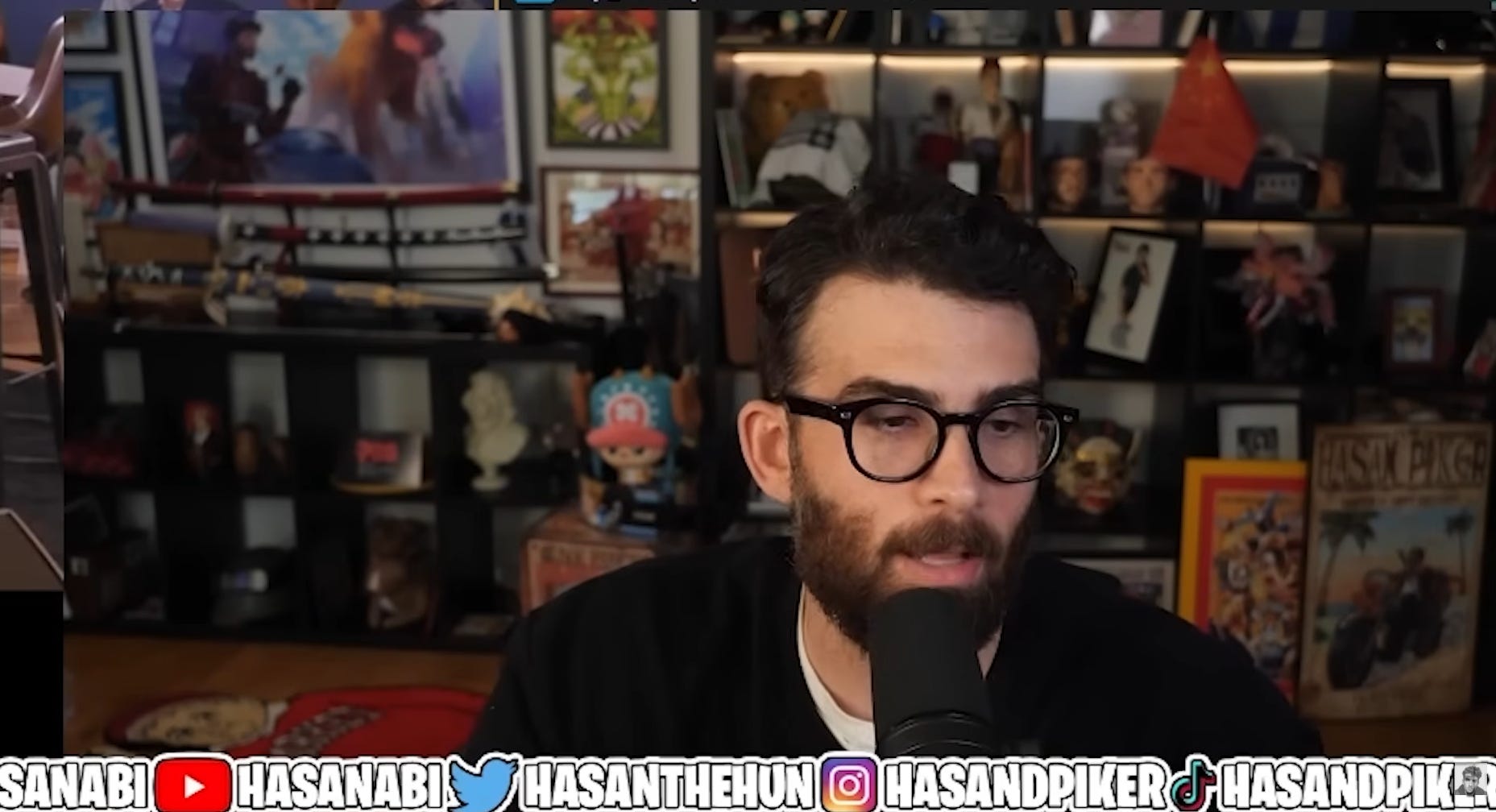
If you don’t know who Hasan Piker is, consider yourself lucky. You just missed months of ideological warfare happening in mainstream media, brought to you by ExxonMobil, CVS Health, Bill Gates, and Reid Hoffman.
Let me rewind a bit.
Last summer, I wrote about the punditry coming from Washington DC, talking about the Democratic Civil War, and perhaps I naively said, “We’re all good in Texas.” But, I should have added, “For now.” Because last summer, things in Texas were looking like bluebonnets and sweet tea for Democrats, but things have changed.
Texas Democrats, specifically Texas progressives, have spent years in coalition, working hard at the state, candidate, and county levels to wrestle the ideals of the “left-leaning party” away from the old Dixiecrat holdovers of the past. Or so we thought. But 2026 has been a strange year, and maybe it’s the crumbling of America or the daily outrages of our fascist government, but it seems to be pushing ideological splits within our two major political parties (both of them), and it’s getting too hard to keep ignoring.
A split or a return?
I’ve concluded that the Republicans’ denial of the Southern Strategy is simply a continuation of the Lost Cause myth. Think about it. The Lost Cause was about control over national memory. It took a system built on racial hierarchy and recast it as honor, heritage, and states’ rights. And when Republicans deny that the Southern Strategy happened, it requires the same kind of historical sleight of hand.
The shift of white Southern voters into the Republican Party was a deliberate strategy. But history doesn’t because it’s inconvenient. The Southern Strategy was documented, debated, and, at times, openly admitted.
One part of the Southern Strategy discussion that gets overlooked is that, during the WWII era, while there were two major parties, both had ideological splits. Dixiecrat Richard Russell (D-GA) founded the Conservative Coalition in 1937, which was later led by Mr. Republican himself, Robert A. Taft (R-OH).
During that same era, some of my favorite “liberals” include Wayne Morse (R-OR), who fought for labor rights and equal access to education, and Claude Pepper (D-FL), who was one of the leading New Dealers in Congress and built his career around anti-poll tax and labor protections. Morse later switched parties.
The point is that 90 years ago, in America, we didn’t have a conservative party and a liberal party. We had the Democratic Party and the Republican Party, and within both, a range of ideologies. Could it be that we’re returning to something simialar?
Or could it be we’re moving to something new altogether?
What does that have to do with Hasan Pike, Texas Democrats, and you?
Everything.
The Third Way Democrats’ attack on Hasan Piker and progressive Senate candidate Abdul El-Sayed is a fight that’s been building for a while. The fight over what the Democratic Party is supposed to be, who it’s supposed to represent, and who gets to define its limits.
While it wasn’t immediately clear when the 2026 primaries kicked off, it’s absolutely clear now that the same ideological battles are happening in Texas. The ideological range of Texas Democrats, or perhaps Democrats altogether, has grown substantially over the last several years, and pieces of our coalition are finding themselves at odds over policy, messaging, and whose interests actually come first.
And with the Texas Democratic Party Convention coming up and a huge election around the corner, after that, these ideological battles could mean the difference between access to healthcare and genocide in a foreign nation.
The questions that every Democratic voter should be asking right now:
How did we get here?
Where do I fall in the ideological spectrum?
Why are these attacks on the left happening right now?
Who is attacking the left, and what outcome do they want?
Does the left start at anti-capitalism?
I made this handy-dandy chart for anyone trying to understand the left’s ideological buckets, because there are several.
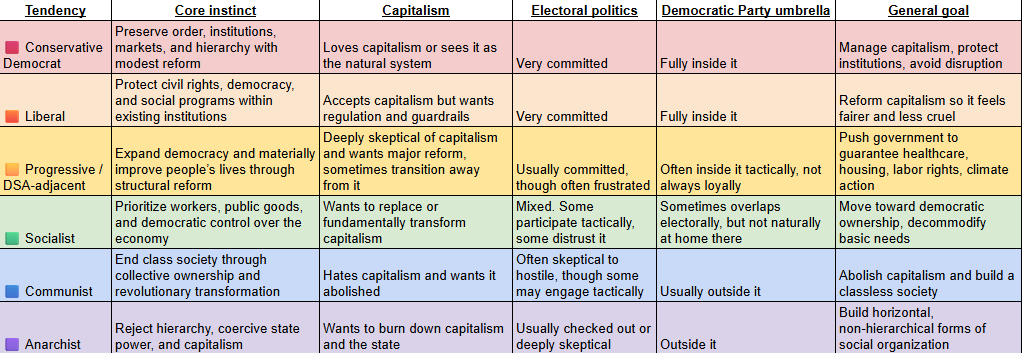
You may have heard people say online (or in person), “the left begins at anti-capitalism,” which is really an inference that the Democratic Party, specifically establishment Democrats, are simialar to Republicans in their goals to uphold capitalism.
For the record, Lone Star Left is a progressive newsletter, and while I could say I’m DSA-adjacent, meaning that I agree with many of their policy positions, I do not belong to the DSA. However, almost all of the Congresspeople whom I hold deep respect for and agree with on almost everything are either current or former members of the DSA. For example:
Greg Casar
AOC
Rashida Tlaib
Summer Lee
“Anti-capitalism” is a scary term for a lot of people in America, as we’ve all been propagandized since birth to believe that’s the only way to achieve happiness/greatness in this country. And capitalism, in theory, sounds great. But what few people ever talk about is how American capitalism too often is simply about corporate power and public harm. Here are some examples:
ProPublica reported in April 2026 that Prospect Medical, a for-profit hospital chain, promised to self-insure malpractice claims but never reserved the funds needed to cover defense costs for injured patients and doctors. They cut costs, pocket the upside, and leave patients and physicians stranded when the bill comes due.
Reuters reported that prison-health company YesCare won approval for a bankruptcy deal after its predecessor faced around 200 lawsuits over allegedly deficient care, including personal injury and wrongful-death claims. Reuters also reported on Wellpath’s bankruptcy settlement after the company faced debt and litigation pressure. Privatized prison medicine produces injury claims, and then the corporate structure helps contain the fallout.
ProPublica reported in 2026 that the FAA warned airlines that rocket launches could “significantly reduce safety” and that catastrophic failures could create dangerous debris, after Starship explosions disrupted air traffic and forced pilots to scramble. ProPublica also reported the FAA killed a rule aimed at regulating space junk even as commercial launches increased. SpaceX, a giant, politically connected company, has room to grow, while public risk trails behind it.
This is American capitalism as it actually functions. Private equity buys the hospital, the nursing home, or the prison health contract, strips it for parts, socializes the harm, and when people die, get sick, or lose everything, there’s always a bankruptcy court, a regulatory loophole, or a consultant ready to explain why none of it is anybody’s fault.
So, when leftists, like Hasan Piker or random internet-bros, are talking about “anti-capitalism,” they are looking at capitalism through the lens of the harm it causes everyday working people in America, not through the lens of “if I work hard enough, I can have the American dream.”
This part about capitalism/anti-capitalism is important to understand when answering the question:
Who is attacking the left, and what outcome do they want?
And I don’t mean Republicans. We all know the GOP never shuts up and doesn’t even know the difference between communism and fascism. Who is left of center and attacking the left?
It’s centrist Democratic institutions, donor-friendly operatives, media gatekeepers, and pro-Israel power centers inside or adjacent to the Democratic Party who see the growing anti-war, anti-corporate, and anti-establishment left as a threat to their control. In the most obvious recent example, Third Way published a letter calling on Abdul El-Sayed to say whether he aligns with Hasan Piker’s views, while recent reporting out of Michigan describes Third Way, the ADL, pro-Israel figures, and establishment Democrats going on the offensive after Piker aligned with El-Sayed.
And the outcome they want is not complicated. They want to police the boundaries of what is considered acceptable Democratic politics. They want a party that stays safely inside capitalism, safely inside donor comfort, safely inside the old foreign-policy consensus, and safely away from anything that sounds too redistributive, too anti-war, too pro-Palestinian, too anti-corporate, or too willing to name oligarchy as the problem. Third Way’s own 2026 polling project makes that clear by framing the electorate around “pragmatism,” “electability,” and “capitalism with guardrails,” rather than systemic transformation.
And if they get their way, we’ll never have universal healthcare, or universal childcare, or a living wage, or affordable housing, or student debt relief, or paid family leave, or strong labor protections, or a serious climate response, or an end to mass incarceration, or any real check on corporate power.
But THESE ⬆️ are the things that Democratic voters actually want.
Don’t believe me? Read the Texas Democratic Party platform. Better yet, check out these polls:
Data for Progress found 78% of Democrats support Medicare for All.
The First Five Years Fund reported that 94% of Democrats say federal child care funding would help lower costs for working families.
Data for Progress found that more than 80% of Democrats say the current federal minimum wage is not enough for a decent quality of life, and 85% support raising it to $17 an hour.
A Bipartisan Policy Center / National Housing Conference / Morning Consult poll found 83% of Democrats say the lack of affordable homes is a significant problem in the United States.
YouGov found that 92% of Democrats support canceling some or all of the debt for lower-income Americans, and 90% support relief for people who have been repaying loans for at least 20 years.
Pew found 80% of Democrats favor requiring employers to provide paid family leave.
Gallup found 90% of Democrats approve of labor unions. That is not a poll on a specific labor bill, but it is a very strong indicator that Democratic voters support pro-labor policy and worker protections.
Yale’s Climate Change in the American Mind found that 96% of liberal Democrats and 94% of moderate/conservative Democrats support federal funding to help farmers adopt soil practices that reduce carbon pollution, and that registered voters across the spectrum support many climate-friendly policies.
FWD.us reported polling showing 85% of Democrats support criminal justice reform, and 84% of Democrats say it is important to reduce the jail and prison population in the United States.
Data for Progress found 93% of Democrats say it is important that lobbyists from Big Pharma, Big Tech, Wall Street, and other corporate interests not influence the next DNC chair, and 89% say party leadership should listen to working- and middle-class voters rather than corporate and wealthy executives.
Politics (noun) pol·i·tics: the art or science of government.
And right now, the “art” part is doing a lot of work.
These attacks are happening at the exact moment more progressives are running for office than we’ve seen in decades. Not just in New York or California, but here in Texas too. People like me. People like you. People who are not waiting for permission from party leadership or donors to talk about healthcare, housing, wages, and corporate power in plain terms.
And when that happens, when new people start stepping into power, the lines get drawn.
If you look at that chart I made, the fault line is pretty clear. It’s between liberals and progressives. That space where one side wants to manage the system, while the other side starts to question whether it is working at all.
In Texas, that divide became very real during the primary.
The term “identity politics,” something that’s been used in political analysis for decades, was being treated as if it were inherently offensive. People were being sorted, labeled, and dismissed faster than anyone was actually listening. And that’s where things started to shift.
Because instead of debating policy, strategy, or how to build the biggest possible coalition, the conversation started to turn into something else. Who gets to speak? Who is allowed to represent what? Who is “problematic.” Who needs to be disqualified?
And yes, there are bad actors in every space. There always have been. But what I saw, and what a lot of people saw, was something broader than that.
People like Hasan Piker are getting labeled in ways that go far beyond critique. People like James Talarico are facing attacks that have less to do with policy and more to do with framing. And people like me, and plenty of others, catch labels just for existing in a space that calls itself “left.”
I watched people with large platforms and comfortable positions spend entire days trying to discredit candidates, not over what they believed about healthcare or wages or housing, but over whether they were the “right kind” of Democrat. They made videos from their multi-million dollar kitchens and on their lunch breaks from their six-figure law careers.
I watched class-based arguments get reframed as exclusionary. I watched serious policy conversations get reduced to optics.
And maybe that’s the breakdown.
Maybe what we’re actually seeing is not just a disagreement over tactics, but a disagreement over what politics is supposed to prioritize in the first place. Class or identity. Systems or symptoms. Coalition or control.
I don’t claim to have a perfect answer.
But I do know this.
When the conversation shifts away from what people need to survive and toward who is allowed to say what, something has gone off track.
Blue state/online leftists are the biggest drivers of this divide.
Of course, it’s worth noting that Hasan Piker is based in Los Angeles. This is a discussion that a lot of “red state leftists” have had online for years, and something I’ve not only observed but also written about in the past.
The material conditions are different.
In blue states, you’re often operating inside systems that, while imperfect, are at least somewhat responsive. There are protections. There are safety nets. There are elected officials who, at a minimum, acknowledge the problems being raised. The stakes are still high, but they’re not always immediate in the same way.
In red states like Texas, the stakes are immediate.
Healthcare isn’t theoretical. It’s access or no access. Voting rights are actively restricted. Public education, labor protections, reproductive rights, even local governance, these are not policy debates here. They are ongoing fights against a state government that is openly hostile to large portions of its own population.
And that changes how you approach coalition.
Because when you are living under that kind of pressure, you don’t have the luxury of ideological purity. You don’t get to sit out elections. You don’t get to disengage from the Democratic Party entirely, even if you’re frustrated with it, because it is often the only available vehicle to slow down or block harm.
So what you see is a difference in strategy.
A lot of leftists in blue states are more willing to operate outside the party, to reject it outright, to treat it as just another institution to dismantle. And in some contexts, that makes sense. But in red states, that approach can feel disconnected from reality.
And then there’s coalition.
Texas Democrats are not just one group. They are multiracial, working-class, urban, rural, immigrant, union, non-union, religious, secular. Building anything here requires constant negotiation, constant compromise, and constant awareness of who is most at risk if things go wrong.
So when conversations flatten into accusations, when people start labeling entire groups instead of engaging with ideas, when class-based arguments get dismissed outright instead of debated, it feels counterproductive.
Because the goal, at least for those of us doing this work on the ground, has never been to win an argument online.
The goal is to build something that can actually win here.
And that requires a different kind of politics.
Is it racism?
Hasan Piker livestreams 70 hours a week, and within the last decade of doing that, there have been a few clips that have been taken out of context to depict him as racist. All of those clips he has responded to and answered for. If Centrist Democrats want to crucify him as a racist, whatever. To my understanding, this attack on him has made him more popular than ever.
However, this new trend, undoubtedly planted by the likes of Third Way Democrats, to paint progressive and leftist ideology as anti-Black is not only absurd but, in itself, racist, as it erases prominent Black leftist voices in history and in our current political spaces.
Black, anti-capitalist politics have always existed. For example, Martin Luther King JR explicitly wrote that capitalism had “outlived its usefulness” and had “failed to meet the needs of the masses.” Other well-known Black leftists include Malcolm X, Angela Davis, Fred Hampton, and Cornel West.
Last year, I heard someone use the term “political entertainment” in a sentence. I was floored. But this is what our political space has become for too many, entertainment, WWE cage matches, while lacking the understanding of ideology and policy. And the outcome is in 2026, a ton of liberals online are calling the political beliefs once held by Martin Luther King JR, “anti-black,” because some Twitch streamer said something stupid and it was clipped out of context. It hurts my brain.
My only advice, IF you’re a liberal or a progressive and you want to understand leftist policy, don’t start with Marx or Lenin. Start with Cedric Robinson, Angela Davis, and W. E. B. Du Bois. Start with the Black radical tradition. It makes more sense in a country where race and capitalism have never been separate.
At the end of the day, this was never really about Hasan Piker.
I don’t watch Twitch. I’m not in that demographic. But I’ve seen Hasan Piker plenty on YouTube, and when there’s nothing on C-SPAN, I’ll throw on a clip in the background while I’m writing or researching. I don’t always agree with him politically, just like I’m sure readers of Lone Star Left don’t always agree with me. That’s not the point. The point is that he is engaged, informed, and part of a broader conversation about policy, power, and what this country is doing both at home and abroad.
And to be clear, if someone has concerns about things he’s said, they are free to make that case. People can watch the full context, review his responses, and draw their own conclusions. That’s how this is supposed to work. But reducing an entire set of ideas, or an entire wing of the left, to a label based on clips, framing, or secondhand narratives is not analysis.
It’s about where the Democratic Party draws its boundaries, and who gets to draw them. It’s about whether voters can push for bigger changes without being written off before the conversation even starts.
And here in Texas, we don’t have the luxury of getting this wrong.
The consequences show up in whether people can see a doctor, whether schools stay funded, and whether workers have any leverage at all. That is the context in which these arguments are happening.
You don’t have to agree with every position on the left. You don’t have to like every messenger. But if the response to new ideas is to label them out of bounds rather than engage with them, then the outcome is already decided before voters get a say.
That’s control.
And in a state like this, control without results doesn’t hold for long.
April 20, 2026: Last day to apply to vote by mail (City elections/SD04 Special Election)
April 20, 2026: First day of early voting (City elections/SD04 Special Election)
April 27, 2026: Last day to register to vote (Democratic primary runoff elections)
April 28, 2026: Last day of early voting (City elections/SD04 Special Election)
May 2, 2026: Last day to receive ballot by mail (City elections/SD04 Special Election)
May 2, 2026: Election day! (City elections/SD04 Special Election)
May 15, 2026: Last day to apply to vote by mail (Democratic primary runoff elections)
May 18, 2026: First day of early voting (Democratic primary runoff elections)
May 22, 2026: Last day of early voting (Democratic primary runoff elections)
May 26, 2026: Last day to receive ballot by mail (Democratic primary runoff elections)
May 26, 2026: Election day! (Democratic primary runoff elections)
Click here to find out what Legislative districts you’re in.
LoneStarLeft is a reader-supported publication. To receive new posts and support my work, consider becoming a free or paid subscriber.
I always thought I was liberal but it turns out I’m progressive.
Good essay. I agree. When the internal competition over the direction of the Democratic party finally permeated my thick skull, I read something that has really stuck with me. This person said when you see purity tests, rules about who gets to speak, attempts at stifling good faith dissent and automatic flattening of adverse positions, you are probably looking at people who are jockeying for personal power within the organization rather than pursuing authentic ideological engagement.
Of course, an authentic ideological contest is inextricably intertwined with power plays. I guess that is as it should be. However, Michelle is correct. We need to observe professional detachment by avoiding the easy tactic of the personal destruction of our internal adversary. Democrats will be a better party if we stick to objective arguments while keeping in mind the best interest of not just the party as a party, but the best interest of the people the party represents.