


By the time we get to November 2026, our country will likely be in ruins. Biden had barely just dug us out of Trump’s first-term economy when Republicans anointed him again. Since then, inflation has continued to rise, the unemployment numbers are in the shitter, there are military forces on our streets, and unidentified federal agents are kidnapping our brown neighbors. A lot can happen in eight months, and every expert on the planet is expecting disaster in the next fourteen.
The 2026 midterms will not be “just another election,” it’ll be one of the most pivotal elections in American history. This will be a tsunami election, and likely a cut-throat primary, where we can clean house and gain some real numbers to make fundamental changes in DC.
One of America’s most significant failures is the for-profit healthcare system. A system that countless progressives have wanted to do away with for decades. And for the 2026 election, the stars are aligned just right to make universal healthcare a winning platform issue.
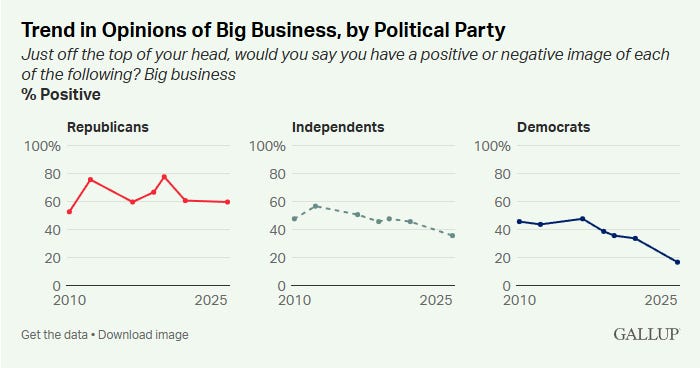
Did you see this new Gallup poll? It says that while 42% of Democrats see capitalism in a positive light, 66% of Democrats see socialism in a positive light. And while universal healthcare is NOT socialism, it will be framed that way. Besides, our current healthcare system is “big business,” and only 17% of Democrats see “big business” in a positive light.
Democrats must run unapologetically on universal healthcare because it’s popular, moral, and fiscally sound.
If you’re new here, hyperlinks lead to sources.
Why is universal healthcare a winning issue for 2026?
First of all, it’s a moral issue. Healthcare is a human right. Democratic voters understand this. At its core, the fight for universal healthcare isn’t about policy charts or budget lines. It’s about dignity. People know in their bones that if your child is sick, you should be able to take them to the doctor. If your spouse has cancer, treatment shouldn’t depend on the size of your paycheck.
And the cracks in our system aren’t hidden. People often see neighbors holding GoFundMe fundraisers to cover their medical bills. They hear stories of patients skipping chemotherapy because they can’t afford the copay. They feel the squeeze when premiums go up while coverage gets thinner.
Luigi Mangione tapped into that frustration. Millions of Americans saw in him a desperate stand-in for their own despair, the feeling of being trapped in a system designed to profit off suffering. You don’t have to condone his actions to understand why his name spread like wildfire. It was a symbol of how broken healthcare feels for working families.
That’s why universal healthcare resonates so powerfully. The outrage is already there. Democrats just need to give it a direction.
The numbers back up what people already feel in their gut. Gallup’s latest poll shows support for capitalism slipping to its lowest point on record. For the first time, fewer than half of Democrats view capitalism positively, while two-thirds now view socialism favorably. Independents are split, Republicans cling to capitalism, but the overall trend is clear. Faith in big business and corporate power is eroding.
Why? Because when people think about capitalism today, they don’t picture a mom-and-pop store or a family farm. They picture insurance giants, drug companies, and hospital chains that jack up prices and deny care. Big business has become synonymous with profiteering at the expense of ordinary lives, and nowhere is that felt more sharply than in healthcare.
That’s why universal healthcare speaks directly to the disillusionment Gallup is recording. When Democrats promise to replace a system people increasingly distrust with one that guarantees fairness and security, they align themselves with the direction public opinion is already moving.
Why running on universal healthcare makes sense politically.
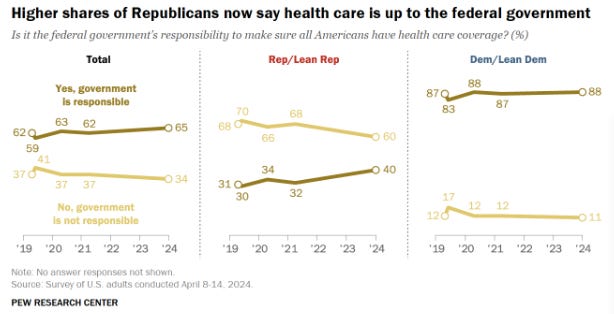
The Pew Research Center finds 65% of Americans say it’s the federal government’s responsibility to make sure all Americans have health coverage. That includes 88% of Democrats.
With 82% of Americans viewing Medicare and 77% viewing Medicaid favorably, voters’ strong support for these programs creates a clear runway to expand public coverage.
Best-estimate modeling found that a US single-payer system would cut total national health spending by roughly 13%, about $450 billion per year, while preventing about 68,000 deaths annually. The savings come from lower administrative overhead and stronger purchasing power, not from cutting care.
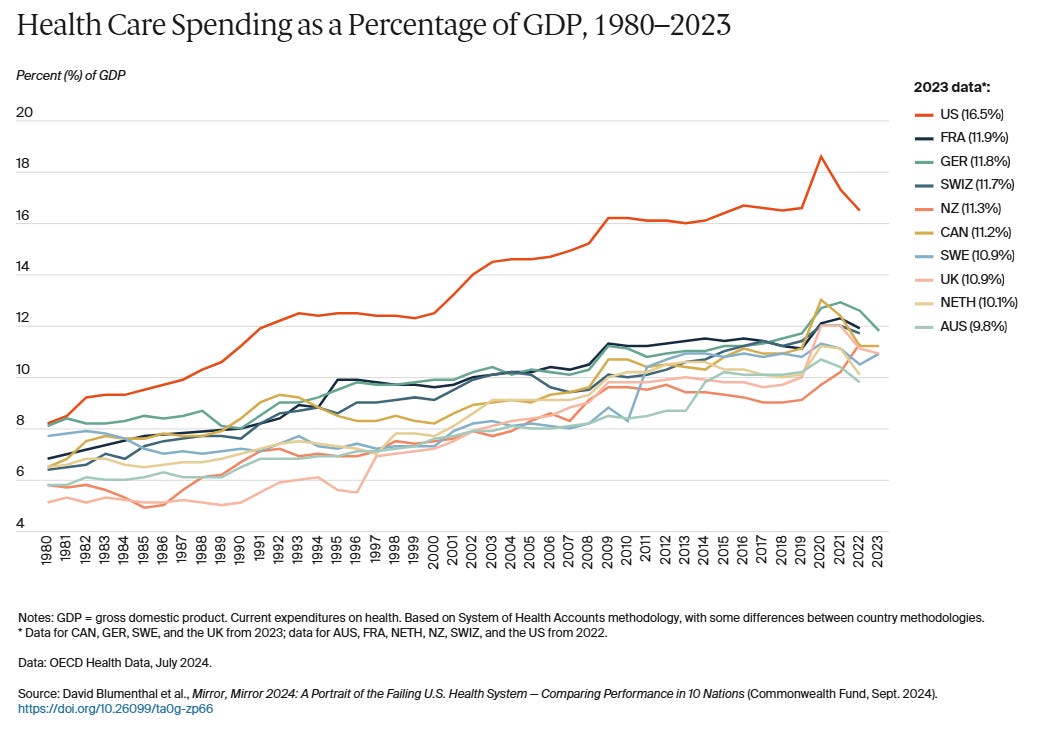
US health spending reached $13,432 per person in 2023, about 1.8× the average of comparable countries. Yet, the US ranks last overall on access, equity, and health outcomes among high-income nations in the Commonwealth Fund’s latest international scorecard. In short, the most money for the least performance.
Employer-based insurance creates measurable job lock, where workers stay put or delay better matches to keep benefits. Natural-experiment evidence around the ACA’s dependent-coverage rule shows increased parental job retention (a job-lock signal), underscoring that decoupling coverage improves labor flexibility and can raise productivity.
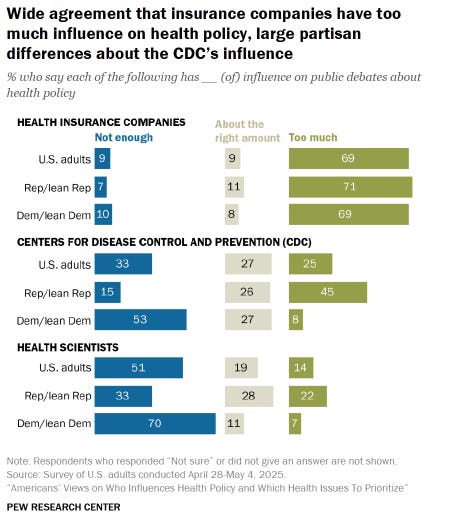
A July 2025 Pew survey reports 69% of Americans say health insurers have too much influence over health-policy debates, a bipartisan signal that reining in middlemen and prioritizing patient care is both sound policy and smart politics.
How Democratic candidates should talk about universal healthcare.
Lead with freedom, not fear. Healthcare is the freedom to change jobs without losing coverage, to start a business without risking your kid’s prescriptions, to see a doctor when something feels wrong instead of waiting until it’s an emergency. Say it plainly. Healthcare is freedom from job lock, from financial ruin, from untreated illness. That’s the promise.
Use real-life stories. Talk about the parent who rations insulin to make rent. The veteran who did everything right and still got hit with a five-figure “surprise” bill. The diner owner is crushed by premiums and deductibles while trying to keep three employees covered. Voters remember people, not pie charts. One story, one name, one bill that broke a family. Then the solution.
Don’t waste oxygen on “socialism vs. capitalism.” Voters will just hear noise. Pivot every attack to three anchors, fairness (everyone gets in, nobody goes broke), cost savings (cut the middlemen, lower premiums and prescriptions), and choice (keep your doctor, see them when you need to).
Keep it simple. Use clean, repeatable lines.
“Every American deserves to see a doctor when they’re sick.”
“No one should go broke to buy medicine.”
“You get care when you need it, and you keep your doctor.”
And then turn it all into a 20-second stump you can reuse. “Universal healthcare is freedom to change jobs, start a business, and take your kid to the doctor without checking your bank account first. We’re ending the chaos and the gotchas, lower costs, fewer hoops, and a real choice of your doctor. Every American deserves care when they’re sick. No one should go broke for medicine.”
Further reading: A Democrat’s Guide to Discussing Universal Healthcare
The roadmap to winning on universal healthcare in 2026.
Make universal healthcare the campaign’s north star. It’s the rare issue that unites values and self-interest: people want dignity and lower bills. Treat it as the centerpiece that ties your whole ticket together.
Promise something worth showing up for. Universal healthcare is concrete, universal, and urgent, this is the kind of material win that motivates volunteers, small-dollar donors, unions, and working families. Tie it to kitchen-table pain (premiums, deductibles, insulin) and to place-based realities (rural hospital closures, maternity deserts).
Appeal to independents disillusioned with corporate profiteering. Lead with cost, access, and stability. “Lower bills, fewer hoops, keep your doctor.” Frame it as freedom from job lock and surprise bills, not an ideological litmus test. Independents want predictability and a fair price.
Draw a sharp contrast with Republicans. “They protect insurance and pharma profits; we protect patients.” Put corporate middlemen on the other side of the table and keep patients, providers, and small businesses on yours. Culture-war noise vs. healthcare security is a contrast you can win.
Make it the backbone of a populist progressive Democratic agenda. Show how healthcare reform unlocks progress everywhere else:
Workers’ rights: No more choosing between a union raise and health benefits; no more job lock.
Cost of living: Lower premiums, deductibles, and drug prices are a direct pay raise.
Economic justice: Close racial and rural care gaps; end medical bankruptcies that entrench poverty.
Small business growth: Entrepreneurs can hire and expand without being crushed by premiums.
Run on this with discipline and repetition. It galvanizes your base, wins over the middle, and forces Republicans to defend the least popular part of the status quo, which is a system that profits when people get sick.
2026 is a once-in-a-generation opening.
Voters are done with a system that rations care by bank account, and they’re looking for leaders who will choose people over profiteers. This is the moment to meet their urgency with our own.
Democrats should not run timidly on half-measures. Run proudly and clearly on universal healthcare, guaranteed care, lower costs, and a real choice of your doctor, making it the centerpiece of every stump speech, ad, and debate.
If we lead with healthcare, we can build a healthier, freer, more prosperous America. Families are protected from medical bankruptcy, workers are free to change jobs or start businesses, rural hospitals reopened, prescriptions are affordable, and care is available when needed. Make healthcare the central promise, and fight like hell to deliver it.
November 4: Constitutional/TX18/SD09 Election
Click here to find out what Legislative districts you’re in.
LoneStarLeft is a reader-supported publication. To receive new posts and support my work, consider becoming a free or paid subscriber.
Follow me on Facebook, TikTok, Threads, YouTube, and Instagram.
Only 40% of Texans approve of Greg Abbott’s job performance which is an all time low. I hope we don't miss this chance to have a Democrat elected as governor.
Universal healthcare is also a good example of why government needs to provide a service in the betterment of the entire country versus a private, for profit endeavor. When it is unprofitable to provide services, business will never do so. And this is what health insurance is, a service*. You cannot make a profit insuring people who will make a lot of claims. So insurers take our premiums and then do everything they can to not pay our claims. It is no different from when we got rural electrification. Only government could provide this service because it was unprofitable to run power lines out to rural homesteads.
And the insurance companies understand this. But rather than backing out of the health insurance business, they try to figure out how to get taxpayers to pay their losses while harvesting the profits from the premiums. This is the play currently underway in the Trump Administration as it tries to privatize Medicare with its little experiment into AI pre-screening. Therefore, the logical answer is for government to take over healthcare and let private enterprise figure out another way to make money in the private insurance business.
So, if Democrats are savvy, they can use the real-world experiences of SS and Medicare users after DOGE butchered its workforce as the example of why we need full-on government provided SERVICES rather than just delivering people into the hellscape of corporate piracy.
*Health insurance used to be a whole lot more profitable when medical science was less advanced. Lifespans were shorter and people didn't survive the medical issues, like hypertension and cancer, that are now managed with medical advances and drugs. Rather than admitting their actuarial tables won't work anymore as a result, insurers try to game it as noted above.