

What do you want to see more of?
November 4, 1960, four days before the election that would decide the country. Lyndon B. Johnson’s motorcade rolled toward the Baker Hotel in downtown Dallas, and a Dallas police officer pulled the car over first, to warn him.
“There’s a little disturbance waiting for you at the hotel,” the officer said.
The disturbance was three hundred women in red, white, and blue. Junior League types, mostly. They’d spent the morning handing out Nixon-Lodge literature to the lunch crowd. By the time Johnson’s car turned onto the block, they were a mob, and they had placards, and the placards had been sitting in the Baker Hotel overnight, stored there by the local congressman who organized the whole thing.
His name was Bruce Alger. And Alger’s legacy outlasted him by fifty years.
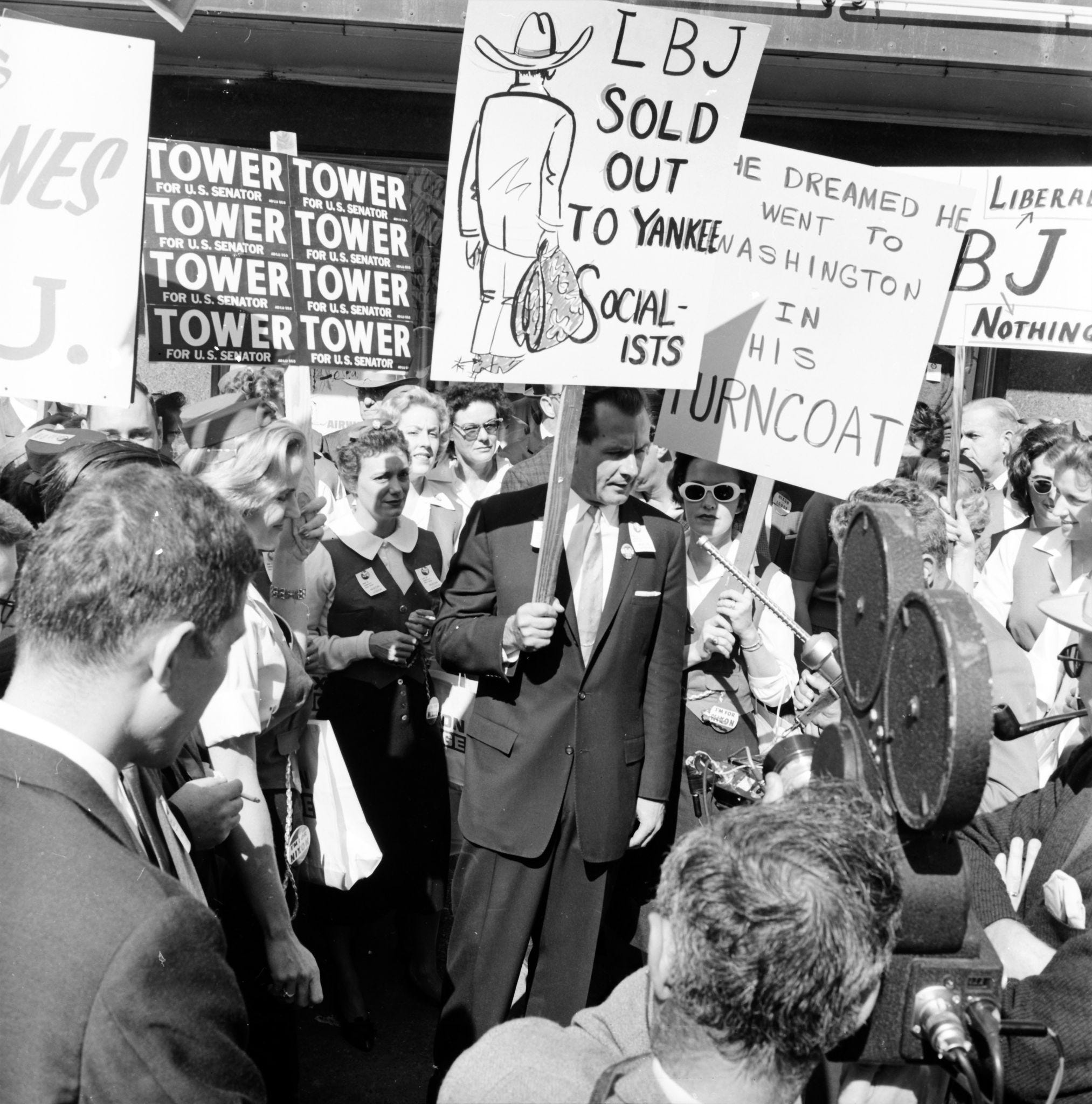
Lady Bird Johnson stepped out of the car and a woman reached in and snatched the gloves off her hands and threw them in the gutter. The crowd cheered. Someone screamed “Judas.” Someone else screamed “traitor.” The signs said LBJ SOLD OUT TO YANKEE SOCIALISTS and JUDAS JOHNSON: TURNCOAT TEXAN.
It took the Johnsons thirty minutes to cross a lobby.
By the time it was over, a Nixon supporter would say the whole stunt had set the Texas Republican Party back twenty years. Of course, in 1960, Bruce Alger was the ONLY Republican in the entire Texas congressional delegation. In fact, Texas was a Conservative Democratic state after the end of Reconstruction, and Alger became the first Republican sworn in after roughly 80 years of no Republicans in office.
But Bruce Alger’s stunt didn’t cost the Republican Party Texas. Bruce Alger built the Texas Republican Party, and everything that came after it. Alger was part of the blueprint.
In May, we discussed some of the early Republican extremism that ran through a Baptist pulpit two miles from that hotel.

This is a continuation of that story, of early Republican extremism in Texas, and the birth of modern day fascism in America.
The Baker Hotel was consistent with a man who spent ten years in Congress proving that the mob outside the hotel was his platform.
Start with the school lunch program. In 1958, Congress voted to subsidize meals for hungry schoolkids. Every member of the House supported it except one. Bruce Alger cast the lone vote against feeding children, on the grounds that it should be a local matter, not a federal one. He said it with a straight face, and he said it as if it made him a man of principle.
That “principle” ran through everything. He voted against the Civil Rights Act of 1957, the Civil Rights Act of 1960, and the Civil Rights Act of 1964, and against the 24th Amendment, the one that outlawed poll taxes. He didn’t sign the Southern Manifesto in 1956, so technically he can’t be filed next to Strom Thurmond on that one document. It didn’t matter. His votes did the same work, he just skipped the theater of putting his name on a joint statement with segregationist Democrats and let his record speak for itself.
After Kennedy was killed in his own city, while the country was still in mourning and Congress was debating the Civil Rights Act as a memorial to the president Dallas had just watched die, Alger wrote a column for the Congressional Record arguing the bill shouldn’t pass out of “emotional appeal,” and that civil rights had “mainly” been “an instrument” for politicians chasing Black votes. Three weeks after a sniper killed the president in HIS district, Bruce Alger’s public response to the moment was to complain that civil rights legislation was a scam.
He also introduced a bill to pull the United States out of the United Nations entirely, voted with his own party’s president, Eisenhower, only 9% of the time because even Eisenhower was too liberal for him, and missed votes at nearly three times the rate of his colleagues. The Washington press corps ranked him the second least effective member of the entire House. “My ignorance of politics,” he liked to say, “couldn’t be matched by anybody in politics.”
Alger sold contempt, contempt for government, for compromise, for the idea that a congressman’s job was to actually do something other than stand in front of a camera and refuse. Alger was everything the modern Republican congressman is, sixty-five years early.
Congressman Alger wasn’t a lone actor.
One congressman screaming into a microphone backed by a 12,000-member church, the state's most powerful newspaper, and one of the richest oilmen in America is a movement.
The Dallas Morning News was run by EM “Ted” Dealey, and under Dealey it became the most reliably paranoid daily paper in the country. He called the Supreme Court the “Judicial Kremlin.” He called Kennedy a crook, a Communist sympathizer, and “fifty times a fool,” in print, before Kennedy had done a single thing to Texas. Every morning, Dallas woke up and read that its own president was a child playing dress-up.
The Dallas Morning News still, to this day, leans right.
Two miles from the Baker Hotel, WA Criswell was running the same operation from the pulpit. In 1960, the same year Alger’s mob went after Lady Bird Johnson’s gloves, Criswell told his congregation that electing a Catholic president would mean the end of religious freedom in America. He later told reporters, that Catholics should never hold higher office. Historian Edward H. Miller said in the Washington Post: Alger “sought to amplify and capitalize on the pronouncements of those like Daley and Criswell.”
And bankrolling the whole ecosystem was HL Hunt, a First Baptist Dallas parishioner and Criswell’s personal friend, pouring oil money into the John Birch Society chapter that made Dallas the Birchers’ largest and best-funded outpost in the country. That chapter’s most famous recruit was retired Major General Edwin Walker, who’d been relieved of his NATO command for handing his troops Birch Society literature and came home to Dallas.
The same Dallas housewives who loved Alger loved Walker too. They made him a local celebrity. A local celebrity important enough that an ex-Marine named Lee Harvey Oswald decided, in March of 1963, that Walker deserved to die, and put a rifle round through his window. Walker survived.
When UN Ambassador Adlai Stevenson came to Dallas to speak, he walked into an auditorium full of Walker’s people, who greeted him with Halloween noisemakers, Confederate flags, and a man screaming that Stevenson’s heart would “stop, stop, stop, and he will burn, burn, burn.” When Stevenson tried to leave, a woman hit him over the head with a picket sign.
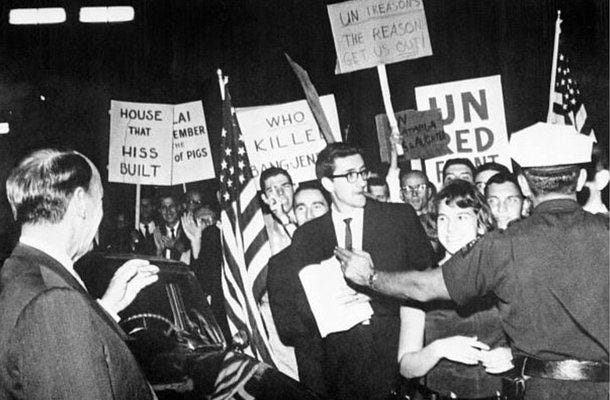
Alger’s response to the fallout was to insist Dallas had nothing to apologize for, that the protesters had only proven the city was “proud, courageous, and truly the home of the brave.”
Twenty-nine days later, Kennedy was dead in the same city, shot from a building six blocks from where Stevenson had been assaulted, by a man who had already tried to kill Walker and had been marinating for years in the exact stew Alger, Criswell, Dealey, and Hunt had spent a decade building.
That’s the part Dallas never wanted to sit with. That an entire city had spent a decade building the pressure that made pulling it feel, to somebody, like patriotism.
The world decided Dallas killed Kennedy.
As a third generation Dallasite, this is something I’ve thought a lot about in terms of Dallas history. All of the older people in my family have their own Kennedy-related stories. A distant cousin of mine (now dead), has footage he took that day in the Sixth Floor Museum. One of my grandmothers used to work with Jack Ruby (she was a bar owner). I think that everyone who had family in Dallas at the time has some story.
But when Kennedy was killed, Dallas didn’t look in the mirror, and decide to become a better place politically, they kept on for more than a decade, embracing extremism. Nixon came calling, campaigning for Alger’s reelection and telling a rally of three thousand cheering Dallas Republicans he had “a hunch” they’d send their congressman back to Washington.
Alger himself finally lost in 1964, swept out in the same landslide that also took down Ed Foreman, the only other Republican in the entire Texas delegation. For a minute, it looked like the whole experiment had burned itself out along with the mink coats and the picket signs.
It hadn’t. It had just gone quiet, just for a little while.
Because the thing about Criswell’s pulpit, Dealey’s press, and Hunt’s money is that none of it needed Bruce Alger personally. Criswell kept building. By the early 1970s he had Nixon at the White House by his own invitation and a stated goal, in his own words, of winning America through the church. His hand-picked successors, Paige Patterson and Paul Pressler, took that goal national in 1979 when they engineered a takeover of the Southern Baptist Convention itself.
And in 1980, twenty years after the Baker Hotel, the same city hosted the moment the whole strategy finally said the quiet part out loud. I’ve told you about it before. Paul Weyrich, standing in front of fifteen thousand preachers in Dallas, telling them flat out that he didn’t want everybody to vote, that his leverage “quite candidly goes up as the voting populace goes down.”
And the men running Texas today are still working from them. The Washington Post put it in five names: “Alger’s progeny dominate the Texas GOP.” Louie Gohmert. Chip Roy. Dan Patrick. Ken Paxton. Same style. Same contempt for anyone who tells them to tone it down. Same conviction that the only real Texans are the ones who already agree with them.
Bruce Alger didn’t get a statue. He got an entire political party built in his image, running the state sixty years after Dallas voters finally threw him out of office.
If it can be built here, it can be broken here too. But first we have to admit it was built at all.
103 days until the November election!
Click here to find out what Legislative districts you’re in.
LoneStarLeft is a reader-supported publication. To receive new posts and support my work, consider becoming a free or paid subscriber.
I’ve always enjoyed reading this blog and hearing your insights about the people and processes. Please keep up the good work!
This is why when my family moved here in 1975, my mother couldn’t wait to get out. And even though I always felt this pull to Texas, my early years here, the inter generational pull of my great grandmother who was born here and also was forced to leave when her father oversaw the 1900 census, it was and still is a terrible place.
They being said though, there are amazing folks like Opal Lee and Barbara Jordan and even LBJ, and now Beto O’Rouke who refuse to give up on this state.
You and I can be included as well. Keep fighting mama.