

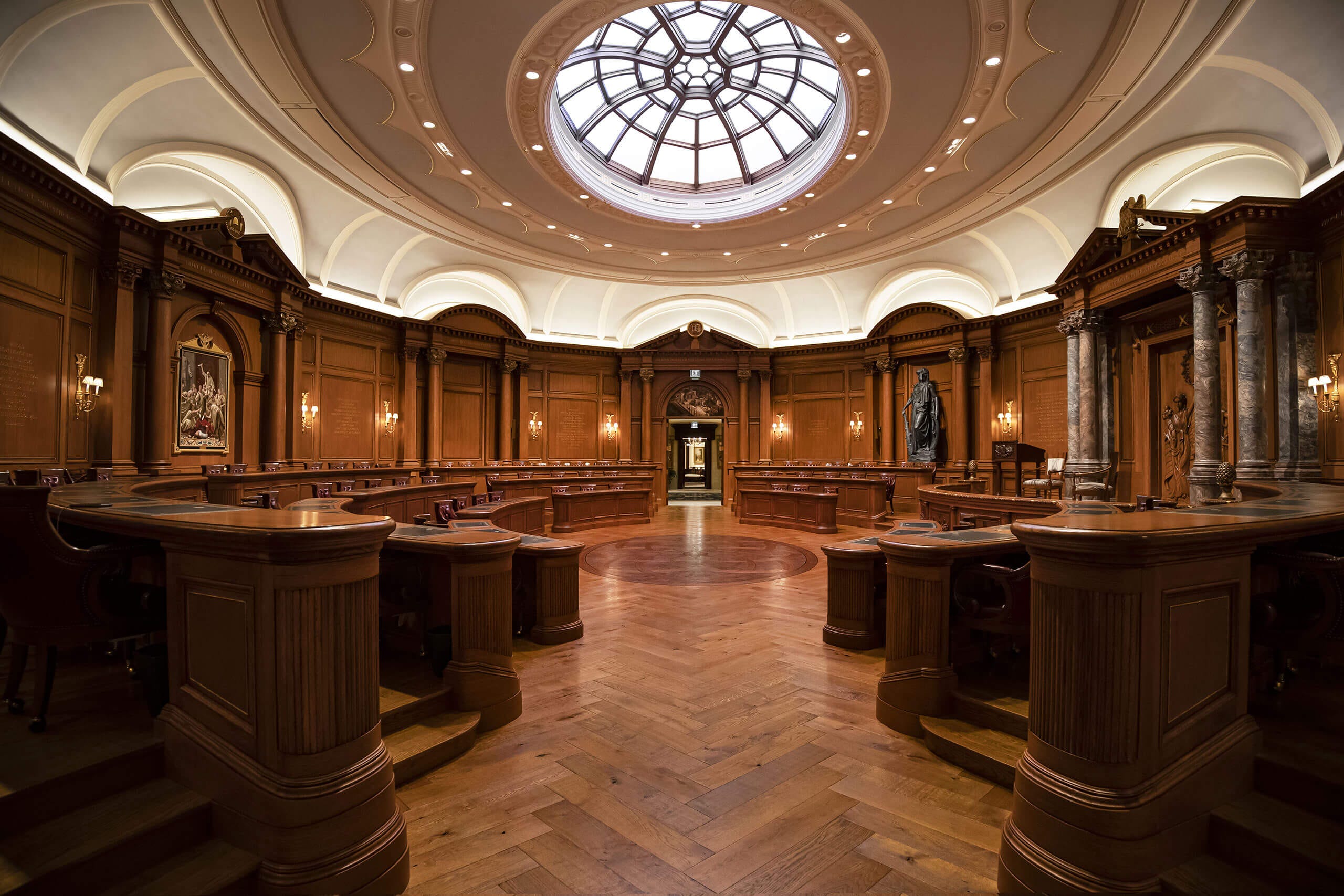
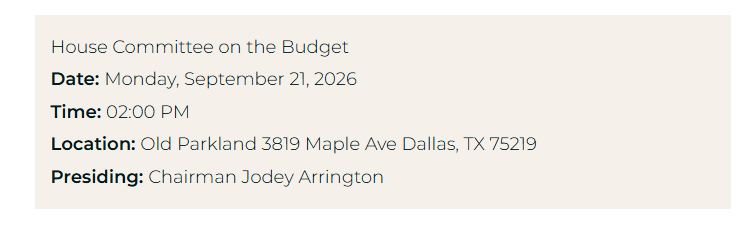
At the end of last week, I learned that the House Committee on the Budget would hold a congressional field hearing in Dallas. Of course, I jumped at the opportunity to attend. The hearing was supposed to be about “America’s Fiscal Future: Examining the Need for a Fiscal Commission.”
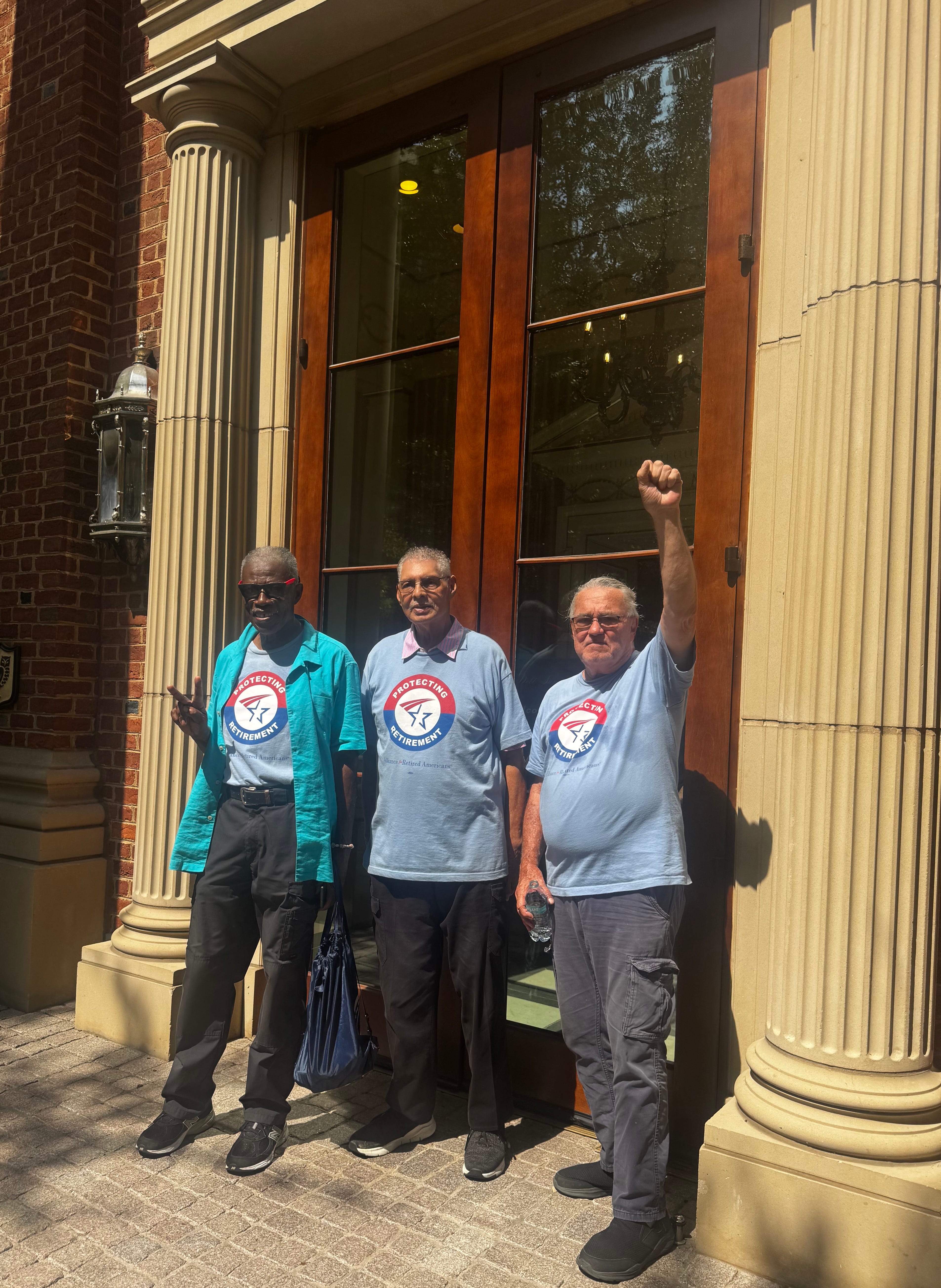
Wanting to make sure I got a seat, I showed up very early. Too early. They told me to go away and come back at 1:50 pm. However, I knew others planning to be there were showing up at 1:30 pm. So, I went and grabbed a bite to eat and came back at 1:30. By then, there were five senior citizens with the Alliance for Retired Americans (ARA), Alex Lawson, the Executive Director for Social Security Works (SSW), and our friend Kathleen from Progress Texas. Eight of us hoped to get in.
One of the women from ARA said she arrived 20 minutes early, and they told her they would let people in at 1:30. But they weren’t letting anyone in.
Time ticked on. At 1:50, I tried to go in myself, and the people at the door said, “They still hadn’t set up the chairs.”
I waited outside with the others.
Finally, at 2 pm on the dot, a few staffers came out and said they only had three chairs for the eight of us. We were the only “members of the public.” So they intended to let only three members of the public into the public hearing on government business.
Lawson at SSW caught that moment on video:
Of course, I’m not an asshole, so I bowed out. Let the seniors have those three seats, and Lawson, who flew in from DC. But the whole thing seemed really fishy. I said, and headed straight home to watch the live stream of the hearing.
Nothing was adding up.
First, they weren’t letting people in, telling us different times we could come in. Then, at 2:00 pm sharp, staffers announced only 3 seats, a number decided at the literal last second, not communicated in advance. This was a hearing on government business, legally required to be open to the public under House Rule XI. A capacity failure isn’t a recognized reason under that rule to restrict access.
Now, here is where it starts getting interesting. This was the Budget Committee’s first field hearing in three decades.
The venue was also an interesting choice. Dallas has no shortage of public buildings, university halls, or convention space. However, the Committee held this hearing at Old Parkland, a private, donor-owned complex.
Congress has a “Field Hearings: Fact Sheet on Purposes, Rules, Regulations, and Guidelines,” in which it states that Congress is explicitly authorized to use private space only when public space is “not available or not suitable.” The Committee did not explain why that applied here.
But it also says that field hearings can be held for a variety of reasons, and those can include:
raise public visibility of an issue;
provide an opportunity to evaluate a government program “on site”;
reinforce a Member’s relationship with his or her constituents; and
attract local, and sometimes national, media attention.
That’s not what was happening. This was the opposite of public visibility. None of those Congresspeople were from Dallas, so there were no constituent relationships, and the only media was Progress Texas, and they weren’t let in, either.
Chairman Jodey Arrington (R-TX19) is also retiring this year, and the election is now 42 days away. So whatever political capital or accountability he’s got left, he won’t have to face voters later with what he does with it.
The whole hearing is here; it’s three hours long. I watched the whole thing last night and have specific clips below it:
A lot of things struck me as odd about this hearing. There were a lot of gushes of “bipartisanship” and “across-aisle unity.” Rare in 2026. The witnesses were:
Leon Panetta, former U.S. Secretary of Defense.
Former Senator Rob Portman (R-OH).
Former Senator Joe Manchin (D-WV).
Congresswoman Beth Van Duyne’s behavior immidiately caught my attention. I’ve followed her career closely enough for the last 15 years to tell you there are two sides of her. There’s the side she shows in Committee hearings and the side she shows on Fox News. The performance she gave yesterday was like it was for Fox News, but Republicans wanted this hearing under wraps.
Now, if you haven’t been watching Van Duyne’s career for the last 15 years, you might not know what was different. I’ll tell you. She didn’t stay on topic. While the rest of the members talked about bipartisanship, the GDP, the national debt, and the Fiscal Commission Act, Van Duyne used her time on a tired old GOP talking point, “administrative-state bloat.” As if she had to stand out from the rest, she pulled from her Rolodex of Republican trigger words.
And the hearing went on. They discussed media blitzes to get the American people on board with their Commission. At one point, Portman said public polling shows “fear, not hope” moves people to support a commission.
Honestly, there were a lot of weird things about this hearing, but it’s what Arrington said at the very end that punched me in the gut, and it all made sense to me.
“Thank you, Harlan.”
That sentence turned three hours of bipartisan back-slapping into something else entirely. Arrington turned, and addressed Harlan by first name, called him “friend” and “great patriot,” thanked “his family,” and joked about moving every future Budget Committee hearing to Old Parkland permanently.
Harlan Crow was in the room all along. He got a seat.
And Old Parkland? Owned by Crow Holdings.
As far as I can tell, the only person in that room who actually lived in Dallas.
Harlan Crow is a Dallas real estate billionaire, heir to the Trammell Crow Company, and one of the country’s most prolific Republican donors. He also bought Clarence Thomas’s mother’s house, flew Thomas on private jets for decades, and funded vacations Thomas never disclosed.
He’s also been a trustee of the American Enterprise Institute since 1996, the think tank that has spent three decades building the intellectual case for exactly the kind of “spending problem, not revenue problem” framing Congressman Jason Smith (R-MO08) pushed from the dais yesterday. He co-founded Club for Growth, an organization whose entire reason for existing is punishing Republicans who so much as consider raising taxes.
Crow’s real estate empire runs on debt, commercial development is financed on leverage, and leverage gets more expensive every time interest rates climb, and interest rates climb every time the market gets nervous about the size of the federal deficit. A fiscal commission that actually stabilizes the debt is a fiscal commission that potentially lowers Crow’s own borrowing costs.
And the money wasn’t hypothetical, or historical, or safely tucked away in the past. Pull the FEC filings and here’s what you find:
Arrington himself took Crow money in 2022, and again in June 2025.
Beth Van Duyne has taken Crow’s money five separate times across three election cycles.
Joe Manchin took a Crow check in 2021, ahead of his final Senate run.
Rob Portman took Crow money in 2014 and again in 2020.
Jimmy Panetta, Leon Panetta’s son, a sitting committee member seated on the dais while his own father testified, took $3,300 from Crow one month before this hearing.
None of these are illegal. None of them are even large, by Crow’s standards. Most are routine, disclosed, federal-max contributions, the same size he cuts checks in for hundreds of other Republicans every cycle.
That’s the point. It’s so normalized that a Budget Committee chairman can stand up at the end of a hearing about the nation’s finances and thank his donor by his first name, in front of cameras, without anyone in that room blinking.
Over 100 organizations have opposed a fiscal commission.
This isn’t a fringe objection. Back in November 2023, when Speaker Mike Johnson first floated the idea, over 100 organizations sent Congress a joint letter opposing it. Social Security Works, the AFL-CIO, the Alliance for Retired Americans, the American Federation of Teachers, AFGE, and dozens more. The letter said, “The White House has accurately described such a commission as a ‘death panel’ for Social Security.”
That’s the Biden White House’s own characterization.
Their core argument is that Social Security does not add a penny to the federal debt. It has its own dedicated revenue, can’t spend more than it takes in, and has no borrowing authority. If a commission with jurisdiction over Social Security gets created anyway, the letter states plainly, “its purpose would be clear: to cut its modest benefits, while avoiding political accountability.”
Five former staffers of the 1983 Greenspan Commission also released a statement opposing this new push. People who worked for both parties on that Commission went on record, saying, “Don’t use us as your justification.”
AFGE weighed in too, calling the whole concept “a confession of failure by Congress to perform its basic Constitutional responsibilities.” In January 2024, 116 House members signed onto a letter from Reps. John Larson and Jan Schakowsky asking leadership to keep the Commission out of any must-pass legislation.
The AFL-CIO’s formal letter names the mechanical reason this bill exists, “The only reason to create an alternative to the budget reconciliation process is to get around the Byrd Rule in the Senate that bars cuts to Social Security.” Reconciliation can’t touch Social Security. A commission with fast-track authority can.
None of this stopped the House Budget Committee. In January 2024, every Republican present voted to advance the Fiscal Commission Act out of Committee. During that same hearing, Alex Lawson tried to deliver the half-million petitions opposing it.
That’s the same Alex Lawson who flew in from DC for the Dallas hearing. The same one standing outside Old Parkland with five senior citizens and me from the Alliance for Retired Americans, waiting to see if we’d get a chair.
Chairman Arrington told on himself again when Lawson spoke out in yesterday’s meeting, saying he thought “they escaped the Washington bubble.”
What Lawson actually said:
Here’s what was really on the agenda.
A retiring chairman, with nothing left to lose, called Congress’s first field hearing in three decades, inside the private complex of the man who has personally funded his campaigns, Beth Van Duyne’s campaigns, Joe Manchin’s campaign, Rob Portman’s campaigns, and the campaign of the witness’s own son. He staged three hours of manufactured bipartisanship, coached by a former senator who told the room, on the record, that fear works better than hope. And when the public showed up to watch their own government debate their own benefits, the Committee found exactly three chairs.
A sales pitch, dressed up as oversight, held in a donor’s living room, for an audience that didn’t include the people it was actually about.
The mechanism itself isn’t subtle once you know what to look for. Social Security doesn’t add a dime to the federal debt. It can’t, by law. The only reason to build a commission with the power to fast-track Social Security “reform” outside the normal reconciliation process is to reach a program reconciliation can’t touch. Over 100 organizations said as much two years before this hearing. The Biden White House called it a death panel. Five people who worked on the last commission everyone keeps citing as the model said, in writing, don’t use our names to justify this.
Every Republican on the committee voted for it anyway, and the last time Alex Lawson tried to hand them proof that Americans didn’t want this, he got physically removed from the room.
Nobody in Dallas said the word “cut.” They said “commission.” They said “fiscal responsibility.” They said, “We have to be brutally honest.” They just never got around to being honest about who that honesty would cost.
I don’t know if Harlan Crow personally picked up the phone and asked for this hearing. But I can tell you the man who has spent decades and millions of dollars building the intellectual and political infrastructure for exactly this outcome, sitting quietly in the back of his own library while the people he funds built the case for it in public, then thanked him for the room on their way out.
Call it whatever you want. A coincidence. A courtesy. A “great patriot” getting thanked for hosting a hearing about cutting the benefits of people who couldn’t get a seat in his own building. I know what I watched.
42 days until the November election!
Last Day to Register to Vote: October 5, 2026
First Day of Early Voting: October 19, 2026
Last Day to Apply for Ballot by Mail: October 23, 2026
Last Day of Early Voting: October 30, 2026
Election Day: November 3, 2026
Did you know you can find links to all the previous Meet the Candidate articles on these lists?:
Click here to find out what Legislative districts you’re in.
LoneStarLeft is a reader-supported publication. To receive new posts and support my work, consider becoming a free or paid subscriber.
Follow me on Facebook, TikTok, Threads, Bluesky, YouTube, and Instagram. Or join my Facebook Group.
Jeez!!! Talk about some alarming reporting! Thank you, Michelle!!! Just shared on bsky.