

In America, the Overton Window is moving. Back in September, Gallup published a poll showing that 67% of Democrats saw socialism positively, while only 17% saw Big Business positively. After Zohran Mamdani’s New York win this month, public discourse has sharply embraced a more progressive attitude of what’s possible in the upcoming elections.
The Overton Window is the spectrum of policies and ideas that the public sees as “acceptable.” It’s the imaginary boundary that decides whether Medicare for All is a serious proposal or a “pipe dream,” whether taxing billionaires is common sense or “class warfare,” whether unions are essential or an inconvenience.
For most of modern American history, that window has been shoved brutally to the right. This has been entirely by design. After WWII, the government and corporate America launched a 75-year anti-socialist PR campaign the size of a small moon. McCarthyism just shifted into Cold War paranoia, Hollywood blacklists, “capitalism = freedom,” and relentless messaging that anything public-owned or public-run was inherently evil. Schools taught it. Films promoted it. Politicians ran on it. Major corporations paid for it.
For decades, the Overton Window was locked in place by fear that anything to the left of Reagan was communism, and communism meant gulags. But economic reality doesn’t stay frozen, and propaganda only works until people’s lived experience contradicts it.
And that leads us here.
What evidence shows the window shifting now?
The Gallup Poll from September, for one.
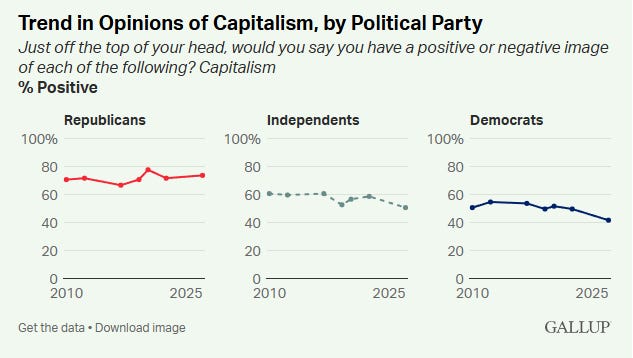
According to Gallup, the favorability of “capitalism” has dropped nationally to one of the lowest points it has ever recorded. 56% of Democrats view capitalism negatively. More than half. A number that high doesn’t happen in a country comfortable with the status quo. It occurs when a country is questioning its economic framework.
And this isn’t just Democrats. Independents under 40 show the steepest decline in trust in capitalism. Even young Republicans are more pro-union and pro-labor than their parents ever were. That’s a generational rupture.
Zohran Mamdani’s victory in New York didn’t cause the shift. He was elected months after this poll was taken.
There are other signs:
In 2025, the approval rate of Unions was 68%, the fifth straight year in the 67-71% range, described as “near all-time highs.”
The Harvard Institute of Politics’ 50th Edition Youth Poll (Spring 2025) shows that younger Americans are under financial strain, distrust institutions, and are open to systemic critiques.
And recent election coverage, exit-poll-based reporting by ABC News notes how “bread-and-butter” economic issues flipped blue for Democrats in the 2025 cycle.
And if you’re anyone who is chronically online (not me), you see it all the time on TikTok, Reddit, even in the political corners of Instagram. The shift is unmistakable. Ten years ago, talking about worker solidarity or nationalizing healthcare would get you labeled a communist. Today it’s just a normal Thursday.
People are sharing:
breakdowns of CEO pay
charts on housing crisis profiteering
stories of uninsured Americans
comparisons with European public services
breakdowns of corporate price-gouging
America is full of people worried about rent, medical bills, wages, debt, and corporate greed. And no matter how many right-winger billionaires own the social media algorithms, they can’t change people’s material conditions in America.
Citizens United exposed the cracks in the system, but COVID-19 ripped the entire facade off American inequality. Suffering on a massive scale forces people to confront systems they were told not to question, and it opens ideological doors that were previously sealed shut.
What’s actually driving the shift?
I’m going to break a bunch of theory-bros’ hearts 💔 when I say this, but this shift isn’t happening because more people are “reading theory.” I believe this is happening because reality beats out propaganda.
Most people don’t go about their daily lives thinking about theory or ideological questions. Every day, people are thinking about, “Can I pay rent and fill my prescriptions in the same month?”
Real wages for most workers have barely budged in decades, especially once you adjust for inflation. Middle-wage workers gained only a few percentage points since the late 1970s, while high earners shot far ahead. The Census just reported that median household income basically flatlined in 2024 once inflation is factored in, with inequality widening and Black households losing ground.
At the same time, we have the most expensive healthcare system on earth and no universal coverage. The US spends roughly twice as much per person on healthcare as other wealthy countries, while being the only high-income country that still doesn’t guarantee universal care. People see that in their bills, in their GoFundMe links, and in the hospital waiting room.
Layer on housing costs, student debt, childcare, and the “flexible” gig economy, where a big chunk of workers earn less than minimum wage and lose income to app glitches. That’s not a theoretical critique of capitalism; that’s people getting squeezed from every direction.
This is why Americans, especially younger Americans, are asking, “If this is capitalism, why should I defend it?”
Is the shift real, or is it a momentary vibe?
A few weeks ago, a friend of mine, a County Chair in South Texas, reached out to me to vent. A donor was angry that one of the county’s precinct chairs was also a DSA member and had publicly opposed “blue no matter who.” My friend, whom I’ve had plenty of conversations about Texas politics, was frustrated because the said donor didn’t understand how they benefit from the current capitalist system, while my friend’s children, who are Gen Z, have few prospects of ever owning a home.
Like most countries, America has a mixed economy, and capitalism still has the edge (for now). Nationally, Americans still view capitalism more favorably than socialism. The 2025 Gallup poll shows 54% have a positive view of capitalism, versus 39% for socialism.
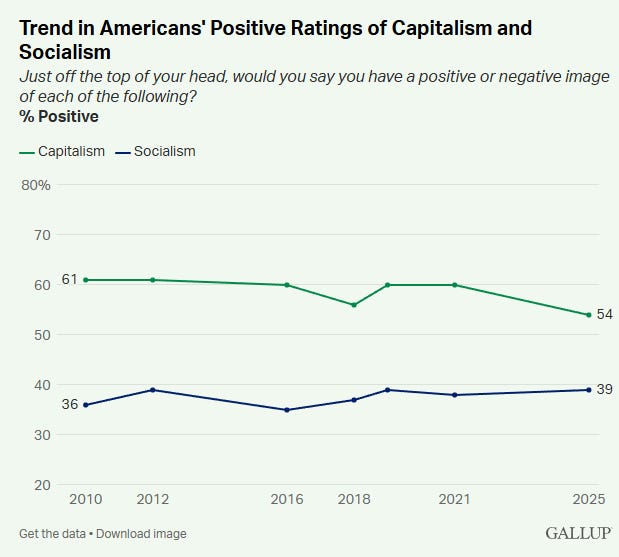
The gap is shrinking, and the trend line is going left, but we’re not in “abolish capitalism by popular demand” territory.
But what I found so remarkable was that my friend perfectly articulated the entire foundation of class analysis, intergenerational inequality, and exploitation without saying “Marx, class struggle, bourgeoisie, or proletariat.”
And that is exactly why the Overton Window is shifting.
People are arriving at left conclusions through lived experience, not ideology.
But what is socialism? Is that what we’re advocating for?
I want to make this abundantly clear before I go on, Lone Star Left is a progressive newsletter, which means we operate within the electoral politics of the left. You can learn a little more about my political philosophies on my About page. But I believe the government should be used to advance the public good of social, political, economic, and environmental issues. And for the record, I don’t worship any men, certainly not the dead, bearded ones theory-bros keep quoting at me.
Ask ten Americans what “socialism” means, and you’ll get twelve answers. Pew found that people project everything from “more government programs” to “full state control of the economy” onto the word. Some folks say they like socialism but freak out when you talk about public ownership. Others say they hate socialism but love Social Security, Medicare, public schools, and the fire department.
While I can tell you that even if I provide the textbook definition of socialism for you here, there will still be those who argue with it. But most importantly, the system is still rigged to the right.
Even if public opinion moves left, institutions haven’t caught up. Corporate money still dominates elections, media ownership is concentrated, and policy is written by people whose social circles live far from the edge of precarity.
Big business remains structurally powerful even as its favorability craters (only 37% positive in that same Gallup poll). Health insurers, hospital chains, fossil fuel companies, Wall Street, they don’t change course because a 25-year-old on TikTok discovered Marx.
The Overton Window is shifting, but the building’s owners still have the keys. And the right’s backlash is very real. Republicans may be losing the long-term ideological battle with younger voters, but they’re not going quietly. Only 14% of Republicans view socialism favorably, and conservative media have every incentive to keep the word radioactive.
That shows up as:
attacks on DEI, labor rights, abortion, and public education,
book bans and curriculum fights,
anti-protest laws,
and relentless smears of anything redistributive as “Marxism.”
Backlash confirms the shift is real. You don’t see this level of hysteria unless elites feel something slipping.
So what do we do with this shift?
I’m going to let you in on a little secret. It’s not about labels or which dead guy’s theory you subscribe to. It’s about policy and material conditions. Attitudes alone don’t change anything. TikToks don’t pass bills. Tweets don’t raise wages. Polling doesn’t house people.
If we want this ideological shift to become a material change, we have to turn vibes into victories, and that means thinking strategically about how power is actually built in this country.
The most potent argument for progressive politics isn’t a debate. Its results. Give people:
affordable housing,
universal healthcare or at least an accessible public option,
cheaper childcare,
higher wages and real worker protections,
public utilities that aren’t designed to gouge them,
and communities where basic needs aren’t a luxury…
…and suddenly you don’t need to convince them that “social democracy isn’t scary.” They’ll already be living it.
Life in America doesn’t have to be this hard. Showing people that is how you move the window.
Most Americans don’t care about ideological branding. But they care deeply about fairness. We have to stop letting the right frame every progressive idea as “big government socialism.” Because when you actually talk to people about the policies, they’re wildly popular:
Should workers have a real say at their jobs?
Should people go bankrupt from getting sick?
Should billionaires pay more in taxes than teachers?
Should housing be affordable?
Should corporations be allowed to price-gouge basics like groceries and medicine?
These are democratic ideas.
Americans think they’re choosing between capitalism and socialism. They’re not. They’re choosing between unregulated corporate greed and a mixed economy in which the government protects people rather than corporations.
Political education doesn’t have to be academic. People don’t need theory. They need someone to explain the math. People don’t care if you call it socialism, social democracy, democratic capitalism, or “Jim from Accounting’s Economic Strategy.”
They care about the price of groceries, the cost of healthcare, whether they’re going to lose their home, and whether their kids will ever afford a home of their own.
Speak that language. Stay rooted in material reality.
At the end of the day, people don’t need a new ideology.
They need a life that isn’t this hard. A life where their paychecks cover their rent. A life where getting sick doesn’t mean financial ruin. A life where their kids have a future that isn’t defined by debt and decline. A life where corporations don’t write the rules of society.
That’s it. That’s the whole project.
If progressives stay focused on that, then this moment becomes a turning point. The Overton Window, because millions of people are waking up to the simple truth that the status quo is failing them, and something better is both possible and necessary.
Our task is to meet them where they are. To offer policies that make their lives easier, not harder. To build coalitions broad enough to win, and movements strong enough to govern. To stay united, even when we don’t agree on every term or tactic. And to keep fighting until the country we live in reflects the country people deserve.
Because the truth is stunningly simple, when life gets better, people believe in the politics that delivered it.
If we stay clear-eyed, disciplined, and rooted in real change, progressives can deliver that better life. And when we do, the Overton Window won’t just shift left. It’ll stay there.
Click here to find out what Legislative districts you’re in.
LoneStarLeft is a reader-supported publication. To receive new posts and support my work, consider becoming a free or paid subscriber.
Follow me on Facebook, TikTok, Threads, YouTube, and Instagram.
In a brave move, Starbucks workers went on strike today for a livable wage. Their CEO made $98M last year. Progressive candidates should be making statements of support or joining a picket line in Dallas or other locations.
An inspiring rant! I like your advice to keep our discourse “rooted in material reality”