


Yes, here we are, talking about ideology again, and you can expect it to come up more in the near future, as the political left works to claw itself back from the disasters of loss to a fascist regime.
The Texas Democratic Party is the most progressive Democratic Party in America. That’s a phrase you’ve heard me say before, and you’ll hear me say again. And it’s starting to catch on. When I meet progressives and DSA members out there in the wild, and I tell them that, they usually agree with me.
Of course, when I encounter a blue state leftist online, they usually regurgitate some sentence about Henry Cuellar and shitlibs. But they aren’t important for this conversation.
Why does ideology, specifically progressive ideology, matter for voter turnout in Texas?
Ideology matters for turnout in Texas because the state has been under one-party Republican rule for three decades, and the material consequences of that rule are everywhere. Poverty, low wages, broken schools, underfunded hospitals, crumbling infrastructure, and relentless attacks on civil rights. When people are struggling day to day, politics can feel abstract or irrelevant. What ideology does is provide a narrative framework. It helps voters connect their suffering not just to “bad luck” or “the way things are,” but to policy choices made by those in power.
For decades, Republicans have won in Texas by keeping people disillusioned and divided, turning neighbors against one another while corporate donors rake in the profits. If Democrats present themselves as merely “Republican-lite,” or if they campaign on vague competence instead of clear values, they feed that disillusionment. But when a party takes an unapologetically progressive ideological stand, rooted in the belief that healthcare, housing, education, and dignity are rights, not privileges, it gives people a reason to believe politics might actually matter to their lives.
Turnout in Texas has always been suppressed by design. The way to break through is not technocratic tinkering, but ideological clarity. Telling working people, “We’re on your side, and here’s what we stand for.” In a state where suffering is widespread, ideology is the difference between despair and hope, between staying home and showing up.
The ideological buckets of the Texas Left.
I think it’s important to map out the landscape of Texas in plain and clear categories, especially since Texas has its own flavor that doesn’t apply to the rest of the non-Texas Democrats/Leftists.
Conservatives or Moderate Democrats: Think Henry Cuellar or Richard Raymond. These are old-school, pro-business Democrats, usually entrenched with Republicans, and aren’t popular with Democrats outside of their districts. These folks are Democrats mostly in name only, and they’re not “leftists.”
Liberals: Think Lizzie Fletcher or Donna Howard. They believe in government action to improve people’s lives, including healthcare access, education funding, LGBTQ rights, and climate action. They’re Democrats, and they can be left-leaning, but they’re not usually comfortable calling themselves “leftists.”
Progressives: Think Greg Casar or James Talarico. This ideology pushes further left than liberals, including Medicare for All, the Green New Deal, student debt cancellation, strong labor rights, and racial justice. These are Democrats, but they’re also leftists, because their politics center on redistribution and systemic change.
Democratic Socialists: Think Bernie Sanders and AOC. They believe capitalism itself is the root problem and push for collective solutions, like housing as a human right, socialized medicine, and public ownership. They often work inside the Democratic Party ballot line but see themselves as building a leftist movement beyond the Democratic label.
Communists: (I don’t know why I’m even including these guys.) Explicitly anti-capitalist, anti-imperialist, and internationalist. Very much leftists, not Democrats in identity or ideology. They may vote for Democrats tactically, but their politics are rooted in a broader revolutionary horizon, and are most likely not to vote at all.
For the record, Lone Star Left is a progressive newsletter.
In 2026, multiple Democratic Socialists will be running on the Democratic ticket in Texas.
There are three already that I’m aware of, and I’m sure more are to come. Etienne Rosas, the primary challenger against Vicente Gonzalez, has so far gotten the most attention, but with six months left until the primary election, we’ll have a lot of time to cover them all. As a Texas progressive, the prospect of Democratic Socialists running on the Democratic ticket in Texas intrigues me.
And this is where ideology stops being some abstract argument on social media and actually becomes flesh-and-blood politics in Texas. For thirty years, the Republican strategy has been to keep the playing field tilted, suppress turnout, and convince working-class Texans that nothing ever changes, no matter who they vote for. The antidote to that cynicism isn’t more bland centrism. It’s candidates who speak plainly about power, who name the corporations and politicians responsible for people’s suffering, and who offer a vision worth showing up for. That’s why the entrance of Democratic Socialists into Texas primaries matters.
They’re running as Democrats because in Texas, the Democratic ballot line is where change has to happen. And that fact alone challenges the tired blue-state narrative that Texas Democrats are “conservative” or “backward.” On the contrary, our platform is the most progressive in the nation, and our candidates increasingly reflect that. When a DSA member runs on the Democratic ticket in Texas, it doesn’t mean the party is splintering. It means the ideological spectrum inside the Texas Democratic coalition is shifting left.
Last week, I spoke with Texas Democratic Party Chair Kendall Scudder and asked him for his opinion about Democratic Socialists running on the Democratic ticket. He told me that “it’s a big tent party,” and “one of the most Progressive Democratic Parties in America.” He welcomes them with open arms and reminds me that Bernie won the primary in several counties in Texas, so depending on where they live, it might make sense for them. He added, these candidates might not work in every corner of Texas, but in some areas, they’ll be a perfect fit.
Here are the counties where Bernie won in 2020:
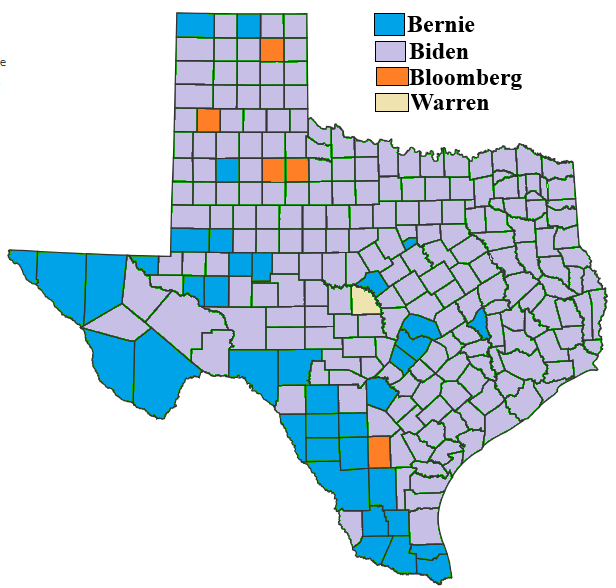
TX34, where Rosas is challenging Conservative Democrat Vicente Gonzalez, is an area where Bernie won, which is why this primary race is going to be one to watch.
The Texas Democratic Party is the most progressive Democratic Party in America.
As the most progressive party in America, it shouldn’t surprise you that we do have some ideological overlaps with the Democratic Socialists of America. Now, don’t get me wrong, there are some very clear differences as well, like the DSA calls for the complete dismantling of prisons and police, and I’ve never once heard a Democrat advocate for that. The DSA also calls for a worker-controlled economy, while Democrats support strong unions, fair wages, and workplace protections.
Recently, the National Progressives mentioned that the Texas Democratic Party was the only state party that had card-carrying DSA members on-staff. I’m not sure if they meant on staff or in the Executive Committee (an elected position), but I’m not questioning it.
I thought it would be a fun exercise to look at the Texas Democratic Party platform and the DSA platform and find their commonality, because it would further prove that the Texas Democratic Party is the most progressive Democratic Party in America. It could also galvanize leftists (i.e., progressives and DSA members) to get to the polls next November, but also to the March primaries.
Although the rhetoric and framing of issues differed significantly, the DSA used socialist language, while the TDP used more reformist and liberal terms. I did, however, find some commonality.
Democracy. Both view democracy as more than just elections. It’s about access, participation, and dismantling systems that give elites disproportionate power.
Economic Justice. Both agree the economy is rigged for the wealthy and must be restructured to benefit working people. The language differs (DSA: “anti-capitalist,” TDP: “fair opportunity”), but the values are aligned.
Healthcare. Both reject a market-only model for healthcare and push for universal, equitable access, with healthcare framed as a right, not a privilege.
Housing. Both see housing as a right and call for government intervention to guarantee it.
Climate and Environmental Justice. Both treat the climate crisis as inseparable from economic justice, tying it to jobs, equity, and systemic reform.
Racial, Gender, and Sexuality Justice. Both prioritize equality and liberation across race, gender, and sexuality, framing civil rights and social justice as core to their mission.
The Texas Democratic Party, operating in a deeply red state, is much more progressive than many people realize. Their platform, while framed in liberal-democratic language, is substantively aligned with DSA’s socialist priorities on most core issues, including healthcare, housing, labor, environment, racial justice, and democracy itself.
Ideology matters.
In a world full of tribalism, it’s the compass that points voters toward who is on their side and who isn’t. Without it, campaigns devolve into personalities, empty slogans, and vague promises of “competence” that never inspire anyone to leave the house on Election Day. In a state like Texas, where voter suppression and apathy are baked into the system, the only way to break through is to offer something bold enough that people can actually believe in it.
That’s why progressive ideology is the key to turnout.
Republicans know this. Their ideology is reactionary, built on resentment and fear, but it’s clear and easy to understand. They’ve weaponized it to hold power for thirty years, even as conditions in Texas have deteriorated for ordinary people.
The mistake Democrats sometimes make is thinking they can beat that by running on “not being Republicans.” But Texans living with poverty wages, astronomical medical bills, and failing schools need more than an alternative. They need a vision that connects their daily struggles to the policies that created them and the policies that could change them.
That’s where ideology comes in. When we say healthcare is a human right, when we promise to raise wages, when we commit to fighting for housing, dignity, and democracy itself, we are giving people a reason to participate.
Ideology makes politics tangible, and it transforms elections from symbolic rituals into vehicles for real change. In Texas, ideology is the difference between living and barely surviving, and it’s the only way we’ll ever turn this state blue.
November 4: Constitutional/TX18/SD09 Election
Click here to find out what Legislative districts you’re in.
LoneStarLeft is a reader-supported publication. To receive new posts and support my work, consider becoming a free or paid subscriber.
Follow me on Facebook, TikTok, Threads, YouTube, and Instagram.
I agree, but also think many voters are attracted to a certain personality almost as much as ideology. There's a desire for candidates who are authentic, who are fighters and don't act like politicians. That's why some Republicans will vote for someone like AOC or Bernie. We need someone like that to run against Dan Patrick. Many independents and Republicans are fed up with him.
Interesting article. Honestly, if the Dems are going to generate consistent growth and support in TX, it will be way less about ideology, and way more about pragmatic solutions that have a true chance of being implemented. We have lost credibility with the muscular and working class - and they don't given a damn about acronyms and tags. They are also proud Texans by and large, who believe Texas has a lot to offer - of course TX can do better in areas, but the prevailing opinion is that it is worse (crime, schools, COL) in blue states . . . Grounding ourselves in that reality and then creating a pragmatic message that talk to, not at, voters. PLEASE!!