


The County Democratic Parties have now come and gone, and we don’t yet know what’s passed in each county and what’s going to the committees before finally being voted out at the Convention in June. But I do know that I had NINE of my resolutions pass at my county Convention, and I got to meet the person who will be my new Congressman next year, so my convention day was a success. I hope yours was as well.
I have no idea how many of the resolutions I submitted last week wound up sponsored in other counties, but I have had a few people mention them to me. Resolutions need to be sponsored in 10 counties to reach the state platform. If they don’t get sponsored by ten counties, I think they still go to the committee, but that doesn’t necessarily mean that they’ll make it into the platform or the rules.
In 2024, some of the Convention Committees were broadcast live on YouTube. I expect that to be the case in 2026 as well. If you’re in the SDEC, can you email me and confirm?
What do we know about the types of rules and resolutions submitted yesterday across the state?
A large share of what was submitted focused on party process, rules, transparency, representation, access, and internal accountability, not just issue advocacy. There were proposals around SDEC structure, financial disclosure, remote participation, convention access, committee procedure, county chair elections, tie-breaking, and who gets to wield power inside the Texas Democratic Party.
That tells me the grassroots is not only thinking about what Democrats should believe, but also about whether the party itself is functioning fairly, openly, and in a way that ordinary people can actually participate in.
At the same time, there was still a very visible ideological current running through the submissions, and it did not read moderate. The policy-side resolutions that stood out most were on democracy reform, labor, civil rights, healthcare, immigration, LGBTQ+ protections, the environment, and foreign policy, especially Palestine and Israel.
There were multiple genocide and arms embargo resolutions, multiple trans-rights resolutions, academic freedom resolutions, labor and state worker resolutions, voting reform proposals, and some very explicitly anti-corporate or anti-privatization language in the mix.
So even though the dominant procedural vibe was “fix the machinery,” the underlying issue agenda leaned more activist, more grassroots, and, in several areas, clearly to the left of where institutional Texas Democrats have often been comfortable.
There is also a noticeable populist thread running through much of this, though not always cleanly ideologically. It shows up in proposals to limit big money in internal party races, expand access for delegates who cannot afford to travel, demand more financial transparency from leadership, push for better constituent accountability, and challenge insider control over information and process.
Another thing worth noting is that some of the repeated resolutions were not random at all. The Texas Progressive Caucus clearly had an organized footprint, with repeated submissions around a Progressive Caucus SDEC seat, remote participation, and convention tracker access. On the other side of the internal-party question, there were also multiple resolutions focused on party loyalty, candidate eligibility, conduct, endorsement rules, and forfeiture for party-switching or violations of party principles.
The biggest trend was internal reform. The clearest ideological energy came from the left. And the strongest emotional undercurrent was distrust of opaque process, top-down control, and politics as usual. If that energy carries through to the convention committees in June, this could get very interesting.
The resolutions I submitted.
I submitted seven before the online submissions closed and then two more the day of the Convention. So, for the two I submitted on the day of the Convention, I’m not sure if other counties outside my own saw them. But I’ll tell you about these resolutions and my rationale behind them.
Now, my friend and I recently disagreed. They think I make too much of the Texas Democratic Party platform, since it’s really the “donors, lobbyists, and organized pressure campaigns” that set the agenda. However, I think the platform, more than anything, represents the will of the people, and is exactly why it should be used to collectively push upward, especially in a state like Texas, where access to power is otherwise limited.
Have you read the Texas Democratic Party platform? I really do think it is a work of art, and I say this as someone who had ZERO input in it. I am literally one of the Texas Democratic Party platform’s biggest evangelists, because it’s more progressive than any other Democratic Party in America. And I think that’s lovely.
I submitted these resolutions thinking about that and hoping they wouldn’t die here but would be picked up later by organizations, candidates, or movements, as my friend mentioned.
Also, some of these got amended. If they were amended in other counties as well, how does that work? I’m sure the Convention Platform Committee will figure it out.
Ban Corporate Ownership of Single-Family Homes.
This one comes down to something simple.
Corporations are buying up single-family homes at a scale we’ve never seen before, and it’s pricing regular people out of the market. A home stops being a place to live and becomes a financial asset.
And once those homes turn into rentals, they rarely come back. Supply shrinks. Prices rise. Entire neighborhoods shift.
If we are serious about affordability and giving working Texans a real shot at ownership, then single-family homes should be for people, not portfolios.
Statewide Climate Resilience Plan.
Texans are already living the effects of climate change. Winter storms, grid failures, extreme heat, and flooding. Right now, we react after disaster hits, after girls drown.
This is about planning. Strengthening the grid, protecting infrastructure, and preparing for what we already know is coming.
At this point, this isn’t just environmental policy.
It’s public safe
Public Banking for Texas Communities.
Right now, public money flows through private banks, and those banks decide who gets access to capital and who doesn’t.
That doesn’t leave any communities behind.
Public banking would allow Texas to invest in itself. Funding local projects, small businesses, and infrastructure without relying on profit-driven institutions.
Ban Corporate Money in Texas Elections.
Corporate money distorts everything.
When companies can pour unlimited money into elections, it drowns out the voices of actual voters and shifts power away from the public.
Break Up Texas Energy Monopolies.
A handful of corporations have far too much control over Texas’s energy, and Texans pay the price.
When monopolies control the market, rates go up, accountability disappears, and the public gets trapped.
This is about breaking concentrated power and putting the public interest ahead of corporate profit.
Automatic Voter Registration.
Voting should be easy, not a bureaucratic obstacle course.
Automatic voter registration would bring more eligible Texans into the process and remove pointless barriers that keep people from participating.
If we want a democracy that actually reflects the people, we should make voting more accessible, not harder.
Restore Voting Rights Immediately After Incarceration.
If someone has served their time and returned to their community, their right to vote should come with them.
Keeping people disenfranchised after incarceration does not make anyone safer. It just extends punishment and weakens democracy.
Transparency for Paid Political Influencers.
These last two are the ones I submitted yesterday. Basically, political influence has moved online, but the rules haven’t caught up. Influencers are paid to promote candidates or agendas; voters deserve to know who’s funding the message.
It’s about transparency.
Dark Money Disclosure in Digital Campaigning.
Massive amounts of money flow into ads, content, and targeting with little transparency about who is behind it.
Voters should know who is trying to influence them.
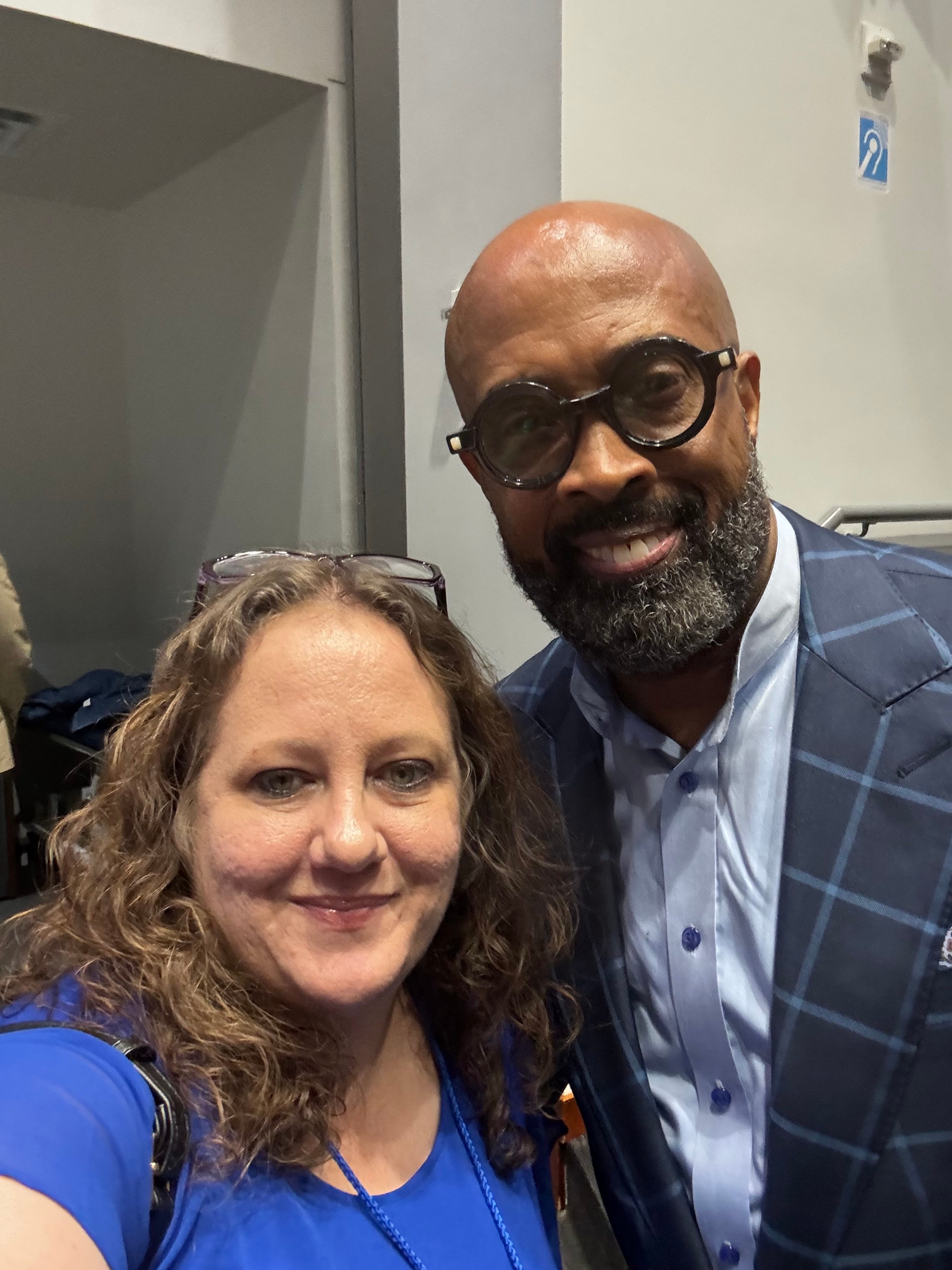
I also had a chance to meet Rev. Dr. Freddie Haynes, who will be my Congressman next year.
What’s next?
Now everything moves into the committees.
This is where resolutions get combined, rewritten, watered down, strengthened, or killed. Similar resolutions from different counties get merged. Language gets negotiated. Some things that passed easily at the county level won’t survive at the town level. Others that had broad support across counties will rise to the top.
And then, in June, whatever survives the committees goes to the Convention floor.
That’s the final vote.
That’s where the platform actually gets written.
So if you care about any of this, this next phase matters just as much as what happened this weekend.
Because this is where ideas either become part of the official Democratic vision for Texas… or disappear.
April 2, 2026: Last day to register to vote (City elections/SD04 Special Election)
April 20, 2026: Last day to apply to vote by mail (City elections/SD04 Special Election)
April 20, 2026: First day of early voting (City elections/SD04 Special Election)
April 27, 2026: Last day to register to vote (Democratic primary runoff elections)
April 28, 2026: Last day of early voting (City elections/SD04 Special Election)
May 2, 2026: Last day to receive ballot by mail (City elections/SD04 Special Election)
May 2, 2026: Election day! (City elections/SD04 Special Election)
May 15, 2026: Last day to apply to vote by mail (Democratic primary runoff elections)
May 18, 2026: First day of early voting (Democratic primary runoff elections)
May 22, 2026: Last day of early voting (Democratic primary runoff elections)
May 26, 2026: Last day to receive ballot by mail (Democratic primary runoff elections)
May 26, 2026: Election day! (Democratic primary runoff elections)
Click here to find out what Legislative districts you’re in.
LoneStarLeft is a reader-supported publication. To receive new posts and support my work, consider becoming a free or paid subscriber.
Follow me on Facebook, TikTok, Threads, YouTube, and Instagram.
We in Dallas had in recent memory our first Convention countywide. It was a bit disconcerting compared to previous conventions. The sheer size and direction also was apparently intimidating to some. We did enjoy all of our speakers. As you say The Rev. Dr. Haynes was on fire, but then he always is! The mystery of why he went out of turn according to the original agenda is solved. He went to a second convention or maybe more!!! The fun part of Talerico 's ending is that my shirt said exactly the same words as his conclusion!
Thank you for your great work Michelle!
The way to bring the platform to the people of Texas is for the party to deliver the progressive energy and the need for change to the working and middle classes. Moderate democrats have lost the working class. For the democratic party to emerge like a phoenix from the ashes, we must reconnect with our historical base: the working class, the middle class will follow. Our tax dollars should not be used for the benefit of the billionaires and institutional investors who price us out of our own state. There is no reason that the billionaires club should own the support of working people, you know how they do this: through vitriolic culture war nonsense. Democrats have to reclaim the message and have to win the messaging. Democrats are smarter, we should be able to do this. Establishment democrats have a place, they have the ability to fund-raise big numbers, but they are lost using the moderate message. They appear antiquated and ineffective to the next generation of voters, and, honestly, we old fogies are more progressive than the establishment democrats ever recognized. Allow the progressives' energy to excite the electorate and allow the establishment democrats to raise the funds and we have a winning strategy.
Additionally, the platform should be delivered in terms of "freedom," individual liberty, and economic prosperity for it to connect with the working class. Democrats must make it clear that conservative corruption is destroying our state and our way of life. This is the way to connect to the working class voters, Gina Hinojosa and James Talarico are out there saying this but they need a louder bullhorn. The one thing the conservatives miss is that Americans and Texans do not want to be harassed and murdered by ICE, to be told which books to read, or to be lead by racist, unpatriotic christian nationalists. Religious freedom matters, freedom of speech matters, academic freedom distinguishes us from ideological ignorance and allows us to thrive, women's access to appropriate health care matters, good schools and not educational gimmicks matter. Access to health care and affordable housing matters, Affordable groceries matter. Affordable healthcare and prescription drugs matter. We have no excuse for losing on these issues.