


There are so many elections happening across Texas, it’s hard to keep track of them all. There’s the US Senate election, the Governor election, the Lt. Governor election, the AG election, and so on… But I’m going to tell you a secret. Taking back Texas doesn’t start in Washington DC, or even in Austin. It starts in your own backyard.
At this very moment, Republicans are actively trying to control your city and your county. Because 30 years ago, they didn’t stop at statewide dominance. They simply pivoted downward.
All that empty land has them fooled.
Did you know that Texas was an urban state? Yes. Technically, Texas is the 15th most urban state in America, with approximately 83.7% of its population living in urban areas, according to 2020 Census data. Even further, Texas has the second-largest urban population in the US, at over 24.4 million, trailing only California.
That means that most of our population lives in cities.
My favorite map:
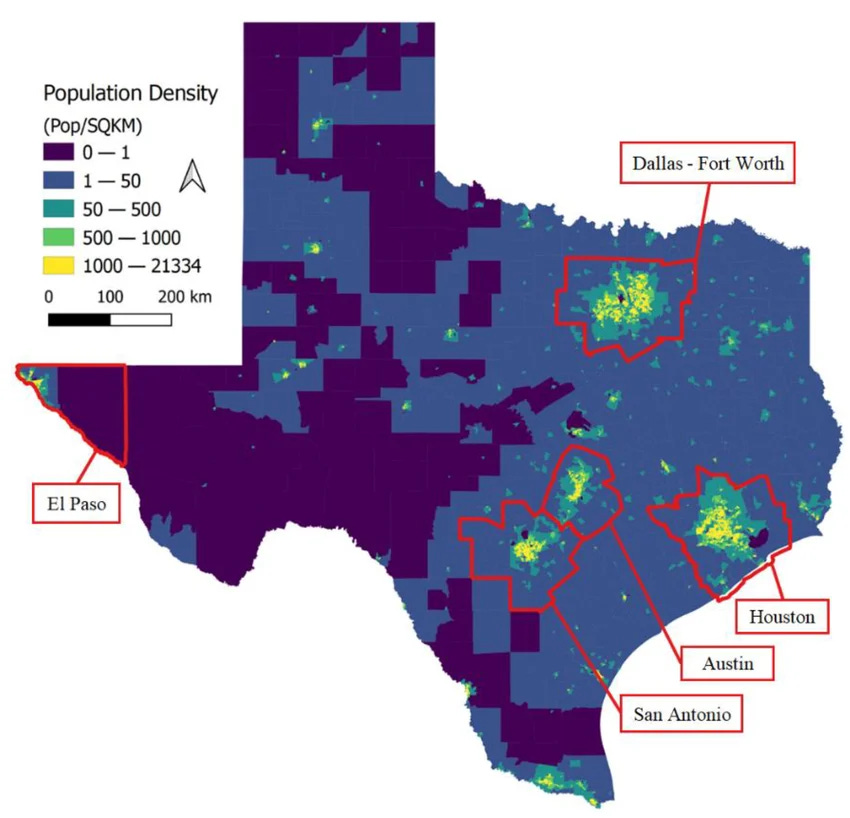
But when you look at our cities, they are more diverse, younger, more likely to be college-educated, and they concentrate where the people, jobs, and institutions are. Cities also cluster knowledge-economy jobs and large professional sectors, jobs at universities, hospitals, media, tech, nonprofits, government, and other service industries. Brookings Researchers have argued that these metro economies tend to produce different social and political coalitions than rural or exurban economies do.
Because of the nature of cities, they tend to produce politics built more around coexistence, public investment, labor protections, transit, housing, and civil rights (except Arlington). That means most cities are blue.
In Texas, we have two problems:
Not enough voters are making it to the polls to ensure they’re blue/stay blue.
Republicans in the state government.
Which cities? In which counties?
I scoured the internet, digging through research to find out whether there was prior research stating that after a city hits X population, it should be blue. It doesn’t exist. But let’s look at some of our biggest cities.
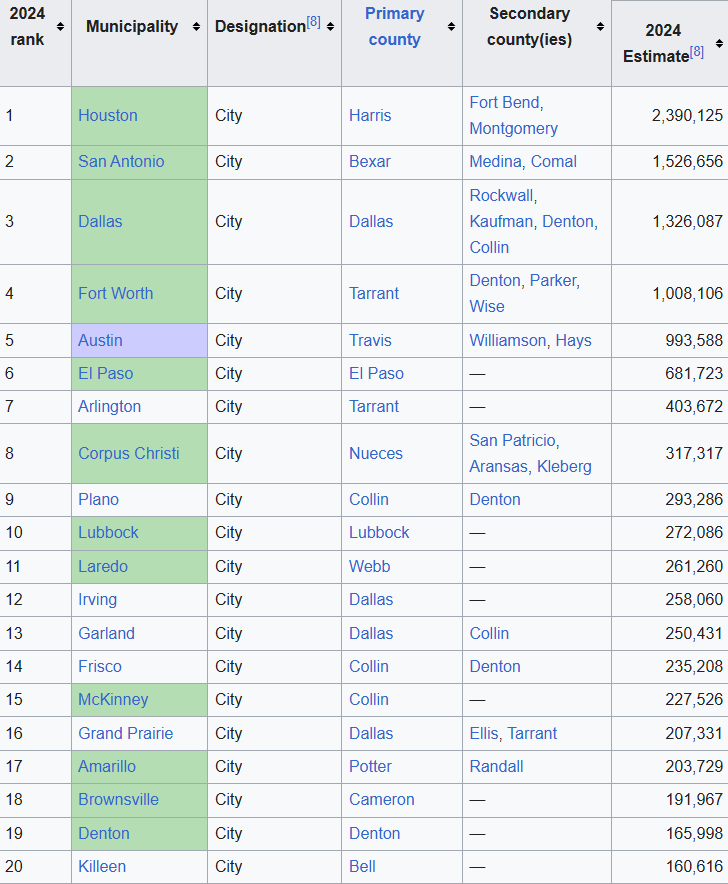
Did you know there are only 44 cities in Texas with a population over 100,000? And only four that have a population over 1,000,000? But that doesn’t guarantee that they’re blue.
Houston is Texas’ largest city, with an estimated 2.39 million residents. Yet Houston elected John Whitmire, a more centrist, law-and-order Democrat, in a low-turnout 2023 runoff. Official canvass results show the December 2023 runoff had a 17.0% turnout. Seventeen!
Dallas voted for Kamala Harris by roughly +22 points in 2024. But Dallas’ mayor, Eric Johnson, switched to the Republican Party in 2023. And he was reelected in 2023 with just 46,255 total votes cast in the mayoral race. That is a tiny share of a city this large, and it is a perfect example of how a very blue urban electorate can still end up with leadership to its right when municipal turnout collapses.
D Magazine separately noted that only about 6% of Dallas residents voted in the May 2024 bond election, underscoring how weak local turnout can be there. By the way, bonds raise taxes.
Fort Worth passed 1 million residents in 2024, making it one of the nation’s largest cities, yet Republican mayor Mattie Parker leads it. Official city election history shows Parker won reelection in 2025 with 26,565 votes, and all mayoral candidates together drew only about 39,886 votes.
Arlington is one of the best examples of a large, diverse city that progressives under-contest locally. The Census estimates Arlington’s population at 403,672 in 2024. In the 2023 mayor’s race, incumbent Jim Ross won reelection by only 646 votes, with 9,059 votes to 8,413. That means the mayor of one of Texas’ biggest cities was effectively decided by fewer than 18,000 votes total.
Plano’s Mayor John Muns is affiliated with the Republican Party. On top of that, the Texas GOP’s 2025 local endorsement page backed multiple Plano City Council candidates, which shows Republicans see Plano municipal government as active turf worth organizing around.
In Frisco, the Texas GOP endorsed Frisco City Council candidates Burt Thakur and Jared Elad in 2025, and its runoff endorsements also included races for the Frisco City Council.
You get the point. What’s most obvious here (besides the fact that I know way too much about the cities in North Texas) is that “nonpartisan” is one of the great scams of Texas local politics. The ballot may not print an R or a D, but the Republicans make no secret about their coalitions, endorsements, and donor networks. And the outcomes impact your everyday life more than any Senate race, any legislative race, or any other race in Texas.
What the hell does a city government do, anyway?
Your city government decides what your life looks like when you walk out your front door.
It decides whether the road you take to work floods every time it rains, or drains like it’s supposed to. Whether the pothole on your street gets fixed this month or sits there for a year. Whether your water is clean or your pipes hold.
It decides what kind of police force your city has. How much of your tax dollars go into policing, who gets hired, how they’re trained, how they respond, and what happens when they don’t.
It decides whether your rent keeps climbing or whether your city actually tries to build housing people can afford. Whether developers can do whatever they want, or whether there are guardrails. Whether tenants have any protections at all, or none.
It decides how your city grows. Roads, sidewalks, public transit, drainage systems, and flood control. In some Texas cities, the lack of flood controls costs people their lives.
It decides whether clinics are funded. Whether there’s a real response when something goes wrong. We all just lived through COVID. You saw exactly what happened when local governments tried to act, and the state tried to override them.
It decides which corporations get tax breaks. Which small businesses get support. Where jobs are created and who gets left out. And who gets to build a chemical plant in your backyard.
And then there are elections.
Your city decides how many polling places there are. Whether early voting is accessible or a hassle. Whether elections run smoothly or turn into chaos. Who staffs them. How easy it is for your neighbors to participate.
Yet, every year we watch city election results trickle in. 15%. 10%. 7%. Your everyday life. The people who sit in your City Hall control much more of your day-to-day life than any “presidential tweet,” any Senate filibuster, and any corporate payoff Abbott has taken that day.
And that’s exactly why it matters who is sitting in those seats.
While you’re going about your day, the state is actively working to strip those same city governments of the power to act on your behalf.
Once Republicans locked down the state, they moved down the ladder, tightening control over the places they couldn’t win outright. They did this by limiting what blue cities are even allowed to do.
Take HB 2127, the “Death Star” bill. That law was designed to stop cities and counties from passing rules that go beyond state law across huge areas of everyday life. Labor protections. Environmental rules. Business regulations. Entire categories of local governance are wiped clean if they don’t align with the state.
Cities like Austin, Dallas, and San Antonio tried to pass paid sick leave so people wouldn’t have to choose between a paycheck and their health. Struck down.
Austin tried to deal with plastic waste through a bag ban. Overruled.
Denton tried to ban fracking. Blocked.
Again and again, local governments tried to respond to the real conditions people were living in, and again and again, the state stepped in and said no.
And look at Houston. The state took over its school district. Removed locally elected leadership. Installed its own. Now, they’re doing the same to South San Antonio and Fort Worth, all while cranking up the school-to-prison pipeline.
They’ve built out local committees to recruit and back candidates for school boards, city councils, and other “nonpartisan” offices. They’re contesting races that used to fly under the radar. They’re showing up where turnout is lowest and influence is easiest to grab.
School boards. City councils. Election offices.
They understand something that too many people still don’t.
You don’t have to win everything. You just have to control enough of the system.
And if the state is going to keep pushing down, then the people sitting at the city and county level cannot be passive. They have to be fighters.
Because right now, local government is the front line.
It is the last layer of government between you and a state that has made it very clear it is willing to override, remove, or dismantle anything that gets in its way.
Republicans already took the top. Now they’re coming for everything underneath it.
Your city. Your child’s school. Your polling place.
And the only reason they’ve gotten this far is that too many people still think those elections don’t matter.
But in Texas, they might matter the most.
Because this is where it all comes together. In the elections that barely crack double digits in turnout. In the races decided by a few thousand votes. In the seats that shape your daily life.
That’s the gap they’ve been exploiting.
I’m putting together a full list of recommendations. I’ve been working on it for the last two weeks, coordinating with local Democratic clubs and groups across the state.
Because if we’re going to take this seriously, we need to treat these elections like they matter. We need to know who’s running. We need to know what they stand for. And we need to show up.
So stay tuned. I’ll have the May 2026 local voting recommendation list ready before early voting starts. (Sorry, I’m not quicker, mail voters.)
All you have to do is one thing.
Vote.
April 2, 2026: Last day to register to vote (City elections/SD04 Special Election)
April 20, 2026: Last day to apply to vote by mail (City elections/SD04 Special Election)
April 20, 2026: First day of early voting (City elections/SD04 Special Election)
April 27, 2026: Last day to register to vote (Democratic primary runoff elections)
April 28, 2026: Last day of early voting (City elections/SD04 Special Election)
May 2, 2026: Last day to receive ballot by mail (City elections/SD04 Special Election)
May 2, 2026: Election day! (City elections/SD04 Special Election)
May 15, 2026: Last day to apply to vote by mail (Democratic primary runoff elections)
May 18, 2026: First day of early voting (Democratic primary runoff elections)
May 22, 2026: Last day of early voting (Democratic primary runoff elections)
May 26, 2026: Last day to receive ballot by mail (Democratic primary runoff elections)
May 26, 2026: Election day! (Democratic primary runoff elections)
Click here to find out what Legislative districts you’re in.
LoneStarLeft is a reader-supported publication. To receive new posts and support my work, consider becoming a free or paid subscriber.
Follow me on Facebook, TikTok, Threads, YouTube, and Instagram.
On your list, please include for folks to become certified Volunteer Deputy Registrars and spend some time out in the community (farmers markets, etc.) registering voters and providing information snout upcoming elections. Yesterday I registered two young people who had just never taken the time to register. We had a great conversation, and I stressed that we so NEED them! My preference is a nonpartisan approach—frankly it gets you into many more venues. Suggestions: https://docs.google.com/document/d/1V5u5gS7S3gzdkDTGVpab9KKbLwhK8Bwt/edit?usp=drivesdk&ouid=101527070974081088657&rtpof=true&sd=true
Right now at the local level, the biggest issue galvanizing Texans is data centers. Democratic candidates must get in front of this and show how the Texas GOP has sold out to outsiders. Secondly it's the wall going through 1 national park and 5 state parks.