


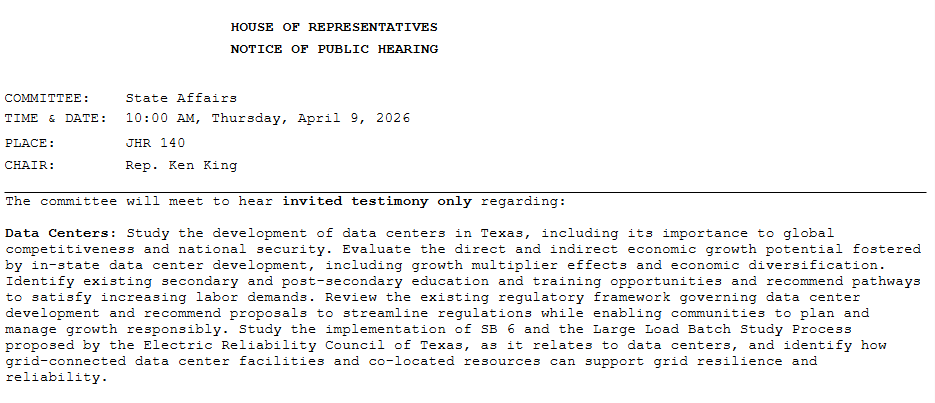
On Thursday, the Texas House Committee on State Affairs met for an interim hearing on our power grid and data centers. The hearing lasted about five hours, and of course, I watched it so you don’t have to. And my biggest takeaway is that Republicans, who are terrible at governance and even worse with money, have spent years ignoring long-term planning and are now trying to figure out, in real time, how to keep the lights on without sticking Texans with the bill.
Honestly, I don’t see how they can pull it off.
You may have seen the Texas Tribune’s recent article about how our government is giving data centers more than $1 billion in tax breaks each year.
Even though 22.5% of the children living in our state are impacted by hunger, and only last year Abbott vetoed a summer lunch program for low-income children because the cost was $60 million.
But that’s not even the most infuriating revelation about data centers this week.
The speaker in this clip is Pablo Vegas, President and CEO of ERCOT (Electric Reliability Council of Texas).
It’s a bunch of jargon, and he sounds really calm and collected while he’s talking about it, but what he’s saying is that Texas has WAY more companies asking for electricity than the grid can realistically handle, and almost all of them are data centers. The main points about load forecasting you need to know:
Companies are asking for about 4–5 TIMES as much electricity as Texas currently uses at its peak. Specifically, they need 410,000 megawatts.
87% of that demand is coming from data centers.
The entire Texas grid at peak usage is roughly 85,0000.
Yes, this one single industry is flooding our electric grid. Which may be ironic considering they’re also sucking our water dry.
Another thing that Vegas said was that many of the projects weren’t real, or wouldn’t even happen at all. Companies are asking for the power in advance to get in line, essentially, and some of the requests could be speculative. ERCOT is in massive planning phases right now because they have no way to serve everyone.
Queue chaos.
These data centers are causing issues within ERCOT, which is messing with their “queue.” The way they currently do it is that each project is approved individually, with a proposed large electricity user asking to connect to the grid at a specific location and time. ERCOT studies whether that project can connect safely and reliably in that area. If ERCOT says yes, the company gets a green light to build.
But these data centers are popping up left and right, and they are being built much faster than other large electricity users. Now, ERCOT is being bombarded with dozens and dozens of projects every month.
What that has caused for ERCOT is a situation like this:
Project A gets studied and approved.
Then Project B and Project C show up right next to it.
What looked workable for Project A alone may not work once B and C are added. So ERCOT has to go back and restudy.
So, ERCOT is telling these companies, “Yes, looks good,” then halfway through building, the answer turned into “Actually, hold on, the situation changed.”
And according to ERCOT, this is creating delays, uncertainty, and a bad environment for companies investing billions in projects.
Spoiler: ERCOT’s true purpose is to create profit, not generate electricity. Interfering with profit could upset the billionaire overlords, whether we have power or not.
Vegas did talk about changing how they do “load forecasting” to fix that. Instead of reviewing them one by one, ERCOT wants to take a large group of projects at once and study them together. Then it can say, “This site can get this much power in 2027, this much in 2028, this much in 2029, and so on. But that would create other risks. Mainly, they will have to build the transmission at the same time the companies are building their locations, and that’s kind of like building a plane while you’re flying it.
Money, money, money.
There are multiple financial aspects of what’s happening here. Before we get into that, I wanted to point to this article published this week from Axiom, which mapped America’s highest electricity bills.
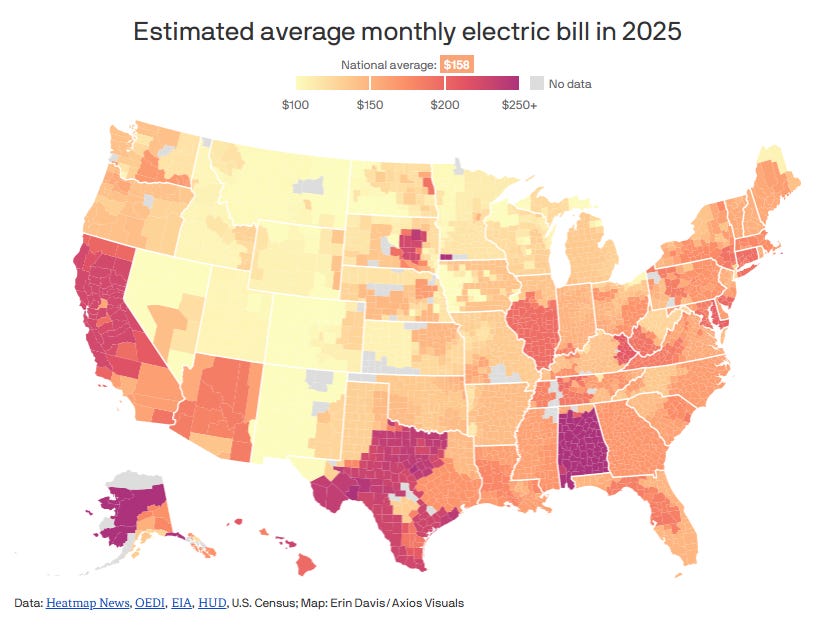
I recently said on social media that I frequently have $400 electric bills. Many people’s ghasts were flabbered. In Tarrant County, the average electricity bill is $225. I happen to have an older house and a bigger family, so it tracks.
The highest average is in Terrell County at $252 per month.
The lowest average is El Paso County at $92 per month.
El Paso County isn’t connected to ERCOT.
Texas runs on what they call a “4 Coincident Peak” (4CP) model, which means ERCOT determines how much electricity each big customer is using during four peak times. Then, their share of usage would equal their bill.
This is a problem for data centers, since they use massive, constant power 24/7. They might not spike specifically during those 4 peak moments. In turn, data centers will avoid paying their true share, even though they require huge new infrastructure. If that happens, you can expect electric bills across Texas (where they are connected to ERCOT) to skyrocket.
Either the Legislature changes the way these formulas work, or it lets massive data centers underpay for the grid they’re forcing Texas to build.
Then there is the $15-$30 million deposit that ERCOT wants to request. They want data center companies to put this money UP FRONT to secure access to power.
ERCOT’s CEO believes that, because everyone is rushing in their “queue,” asking for this money up front will filter out speculative projects vs. real ones.
Then where does that money go? Presumably into the pockets of the ultra-wealthy ruling class, but the actual answer wasn’t totally clear. It would be basically a mostly non-refundable deposit to reserve a spot. And they want to ask companies for this deposit without even knowing if they’ll get power, how much they’ll get, or when they’ll get it. This sets the stage for a possible high rate of refunds. Maybe it’s a good option if it cuts back on/eliminates/chases away data centers in Texas.
It boils down to this, if ERCOT doesn’t charge enough, then taxpayers/ratepayers get screwed. If they charge too much, companies leave Texas or stall projects.
And what happens in an emergency?
After what happened in Winter Storm Uri, we know one bad storm can cipple our state. They’re continuing to happen. Wildfires in the panhandle. Derechos in Houston. Every time the wind blows sideways.
If we let all these data centers plug in, are regular people going to get screwed when things go bad?
This came up in the hearing. ERCOT assured that residential customers will be prioritized and that, in an emergency, data centers must stop drawing power from the grid or switch to their own generators. Which sounds fine in practice, but will it actually work in an emergency?
Most people think Texas’ electric grid is a fixed size, but it’s more complicated than that. Our grid is fluid and unpredictable. Whether it’s working as intended depends on the weather, whether plants are running or offline, and whether the power we have can reach where it’s needed when it’s needed.
ERCOT stated that they might be able to handle ~140–150 GW by ~2031. And that only works if transmission gets built and the new generation actually comes online. That 150 GW number is a best-case scenario, and Texas Republicans are betting its future on infrastructure that doesn’t exist yet.
Another point raised during the hearing was that Representative Ken King (R) asked about Virginia, the data center capital of the US. Virginia already has hundreds of data centers, but it can handle them because it has built its electric infrastructure over decades. Texas, however, is in rapid growth mode. Yet, companies want to come here because we have more land, fewer regulatory hurdles, and room to expand. We don’t have the infrastructure for it.
Then, there’s the water.
The answer we got about the water was basically, “We don’t actually know enough yet.”
The PUC is surveying data centers to understand their water use and report it back to the Legislature and the Texas Water Development Board. He said the survey asks not only about water use at the data center itself, but also about total water use if the company is bringing its own generation, meaning the whole facility ecosystem.
But the problem is that the survey is voluntary. If they do not get the information they need, they will have to find another way to obtain it. Texas opened the door to a giant wave of data centers before it had a firm handle on their water footprint.
One later industry witness argued that data centers are often misunderstood on this issue, saying water “withdrawal” is not the same as water “consumption,” emphasized newer cooling technologies, recycled wastewater, direct-to-chip cooling, immersion cooling, and seasonal or ambient-air strategies, and argued that water numbers are often presented without enough context.
But, as you know, the cigarette industry once said they were safe. So we shouldn’t trust the words of industry witnesses. The Legislature needs to do its own study.
Texas didn’t plan for this.
And now, instead of slowing down and doing it right, Republicans are trying to retrofit an entire system around a boom that’s already happening, hoping they can keep the economy humming, keep billionaires happy, and keep voters from noticing the cracks.
Either data centers pay what it actually costs to build the infrastructure they need, or Texans do. Either the grid holds under pressure, or it doesn’t. Either we have enough water to support this kind of growth, or we find out the hard way that we don’t.
And right now, the people in charge don’t have clear answers to any of those questions.
What they do have is a best-case scenario, a bunch of assumptions, and a timeline that depends on everything going exactly right. Transmission gets built on time. Power plants come online. Companies follow the rules in a crisis. The market behaves. The weather cooperates.
That’s a gamble.
And it’s not the tech barons or the corporate power players who will feel it first if that gamble fails. It’s the rest of us.
Texas wants to be the center of the AI boom. Fine.
But if we’re going to build the future here, we should probably make sure we can keep the lights on first.
April 20, 2026: Last day to apply to vote by mail (City elections/SD04 Special Election)
April 20, 2026: First day of early voting (City elections/SD04 Special Election)
April 27, 2026: Last day to register to vote (Democratic primary runoff elections)
April 28, 2026: Last day of early voting (City elections/SD04 Special Election)
May 2, 2026: Last day to receive ballot by mail (City elections/SD04 Special Election)
May 2, 2026: Election day! (City elections/SD04 Special Election)
May 15, 2026: Last day to apply to vote by mail (Democratic primary runoff elections)
May 18, 2026: First day of early voting (Democratic primary runoff elections)
May 22, 2026: Last day of early voting (Democratic primary runoff elections)
May 26, 2026: Last day to receive ballot by mail (Democratic primary runoff elections)
May 26, 2026: Election day! (Democratic primary runoff elections)
Click here to find out what Legislative districts you’re in.
LoneStarLeft is a reader-supported publication. To receive new posts and support my work, consider becoming a free or paid subscriber.
Take a look at Land Commissioner candidate Benjamin Flores’s plan to invite and perhaps incentivize clean energy producers - like solar, wind and hydrothermal - to join the existing oil and gas producers operating on leased state land because it will fast-track much needed additional megawatts onto the grid. That this will also increase the General Land Office revenue and, in turn, increase money going into the state’s Permanent School Fund which can take pressure of school districts to raise property taxes, is an added plus. Learn more about Flores’s plan at www.letsgowithben.com/glo2030.
Planning to send this to everyone I can. Water itself has been an important issue for me for a long time. And no one who experienced the storm in 2021 can trust anything ERCOT says imho. Thanks for listening to this meeting. I should add this committee to my notifications list!