


Today’s episode of Lone Star Left is going to be super inside baseball, but it covers some of the most important yet least understood power centers in Texas Democratic politics today. That’s right, I’m talking about the SDEC, or the State Democratic Executive Committee, which is the governing board of the Texas Democratic Party (TDP).
Why are we talking about the SDEC?
Applications to file for office as an SDEC member have officially opened and will remain open until June 22.
Who is the SDEC, and what do they do?
The SDEC are the people chosen through the party structure to handle business. Officially, the party says the SDEC carries on party activity across Texas and conducts party business in committees. That means governance, committee work, internal votes, rules fights, officer elections, oversight, and all the unglamorous choices that shape whether the party is open, responsive, stagnant, controlled, grassroots, or consultant-driven.
The official TDP structure also ties the SDEC to committees, public documents, and party officers, which suggests this is where much of the real organizational life happens.
These members meet quarterly in different locations across the state and at the state convention. They also take care of their own travel, hotel costs, gas, food, missed work, family juggling, and entire weekends handed over to party business. The party’s public-facing language emphasizes volunteering and involvement, so it’s a completely unpaid position.
It’s important to point out that this is a volunteer/unpaid position that requires quarterly travel, plus travel for the convention, all on the member’s own dime.
Why is it important to have progressives in the SDEC?
Texas is turning blue. Maybe this year, maybe 2028, maybe 2030, but eventually Texas will be blue. All the data points us there. Over the last few decades, while Texas Democrats have struggled on their own, battling fascists, the National Democrats mostly ignored us. But more importantly, the establishment ignored us.
As Texas inches closer toward blue, the vulture establishment is circling. Progressive SDEC members can push for a party that is more transparent, less insider-controlled, and more responsive to grassroots activists rather than just big donors, consultants, and whoever already knows how to work the machinery.
The Texas Democratic Party is already one of the most progressive Democratic Parties in America, and we want it to stay that way. The party does not drift left, right, or grassroots by accident. It gets pulled there by the people who show up, serve, organize, vote, and stay in the room for the tedious parts. If you want a state party that is serious about labor, reproductive freedom, public schools, democracy reform, rural investment, and year-round organizing, then you need people in these seats who actually believe in those things.
As someone who has had a moderate SDEC member and worked with them before, they seem softer in their demands, less transparent, and more willing to preserve existing power arrangements. That’s what happens when you have someone more interested in keeping the peace than pushing the party forward.
Yes, I will be making endorsements in the SDEC races this year.
Decisions the SDEC has been responsible for recently.
Decentralizing the Texas Democratic Party. This one was controversial, depending on who you ask. To my understanding, it wasn’t a clean majority, but honestly, right now, everyone should be happy with how Democrats have performed in Texas since, and that’s all that really matters.
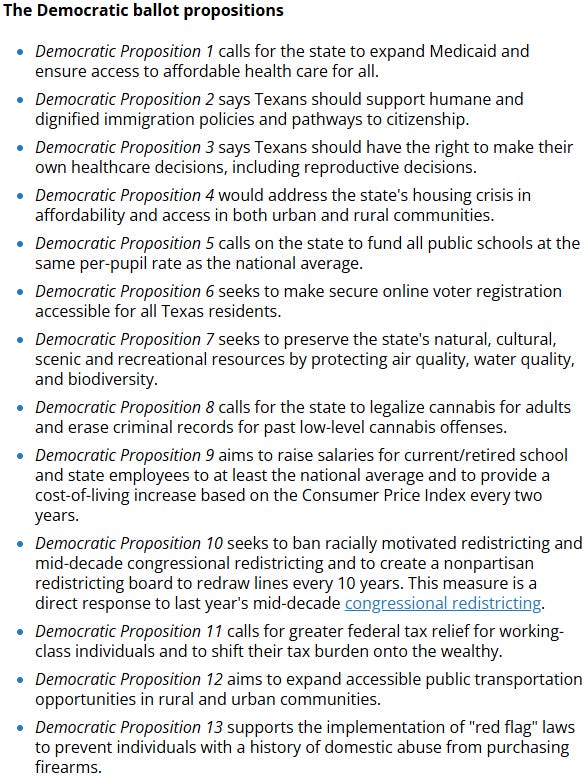
They added ballot initiatives this year. I actually don’t think we talked about them since the election. Unsurprisingly, they all showed overwhelming support from Democratic voters.
In early 2025, the SDEC elected our new(ish) chair, Kendall Scudder.
And who can forget the time they threatened to censure Richard Raymond? Haha, good times. It was entirely within their power to do so, but they never did.
This was all in the last year, and there was plenty of other stuff that we didn’t hear about, that we didn’t know about, and they were responsible for in making sure the Texas Democratic Party was running and functioning.
Why should you consider running for the SDEC?
And when I say you, I don’t mean just anybody.
This is insider baseball. There are fewer than 100 of these seats in the entire state. They last two years. They require quarterly travel across Texas, plus convention travel, all on your own dime. No paycheck. No stipend. No glory.
It is long meetings. It is committee fights. It is reading documents most people will never see. It is navigating process, rules, personalities, and sometimes outright dysfunction. It is giving up weekends, time with your family, and, in some cases, income.
And if you do it well, most people will never know your name.
But the impact is real. Because this is where the party actually functions, decisions are shaped before they ever reach the broader base. This is where direction gets set when no one is paying attention.
So no, this is not for everyone. This is for people who are already plugged in. People who understand the stakes. People who are not afraid of doing unglamorous work in small rooms that have outsized consequences.
There are still moderates on the SDEC. There are more running this year. And they are not going to sit this out. They understand the process. They know how to win these seats.
So if progressives don’t step up, those seats don’t stay empty. They get filled.
It’s convention season. Which means this is one of the few moments where the internal direction of the Texas Democratic Party is actually up for grabs.
Which means it’s time to push the party left again.
The SDEC is where the work is.
If progressives want a Texas Democratic Party that fights, organizes, and actually delivers for working people, we cannot sit this out. These seats matter too much.
I’ll be making endorsements in June.
Because small rooms, small votes, and the people in them decide what kind of party we’re going to have.
File to become an SDEC member here.
You’ll have to be at the Convention on June 25-27 in Corpus Christi, don’t forget to RSVP.
April 2, 2026: Last day to register to vote (City elections/SD04 Special Election)
April 20, 2026: Last day to apply to vote by mail (City elections/SD04 Special Election)
April 20, 2026: First day of early voting (City elections/SD04 Special Election)
April 27, 2026: Last day to register to vote (Democratic primary runoff elections)
April 28, 2026: Last day of early voting (City elections/SD04 Special Election)
May 2, 2026: Last day to receive ballot by mail (City elections/SD04 Special Election)
May 2, 2026: Election day! (City elections/SD04 Special Election)
May 15, 2026: Last day to apply to vote by mail (Democratic primary runoff elections)
May 18, 2026: First day of early voting (Democratic primary runoff elections)
May 22, 2026: Last day of early voting (Democratic primary runoff elections)
May 26, 2026: Last day to receive ballot by mail (Democratic primary runoff elections)
May 26, 2026: Election day! (Democratic primary runoff elections)
Click here to find out what Legislative districts you’re in.
LoneStarLeft is a reader-supported publication. To receive new posts and support my work, consider becoming a free or paid subscriber.
Follow me on Facebook, TikTok, Threads, YouTube, and Instagram.
I’m running for SDEC CD-18 and Disabilities chair
You know I have been screaming for new leadership and was fighting alongside Kendall and now Progressive Caucus Chair Angel Smith at the DNC. I am so sick of democrats who only fight democrats. It is time to start winning elections and that means SDEC members who support the growth of their county parties year round.