


The last two days I’ve been in bed with a fever. I’m fine. But I wanted to get you an update on the early voting numbers. Maybe there are other things in Texas to talk about right now, but this is just too darn exciting to focus on anything else. By “this,” I mean the Democratic excitement permeating across the Lone Star State.
I want to start tonight with Ryan Data & Research’s data, which is a Texas Republican data firm, but it’s fairly accurate.
Turnout (verified with the Secretary of State):
Democrat: 865,385
Republican: 747,008
That’s right, Democrats are outpacing Republicans by 120,000 votes. Woo-hoo. Go us!
According to Ryan Data, if we continue this trend, this is what our final voting numbers should look like:
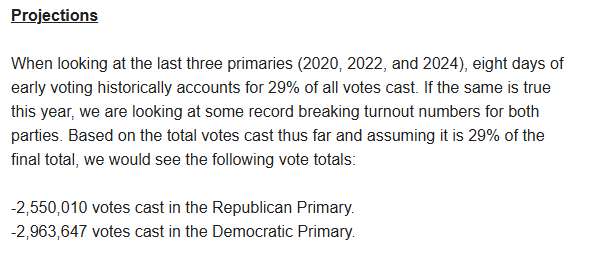
Having 5.4 million Texans vote in the primary would be exceptional and unprecedented. Then, we’ll have to keep that excitement going all year until November, beat the Republicans, and finally take our state back.
One of the reasons I like Ryan Data is this particular breakdown:
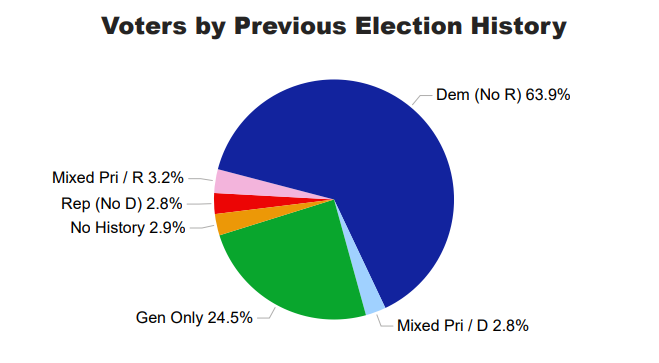
Why is this interesting? Because Jasmine Crockett’s entire turnout strategy hinged on bringing out low-propensity voters into the electorate.
According to this pie chart, only 2.9% of voters in this primary cycle are low-propensity voters, the voters with no history. This is the purest new voter turnout expansion group.
Another thing that stands out to me, which should be mentioned, is that there’s a rumor going around that Republicans are flocking to the Democratic primaries to vote for Crockett to throw the general. However, only 2.8% of these voters have only voted in the Republican primaries before. So, I don’t think there’s a lot of merit to that.
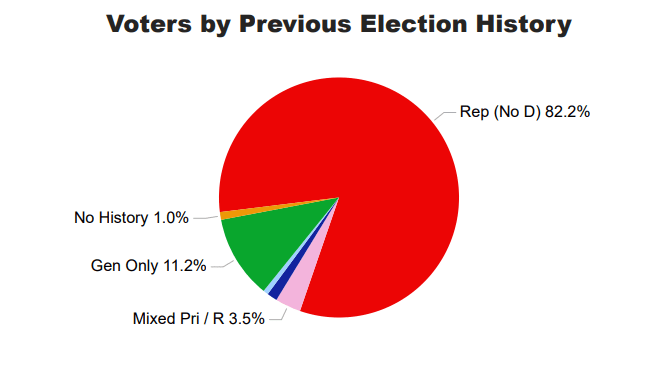
But there definitely are more people voting in the Democratic primary than ever before. Look at it in comparison to the Republican pie chart:
Demographics.
How do voter data companies get demographic data? They layer on additional data, such as consumer data, neighborhood demographics, census data, home ownership, magazine subscriptions, and so on.
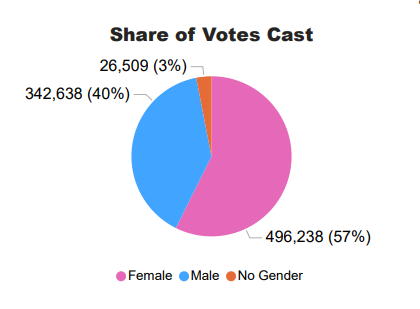
Here are the genders voting for Democrats:
Here are the genders voting for Republicans:
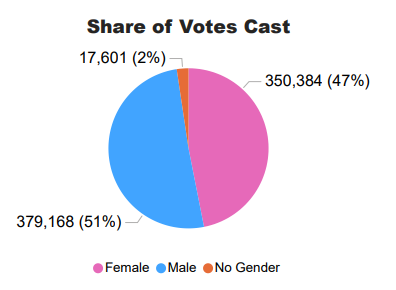
Higher female turnout is a good sign for Jasmine Crockett, but aside from that, look how different it is for each party. Democrats are overwhelmingly female, while Republicans are slightly more male.
Here are the ages voting for Democrats:
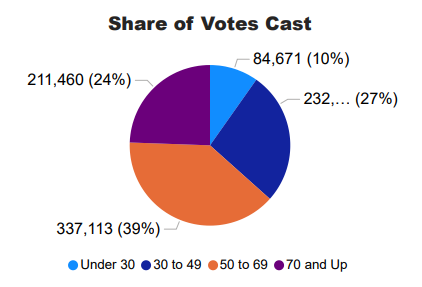
Here are the ages voting for Republicans:
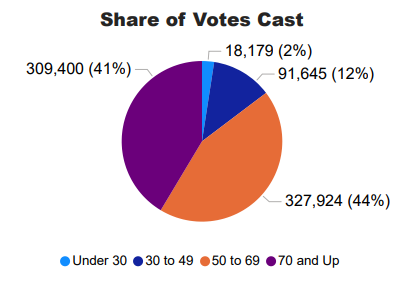
Actually, I love this. Because more of them are closer to death than we are. Can I say that? I just mean in 10 years the electorate will look very different.
85% of Republicans are over 50.
64% of Democrats are over 50.
2% of Republicans are under 30.
10% of Democrats are under 30.
The takeaway from this is that the Democratic Party in Texas is much younger and much more female than the Republican Party. Again, go us! 🥳
VoteHub’s Tarrant County analysis.
If you missed it today, VoteHub published a deep dive on Tarrant County’s data. Remember that’s the bellwether county every political analyst in the country is watching. And the numbers are interesting.
Here is the main takeaway:
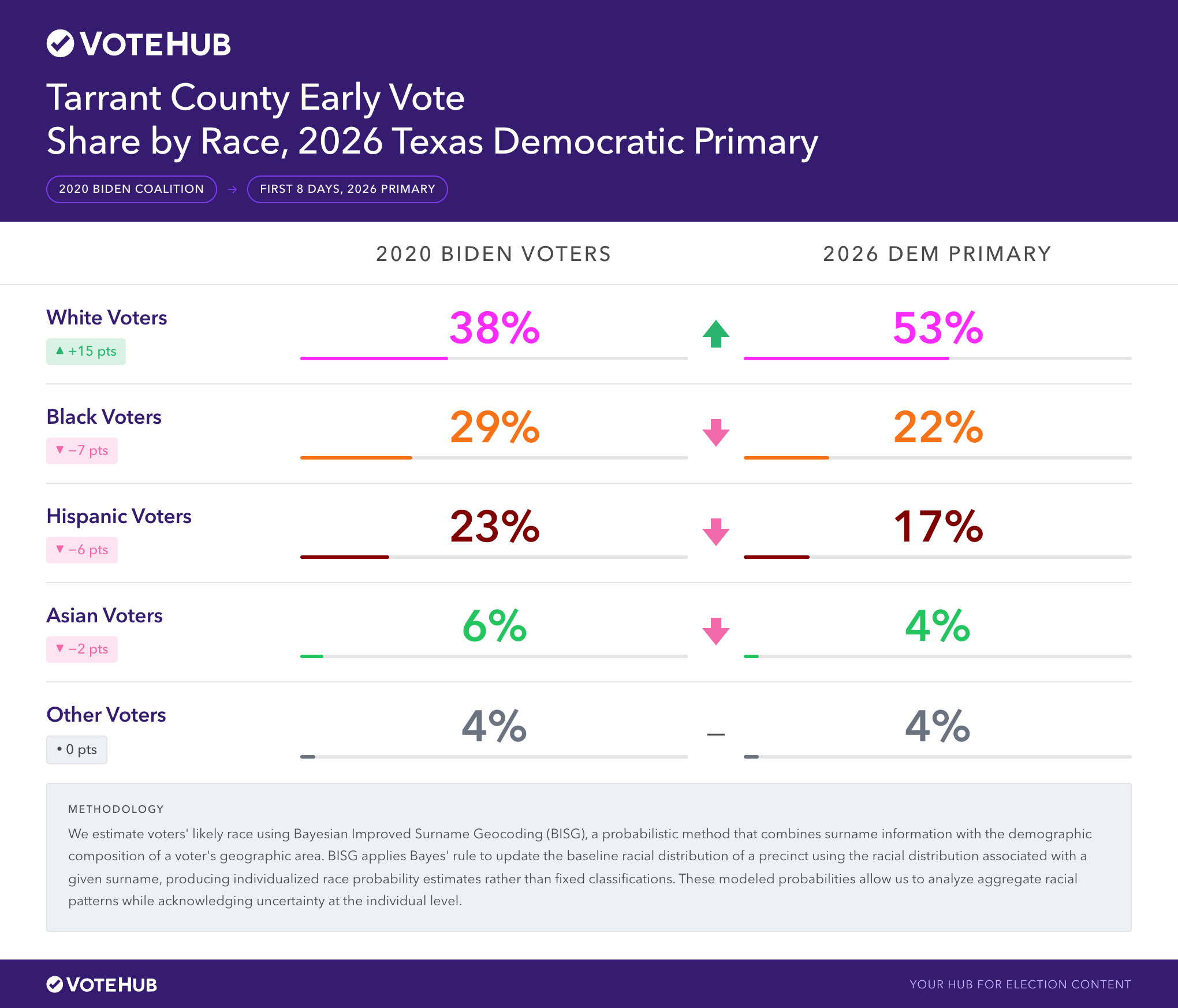
In the Democratic primary, white voters are way up, while Black, Hispanic, and Asian voters are down. This is interesting because, aside from targeting low-propensity voters, a core tenet of the Crockett campaign was to center Black voter turnout. The Houston Chronicle reported that Crockett was explicitly betting on boosting Black turnout across Texas, targeting places with large Black populations and treating Black primary voters as a decisive share of the Democratic electorate.
Earlier this month, the AP reported that Crockett was relying heavily on a social media strategy to get voters to the polls. However, anyone who has spent time on social media during this primary can see that much of the online conversation has increasingly centered around racial identity. Support and opposition have often been framed through racial lenses, with arguments about representation, coalition strength, and who constitutes the Democratic base in Texas. That kind of discourse can energize some voters, but it can also narrow the electorate rather than expand it.
After this primary is over, we’ll definitely do an autopsy of primary strategies, not only for the Senate race, but for the downballot races that matter too.
We have two days left of early voting. Have you voted yet? Why not?
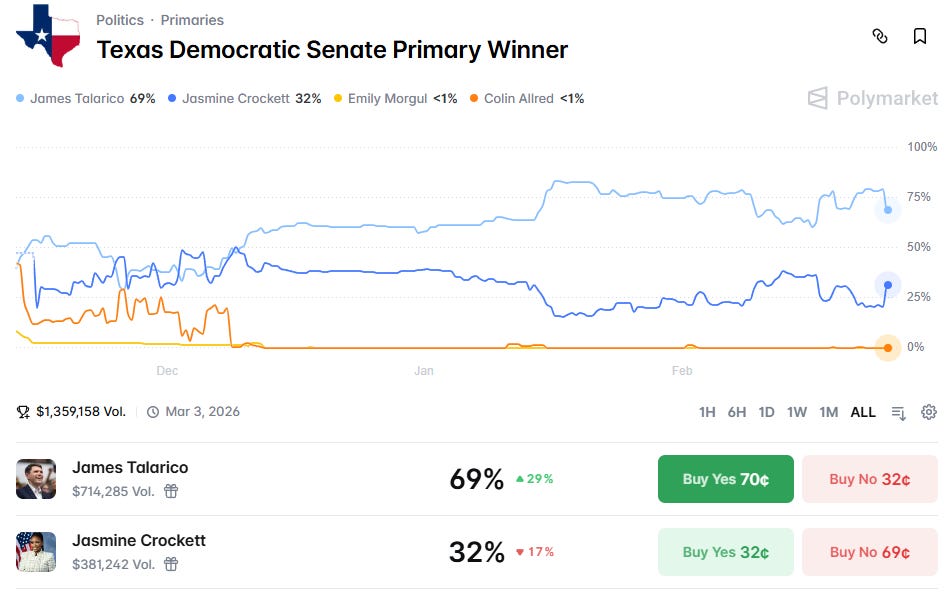
One more word about the Senate primary. At this moment, Polymarket is showing Talarico at 69% and Crockett at 32%.
Democrats are showing up.
They’re outpacing Republicans. They’re younger. They’re more female. And they’re participating in numbers we haven’t seen in years. That alone represents a structural shift in Texas politics, regardless of who ultimately wins the Senate nomination.
But the deeper story, the one we won’t fully understand until the final datasets come in, is who made up that surge. Was this a true expansion of the electorate, bringing in voters who don’t normally participate? Or was this a mobilization of existing Democratic voters who were already likely to show up?
Those are two very different political realities. One changes the state's long-term trajectory. The other reflects enthusiasm within the existing coalition.
Every additional voter reshapes the electorate, not just for this primary, but for the general election in November and for every cycle that follows.
The campaigns will make their closing arguments. The analysts will dissect the numbers. The narratives will form.
We’ll know soon enough which direction the state is heading.
February 27, 2026: Final Day to Early Vote
March 3, 2026: Primary Election
Click here to find out what Legislative districts you’re in.
LoneStarLeft is a reader-supported publication. To receive new posts and support my work, consider becoming a free or paid subscriber.
Follow me on Facebook, TikTok, Threads, YouTube, and Instagram.
A friend of mine want to know this information. I told her long ago to follow you. I told her that I love your articles so much that I am a paid subscriber. I will share this with her but I’m angry that she isn’t following you yet so I almost don’t want to.
I’m sorry to read that you had fever. I hope and 🙏🏼 you continue to get better. I did miss your article.
Again, thank you for this great article!
Very interesting to see all the demographics. And knowing that Democrats are *finally* showing up for a spring primary! I've mentioned this before, but it's worth repeating: In the 10 years I was a poll worker, *95% of voters in the primaries were Republicans.* I know this for a fact because there were separate party ballots (and waiting lines!) for each party in the primaries. Dems only showed up in big numbers for (some) Midterms and presidential elections. So this is very, very encouraging overall, in spite of the individual demographics of a decline in participation among Black, Hispanic and Asian voters. I guess it took a crisis like what we are facing now to wake folks up to the consequences of blowing off primaries and local elections. —Sidebar: Feel better soon! We need you! Or as I would say in Spanish 😉 : Tu dedicación y trabajo profundo de investigación no tiene precio. = Your dedication and in-depth research work are priceless. 👌🥰