


Years ago, when I read How to Be an Antiracist by Ibram X. Kendi, one of the ideas that stuck with me was that racism is about whether people are willing to confront systems, history, and policy honestly. In Kendi’s book, the question was whether someone is actively willing to challenge the structures and narratives that sustain inequality.
Not long after, during the 2021 Legislative Session, James Talarico questioned a proposed amendment to a racist bill led by Steve Toth. The exchange immediately stood out to me. It was one of the clearest examples I had seen of an elected official articulating why teaching the full history of racism in America matters.
When I watched this, I remember thinking, “This is what antiracist politics is supposed to look like. Someone willing to stand on the floor of a legislature and insist that students deserve the truth about the country’s history.”
That moment is when I first became a fan of Talarico. The way he framed the issue felt consistent with the thinking Kendi talks about, acknowledging that racism and white supremacy were real forces in American history, and that confronting that history honestly is part of loving the country enough to improve it.
I’ve followed his career ever since.
Jasmine Crockett vs. James Talarico
I really wish we could move on from this race, but the internet is still talking about it, and widely talking about it. So, after a week, we need to talk about it too. By this point, there have been plenty of deconstructions of the Crockett campaign and what went wrong, and why Talarico came out victorious. Most people agree that Crockett underestimated how competitive the primary would be.
One of the earliest flashpoints involved commentary from political influencer Keith Edwards and a podcast community often referred to as the Culturistas. Before this race, I had never heard of either. But almost immediately, people across political social media began reacting to comments they made about Jasmine Crockett that many viewers saw as racial microaggressions.
A wide range of Texas Democrats, including supporters of both Crockett and Talarico, pushed back, telling out-of-state commentators to stay out of Texas politics. The backlash became intense enough that the Culturistas issued an apology. Edwards, meanwhile, continued commenting on the race, often critically of Crockett.
As the online discourse escalated, some Crockett supporters began associating Edwards’ commentary with Talarico’s campaign, even though there was no formal connection.
At the same time, several rumors began circulating on social media, later proven inaccurate.
One example involved claims that Talarico had committed to running on a political slate with Beto O’Rourke, Joaquin Castro, and possibly even Crockett herself. That claim spread widely online but was never substantiated and was later contradicted by reporting, including coverage in The New Yorker.
Another rumor involved political strategist Lis Smith. Online discussions claimed she was advising Talarico’s campaign. In reality, campaign finance records and reporting showed that was never true. Both the campaign and Smith publicly clarified that she had no role in the race, yet the claim continued to circulate on social media even after it was debunked.
Then, just before early voting started, what appeared to be bot armies were out in full force.
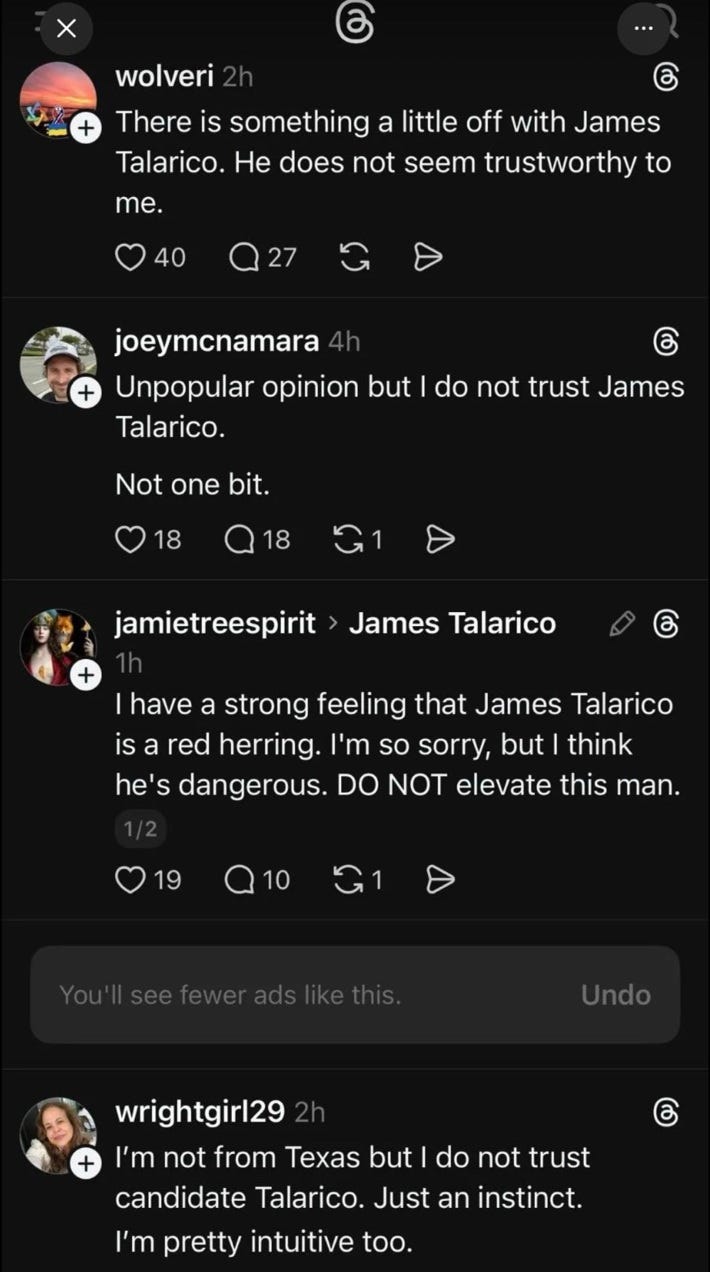
You should take some of these things into consideration if you’re wondering how there ever came to be a Democratic narrative against Talarico in the first place. Misinformation from Republicans, from Russia, from bots, and from friendly fire.
Jacobin had a great analysis of Talarico’s win:
The protest vote?
In the days after the primary, a new conversation began circulating online about what Black voters should do next.
Across TikTok, Threads, and YouTube, dozens of videos started appearing discussing the idea of a protest vote in November’s Senate race. The basic argument is that if Democratic strategists believe they can win Texas by appealing to moderate Republicans and MAGA-adjacent swing voters, then perhaps those strategists should prove it.
The frustration behind these videos is about what many voters interpret as the logic behind Talarico’s candidacy. Commentators have pointed out that the archetype of the “winnable Texas Democrat” is still shaped heavily by white, Christian, moderate imagery. A candidate who can walk into a rural diner, talk football, quote scripture, and not immediately trigger partisan defenses among conservative white voters.
From a purely strategic standpoint, the argument makes sense. But for many Black voters watching the race unfold, the message sounded different. It sounded like the campaign was designed to appeal to voters who may have supported Trump or MAGA politics, while assuming that Black voters would ultimately fall in line no matter what.
Most Democratic voters, including most Black voters, will likely still vote against the Republican nominee in November. But the fact that this conversation is happening at all tells you something about the level of frustration circulating in parts of the Democratic coalition.
The Talarico campaign is facing monumental challenges as it moves into the general election campaign.
Winning the primary was the first step.
There’s an Instagram influencer who has been posting emotional videos all week. Crying, convinced that Talarico was going to force us all to be in a coalition with white supremacists. But seeing the video from Farming While Baige (above) made it kind of make sense how the narrative was being interpreted differently.
Talarico’s political framing is very straightforward. He often says politics today isn’t really “left versus right,” but “up versus down.” In other words, the conflict is between working people and economic elites. His speeches focus heavily on class. Fighting billionaires, defending working-class communities, and expanding policies like healthcare access, wages, and public education.
That kind of framing is common in progressive politics. But it can be heard very differently depending on who is listening.
For many Crockett supporters, particularly Black voters who were deeply invested in her candidacy, the “broad coalition” implied by that message sounds less like class solidarity and more like an attempt to bring in voters who previously supported Donald Trump or MAGA politics.
Obviously, that creates concern. Why should Black voters feel comfortable entering a coalition that includes people who have voted for candidates and movements openly hostile to them?
Whether that interpretation is correct or not, it explains why some online reactions have been so intense. The disagreement is about trust.
From a campaign strategy perspective, the math in Texas has always forced Democrats to think about coalition building. A statewide candidate has to bring together urban Democrats, younger voters, Latino communities, suburban moderates, and at least some voters who have previously voted Republican.
But there is a difference between building a broad coalition and appearing to prioritize one part of that coalition over another.
If the Talarico campaign wants to repair trust with Crockett supporters and Black voters who feel alienated by the primary, it will need to do more than rely on general messages about unity.
The campaign will need to show up directly in Black communities, listen to concerns about safety, representation, and respect, and clearly communicate that expanding the coalition does not mean tolerating racism or excusing it.
The irony is that Talarico’s own record shows that he is capable of making those arguments clearly. But in politics, perception matters as much as intent.
That gap in interpretation is something the campaign will have to address if it hopes to build the coalition necessary to win a statewide race in Texas. And Talarico supporters should allow the Talarico campaign the space it needs to do that.
At the end of the day, this primary exposed how fragile the Democratic coalition in Texas still is.
Talarico’s victory showed that a message centered on class, economic justice, and working-people politics can resonate across parts of the state where Democrats have historically struggled. But winning a primary coalition is very different from sustaining a general-election coalition.
Texas is one of the most difficult states in the country for Democrats to win statewide. No part of the coalition can be ignored, and no group can be assumed.
The anger circulating online right now may fade. But the concerns behind it are real. If Democrats want to win in Texas, they cannot simply ask voters to “move on” from the primary. They have to rebuild trust and demonstrate that every part of the coalition matters.
For the Talarico campaign, that means showing up, listening, and engaging directly with communities that feel overlooked. If the conversation that began after this primary leads to a deeper understanding within the Democratic coalition about trust and representation, then something constructive may come out of it after all.
And if the kind of politics I saw in that Texas House back in 2021 is any indication, that conversation is still possible.
April 2, 2026: Last day to register to vote (City elections)
April 20, 2026: Last day to apply to vote by mail (City elections)
April 20, 2026: First day of early voting (City elections)
April 27, 2026: Last day to register to vote (Democratic primary runoff elections)
April 28, 2026: Last day of early voting (City elections)
May 2, 2026: Last day to receive ballot by mail (City elections)
May 2, 2026: Election day! (City elections)
May 15, 2026: Last day to apply to vote by mail (Democratic primary runoff elections)
May 18, 2026: First day of early voting (Democratic primary runoff elections)
May 22, 2026: Last day of early voting (Democratic primary runoff elections)
May 26, 2026: Last day to receive ballot by mail (Democratic primary runoff elections)
May 26, 2026: Election day! (Democratic primary runoff elections)
Click here to find out what Legislative districts you’re in.
LoneStarLeft is a reader-supported publication. To receive new posts and support my work, consider becoming a free or paid subscriber.
Follow me on Facebook, TikTok, Threads, YouTube, and Instagram.
The bots are still working nonstop against Talarico on social media, and will continue to do so until the election
Oh Michelle and the rest of your readers, I don’t know how to fix this, and it makes me sad. I love Congresswomen Jasmine Crockett! I don’t want the Black women to feel that they have been disrespected. I need to do research on the Jacobin podcast. I didn’t understand that either. I will try to understand that too. Rep. James Talarico has spoken several times about white nationalism is not in the Bible. Did he pick up MAGA voters?
Not voting (as many did with Kamala) would cause the GOP to win again. And that could be Paxton which would be way worse than Rep. Talarico would be. Even if Cornyn was the primary. Rep Talarico would be better than Cornyn too. 🤦🏽♀️😤