


Over 85 million Americans are uninsured or underinsured. One in four can’t afford their prescription drugs. More than half a million people go bankrupt from medical debt every year. And more than 60,000 die because they can’t afford to see a doctor. That’s America, right now, in 2026. The wealthiest country in the history of human civilization.
In April, 2025, Rep. Pramila Jayapal, Rep. Debbie Dingell, and Sen. Bernie Sanders introduced the Medicare for All Act of 2025 in both chambers of Congress. It currently has 114 cosponsors in the House. That’s more than half the House Democratic caucus putting their name on the most important piece of domestic legislation in a generation. What’s missing is the majority.
If the 2026 wave materializes the way the data and the political environment suggest it can, Democrats will walk into January 2027 with a real shot at governing, and governing boldly. This is not a moment to play small. When we flip the House, we don’t get to pick one thing to fight for. We walk, and we chew gum. We deliver for working families on all of it, and near the top of that list is universal healthcare.
Best-estimate modeling shows that Medicare for All would save roughly $450 billion and 68,000 lives every year. Trillions of dollars over a decade, lifted out of the pockets of insurance executives and pharmaceutical shareholders and put back into the lives of families who have been rationing insulin, skipping mammograms, and going bankrupt over ambulance bills while CEOs collect nine-figure bonuses for denying their claims.
This is the moment. And when Democrats have the numbers to pass it, they have a moral obligation to do exactly that.
So the question for Texas is personal. Texas, with the highest uninsured rate in the country, has more to gain from universal healthcare than almost any other state in the union. Which means Texas voters need to know exactly who they’re sending to Washington, what those people believe about healthcare, and whether they’ll be a yes vote when it counts.
This article is about that.
We’re going to cover three groups:
The Texas Democrats currently in Congress have already signed on to the Medicare for All Act.
The Texas incumbents who haven’t, and who need to hear from you.
And the 2026 candidates running on it, who should be expected to sign the moment they’re sworn in.
Your vote is a down payment on someone’s life. Make it count.

The current Texas signees, and the shakeups coming.
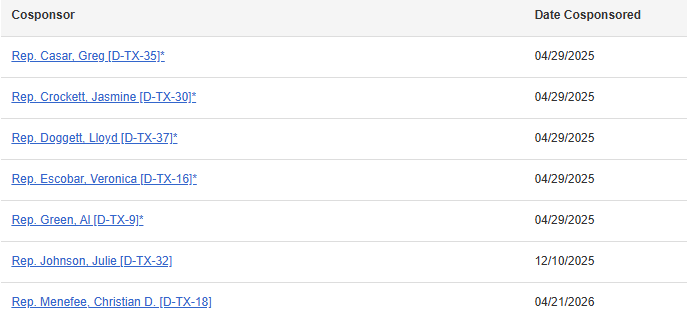
The good news is that seven out of the thirteen members of the Texas Democratic Congressional Delegation have already signed on to this bill. The bad news is that four of them won’t be in Congress next year. So, for Texas Democrats to do their part to get the votes for this bill, which will be a generational accomplishment, we need to replace those four votes AND add to them.
Ultimately, even if this bill doesn’t pass in the 120th Congress, every cosponsor is a statement of values and a binding commitment. The next time Democrats have the numbers, we need a Texas delegation that shows up ready.
Currently:
However, in the next Congressional session, this list will be shorter:
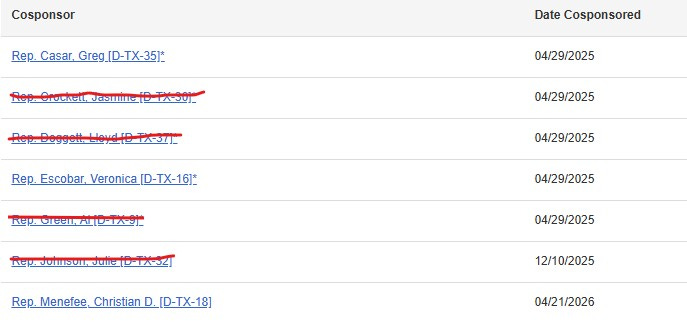
Those four members are leaving Congress, mostly because of the Republicans’ gerrymandering shenanigans, and musical chairs didn’t work out. Congressman Marc Veasey is also leaving Congress, but he never signed onto this bill.
The first question we should ask is which sitting Democratic members haven’t signed on to this bill, and why?
Before I looked this bill up again tonight, I could have sworn that Congressman Joaquin Castro was already a cosponsor. A few years ago, Castro was interviewed by the San Antonio Express-News, where he openly called for Universal Health Care, saying, “Quality, affordable health care is a human right that shouldn’t only be afforded to the privileged.”
Many of us have heard speeches Castro has given, regarding his bout with cancer, and the unbelievable costs associated with treatment. Castro is also a member of the Congressional Progressive Caucus. Why hasn’t he signed onto this bill yet? I think, if you’re his constituent, you should probably call his office and ask.
Then there is Sylvia Garcia, not exactly a staunch progressive, but she’s always leaned a little to the left. Now, mind you, I’m writing this article without looking at anyone’s campaign finance related to the health insurance industry. Let’s just assume that not hopping on this bill was an oversight.
Lizzie Fletcher. The Liberal Queen of Exxon, and everyone gets mad at me because she’s a warrior for women and the LGBTQ+ community, but I haven’t given her a lot of grace because she’s deep in bed with the fossil fuel industry. People can totally change, though. If I were her constituent, I would call her office and say, “Please sign onto this bill.”
Henry Cuellar and Vicente Gonzalez. More uninsured Texans live in their two districts than in most places in Texas, but neither will agree to this bill without a suitcase of cash in unmarked bills attached. We should be looking for their 2028 replacements right now.
With enough pressure, Castro and Garcia may sign onto the M4A bill now or next session. The rest? I wouldn’t count on it.
Headed to Congress.
First, let’s talk about the sure things.
TX30: Rev. Dr. Freddie Haynes. As a Justice Democrat, there should be no doubt in anyone’s mind that he’ll sign on to this bill right away.
TX33 Colin Allred. Now, Allred spent this last primary election running on a “new-and-improved progressive world view,” his primary opponent, Julie Johnson, did sign on to this bill. If Allred really has turned over a new leaf and is committed to the working class in Texas, then committing to this legislation now would go a long way, and signing it upon being sworn in would help him rebuild trust with Texas progressives.
The DCCC is expecting we’ll flip TX15 and TX35. That’s Bobby Pulido and Johnny Garcia. Honestly, their politics are going to be simialar to Cuellar and Gonzalez. This should tell you a lot about the DCCC’s priorities, considering how many seats the Republicans likely dummymandered with their racist maps.
From my Meet the Candidate series, here are the candidates who have directly told me that they would support universal, publicly funded healthcare:
TX05: Chelsey Hockett
TX06: Danny Minton
TX11: Claire Reynolds
TX19: Kyle Rable
TX21: Kristin Hook
TX22: Marquette Greene-Scott
TX24: Kevin Burge
TX27: Tanya Lloyd
TX31: Justin Early
We have a lot of progressive Democrats on the Texas ticket this year, running on generational issues like universal healthcare. And the DCCC is backing the only two guys who aren’t running on it. 🙄 I’m not trying to hide my annoyance.
But I haven’t written a Meet the Candidate article about every candidate yet, or met everyone running for office. So, I searched through their websites, and here are the other Texas Democratic Congressional candidates who support universal healthcare:
TX08: Laura Jones
TX12: Heli Rodriguez Prilliman
TX13: Mark Nair
TX23: Katy Padilla Stout
TX26: Steven Shook
TX38: Melissa McDonough
We just need to pause for a moment and recognize that SIXTEEN Texas Democrats are running on the Congressional ticket who support universal healthcare.
Meanwhile, California Democrats selected in their primary for governor a guy with more corporate sponsorships than a NASCAR driver. 🤦🏻♀️
Now, let’s not get too ahead of ourselves. Just because all of those candidates are running doesn’t mean they’ll all win. But for sure, Republicans dummymandered the maps, and several of these districts will flip this year.
If we’re looking at a huge wave in November (fingers-crossed), looking at the numbers, including the Hispanic swing left, we could flip as many as ten as these seats. If we do, that would be monumental, for the GOP’s stupid dummymandering, but also toward taking a step forward to universal healthcare.
The math is simple. The moral case is airtight. The only thing missing is the political will.
Every other wealthy country on earth has figured this out. Every single one of them decided, at some point, that letting people die because they can’t afford a doctor is not an acceptable feature of a civilized society. The United States is still having that argument. Sixty thousand people a year are losing it.
Texas doesn’t have to wait for the rest of the country to lead. We can send a delegation to Washington that shows up on day one, ready to vote yes. We can replace the incumbents who’ve been too comfortable, too cozy with the insurance industry, or too cautious to say what they actually believe. We can elect the candidates on this list who’ve already said healthcare is a human right, and they’ll fight for it.
Medical deserts result from the closure of hospitals in rural Texas. Families in the Rio Grande Valley are rationing insulin. Parents in Houston are choosing between their kids’ prescriptions and their rent. It’s the lived reality of millions of Texans, in a state that has refused to expand Medicaid, refused to protect its most vulnerable residents, and watched the human cost pile up for thirty years of Republican rule.
That ends when we decide it ends.
If you believe America should finally catch up to the rest of the developed world, if you believe 60,000 lives a year are worth fighting for, that medical debt shouldn’t follow a family into bankruptcy, that a cancer diagnosis shouldn’t mean financial ruin, then support these candidates. Donate. Volunteer. Knock doors. And in November, vote like someone’s life depends on it.
Because it does.
Click here to find out what Legislative districts you’re in.
LoneStarLeft is a reader-supported publication. To receive new posts and support my work, consider becoming a free or paid subscriber.
We will work on Collin.
Very good. We should also demand that any Medicare for All final bill NOT include any private insurers, etc. Medicare for All is a huge case of waste, fraud and abuse. (Where art thou DOGE?). The good thing is Congress people run for re-election every two years and we can use that as leverage, especially in the first few years after they are elected. "We put you into Congress and we can take you out".
In conjunction with setting up Medicare for All, it is necessary for Congress to figure out how to upgrade the rickety COBOL structure.