


Texas leads the nation in something, and it ain’t nothing to brag about. And I’m not talking about childhood hunger, although we lead the nation in that too.
In 2024, Texas utilities shut off power to more than 3 million households, the highest total of any state in the country. That’s three million times someone came home, flipped a switch, and nothing happened. Three million times, a family figured out how to keep food cold without a refrigerator, or how to sleep when the AC is gone in July, or whether the medicine in the fridge was still safe. Texas accounts for about 9% of the country’s electricity customers. We account for nearly 23% of its shutoffs, according to a new report on energy poverty in Texas from TEPRI.
Meanwhile, Greg Abbott was next to Google’s CEO at a data center in Midlothian in November, bragging about a $40 billion investment in Texas. He called this state the “epicenter” of artificial intelligence development. He did not mention your electric bill. ⬇️
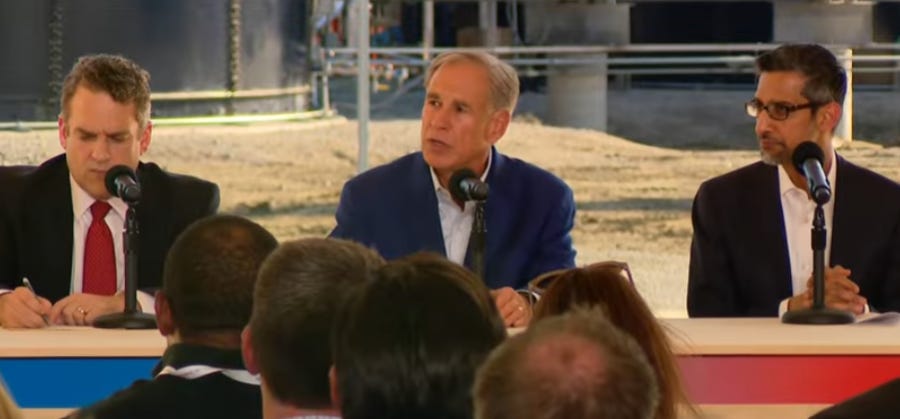
This is what Republican governance looks like in Texas.
The wires that they never talk about.
To understand what’s happening to your electricity bill, you have to understand that industry would rather you didn’t think about the difference between the cost of electricity and the cost of delivering it.
When you pay your electric bill, you’re paying for two things.
You’re paying for the electricity itself, the power that gets generated and put on the grid.
And you’re paying for the wires, the poles, the substations, and the transformers that carry it to your house. That second part is called transmission and distribution, and the Public Utility Commission of Texas regulates it, the state body that approves what utilities can charge ratepayers.
Here’s what the Texas Energy Poverty Research Institute found in their affordability report: since 2002, the transmission and distribution share of your electric bill has grown from 28% to 39%. It is now the fastest-growing part of what you pay every month, not the electricity, but the delivery. And it’s about to get much worse.
Oncor, the utility that serves the Dallas-Fort Worth area, has announced a $36 billion capital spending plan for 2025 through 2029. CenterPoint, which serves Houston, is spending $21 billion through 2030. On top of that, ERCOT (the entity that manages the Texas grid) has approved $38 billion in additional transmission projects, including a new high-voltage “power superhighway” to West Texas. TEPRI estimates over $96 billion in total planned investment in transmission and distribution through 2030.
Every dollar of that investment gets recovered from ratepayers. Residential ratepayers are specifically at a higher rate per kilowatt-hour than commercial and industrial customers. In CenterPoint’s territory, residential customers use 33% of the electricity but bear 49% of the transmission costs. That gap is baked into the rate design, approved by Republican-appointed regulators, and it’s getting worse.
TEPRI projects that by 2030, average residential electricity prices in the ERCOT competitive market will rise another 29%, on top of the 30% they already rose between 2021 and 2025. For a low- or moderate-income household, that means the average annual electricity bill climbs from around $1,682 today to $2,269 by 2030. The portion of that bill that exceeds what those households can reasonably afford doubles from $420 a year to $863.
Who’s plugging in?
So why does Texas need $96 billion in new transmission infrastructure? Who exactly is drawing all this power?
Data centers. The grid operator projects that data centers alone will add approximately 24 gigawatts of new demand by 2031. However, we heard directly from ERCOT at a House State Affairs Committee last month that data centers could quadruple the grid usage.

Right now, data centers account for roughly 87% of new large-load connection requests coming into ERCOT. The grid is being rebuilt at residential ratepayers’ expense to accommodate them.
This is the part of the story Greg Abbott doesn’t put in all of his press releases about the “Texas miracle.” He announces the forty-billion-dollar Google investment. He does not mention that the transmission lines Google needs to run those facilities are paid for by the people whose lights were shut off last year.
According to a Texas Tribune analysis published this week, nearly 60% of planned or under-construction data centers in Texas are located in state House districts that voted for Donald Trump and elected a Republican state representative in 2024. These are not Silicon Valley suburbs. These are rural Texas counties, where residents are watching industrial campuses consume their farmland, stress their aquifers, and hum twenty-four hours a day next to homes where people are skipping meals to pay the electric bill.
The tax break nobody voted for.
The power bills are only part of it.
Texas has been giving data centers a sales tax exemption since 2013, quietly expanded under Republican control until it became one of the largest corporate giveaways in state history. The Texas Tribune reported last month that this exemption will cost the state $3.2 billion in revenue over the next two years alone. Last year alone, it exceeded one billion dollars.
To put that in perspective: Texas has not raised its minimum wage from $7.25 since 2009. The state ranks near the bottom nationally in per-pupil education spending. Rural hospitals close every year. But a billion dollars a year flows out of the public treasury so that hyperscale data center operators like Google, Microsoft, Amazon, Oracle, and UAE-based G42 can buy servers and cooling equipment without paying sales tax.
Dan Patrick, who has spent years blocking Medicaid expansion and cutting school funding, is now calling for a “study” of the exemption. Of course, don’t expect anything to come of it. Lt. Governor Patrick’s net worth is $40ish million, and he said that your grandparents should sacrifice their lives for the sake of the economy. Perhaps we can vote him out in November?
Abbott, for his part, has taken more than two million dollars from people and companies linked to the tech and AI industries since last year. AI-aligned super PACs spent $4.2 million in Texas during this primary cycle, with all but $150,000 going to Republicans. Meta’s super PAC, Forge the Future, spent over $1 million boosting Republican state candidates.
The mess that Republicans have created with our electricity and these data centers in Texas has nothing to do with pro-business governance. It’s all transactional for their own pockets. The industry gets the tax break, the infrastructure subsidy, and the water. Texans get the bill.
What Texans are actually doing.
Here is what the data shows is happening inside Texas homes.
TEPRI surveyed more than 6,500 low- and moderate-income Texas households as part of its Community Voices in Energy Survey. More than one in ten said they had their electricity disconnected in the past year. 32% had received a shutoff warning or experienced a disconnection. Among households earning under $27,000 a year, that number rises to more than a third.
72% of respondents reported cutting back on basic household expenses to pay their electricity bills. 29% cut food. 44% cut clothing. 12% cut back on medicine.
That’s the world Republicans create.
65% reported practicing what researchers call “energy-limiting behaviors,” meaning they turned off the air conditioning during Texas summers or the heat during Texas winters, not because they wanted to, but because they were rationing. Among the lowest-income households, that number reaches 68%.
These are people making impossible choices in a state that decided their comfort, their health, and their children’s dinner are acceptable collateral damage for a forty-billion-dollar press release with a tech CEO.
Texas’ minimum wage is $7.25 an hour. Unchanged since 2009. The average annual electricity bill for a low-income Texas household by 2030 will be $2,269.
You do the math.
Republicans fail at governing, once again.
This required sustained, deliberate choices by Texas Republicans over more than a decade.
They deregulated the electricity market, creating the ERCOT structure that isolated Texas from the national grid and left consumers exposed to price volatility with a limited federal backstop.
They failed to winterize the grid after the 2011 freeze. A decade later, Winter Storm Uri killed hundreds of Texans and left millions without power for days. The “reform” that followed mandated grid-hardening investments, which imposed billions of dollars in costs that now flow directly onto ratepayers’ monthly bills through growing transmission and distribution charges.
They created and expanded the data center sales tax exemption, costing the state billions while adding a load that requires even more grid investment.
They invited hyperscale data centers into rural Texas counties without requiring those counties to assess water, grid, or community impacts before approving them.
They appointed regulators to the Public Utility Commission who approved cost recovery structures that shift an outsized share of transmission costs onto residential customers.
And now, as the backlash builds and even Republican constituents in rural Texas are screaming, their response is to summon consultants, form working groups, and announce studies. At the same time, the industry’s lobbyists multiply, and its super PAC money continues to flow.
State Senator Paul Bettencourt was invited to the White House with nearly a hundred other Texas Republican lawmakers to hear Trump administration officials pitch faster data center expansion. He came back persuaded. His constituents’ concerns, he said, reflect people who “fear change.”
Tell that to the family rationing the AC in August so they can afford insulin.
Because Texas Republicans don’t give a shit about that family, or you, they only care about the CEO, the corporation, and whether they can make more money and pad the GOP coffers a little bit.
The choice.
Texas is the fastest-growing data center market in America. That growth is being subsidized by every person who turned off their AC to avoid a shutoff notice. It is being paid for by the family that skipped the grocery run to cover the electric bill. It is being built on the backs of three million households that lost power last year in the state with the country’s highest disconnection rate.
Greg Abbott spoke in front of a data center and called Texas the epicenter of artificial intelligence. He was right. He just left out who’s paying for it.
Texas Democrats should be putting this on the table and refusing to let go of it between now and November. It’s time to remind Texans, who does this state work for?
Because right now, the answer is Google, Microsoft, Amazon, and their forty-billion-dollar ambitions. And the people paying for it are the ones who can’t keep the lights on.
May 15, 2026: Last day to apply to vote by mail (Democratic primary runoff elections)
May 18, 2026: First day of early voting (Democratic primary runoff elections)
May 22, 2026: Last day of early voting (Democratic primary runoff elections)
May 26, 2026: Last day to receive ballot by mail (Democratic primary runoff elections)
May 26, 2026: Election day! (Democratic primary runoff elections)
Click here to find out what Legislative districts you’re in.
LoneStarLeft is a reader-supported publication. To receive new posts and support my work, consider becoming a free or paid subscriber.
Michelle pretty much covered it all. I hope our Democratic candidates campaign hard on this issue. I think it will turn the tide for many Republican voters too. This camel's back cannot hold too many more straws like this.
There is no benefit to having data centers here. They just take our resources and don't provide any economic benefit and only a couple low paying jobs swapping out broken computer parts. Even for people using AI, it doesn't matter if the data center is here or in another state. So if data center companies want to build here, it only makes sense economically for them to cover all costs and maybe even pay us for the benefit of being here. If they don't agree then go somewhere else.